
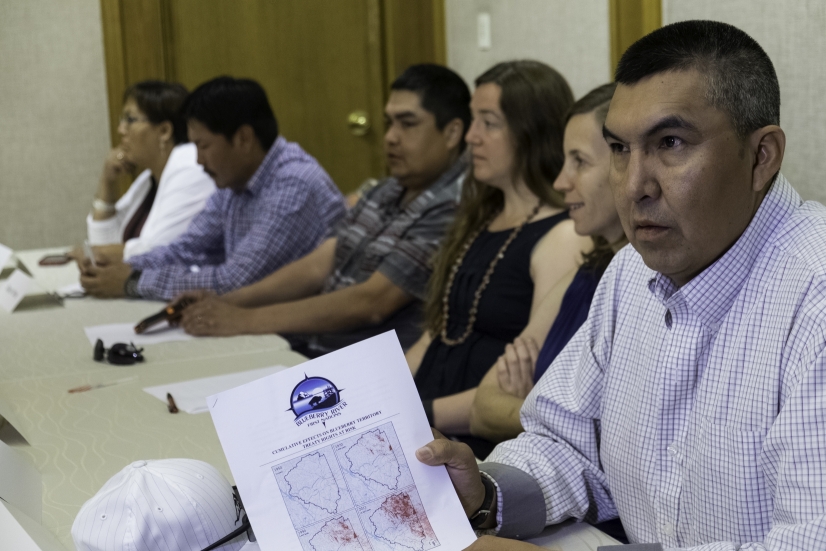
Photo: Chief Marvin Yahey shows the new Ecotrust report at a news conference in Vancouver.
By Sarah Cox • Thursday, June 28, 2016
The B.C. government has significantly accelerated the rate and scale of industrial development in the Blueberry River First Nations’ traditional territory over the past four years despite knowledge of alarming impacts, says a major science report released today.
“Our very life, our way of existence, is being wiped out,” Blueberry River Chief Marvin Yahey told a Vancouver press conference. “It’s devastating. It’s really impacted my people, culturally but socially also. It puts a lot of stress on a community.”
The report, authored by Ecotrust Canada and based on B.C. government data, found that up to 84 per cent of the Blueberry River traditional territory in B.C.’s northeast has been negatively impacted by industrial activity.
Almost 75 per cent of the territory now lies within 250 metres of an industrial disturbance, and more than 80 per cent is within 500 metres.
“The industrial activity has really hammered our traditional territory,” Yahey said in an interview. “It affects our hunting, fishing, camping and teaching our children our way of life. The wildlife are vanishing. Our berry picking sites are being destroyed by pathways and pipelines.”
The 86-page study, commissioned by the Blueberry River First Nations and David Suzuki Foundation, is called the Atlas of Cumulative Landscape Disturbance in the Traditional Territory of Blueberry River First Nations.
It paints a bleak picture of the total impacts of all industrial development in the nation’s traditional territory, which covers more than 38,000 square kilometers in the Peace region.
Since 2012, the B.C. government has authorized the construction of more than 2,600 oil and gas wells, 1,884 kilometres of petroleum access and permanent roads, 740 kilometres of petroleum development roads, 1,500 kilometres of new pipelines and 9,400 kilometres of seismic lines, according to the report. Approximately 290 forestry cutblocks were also harvested in Blueberry River traditional territory over the same time period.
The disturbance atlas found that almost 70 per cent of Blueberry traditional territory is now covered by active petroleum and natural gas tenures. There are 4,676 abandoned oil and gas wells in the territory.
Several proposed liquefied natural gas (LNG) lines could also extend into Blueberry River First Nations traditional territory, including Spectra Westcoast Connector, Coastal GasLink, North Montney Mainline and Prince Rupert Gas Transmission Project, the report said.
Blueberry River First Nations – Industrial Development Change Over Time
David Suzuki Foundation spokesperson Rachel Plotkin called the findings both an “ecological crisis and a crisis of social justice.”
In 1979, a sour gas leak forced Blueberry River members to flee from their original reserve on the banks of the Blueberry River, with only the clothes they were wearing.
“Everything we left behind was destroyed,” recounted Yahey. “Animals, pets, food, clothing.”
The nation was eventually moved to its current location just two kilometres away, 80 kilometres northwest of Fort St. John.
The ‘Little Kuwait’ of Northern B.C.
Yahey said people refer to the current reserve as “Little Kuwait” because of the flares from fracking that light it up at night. Community members have purchased sour gas monitors to ensure they will have time to evacuate if there is another sour gas leak and they have to haul in safe drinking water due to a drop in water levels they believe is caused by nearby fracking operations.
“We leave one area and go to another and it’s just as bad there today. We go to our hunting camps and [they’ve] been destroyed.”
The B.C. government ignored a September 2014 request from the Blueberry River First Nations for a cumulative impacts assessment and monitoring program that would guide decisions about land use and resource extraction, said Yahey.
“There has been no meaningful response.”
On the contrary, the chief said the province continues to approve major industrial undertakings, including the expansion of fracking operations and the $8.8 billion Site C dam.
In an e-mailed statement, John Rustad, Minister of Aboriginal Relations and Reconciliation, said the B.C. government is aware of the Blueberry River First Nations’ concerns regarding resource development in their traditional territory.
Rustad said the government has developed a cumulative effects framework that is being applied in northeast B.C. to improve natural resource decision-making, along with a “regional strategic environmental assessment project.” Blueberry River First Nations has been invited to join these initiatives, Rustad said.
“We also regulate all industries with rigorous environmental standards, and have programs in place to protect critical habitat for wildlife and water resources, and to ensure our air is clean,” said the minister’s statement.
Yahey said the government’s initiatives are not sufficient, and that there is “a hurry for B.C. to clear everything [and] wipe everything out without acknowledging our rights.”
In an effort to seek solutions, the Blueberry River First Nations used its own resources to develop a science-based Land Stewardship Framework. The framework, which Yahey calls a “path to yes”, identifies immediate action the provincial government can take to protect areas of importance to the Blueberry and to allow industrial development “without sacrificing ecological values.”
Critical Area Slated for Fracking
The Pink Mountain area, described by Chief Yahey as a “critical area” for Blueberry River First Nations traditional practices and an area the nation has been trying to protect, is one of many zones throughout Blueberry River territory that has been slated for shale gas drilling and fracking. Pink Mountain is currently the site of intense fracking operations by Progress Energy, a subsidiary of Malayasian-owned Petronas, one of the leading liquefied natural gas proponents in B.C.
Expansion of Pink Mountain fracking operations, leading to further landscape fragmentation, will occur if a proposed privately-built transmission line is built across Blueberry River territory to link the project with hydro facilities on the Peace River, including the Site C dam. In a controversial move, the B.C. government has excluded the proposed transmission line to Pink Mountain from independent review by the B.C. Utilities Commission.
Much of the development in the wildlife-rich Pink Mountain area is occurring in a region that, until very recently, had not been subject to the intense industrial development that characterizes the landscape further to the south in Blueberry River traditional territory.
The territory overlays the Montney basin, which contains the largest shale gas reserves in the province and some of the largest in the world. While much of the gas industry currently battles low prices, the Montney’s gas resources contains a high content of valuable liquids that allow companies to continue to extract the gas profitably.
The Blueberry River First Nations are not opposed to development but want to be included in plans, said Yahey. To that end, the chief described a lawsuit the nation launched against the province of B.C. in March 2015 as a “last hope.”
The ongoing lawsuit claims that the cumulative impacts from extensive industrial development, including Site C, violate Treaty 8, which the Blueberry River First Nations signed in 1900.
The claim asserts that Blueberry River members can no longer access uncontaminated land and resources capable of sustaining traditional patterns of economic activity and land use, as guaranteed by the treaty. These include hunting, eating moose, harvesting berries and medicinal plants and teaching children their language while on the land.
“Our backs are against the wall,” said Yahey. “We’ve tried all the time to come up with a solution. This was our only way to get them to the table to protect our way of life.”
The disturbance atlas also demonstrates that the Peace region has received a disproportionate share of the province’s industrial activity and lacks protected areas compared to other regions of B.C.
Less than one per cent of Blueberry River First Nations traditional territory is conserved in parks and protected areas, compared to 14 per cent province-wide.
While 60 per cent of B.C. is classified as intact forest landscape, less than 14 per cent remains in Blueberry territory. And almost one-half of the total area in B.C. reserved for pipelines through tenures falls in the Blueberry River traditional territory.
Source: ‘Our Way of Existence is Being Wiped Out’: B.C. First Nation Besieged by Industry | DeSmog Canada



 Andrew Phillip Chernoff