Prime Minister Elect Justin Trudeau To Shape Canada’s Domestic And Foreign Policies In The Shadow Of His Father
October 20, 2015 Andrew Phillip Chernoff Just Saying….
Justin Trudeau will have little time after his inauguration as Prime Minister to sit and gloat about his good fortune as he will quickly be on the international stage with: the G20 Summit in Turkey, November 15-16; APEC Summit in Philippines, November 16-18; Commonwealth Heads of Government Summit in Malta, November 27-29; and, the UN Climate Change Conference, November 30-December 11.
But that is not all facing the new Prime Minister and Liberal government:
Both at home and abroad, Trudeau faces several pressing priorities and a raft of longer-term promises.
The immediate issues for the prime minister-designate include a major international conference on climate change, a military mission in the Middle East he has pledged to end and the still-churning refugee crisis enveloping Europe.
On the horizon domestically loom keystone promises from his party’s successful campaign: lower taxes for the middle class, the legalization of marijuana, and a slate of democratic reforms including a new electoral system to replace the venerable first-past-the-post regime under which he swept to power.
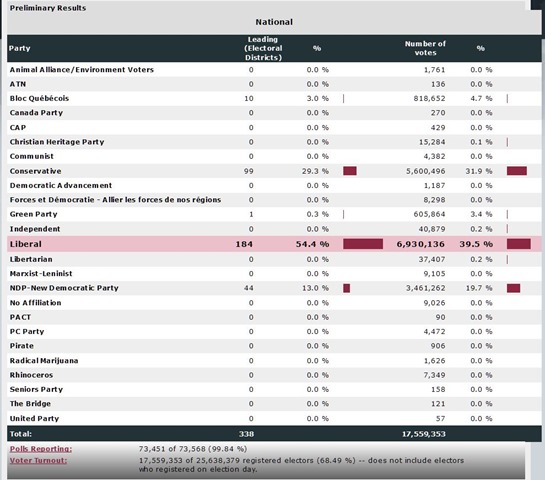
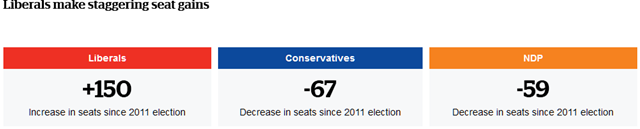
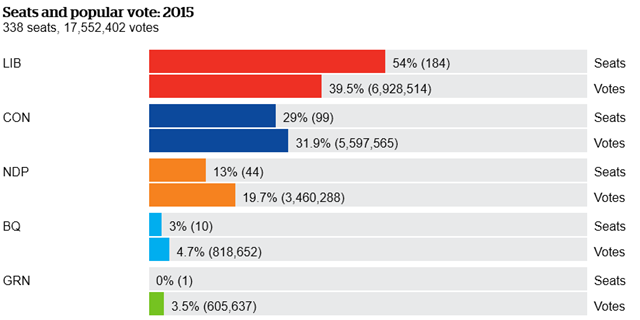
Trudeau will no doubt be riding an electoral high from the 184 seats the Liberals captured — a whopping 149-riding increase from the last election — but he will already be facing tough questions on how and when he will implement his plan. http://www.cfra.com/NationalCP/Article.aspx?id=483607
Justin Trudeau hopes to develop a positive legacy with respect to domestic, and foreign policy and international relations, as his father, Pierre Elliott Trudeau did.
Pierre Elliott Trudeau led Canada as Prime Minister for16 years and with his governing Liberal party, left Canadians the legacy of a new Canadian Constitution and the Charter of Rights and Freedoms.
Justin Trudeau hopes to follow in his father’s footsteps as he attends upcoming, and further international events during the next four years, outlining Canada’s position on foreign and international affairs and events; putting his own stamp on Canadian domestic and foreign policy; and international relations.
And Justin Trudeau will have a lot to live up to.
Jeremy Kinsman, a retired Canadian career diplomat, who was the Canadian High Commissioner to the United Kingdom (2000–2002) and the Canadian Ambassador to the European Union (2002–2006), said of the late Prime Minister in his paper “Who is my Neighbour? Trudeau and Foreign Policy”, published in the London Journal Of Canadian Studies 18: 2002/2003:
Pierre Elliott Trudeau’s impact on Canada was enormous. His dual commitment to individual civil liberties and to building the Canadian nation resulted in a charter of rights enshrined inside a patriated constitution and a changed country. In foreign policy, where he dealt with a wider and changing world, not so amenable to shaping by any one middle power, his impact was less convincing. Moreover, a political leadership career spanning 16 years inevitably takes one down a long and winding road. Inconsistency-seekers can feast on a record that long—no matter what the vision.
Trudeau’s foreign policy was assembled from within a conceptual framework analogous to his view of Canada and Canadians that emphasized nation-building within a general vision on the great fault-lines of global relations: North-South and East-West. For all the twists in his foreign policies, Trudeau was remarkably consistent in his commitment to individual civil rights, and to the rights of individual states, to be free from arbitrary interference in their affairs, which necessarily involved something of a contradiction. At the time, the doctrine of humanitarian intervention had not yet been developed. Though Trudeau the anti-racist abhorred apartheid, and the assumptions governing the conduct of racist Rhodesia, Trudeau the international jurist was less confrontational on the issue of individual political freedoms within the socialist states of Eastern Europe. Whatever he thought of individual regimes, he endeavoured to work with them.
As for the North Atlantic Treaty Organization (NATO), Trudeau was his own man. Kinsman writes:
In 1968, NATO was a closed-doctrine shop. But maintaining a Canadian military almost uniquely for the purpose of fighting a land war in Western Europe made no sense to the new prime minister. Over 10,000 Canadian soldiers and 108 Canadian combat aircraft with dual reconnaissance/nuclear strike roles were stationed in an already prosperous Germany, along with heavy tanks and armour of no use to Canada in any other theatre. He didn’t buy the official advice that Canada’s alliance obligations or the state of the cold war removed any choice in the matter. His unilateral reductions in 1968–9 to Canadian forces in Europe created a stir in Washington and fed the notion that he was a ‘lefty’ who was soft on the challenges of the cold war. It was an impression that would dog him for the next twenty years.
Trudeau was never soft, but he did have enduring concerns about the need to reduce tension in the East-West standoff, especially over nuclear détente. He firmly believed in the need to move back from the danger of direct conflict—he knew NATO helped by being a clear deterrent but worried it locked Canada into a culture of anti-communist conservatism.
The Americans and others frequently found Trudeau infuriating because he questioned received wisdom. His decisions on nation-building and on internationalism were assertive, and inevitably his actions were felt in the immediate neighbourhood.
Canadian sovereignty and environmental protection in the Arctic, was high on Trudeau’s foreign policy, according to Kinsman, saying, “Trudeau made the north part of Canada’s idea of itself.”
During Trudeau’s first term in office, another issue at the core of Canadian ‘business’ that the United States saw as a threat was a product of Trudeau’s legal reasoning and his bent for ‘nation-building.’ That was the Canadian response to the planned voyage through the northwest passage in September 1969 of the United States super-tanker, Manhattan, which sought a way to bring newly discovered Alaskan energy to east coast markets. Ivan Head, Trudeau’s personal foreign policy adviser and intellectual companion during his first several years in office, has written comprehensively about this defining episode in Canadian foreign policy in which Canada asserted jurisdiction over its Arctic waters because its responsibility for protecting the fragile Arctic environment insisted upon it. In strategic terms, of course, the cold war rivalry between the USSR and the United States took concrete form most dramatically under the sea, especially under the polar icecap. Few prerogatives have been held as tenaciously by United States government lawyers as those favouring the maximum freedom of the sea for the United States navy. The possibility that Canada would draw straight baselines to enclose the northwest passage in Canadian internal waters and assert economic sovereignty over the waters by establishing an economic protection zone extending 100 miles offshore posed a dangerous challenge to the United States.
Trudeau made the north part of Canada’s idea of itself. His initiative to assert Canadian sovereignty in the Arctic for the purposes of environmental protection was a precursor to the drafting of a new law of the sea convention that would eventually codify the existence of coastal state responsibility for a 200-mile economic zone. The 1970 Arctic Waters Pollution Prevention Act anticipated a whole body of vital international law and of practice regarding the regulation of the transport by sea of bulk cargoes. If the Trudeau administration did nothing else that was new in foreign policy, this concrete and very real contribution to international law and to Canadian sovereignty would stand as a fine monument.
What will history say of “Prime Minister” Justin Trudeau with respect to foreign policy and international relations.? The diary is about to be written, and a book to follow after all is done and said.
“We need to keep working hard to show Canadians that we can have an open, optimistic and positive Canada, positive government, and that we can build a better Canada for everyone,” Trudeau said after the election victory.
Governments plan to gather in Paris in December for a global summit on climate change. That leaves the Liberals just weeks to come up with a national position based on the party’s promise to join with the provinces and territories to take action on climate change, put a price on carbon and reduce carbon pollution.
The Liberals have also committed to ending Canada’s combat mission in Iraq against rampaging radical militants — instead focusing Canada’s military contribution in the region on the training of local forces, while providing more humanitarian support and immediately welcoming 25,000 more refugees from Syria.
Trudeau has said that the first piece of legislation his government would put forward is one to lower taxes for the middle class and raise taxes for the wealthiest Canadians.
A Liberal government is also committed to revamping the recently enacted omnibus security bill, known as C-51, that gave Canada’s spy agency substantial new powers and angered civil libertarians.
Trudeau has also promised the largest new infrastructure investment in Canadian history. The plan would nearly double federal spending on public transit, affordable housing, recreational facilities and other items to almost $125 billion over the next decade. http://www.cfra.com/NationalCP/Article.aspx?id=483607
It is clear that there are many domestic and international issues coming out of the starting gate that will give both Canadians and global leaders an indication just how “Prime Minister” Justin Trudeau will act compared to “Member of Parliament” Justin Trudeau.
Trudeau knows he is not just the Liberal leader, and Member of Parliament for Papineau, but that he speaks and acts for all Canadians both in Canada and abroad, as Prime Minister.
“Many of you have worried that Canada has lost its compassionate and constructive voice in the world over the past 10 years,” Trudeau told a boisterous rally in Ottawa on October 20, 2015.
“Well, I have a simple message for you: on behalf of 35 million Canadians, we’re back.” http://www.cfra.com/NationalCP/Article.aspx?id=483607
As said in an earlier column, Trudeau and the Liberals now have to answer the bell of parliament and put action behind the hype, the rhetoric, the promises, and the bold statements of the election campaign.
May God be with him, and the shadow of his father be kind…..Just Saying….
 November 15-16, 2015
  November 16-18, 2015
 November 27-29, 2015
  November 30-December 11, 2015

 The Broadbent Institute is an independent, non-partisan organization championing progressive change through the promotion of democracy, equality, and sustainability and the training of a new generation of leaders.

 Andrew Phillip Chernoff