Canada’s Fiscal Sustainability Report 2016

28 June 2016

Get the report
Fiscal Sustainability Report 2016.pdf

Get the data
FSR 2016 – Figures.xlsx

Summary
Medium-term budget plans are insufficient to evaluate the long-term prospects for public debt under current fiscal policy. This report extends PBO’s medium-term analysis to assess the fiscal sustainability of Canada’s federal government, subnational governments and public pension plans.

Fiscal sustainability means that government debt does not grow continuously as a share of the economy. The goal is to identify if policy changes are required to avoid unsustainable public debt accumulation, after considering the economic and fiscal impacts of population ageing.

Government sector net debt over the long term
% of GDP
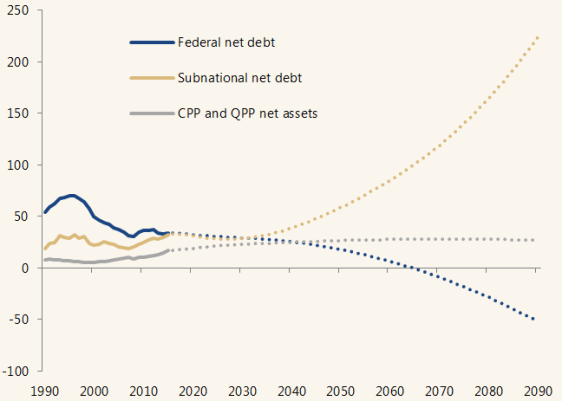
Sources:  Statistics Canada and Parliamentary Budget Officer.

Federal government

PBO’s 2015 Fiscal Sustainability Report concluded that the federal government had room to increase spending or reduce taxes. Measures in Budget 2016 have reduced this room. However, the government continues to have flexibility to expand policy while maintaining fiscal sustainability.

To maintain net debt at its current level of 33.7 per cent of gross domestic product (GDP) over the long term, PBO estimates that the federal government could permanently increase spending or reduce taxes by 0.9 per cent of GDP ($19.2 billion in current dollars). This is down from 1.4 per cent in last year’s assessment.

PBO’s federal sustainability assessment concludes:

  • Federal fiscal room has been reduced as a result of reversing the increase in the age of eligibility for the Old Age Security program. The higher long-run cost as a result of the change is expected to reduce federal fiscal room by 0.2 per cent of GDP.
  • Removing existing children’s benefits and introducing the Canada Child Benefit are expected to reduce fiscal room by 0.1 per cent of GDP. However, a complete picture of the impact is uncertain, as no details have been announced describing the indexation of benefits or eligibility thresholds beyond the medium term. Parliamentarians may wish to seek further clarification.
  • The impact of other Budget 2016 spending measures, including Phase 1 and Phase 2 of Canada’s New Infrastructure Plan, is 0.1 per cent of GDP.

Subnational governments

The outlook for subnational governments (that is, combined provincial, territorial, local and Aboriginal governments) is little changed from last year’s assessment. Permanent policy actions amounting to 1.5 per cent of GDP ($30.2 billion in current dollars) would be required to stabilize the subnational government net debt-to-GDP ratio at its current level (32.5 per cent) over the long term. The required fiscal consolidation has increased marginally from 1.4 per cent in last year’s assessment.

PBO’s subnational government sustainability assessment concludes:

  • The slight increase in the fiscal gap is the result of higher-than-projected program spending in 2015.
  • Health care spending outpaced nominal GDP growth in 2015. This, along with historical revisions to the national accounts, has raised PBO’s projection for excess cost growth.  Excess cost growth refers to the increase in health spending that cannot be accounted for by general inflation, real per capita income growth, population growth and ageing.
  • Although provinces cannot meet the challenges of population ageing under current policy, the required fiscal consolidation is not insurmountable if compared to previous consolidation episodes. Furthermore, the changes do not need to occur immediately. However, the longer they are delayed, the greater the adjustment that is required.

Canada Pension Plan and Quebec Pension Plan

The fiscal gap for the public pension sector represents the immediate and permanent change in contributions and/or expenses that returns the net asset-to-GDP ratio to its current level over the long term. PBO estimates that public pension plans are sustainable over the long term.

The long-term projection of the Canada Pension Plan (CPP) does not incorporate the agreement in principle signed by Canada’s Finance Ministers on 20 June 2016. PBO will assess the changes to the CPP when further details on implementation are released.

Total general government sector

The total general government sector in Canada (that is, the combined federal and subnational governments and public pension plans) is not fiscally sustainable without permanent increases in revenues or reductions of at least 0.6 percentage points of GDP.

Changes could be made at any level of government to eliminate the total government fiscal gap. However, ensuring the sustainability of each government sector on its own would require a consolidation at the subnational level and/or higher transfers from the federal government.

Related posts

  • 21 July 2015

    This report provides an assessment of the long-term sustainability of government finances for three government sub-sectors: the federal government; subnational governments consisting of provinces, territories, local, and aboriginal governments; and, the Canada and Quebec Pension Plans.    [PDF]

Source: Fiscal Sustainability Report 2016

Leave no one behind in CPP expansion: Mark Hancock

June 16, 2016

A growing number of business and financial sector voices with histories of strong opposition to expanding the Canada Pension Plan have suddenly accepted that our public, not-for-profit, pension system should grow. Their newfound support, however, comes with many caveats. Their strategy now focuses on ensuring any expansion of the CPP is overly narrow and extremely modest.

Various Chambers of Commerce, financial industry lobby groups, and the Canadian Life and Health Insurance Association argue that CPP expansion should: 1) not apply to low-income workers, 2) only apply to some middle-income workers and 3) not be the focus for new saving among higher-income earnings, who, in their view, are presumably better served by the for-profit private pension system. The small number of workers remaining who would be affected would only see a “modest” increase to CPP benefits.

These carve-outs would have significant consequences.

All workers currently participate on an equal basis in the CPP. Adding new exceptions for workers at certain income levels would make it more complicated and costly to operate the plan. More contributions would be used to pay administrative and compliance costs instead of being invested. A simple universal expansion of CPP is the more efficient solution.

Cutting low-income workers out of CPP expansion will also encourage employers to game the system. If new CPP contributions and benefits only applied on earnings above $27,500 as some are suggesting, employers would have yet another incentive to offer lower-wage, lower-hours jobs – keeping total earnings below this threshold would keep payroll costs down. This would lead to a new incentive to split full-time positions into precarious part-time positions. Canada’s governments should not be encouraging precarious employment by building these incentives into the CPP. Canadian workers deserve more good jobs and our governments should be fighting to keep them.

If Finance Ministers are concerned with the retirement prospects of low-income Canadians, CPP expansion should not be carved up. Low-income Canadians would see their retirement incomes rise like others under a bigger CPP. If Finance Ministers are concerned about the impact of the GIS clawback on these workers, they should address that particular mechanism rather than undermine the universal CPP.

Polling shows Canadians of all income levels, including low-income Canadians, strongly support CPP expansion. This federal government clearly campaigned on commitment to expand the CPP without reference to any new caveats.

As the salespeople for many for-profit private retirement products, Canada’s insurance industry has a long track record in lobbying against CPP reform.  Canadians pay the highest mutual fund fees in the world in their RRSPs and these companies like it that way.

The insurance industry ran a massive campaign that tried to kill the CPP before it was born in the 1960s. The Canadian labour movement, on the other hand, was rightly skeptical that most workers would be able to achieve a pension plan at work, leading to our call for CPP benefits to be set at a much higher level. A middle ground was ultimately chosen, establishing a public pension plan with overly modest benefits. Political leaders at the time believed workplace pension plans would grow – enough to fill the gap left by the modest CPP. This hasn’t happened, and the basic benefit target of the CPP remains basically the same as when it was established.

Unions pushed for a doubling of CPP benefits in the 1980s,as the private pension system was not working for most Canadian workers. The insurance industry and other business groups successfully quashed CPP expansion, arguing that workplace pension coverage and private savings vehicles would grow and expand over coming decades.

These business groups were proven spectacularly wrong. Workplace pension coverage has been on a decline ever since. It’s no surprise we are facing a retirement crisis.

If we had listened to the insurance industry in the 1960s, we wouldn’t have a CPP today. If we hadn’t listened to them in the 1980s, Canadian baby boomers would be retiring with bigger CPP benefits today, instead of the justified anxiety of the retirement insecurity our failed system has left them with. The picture for their children looks even bleaker – unless something is done today.

Our Finance Ministers should reflect on this history next week as they weigh the latest, flawed advice from the insurance industry about CPP.

The labour movement’s message has been simple for the past 50 years: the CPP works very well in terms of coverage, benefit security and inflation protection. Its only flaw is that its benefits are too modest. It should be expanded for all Canadian workers. Relying too heavily on our private, for-profit retirement system has not and will not work for most Canadians.

Canadians are overwhelmingly behind the simple idea of setting aside a bit more today for a decent and secure retirement. Our Finance Ministers have an obligation to listen to Canadians, and universally expand the CPP.

Mark Hancock is national president of the Canadian Union of Public Employees. Representing over 635,000 members across the country, it is Canada’s largest union.

Home

Source: Leave no one behind in CPP expansion: Mark Hancock

Asbestos ban is a good start but we need a registry, says Hancock | CUPE

May 11, 2016

Following Prime Minister Justin Trudeau’s announcement that the federal government is “moving forward on a ban” of asbestos, CUPE National President Mark Hancock reiterated CUPE’s call for a comprehensive ban of the deadly substance.

“Asbestos is killing CUPE members. It’s been a serious hazard for decades. We’re happy to hear the government is moving on this issue, and we want to see them do the right thing by introducing a comprehensive ban,” said Hancock.

A comprehensive ban means, among other measures:

  • Banning the use, export and import of all asbestos-containing materials
  • Establishing an expert panel to make recommendations for implementation of the ban
  • Creating registries of cases of asbestos-related diseases and buildings used by the public that contain asbestos.

The Canadian Labour Congress has a detailed description of what a comprehensive ban would look like here.

“The government has to do more than just say ‘we’re banning it.’ We need to find out exactly where it is, so workers can take the appropriate actions to protect themselves from exposure. We need to prevent exposures, and support workers who have been exposed. It’s about protecting workers and protecting Canadians,” said Hancock.

Trudeau made the announcement on Tuesday at a building trades unions policy conference in Ottawa. No details or timetables for imposing a ban have been released. In April, CUPE joined the CLC in lobbying the federal government about implementing a comprehensive ban, and sent a letter to the prime ministeron the issue.

CUPE has been calling for a full ban of asbestos for decades, but successive governments have been slow to act and sometimes even worked counter to the cause, despite overwhelming evidence of the serious harm caused by exposure. Every year approximately 2,000 Canadians die from asbestos-related diseases.

Learn more about asbestos here.

Source: Asbestos ban is a good start but we need a registry, says Hancock | Canadian Union of Public Employees

BoC considers changing ‘core inflation’ tracking | The Chronicle Herald

HALIFAX — The Bank of Canada is examining alternatives to its “core inflation” method of tracking prices as it prepares to review its inflation-control agreement with the federal government next year.

Source: BoC considers changing ‘core inflation’ tracking | The Chronicle Herald

Federal Minister says child poverty not Ottawa’s problem

James Moore says child poverty falls under provincial jurisdiction

Sara Norman December 15, 2013 http://www.news1130.com

VANCOUVER (NEWS1130) – It was a disturbing milestone for BC this year–child poverty watchdogs announced our province is in the number one spot when it comes to kids in need. But it seems the Federal Government won’t be helping out.

“Is it my job to feed my neighbour’s child? I don’t think so.” That from Federal Minister of Industry James Moore who is also the Member of Parliament for Port Moody—Westwood—Port Coquitlam. He says it’s the responsibility of the provinces to deal with child poverty, and Ottawa has no plans to step in.

The Federal Government has been criticized for not meeting a unanimous motion passed in the House of Commons back in 1989 to end poverty by the year 2000. Nothing was done, but the motion was renewed in 2009. Child Poverty Watchdog Campaign 2000 says to this date there has been no movement from Ottawa on helping the estimated 1 in 7 kids living in poverty in our country.

Here in BC, thousands of kids go to school hungry every day because they’re not getting enough to eat. Of late, schools across Metro Vancouver have been left with the difficult decision on whether to put already strained resources into creating lunch and breakfast programs for students in need.

“Certainly we want to make sure that kids go to school full bellied, but is that always the government’s job to be there to serve people their breakfast?” Moore says Ottawa is helping keep kids fed by creating more jobs, and while unemployment was up in BC last month, joblessness across Canada was down.

“We’ve never been wealthier as a country than we are right now. Never been wealthier,” Moore claimed at an event Friday. He says how poverty is defined is not the same across the country.