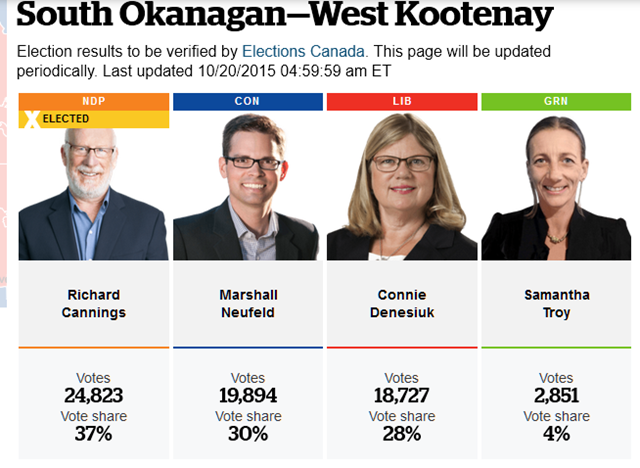
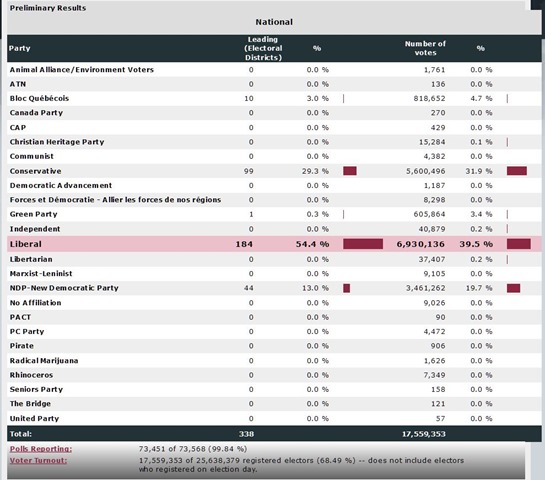
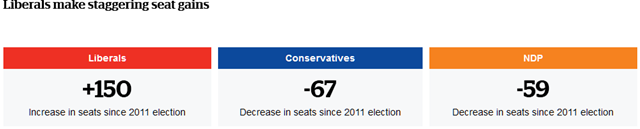
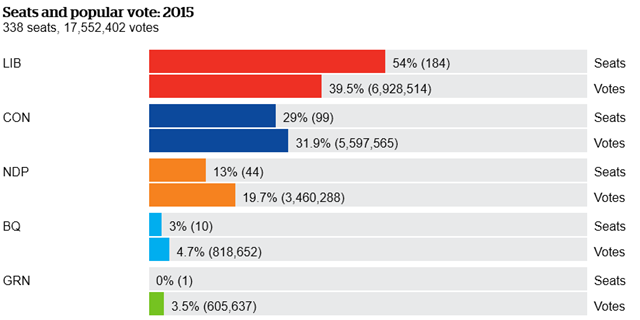
With thanks to: http://www.cbc.ca/news2/interactives/results-2015/; Elections Canada



October 13, 2015 Andrew Chernoff 
The headlines have the Harper Conservatives on the ropes; the election all but over:
‘There’s a real chance that Justin’s Liberals could form government’: Conservatives warn-National Post-Oct 12, 2015
Liberals within reach of strong minority: poll-Toronto Star – Oct 10, 2015
Conservatives On Defence In Several Urban Man. And Sask. Ridings-Huffington Post Canada-Oct 13, 2015
Harper Tries to Fend Off Trudeau in Last Week of Canada Vote-Bloomberg-Oct 11, 2015
No room for ambition or contenders in ‘party of one’ –Waterloo Record-Oct 13, 2015
“The Conservatives will have only themselves to blame when the votes are counted next Monday” says Geoffrey Stevens, an author and former Ottawa columnist and managing editor of the Globe and Mail, teaches political science at Wilfrid Laurier University and the University of Guelph.
Say it isn’t so? Gentle my heart….Proof that Santa Claus exists…..Must get that Lotto 649 ticket NOW!!!
As a British Columbian, since the provincial election of 2013 (2013 B.C. election: The post-mortem), forgive me for being once bitten, twice shy. The BC NDP were to win by a landslide. The polls said so. The electorate said so. The province had enough of the Liberals and it was time to strike them down and put an end to that totalitarian government once and for all.
Yeah, right. The polls lied. British Columbians lied.
When it came to actually putting their vote where it counted, too many British Columbians committed hari kari and drank the BC Liberal juice.
Once again proving that too many British Columbians are ineffectual and timid to affecting real change. They are pussies: B.C. election: Christy Clark pulls off an upset for the ages: Defying all pre-election polling and prognostication, Liberal Leader Christy Clark retained power in British Columbia Tuesday night-Tim Harper.
On Monday, October 19, will Canadians from coast-to-coast-to coast make the pollsters right? Will there be at least a federal Liberal minority government, if not majority government, in place on Tuesday, October 20? Or, will it be a minority NDP federal government? Or, dread the thought, more of the same?
Both Stephen Harper and his government were supposed to be regulated to the opposition last election. Remember?
“Harper finally wins majority as NDP surges into Opposition”-Globe and Mail-May 2, 2011:
Canadian voters have radically redrawn the country’s political landscape, handing the Conservative Party its long-sought majority in an election that decimated the Bloc Québécois and humbled the Liberals.
For the first time in history, the New Democratic Party will form the Official Opposition after an extraordinary breakthrough that propelled the party to more than 100 seats.
The extent of the transformation is startling. The Liberals now hold just four seats west of Guelph, Ont. The Conservatives, formerly shunned by Toronto voters, won nearly half of the seats in that city, twice as many as the Liberals. The Bloc Québécois, which defined Quebec federal politics for two decades, no longer qualifies for official party status. And Green Party Leader Elizabeth May won the party’s first seat, and the right to a place in the next election’s debates.
Bloc Leader Gilles Duceppe lost his seat and resigned. Liberal Leader Michael Ignatieff lost his riding. Both defeated leaders were squeezed, like many of their candidates, between growth in Conservative support and Jack Layton’s surging New Democrats.
The night belonged to Stephen Harper, who put his party over the top after five years of minority government and becomes just the third Conservative leader since Confederation to win triple victories.
Federal elections are much tougher to win, I must admit and the NDP did make a strong showing, to become the official opposition.
But……Canadians are like teenage girls drawn to “bad boys”……they are drawn to Harper and the rest of the Conservatives “bad boys…and girls”. Whatever the bad boys do opposes the book of rules which they rewrite for their own needs and purpose and that’s how they succeed to trigger an adrenaline rush in the Canadian electorate and draw them in for four more years.
I mean, how else do you explain the sado masochistic tendency that occurs every time Harper leads his Conservative party into a federal election. Between elections Canadians complain about everything and swear on everything including the Bible that change must occur: we must get rid of Harper and his Conservatives and elect a different federal party to be the government of Canada.
The polls prove it…..remember 2011…..and those trusting polls…..the Conservatives on the ropes….the NDP support….the Liberals.
The lesson from the 2011 federal election….the lesson the provincial BC NDP learned the hard way in 2013, repeating the history of the 2011 federal election….is that most polls aren’t worth believing: Canadians love to hear themselves complain and do nothing about it when it counts. Talk talk. Talk talk.
10. Most polls aren’t worth more than a glance of Canada’s political future through a crystal ball.
Most polling firms underestimated the Tories’ strength and overestimated the Liberals’ influence. So what did Canadians learn from the raft of fluctuating numbers and contradictory public opinion polls?
According to Harris-Decima chairman Allan Gregg, not much. “[They learned] that sometimes it’s better to be uninformed than misinformed,” he said.
Mr. Gregg says methodological issues are skewing results of telephone and online polls, including a dwindling number of landlines and people not answering their home phones to avoid telemarketers.
“The industry is going through a transition, and as a result our work is more imperfect than it is at the best of times,” he says. “We cannot predict behaviour, predicting turnout is impossible, and answers are only reflections of the questions that are asked.”
Ipsos Reid proved to be the most accurate of the country’s data slingers, posting poll results that closely mirrored the final tally. But Ipsos Reid’s Darrell Bricker says he doesn’t count on results purely from the so-called “random sample.”
“The real issue is coverage and making sure you have an adequate representation of the population in the sample,” he said. “What it comes down to is good science and being skeptical by your own numbers. The job of good social science is you never take anything from one source.” Ten lessons to learn from the 2011 election National Post (blog)-May 3, 2011
So what will it be? C’mon I have to know right now. What’s it gonna be? Harper’s Conservatives, Trudeau’s Liberals or Mulcair’s New Democrats?
I know….I know….the same ole tune, right. Let me guess…..
Let me sleep on it
Baby, baby, let me sleep on it
Let me sleep on it
And I’ll give you an answer in the morning
Let me sleep on it
Baby, baby, let me sleep on it
Let me sleep on it
And I’ll give you an answer in the morning
Let me sleep on it
Baby, baby, let me sleep on it
Let me sleep on it
And I’ll give you an answer in the morning
My prediction is….more of the same….the Harper Conservatives are the federal party Canadians love to hate, and the majority of Canadians are too far-gone on that Harper Conservative cocktail. It’s an obsession you just can’t quit. Defies all logic and common sense.
In the end, you disavow any personal responsibility. Harper made you do it. That bad boy.
Like the song says:
I couldn’t take it any longer
Lord I was crazed
And when the feeling came upon me
Like a tidal wave
I started swearing to my god
And on my mother’s grave
That I would love you to the end of time
I swore I would love you to the end of time
Just saying….
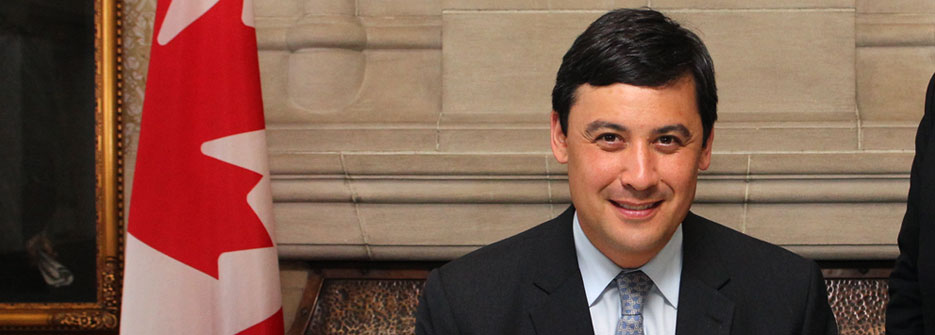 Michael Chong, P.C., M.P. Wellington-Halton Hills
On December 3, Michael Chong, P.C., M.P. Wellington-Halton Hills introduced to the Canadian Parliament a private member’s bill, Bill C-559, Reform Act, 2013: An Act to amend the Canada Elections Act and the Parliament of Canada Act (reforms).
The following is a backgrounder behind Bill C-559 put out by Mr. Chong.
On December 3, 2013, Michael Chong, Member of Parliament for Wellington-Halton Hills, introduced the Reform Act, 2013. The Reform Act is an effort to strengthen Canada’s democratic institutions by restoring the role of elected Members of Parliament in the House of Commons.
The proposals in the Reform Act would reinforce the principle of responsible government. It would make the executive more accountable to the legislature and ensure that party leaders maintain the confidence of their caucuses.
Responsible government was introduced to Canada in the 1840s by Robert Baldwin and Louis-Hippolyte LaFontaine, reformers whose contributions to responsible government are commemorated in a monument behind Centre Block on Parliament Hill. Together, they led the first responsible government in Canada. Responsible government is the principle that the Executive Council (cabinet) is responsible and accountable to the elected Legislative Assembly (House of Commons), and not the appointed Governor.
Since Confederation, numerous and gradual changes have eroded the power of the Member of Parliament and centralized it in the party leaders’ offices. As a result, the ability of Members of Parliament to carry out their function has been curtailed by party leadership structures. The Reform Act proposes to address this problem by restoring power to elected Members of Parliament.
The Need to Reform Parliament
In Canada’s single-member district plurality (first-past-the-post) system, Canadians directly elect Members of Parliament to represent them in the House of Commons. This is the only franchise (excepting the occasional non-binding ad-hoc consultative Senate elections) that Canadians exercise at the federal level.
It is important to note why the role of the Member of Parliament is so vital to our system.
In many systems of government, citizens exercise three franchises, three votes. For example, in the United States, citizens exercise three votes at the federal level: A vote for the President, a vote for a Senator and a vote for a Congressman or Congresswoman. So, citizens have three avenues to pursue their democratic representation.
But in Canada, citizens exercise only one franchise, one vote: A vote for their local Member of Parliament. And they rightfully expect that their local member be responsive to their views.
It is for that reason that the role of the Member of Parliament in the Canadian system is so critical.
However, evidence demonstrates that Canadians are becoming increasingly disengaged with their elected Parliament. Recent public opinion research reveals that only 55 per cent of Canadians report being satisfied with the way democracy works in Canada,i dropping 20 per cent from 2004.ii Voter turnout during federal elections has reached an all-time low, and in the last federal election, four out of ten Canadians chose not to vote.iii
Studies have found that many Canadians are disengaged because they feel that politicians work for someone else, and are therefore indifferent to their views.iv
The Reform Act will help to re-engage citizens by introducing bottom-up reforms, giving greater decision-making authority to electoral district associations, and strengthening accountability in parliamentary party caucuses. When electoral district associations have the final authority over selecting party candidates in the electoral district, it ensures local control over who represents the district in Parliament. The Reform Act also provides greater power to elected Members of Parliament to hold their party leaders to account, thus reinforcing the confidence that caucus must have in the leader, and strengthening the principle of responsible government, the foundation of the Westminster system of parliamentary democracy.
The reforms proposed in the Reform Act are not new. If enacted, they would restore Parliament to the way it worked in Canada for many decades. Furthermore, many of the reforms proposed in the Reform Act are similar to current practices in other Westminster parliaments. The Reform Act would, however, codify into statute practices that are currently governed by unwritten convention.
The Reform Act proposes three main reforms: Restoring local control over party nominations, strengthening caucus as decision-making body, and reinforcing the accountability of party leaders to their caucuses. The Reform Act amends two Acts of Parliament: The Canada Elections Act and the Parliament of Canada Act.
It is important to note that the Reform Act would not come into force until seven days after the next general election.
Restoring Local Control over Party Nominations
Currently, the Canada Elections Act effectively gives a party leader authority over the selection of a candidate by an electoral district association. According to paragraph 67(4)(c) of the Canada Elections Act, a prospective candidate must submit to the Chief Electoral Officer of Canada, proof that a party leader has endorsed his or her candidacy. Only after this proof has been submitted, can the Chief Electoral Officer approve his or her nomination as a candidate for a party in an election. This requirement was introduced when the Canada Elections Act was amended in 1970.v Without such endorsement, the name of a prospective candidate and the political party with which he or she is affiliated cannot be put on the election ballot.
In other Westminster parliaments, the leaders of political parties do not exercise this type of centralized authority. For example, in Australia’s Labor Party and Liberal Party, decisions on candidate nomination are generally made by the local party membership.vi,vii In the United Kingdom’s Conservative Party and Liberal Democratic Party, candidates are generally selected by the constituency membership or constituency association.viii,ix In these parties, the final decision on candidate nomination rests with the members of local constituencies.
The Reform Act proposes to amend the Canada Elections Act, restoring local control over party nominations by replacing a party leader with a nomination officer, for the purpose of endorsing a party candidate in an election. Nomination officers are to be elected by members of electoral district associations through a majority vote. The Reform Act ensures that decisions pertaining to candidate nominations are made locally and are binding; meaning that the decisions of the electoral district association cannot be overruled by a party leader. By restoring control to electoral district associations to nominate candidates, power is effectively restored to Canadians, since it becomes a local decision as to who gets to represent the party in an election.
In effect, the Reform Act gives local associations the final decision on which candidate will run for a political party in that electoral district. Strengthening electoral district associations would enhance local engagement with political parties by giving these associations a stronger voice in a party’s direction.
Strengthening Caucus as a Decision-Making Body
Caucus is central to the functioning of a Westminster parliament. Most parliamentary power flows from the institution of Parliament through the caucus leadership to individual caucus members. Therefore, the structure and governance of caucus, as well as the accountability of the caucus leadership to its members, becomes vitally important in the Westminster system. Those members who sit outside a recognized party caucus are distinctly disadvantaged.
It is important to draw a distinction between registered political parties (Conservative Party of Canada, Liberal Party of Canada, New Democratic Party of Canada, etc.) which are created and exist outside Parliament, and parliamentary parties – also referred to as caucuses or recognized parties – which exist inside Parliament. While there is significant correlation between both types of parties, they are separate in structure and governance.
It is clear that, due to a series of changes going back decades, the ability of Members of Parliament to carry out their functions has been curtailed by caucus leadership structures. This stands in stark contrast to the significant power that members have in other Westminster parliaments, such as Australia and the United Kingdom.x,xi,xii
While the Parliament of Canada Act implicitly recognizes House of Commons caucuses by providing for the remuneration of House of Commons caucus chairs, no detail is provided as to how these caucuses should be structured or governed. In particular, no mention is made of how a House of Commons caucus chair is to be selected, nor is any mention made regarding caucus membership and expulsion. Currently, the structure, governance and membership of caucuses are regulated by unwritten convention. Over the decades, this unwritten convention has evolved in a way that has advantaged caucus leadership and disadvantaged caucus members.
The Reform Act proposes amendments to the Parliament of Canada Act in order to formally define the structure and governance of House of Commons caucuses.
The Reform Act would amend the Parliament of Canada Act by adding the definition of a House of Commons caucus.
The Reform Act would also formalize the procedure for the expulsion and re-admission of caucus members. Currently, the process for expulsion and re-admission is an undefined process that can vary between caucuses and individual cases. Under the Reform Act, a caucus member may only be expelled if the caucus chair has received a written notice signed by at least 15 per cent of the caucus members requesting that the member’s membership be reviewed at a meeting and the expulsion be approved by a majority vote by secret ballot of the caucus members present at that meeting.
Expelled caucus members may be re-admitted if one of two criteria is met. One criterion for re-admission is that the expelled member is re-elected to the House of Commons as a candidate for that party. The second criterion is that the caucus chair has received a written notice signed by at least 15 per cent of the caucus members requesting a vote to re-admit that member at a meeting, and the re-admission is approved by a majority vote by secret ballot of the caucus members present at that meeting.
The Reform Act also sets out a formal procedure for the election of a caucus chair. The chair of caucus is elected following every general election, or following the death, incapacity, resignation or removal of caucus chair. The chair is elected by a majority vote by secret ballot of the members of caucus who are present at a meeting of caucus. That meeting is presided over by the caucus member with the greatest number of years of service in the House of Commons.
The Reform Act also sets out a formal procedure for the removal of a caucus chair. The chair of a party caucus can only be removed if the chair has received a written notice signed by at least 15 per cent of the caucus members requesting that the occupancy of the chair be reviewed at a meeting, and the chair’s removal is approved by a majority vote by secret ballot of the caucus members present at that meeting. That meeting is presided over by the caucus member with the greatest number of years of service in the House of Commons.
These measures will enhance the accountability of caucus leadership to caucus members, ensuring party leaders and their caucuses are mutually accountable by virtue of requiring the maintenance of confidence. This is particularly important in House of Commons caucuses, since it is only members of the House of Commons to which the constitutional convention of confidence applies.
Reinforcing Accountability of Party Leaders to Caucuses
By convention, leaders of parliamentary parties must maintain the confidence of their House of Commons caucuses. While this convention is frequently used in Australia and the United Kingdom, it is rarely used in Canada.
Since the 1960s, party leaders in most Westminster systems have become more powerful in relation to elected Parliaments. With a few exceptions, the checks and balances on the power of party leaders has weakened. One of those exceptions is the ability of party caucuses to conduct a leadership review, which is the most important check and balance on the power of party leaders. In the United Kingdom’s Conservative Party, Australia’s Liberal Party, and New Zealand’s National Party and Labour Party, the party caucuses retain the power to review their party leaders.xiii,xiv,xv,xvi Within the last two decades, caucuses in all three countries have exercised this important power.
However, in Canada registered political parties have increasingly displaced the role of caucus in reviewing the party leader. Furthermore, the by-laws of registered parties make it difficult to initiate a leadership review.
Much like caucus structure and governance, little is set out in Canadian statute regarding leadership review. The Reform Act proposes to amend the Canada Elections Act to ensure that party by-laws recognize the current caucus power to review the caucus leader, by making explicit what is currently unwritten convention. Quite simply, the bill takes the current unwritten constitutional convention and makes explicit in statute the rules and process for caucus to review the party leader.
The Reform Act proposes that a party leadership review may be initiated by the submission of a written notice to the caucus chair, signed by at least 15 per cent of the caucus members. The review will occur by secret ballot, and the result will be determined by a majority vote of the members present at the meeting. When a majority of caucus members vote in favour of a leadership review, a second vote by secret ballot occurs immediately to select a person to serve as the interim party leader until a new leader has been elected. Aside from the election of an interim party leader, the Reform Act does not specify how a party leader is to be elected, leaving that decision to the political party.
The Reform Act makes registration of a political party contingent on the party’s by-laws conforming with these leadership review provisions. Registered political parties will have twelve months after the Reform Act comes into force to bring their party by-laws into compliance.
The Reform Act does not affect, in any way, the current power of registered political parties and their members to review a leader or to select a leader, regardless of what their current practises are.
Evidence shows that Westminster parliaments that operate under the rules proposed in the Reform Act, like those in the United Kingdom, Australia and New Zealand, are no more are unstable than the system Canada currently operates under. The length of time between leadership changes are about the same in both systems.xvii,xviii
Currently, party leaders exercise a great deal of control over caucuses, with the result that caucuses decreasingly function as decision-making bodies. The provisions proposed in the Reform Act would make explicit the requirement that the party leader maintain the confidence of his or her caucus, making the leader more accountable and restoring the role of elected Members of Parliament.
_________________________
i Anderson, Kendall, et al., “Lost in Translation or Just Lost?: Canadians’ Priorities and the House of Commons”, Samara Democracy Report #5, Samara Institute, February, 2013. p.2.
ii Anderson, Kendall, et al., “Who’s the Boss?: Canadians’ Views on Their Democracy”, Samara Democracy Report #4, Samara Institute, 2012. p.1.
iii Bastedo, Heather, et al., “The Real Outsiders: Politically Disengaged Views on Politics and Democracy”, Samara Democracy Reports, Samara Institute, December, 2011. p.2.
iv Bastedo, Heather, et al., “The Real Outsiders: Politically Disengaged Views on Politics and Democracy”, Samara Democracy Reports, Samara Institute, December, 2011.
v http://www.parl.gc.ca/content/lop/researchpublications/bp437-e.htm
vi Australian Labor Party National Platform and Constitution, Constitution, part D. s.9. http://d3n8a8pro7vhmx.cloudfront.net/australianlaborparty/pages/121/attachments/original/1365135867/Labor_National_Platform.pdf?1365135867
vii The Liberal Party of Australia is a Federation of Divisions. http://www.liberal.org.au/the-party/our-structure
viii Constitution of the Conservative Party, Schedule 7. s.15 http://www.bracknellconservatives.org.uk/sites/www.bracknellconservatives.org.uk/files/constitution_0.pdf
ix Liberal Democrat Federal Constitution Article 4 and Appendix Leadership Election Regulations. http://libdems.org.uk/constitution.aspx
x http://en.wikipedia.org/wiki/1922_Committee
xi http://en.wikipedia.org/wiki/Parliamentary_Labour_Party
xii Australian Labor Party, “National Executive Guidelines for the Election of the Labor Leader”, Ballot Rules, http://www.alp.org.au/ballot_rules
xiii United Kingdom, House of Commons Library, Leadership Elections: Conservative Party, Standard Note, SN/PC/1366, 7 December 2005, pp. 7-9.
xiv Guaja, Anika, “Labor leadership spill: the rules of the game”, The Conversation, [University of Sydney], 27 February 2012. http://theconversation.com/labor-leadership-spill-the-rules-of-the-game-5575
xv http://en.wikipedia.org/wiki/1922_Committee
xvi http://en.wikipedia.org/wiki/Parliamentary_Labour_Party
xvii http://reviewcanada.ca/magazine/2012/06/keeping-party-leaders-honest/
xviii Blais, A., & Cross, W. P. (2012). Politics at the Centre: The Selection and Removal of Party Leaders in the Anglo Parliamentary World. New York: Oxford University Press.
Tory tweets, convention chatter and looming legislation hint at what may be coming, say labour advocates.
By Tom Sandborn, Today, TheTyee.ca
“Just wrapped up a meeting with several staff members, at midnight. Good thing they’re not unionized!”
Federal Conservative Employment Minister Jason Kenney’s tweet was the object of some derision on social media in the early hours of Nov. 19. Although quickly deleted, the tweet’s sentiment hit a deep nerve for some trade unionists across the country — particularly those already worried about what the federal Conservatives have in mind for labour legislation in Canada.
A set of non-binding resolutions was adopted earlier this month at the federal Conservative party convention in Calgary. The resolutions include a call on government to reduce wage and benefit levels for civil servants. The resolutions also call for stripping unions of the right to use member dues to support social policy campaigns and other expenditures not part of a set of narrowly-defined workplace issues.
The resolutions, in addition to clauses in Bill C-4, the omnibus budget bill currently before Parliament, aren’t merely expressions of Conservative anti-labour sentiment; according to trade unionists and labour advocates, they signal a growing war on Canadian workers.
For one, trade unionists argue because Tony Clement, Conservative cabinet heavyweight and president of the Treasury Board, supported a resolution at the convention that calls for public-sector wage and benefit roll-backs, it suggests that the Harper majority government may be inclined to implement them.
“We’re not here to buy labour peace through caving in to every single public-sector union boss’s demands,” Clement told The Globe and Mail at the Calgary convention. “We’re not here to do that. We’re here to represent the taxpayer.”
Bob Jackson, vice president of the Public Service Alliance of Canada, describes Conservative actions on labour as “an all-out declaration of war on unions, coming from the highest levels of the party.” Jackson traveled to Calgary to participate in a union-sponsored demonstration outside the Calgary Stampede Grounds where the convention took place.
“We have never encountered this level of animosity and ill will from the government before,” Jackson said in an interview. “They want to get rid of us and to strip away things we have maintained for decades.”
Fears over labour gain roll backs
Hassan Yussuff, secretary treasurer of the Canadian Labour Congress, shares Jackson’s concerns about a turn to more anti-labour confrontations by the government. Yussuff said he thinks Minister Clement is “fixated” on rolling back gains that organized labour has won over the past half century.
Yussuff expressed particular concern about provisions in Bill C-4, the latest signature government omnibus budget bill, that would strip away rights from public-sector workers to refuse unsafe work. He also raised concerns about Bill C-4’s reduction of independent federal work-site safety inspections.
As well, Yussuff highlighted language in the bill that would allow the government to unilaterally define workers as “essential” during a labour dispute, a definition that has previously been negotiated between the employer and public-sector workers.
This power could conceivably allow government to define workers in a particular job setting as essential, rendering strike action impossible.
Simon Fraser University professor Marjorie Griffin-Cohen is also concerned about the Conservatives’ get tough approach to labour, as evidenced both in the Calgary resolutions and the provisions of Bill C-4. In particular, she said the right of unions to use member dues in social policy campaigns is important.
“If trade unions were not active in encouraging governments to deal in fair ways with labour issues, they would be derelict in their support of labour,” Griffin-Cohen told The Tyee via email.
“Corporate spokespeople, of course, are really objecting to labour uniting on political issues — they would much rather every individual work organization deal with their mighty power all by themselves,” she added.
Resolutions ‘not an attack on labour’: CPC activist
If the Harper government is declaring war on organized labour in Canada, John Mortimer has no apparent objections.
Mortimer, president of the Labour Watch Association and a board member of the Canadian Taxpayers’ Federation, is a prominent spokesperson for Canadian conservatism who ran for Parliament in 2000 for the Canadian Alliance.
“Unionization doesn’t belong in the public sector,” Mortimer said, adding that he does not endorse any specific party because of his role in the taxpayers’ federation.
Mortimer said that Canada is the only country in the world in which unions can collect compulsory dues and spend part of what is collected to campaign on broad social issues like poverty, minimum wage levels and environmental protection.
“Look at what the Canadian Autoworkers did not so long ago. They used auto workers’ dues to bring Saint [David] Suzuki to a meeting to tell the members their industry was ‘disgusting’,” he said. “I have no issue if a union wants to donate to a party or to promote a cause, but they shouldn’t be able to use mandatory dues collected from all of their members to make those donations.”
Vancouver lawyer and Conservative Party activist Scott Lamb, a member of the party’s national council, said there was broad party support at the Calgary convention for the labour-related resolutions. He disagrees with critics who characterize them as a “war.”
“That’s not fair. We are a grassroots party,” he said in an interview. “Those resolutions came from all across the country. They were not an attack on labour.”
The business-friendly Fraser Institute recently weighed in on public sector wages in an April report that suggested public-sector workers have, on average, a 12 per cent better wage level than comparable workers in the private sector, with most of the difference due to the higher level of unionization in the public sector.
The tone of the Institute’s report suggests that it would be better for public employees to have their wages reduced than for private sector workers to earn more in order to address this disparity.
‘Social unionism’ under threat?
Since 1946, after an influential arbitration ruling by Justice Ivan Rand in an auto industry dispute, Canadian labour law has permitted unions to collect dues from all workers in a bargaining unit, whether they choose to join the union or not.
This led to government and the courts allowing unions to use dues not only for narrow job site issues, but also for campaigns, such as the BC Federation of Labour’s long-standing push to increase the minimum wage in British Columbia.
In the early 1990s, for example, the Supreme Court of Canada ruled in Lavigne v. Ontario Public Service Employees Union that “the state objectives in compelling the payment of union dues which can be used to assist causes unrelated to collective bargaining are to enable unions to participate in the broader political, economic and social debates in society, and to contribute to democracy in the workplace.
“These objectives are rationally connected to the means chosen to advance them, that is the requirement that all members of a unionized workplace contribute to union coffers without any guarantee as to how their contributions will be used,” the judgment continues. “An opting-out formula could seriously undermine the unions’ financial base and the spirit of solidarity so important to the emotional and symbolic underpinnings of unionism.”
Unionization in the Canadian private sector is down from 30 per cent in 1997, to 18 per cent last year in both Canada and B.C. Public-sector unionization is just over 70 per cent, even after a 4.7 percent reduction in that sector over the same period — a reduction created mainly by the contracting out of public services to for-profit providers whose workers are often not unionized.
If the recent Tory convention resolutions ever make it into Canadian law, trade unionists worry the kind of “social unionism” described in the Lavigne case will become illegal, and union membership could continue to shrink across the country. ![[Tyee]](https://i0.wp.com/thetyee.cachefly.net/ui/img/ico_fishie.png)
 Andrew Phillip Chernoff