But the union that represents secretaries, bus drivers, remains on job action alert should talks break down again.
By Katie Hyslop, Today, TheTyee.ca

Six unions in the Lower Mainland launched a one-time job action June 25 after negotiations stalled.
Staff, teachers and parents of public-school kids can breathe a sigh of relief because CUPE-BC is headed back to the negotiation table.
Until last week it looked like they were headed in the opposite direction. With just three weeks left until school started, CUPE-BC had announced the breakdown of talks between the union and government on August 13.
Almost all of the union’s 57 locals had already voted yes for possible job action when schools reopened if summer negotiations failed. A support staff walkout — including custodians, education assistants, secretaries and bus drivers — that would shut down classes seemed imminent.
But new bargaining sessions scheduled for Sept. 4-6 have put that crisis on hold thanks to the intervention of Peter Cameron, government’s spokesperson for both the support workers’ and teachers’ provincial bargaining tables.
“Cameron [has] given us an indication that they’re going to have something different for us. So we are prepared to give them the opportunity to explain what that might be and consider,” said Bill Pegler, CUPE-BC’s national rep.
Pegler says the union still hopes for a negotiated settlement, but they’re on strike alert in case bargaining stalls again.
With only three days of bargaining scheduled, there’s a lot riding on these talks. At best a negotiated settlement could foretell positive negotiations with the teachers’ union this fall.
But at worst the move only delays support workers’ strike long enough to get through the first week of back to school before kids are sent back home because of a strike.
Cautiously optimistic
Now in their second year without a contract, the CUPE-BC school support staff has been unhappy the government and their employer, the BC Public School Employers Association (BCPSEA), haven’t brought any new money to table.
Government wants the union to identify areas that can be cut to fund a raise, the workers’ first since 2009. It’s part of the cooperative gains model they’re applying to all public-sector bargaining.
CUPE-BC public school support workers unions make up 57 locals active in 53 school districts, covering 27,000 employees. Without a contract since June 2012, the union is seeking more money and more time for its members. The union says average annual salary for a full-time support worker is $24,000, and full-time means less than 35 hours per week.
Talks haven’t been going well. Negotiations for a new support workers contract have stalled three times already since they began last November.
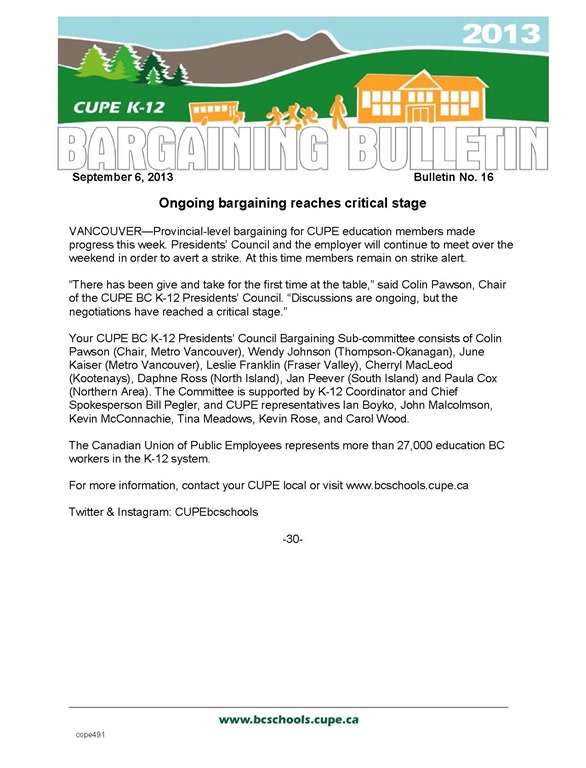
The most recent round of talks ended in August when, as Colin Pawson, chair of the CUPE BC K-12 Presidents’ Council, put it, “we came to the table with ideas for cost savings. The only thing missing was a committed bargaining agent on the employer’s side.” Government is refusing to talk to media about negotiation issues from their end.
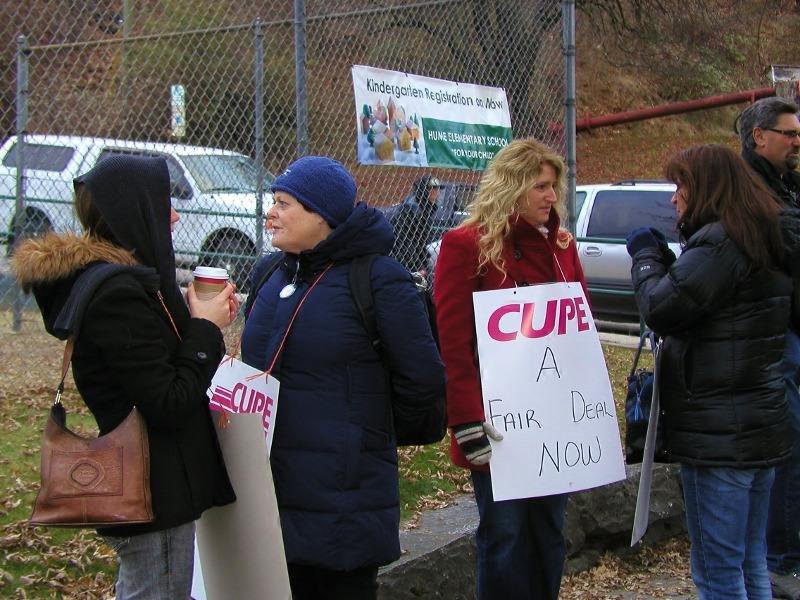
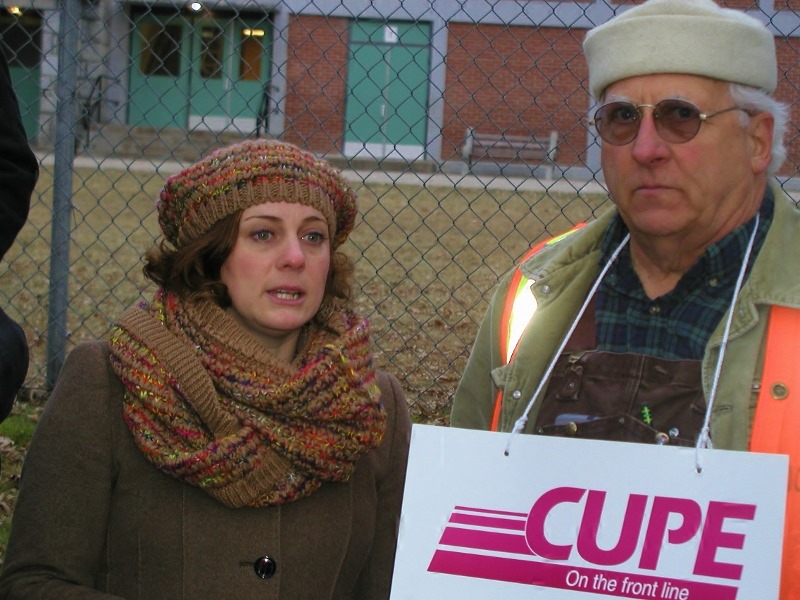
Most of the 57 locals had already voted in favour of a strike by June. Six unions in the Lower Mainland launched a one-time job action on June 25, taking part in information sessions and walkouts held outside of class hours. Summer bargaining was supposed to be the last ditch effort to prevent a fall strike.
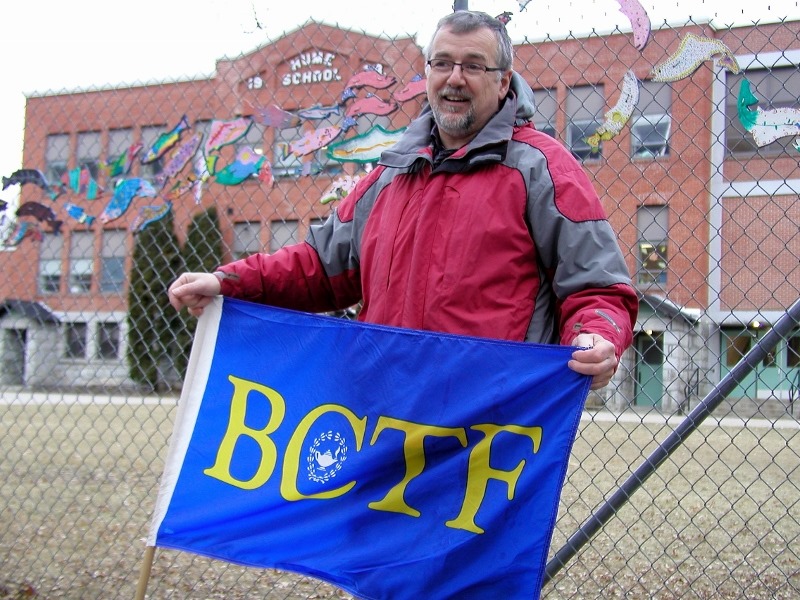
When that failed, government was faced with the looming reality of students across the province staying home from school next week. The BC Teachers’ Federation said they would respect CUPE picket lines and not cross them.
Speaking on background, a Ministry of Education official told The Tyee the employers’ bargaining committee would be working hard towards a negotiated settlement in the next bargaining sessions. Along with spokesperson Cameron, they remain “hopeful any significant disruption of schools can be avoided.”
CUPE is happy to be going back to the bargaining table, even if they don’t know if it will be worth it.
“We know that [government have] been speaking to employers. But beyond that, we are not really clear on what to expect,” he told The Tyee, adding more bargaining dates could be added if talks go well.
“We remain cautiously optimistic.”
What school support workers want
Like the teachers union and school boards, CUPE-BC takes issue with education funding. The Annual Facilities Grant, once provided to districts for maintenance and repairs, has been halved.
But the current per-pupil funding model has an even worse effect on support workers, says Pegler.
With enrollment down across the province, funding dollars have shrunk. To balance the budget, boards have cut support workers’ hours.
“We see educational assistants have their hours trimmed by a few hours each week,” Pegler told The Tyee.
“The real trend is districts moving to an extended spring break, which has had the effect of reducing a week’s worth of contribution to student service by many support staff: clerical support staff and education assistants, all for financial reasons.”
It’s different for maintenance workers, who are typically laid off instead of losing hours. Since 2007 the union has lost about 300 trades workers, including painters, gardeners, electricians and plumbers who worked in school districts, leaving them with 1,300.
Pegler says districts tend to prioritize maintenance for health and safety risks like mold. But he says you can see the effect cuts have, like the dead rat found in the ceiling of a Langley school last January.
“Schools are not maintained to the full potential. It means that aging physical plant may have to be subjected to more costly maintenance in the long run because the trouble-shooting isn’t being done. It may mean that green initiatives are not being undertaken in terms of maintaining equipment at its optimal level,” he added.
Principals have had to take on extra duties in schools where office staff hours are cut, answering phones and manning the school office. But for maintenance staff reductions, districts like Nanaimo-Ladysmith have pooled their resources to cover the losses.
“We created a district team that if you had a child getting sick, you would call the district team and they would come to your school,” said Shelley Green, president of the BC Principals and Vice Principals Association, and a Nanaimo-Ladysmith principal until last year.
“They aren’t necessarily based in your school, once again shifting the way it’s done.”
Cuts across the board
Other districts have had to cut service workers because of financial mismanagement. The New Westminster School District cut 27 special education support workers, 10 other support workers, and almost 20 teachers earlier this year after they discovered a $4-million deficit. The district projects to have 264 support staff for the 2013/14 school year, just above the 258 staff they had in 2010/11.
“That (deficit) necessitated making broad cuts across the whole district,” said Michael Ewan, chair of the New Westminster School Board, adding the secretary treasurer at the time had miscalculated the district’s budget.
“Whether it’s classrooms that aren’t as clean, whether it’s (special education assistants) that are no longer providing service, it just means that we’re going to be doing less for education. There’s no way around that.”
But Ewan maintains the per-pupil funding model also shares some of the blame for his district’s financial hole, saying even without the deficit services for kids weren’t what they should be. BC Teachers’ Federation president Jim Iker agrees.
“All of our system has been underfunded. It’s affected us with larger class sizes and less learning specialist teachers in support of our students. It’s also affected less learning support workers, less maintenance and custodial hours also. It cuts across the whole system,” he told The Tyee.
“It’s important that all custodial hours, maintenance hours get restored in schools, and so that’s where we would encourage school boards to restore those hours.
“If CUPE gets what it wants — more resources for its members, including a pay raise — the BCTF will expect the same. But that’s not CUPE’s concern right now.”
“Our number one priority is getting a settlement with the government and the employers association,” said Pegler.
“But given the fact that we’ve had three false starts, each time with the employers association or government saying that they’re ready to bargain and then finding that they weren’t ready when we were ready to bargain, we have to prepare for full-scale job action in the fall, there’s no question.” ![[Tyee]](https://i0.wp.com/thetyee.cachefly.net/ui/img/ico_fishie.png)







 Andrew Phillip Chernoff