
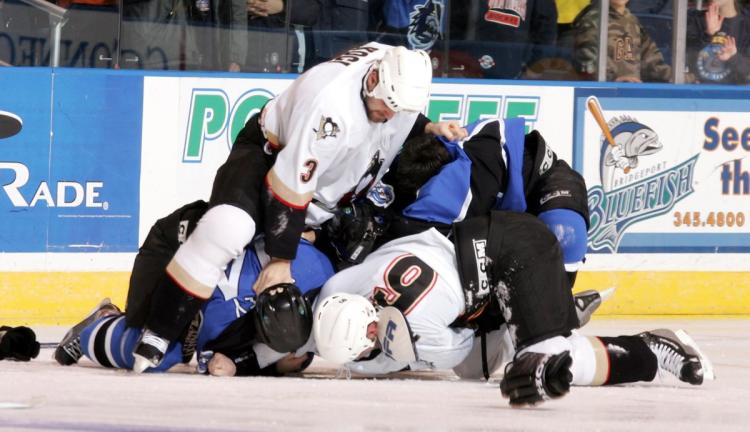
The AHL is putting new rules in place to cut back on fights. (JIM MCISAAC/GETTY IMAGES)
Pat Leonard NEW YORK DAILY NEWS Friday, July 8, 2016
The American Hockey League, the NHL’s primarily U.S.-based feeder league, passed new rules at its most recent Board of Governors meeting to clamp down on fighting.
Players who fight before, at, or immediately following a face-off will be ejected with an automatic game misconduct. During the AHL regular season, players will be suspended one game apiece for their 10th fight of the season, all the way through their 13th bout, until a two-game suspension kicks in for fights 14 and up.
Everyone is already asking why NHL commissioner Gary Bettman continues to allow fighting at the sport’s highest level, why he chooses even to champion its existence rather than oppose its presence or, at the very least, say nothing at all.
But now there is another question, because the NHL typically monitors new measures applied in the AHL before considering adding them to its own rule book:
Why should the NHL need to wait to see the results of these new AHL rules before acting?
Bettman has plenty of reason to ban fighting from hockey entirely already. All of this tip-toeing around officially abolishing the practice just feels tired and futile.
In May, the NHL had its motion to dismiss a lawsuit from former playersdenied, in the face of accusations that the league failed to warn, inform and adequately care for them while glorifying violence that leads to head trauma.
In the face of this litigation — and despite improved science and increased knowledge about the debilitating effects of repeated head trauma, concussionsand the degenerative brain disease CTE — Bettman nevertheless told Sports Illustrated recently that fighting “has been a part of the game, it does act a thermostat in the game” and contended “your question presumes that it should be eliminated, and that isn’t necessarily the case.
“Fighting may help prevent other injuries,” Bettman added.
Why he keeps fighting for fighting, though, is beyond me.
First of all, banning fighting would not necessarily imply the NHL is guilty as charged in this lawsuit of infractions in the past – unless the league has something to hide, of course.
Secondly, Bettman’s continued comments on the subject — including his 2015 assertion that there is “no evidence” linking concussions and CTE — are ignorant and insensitive to the findings of new science and the identification of the brain disease in late NHL players such as former enforcer Bob Probert.
Third, fighting is increasingly irrelevant in today’s NHL already, even in the AHL compared to the old days.
The NHL’s more-recently adopted “instigator” rule often deters players (they’ve told me themselves) from taking any sort of retribution they may desire, since the penalty would be too costly to that game’s outcome.
Clubs are more reticent to encourage the violence, since every win and point matters even more in a league with so many teams in the playoff hunt due to the NHL’s cherished baby, its competitive balance. They can’t afford to sacrifice games just to settle a score with a hated rival.
And with the NHL’s salary cap so restrictive and the game of hockey so much faster, most teams can’t afford anymore to pay or play a player who is strictly an enforcer anyway. A sort of natural selection has weeded out this type of hockey breed from the highest level of the game.
So why not just stamp it out for good and eliminate unnecessary risk to players’ health?
The NHL was policed by the Broad Street Bullies back in the 1970s. I remember Philadelphia Phantoms AHL games at the Spectrum in the 1990s when they barely needed a puck on the ice there were so many brawls.
But as a CBC article pointed out recently, Rockford’s Michael Liambas led the AHL with fighting majors with 20 last season, while in the NHL only four players reached the 10-fight threshold: Colorado’s Cody McLeod (12), Vancouver’s Derek Dorsett (11), former Islander and new Maple Leaf Matt Martin (11) and Shark/Canadien Mike Brown (10).
Even Bettman said that “fighting is at the lowest level … in the history of the game.” The only problem is, he is using that as an argument for keeping fighting in hockey. On the contrary, that is one of the best reasons to say goodbye to the glove-dropping altogether.
Granted, the NHL’s ever-faster, ever-more physical high-speed collisions can be even more dangerous for players than some fights. But the time for parsing these details and statistics and defending fighting’s place in the game of hockey is over.
From an image standpoint, at least, the always-booed Bettman should at least understand how much better he and the NHL would look if he simply stepped up and banned fighting, announcing that in a sport so inherently high-risk there is no need to put these men in increased danger.
He seems determined, though, to make the fighting issue a hill he will die on — when what he should really do is, well, lock it out.
_____________________________________________

Pat Leonard
Pat Leonard is in his fifth season on the Rangers/NHL beat. He has worked at the Daily News since May 2010. Pat graduated from the University of Notre Dame in 2006.
Source: NHL shouldn’t wait on results of AHL experiment to end fighting – NY Daily News
 Andrew Phillip Chernoff