07/10/2012 http://www.huffingtonpost.ca
 Althia Raj

Civil Society Critics of CETA, the Canada-EU free trade deal, deliver a Trojan horse to Parliament Hill in Ottawa on Monday, October 17, 2011. (THE CANADIAN PRESS/Sean Kilpatrick)
OTTAWA — Canadian provinces are either ill-equipped or incompetent when it comes to defending their rights in a massive and overarching free trade agreement Canada is currently negotiating with the European Union, says a lawyer who has studied leaked drafts of the text.
“The provinces are selling us out and they are not doing their homework,” Steven Shrybman, an international trade and public interest lawyer, told The Huffington Post Canada.
The federal government, along with provincial and territorial representatives, is finishing up negotiations on CETA, the Comprehensive Economic and Trade Agreement, which it hopes to sign with the EU by the end of the year. The deal, the government says, will boost bilateral trade and inject $12-billion annually into the Canadian economy.
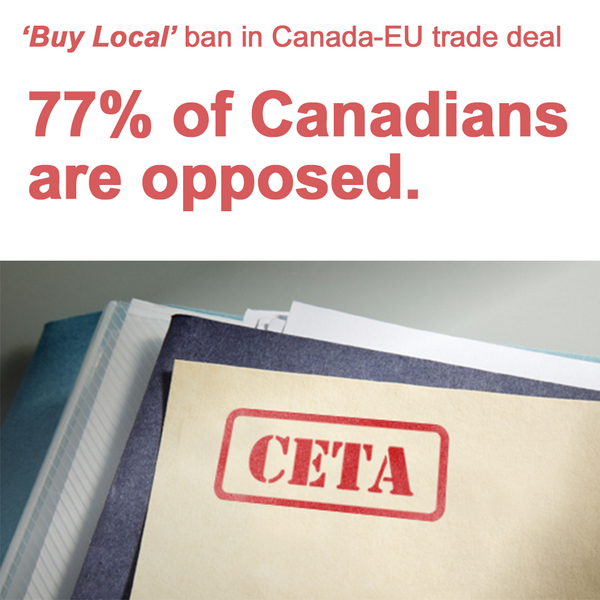
But critics decry what they’ve seen of the deal, which applies to sub-national governments for the first time, saying it will give European corporations the ability to compete for local contracts on everything from school buses to municipal water systems.
They are also concerned foreign companies will be able to challenge municipal or provincial regulations that favour local jobs or regional development.
Though Ottawa will sign off on the final agreement, for the first time provincial negotiators are at the table. Municipalities, as creatures of the provinces, are represented by provincial negotiators.
In a legal brief prepared for CUPE, the Canadian Union of Public Employees, Shrybman studied the list of items Canada sought to exempt from international competition. He found that while the European Union had asked for blanket exemptions to protect many public utilities in various sectors, most provinces and the territories have not done the same.
“There is a dramatic disparity between what the Europeans have put on the table and what we have put on the table,” Shrybman said. “They are preserving their ability to govern in the public interest in far more ways then we have.”
Paul Moist, CUPE’s national president, said the union was sharing the legal brief as a “wake-up” call for premiers.
“Why are European member countries seeking exemptions for their water and their public transit systems and we are not, are there not red flags being raised by the conduct of the Europeans?” he asked.
Moist, whose members work in many sectors covered under CETA — such as school boards, the health care system, municipalities and social services agencies — said the free trade agreements negotiated in the 1980s and 1990s exempted most of those services.
“The opposite is happening here, so CETA represents pretty uncharted territory for Canada,” Moist said. “If you don’t exempt something, it is included.”
Under NAFTA rules, any rights granted to European corporations under CETA would also automatically apply to North American companies.
Canada’s initial offers, leaked earlier this year and circulated by the Trade Justice Network and Reseau quebecois sur l’integration continentale (RQIC), show wide variations between the provinces. Manitoba, for example, wants to limit market access to foreign providers and investors in fishing, forestry, food, liquor, beer and wine retail trade, agriculture, energy, recreational services and insurance. Other provinces, including Ontario, Quebec and B.C., sought few or no restrictions.
Some provinces may be doing a poor job of defending their interests simply because they don’t fully understand the effects the deal could have, Shrybman said.
“There is general illiteracy in the political leadership of provincial governments. They’ve never confronted anything like this before. Free trade is kind of old news to them and the fact that the dramatic transformation of how these agreements would apply to sub-national governments I don’t think has been properly conveyed,” he said.
Shrybman believes some provinces have not sought exemptions because they are led by parties that believe in smaller government and more privatization.
Without negotiated exemptions, the provinces and territories will be permanently bound by the agreement. Future governments won’t be able to establish new policies or public services without paying out millions — or possibly hundreds of millions of dollars — in compensation to foreign companies who challenge them, Shrybman said.
MUNICIPALITIES’ CONCERNS
Concerns about the trade deal prompted dozens of Canadian municipalities to pass resolutions asking their respective provinces to exclude them from CETA, including: Toronto, Victoria, London, Ont., and Sackville, New Brunswick.
In Baie-Comeau, Que., a township on the northern coast of the Saint Lawrence River, Councillor Alain Larouche brought forward a motion to try to exclude his municipality from CETA because he wanted to ensure local companies could be favoured in government contracting.
“International competition could jeopardize our local businesses and companies, so we sought a form of protectionism,” Larouche told HuffPost.
“We’re in the regions and our industries are more fragile, they are a lot less competitive than international firms. It’s obvious for us that our companies are a generator of jobs and that’s why we want to protect our jobs,” he said in a phone interview.
Those concerns were echoed by Bill Holmes, a former councillor in the Ontario township of Alnwick/Haldimand. Holmes, who recently stepped down due to a cancer diagnosis, said he wanted his municipality excluded from CETA because he was concerned it would affect the council’s ability to establish ‘buy-local’ policies and create good full-time jobs with benefits for the town.
In New Tecumseh, Ont., Councillor Jim Stone fears a loss of control with new international players.
“What are the benefits and what are the costs? We have never received that equation,” he told HuffPost.
For example, if the town wants to bid on water or sewage systems, “we would have to include the European community to bid on these things and you would lose total control over environmental aspects (and) the things that you would like to see local,” he said. “It puts our workers in jeopardy.”
Government and business leaders say CETA’s $340,000 procurement threshold — the minimum cost at which international firms are allowed to bid — in the goods-and-services sector and $8.5 million for construction projects is higher than what is already in place through the Agreement on Internal Trade. But for Stone, that’s still too low.
“You don’t get much for $300,000 in a municipal service today,” he said.
CETA will give corporations further powers to influence Canadian laws, Stone told HuffPost.
“(They’ll say) you can’t pass a law that benefits your own people because we are not going to do it over here. You know, that’s what happens so the whole bar gets lowered. We are trying to raise our bar and they come and knock it off the peg and say you start back down here,” the New Tecumseh Councillor said.
City Councillor Sav Dhaliwal of Burnaby, B.C., said that while he is a staunch supporter of free trade, local politicians want to know what they are being forced to sign on to. Burnaby has led an effort for several years to exempt all municipalities from CETA.
“We have never found out clearly, or at least to a point, what is on the table, what is being exempted, so that is a part of the frustration for us,” Dhaliwal said.
THE PROVINCES RESPOND
Andy Watson, a public affairs officer with the British Columbia Ministry of Jobs, Tourism and Innovation, said he won’t provide the list of exemptions British Columbia has sought because the negotiations are ongoing.
“Making public our negotiating positions would undercut our leverage not only in the CETA talks but in other negotiations as well,” he told HuffPost.
Manitoba, however, said it had put forward a lengthy list of exemptions with Manitoba Hydro at the top.
“Manitoba Hydro is Manitoba’s oil. Every year, it brings hundreds of millions of dollars into our provincial economy. We’re continuing to build it for future generations, for reliability and to secure international export sales,” said Jodee Mason, a press secretary for the province’s cabinet.
Mason said Manitoba and its lead negotiator met regularly with municipalities and consulted them throughout the negotiations. As far as they are aware, not one municipality passed a motion asking to be excluded from CETA.
Quebec, which pushed for the EU free trade deal, believes it may reap greater benefit from CETA than other provinces because of pre-existing commercial roots on the other side of the Atlantic, its geographic proximity to the European market and a shared culture.
Jean-Pierre D’Auteuil, a spokesman in Quebec’s Department of Economic Development, Innovation and Export Trade, told HuffPost that nothing in CETA would prevent its municipalities from pursuing their socio-economic goals.
“Municipalities will be able to continue to adopt and modify rules, as long as these rules are applied in a non-discriminatory fashion,” D’Auteuil said.
Federation of Canadian Municipalities President Karen Leibovici, who speaks on behalf of the umbrella organization representing municipalities across the country, said the FCM identified several concerns about CETA: that procurement thresholds were too low, that new administration processes could increase costs, that the barring of preferential treatment for country of origin would negatively impact the strategic or public interest considerations of municipalities, that transit and environmental protection should be allowed “within reason” and that the municipalities would have a role to play in the dispute resolution process.
Without a final draft to examine, it’s too early to say if the deal has met the federation’s expectations, said Leibovici, a city councillor in Edmonton.
But she’s confident International Trade Minister Ed Fast and Canada’s lead negotiator Steve Verheul will defend the interests of municipalities. The men have pledged to uphold a list of seven guiding principles put forward by the federation, she said.
If municipalities have specific concerns they should speak to their province and work with municipal and territorial associations, Leibovici said.
The Council of Canadians, along with CUPE, is urging municipalities to do just that.
“CETA is not about trade at all,” Maude Barlow, the Council’s national chairperson, told HuffPost in an email. “Most trade with Europe is tariff free now. CETA is about giving corporations in Canada the right to challenge European rules that protect domestic economies, jobs, farmers and resources and European corporations the right to do the same in Canada.”
Ed Fast’s spokesman Rudy Husny insists CETA will be a boon for Canada and will open the largest procurement market in the world, worth about $2.3-trillion annually, while boosting job opportunities in this country.
“There are no costs — there are only benefits; we are going to remove tariffs and we are going to increase trade,” Husny said.
Nothing in the agreement will prevent governments from regulating in the public interest, in areas such as the environment, labour and health and safety, Husny added.
Local governments will be allowed to continue to give preferential treatment to hometown companies through grants, loans and fiscal incentives, he said, while research and development, financial services, public administration, education and health care will all be excluded from the deal.
Brianna Ames, press secretary to Ontario’s Economic Development Minister Brad Duguid, noted Ottawa has asked for exclusions for health care, public education, and social services, such as child care, welfare and employment insurance, but she would not discuss what exemptions or exclusions Ontario has sought because the negotiations are still ongoing.
“We are pursuing in these negotiations the best deal. We can’t look at things in isolation,” she said.
Any requests by municipalities to be exempted from the trade deal would have to be agreed to by the parties and could impact other areas of the discussion, she said.
“At this stage of the discussions, it is to be determined how those requests would be treated,” Ames added.
“WE ARE GOING TO GET STIFFED”
Stone, the New Tecumseh councillor, doesn’t trust Ontario to a sign a deal that won’t penalize his community.
“We’ve heard that before, ‘Trust us, eh? We’re from the government, we are here to help you.’ That’s almost like an oxymoron. No, I think we are going to get stiffed,” he told HuffPost.
Ontario kept municipalities in the dark and, as representatives of the level of government closest to the people, Stone feels citizens are being excluded.
Dhaliwal said B.C. municipalities are getting the run-a-around from their province, which is insisting it is not at liberty to inform them about the status of the negotiations.
“For us, it’s far too late if the ink is already put in the paper to say well this is in and this is out,” he said.
Everyone believes in international trade agreements, Dhaliwal said, but the municipalities are concerned CETA will affect the delivery of services that councillors like himself are responsible for providing to their residents and they want the opportunity to propose certain changes or give their endorsement.
“We want to make sure that they are not going to suffer, but we won’t know, I don’t think we’ll ever know because by the time we hear about it everything will be signed, sealed and delivered.”



 CUPE National @cupenat

 Andrew Phillip Chernoff