Fraser Institute thinks sending your kid to university counts as “child care”

MAY 05, 2016 by

Apparently when the Fraser Institute hears “child care,” they seem to think about sending young adults off to university.

When most Canadians hear “child care,” they probably picture toddlers in daycare.

But when the Fraser Institute hears “child care,” they seem to think about sending young adults off to college or university.

In their latest report examining “child care in Canada,” the right-wing think tank sets out to calculate just how much money Canada spends on child care every year.

But a closer look at how they came up with their numbers shows a few interesting surprises!
fraser-childcare-header.jpg

What surprises?

Well, although the cover of the report features a photo of a tiny infant struggling with a set of building blocks, the report itself says it counts saving for university as a “child care” cost.

In calculating child care costs in Canada, the Fraser Institute includes the $800 million Canada Education Savings Grant program that the report itself describes as something designed to help parents “save for their child’s post-secondary education.”

Which only begs the question: is it reasonable to include the cost of saving for college or university as a “child care” program?

fraser-university-childcare.jpg

The Fraser Institute has a few other “child care” costs that may stretch the definition of “child care”:

The former Conservative government’s Children’s Fitness Tax Credit, eliminated in the Liberal government’s 2016 budget, which deducted up to $150 for kids under 16 involved in organized sports. Canada Revenue Agency said that includes “strenuous games like hockey or soccer, activities such as golf lessons, horseback riding, sailing and bowling.”

 The Canada Child Tax Benefit, a means-tested grant aimed at lower-income families to “help them with the cost of raising children under 18 years of age” – although it’s a direct-payment that is not explicitly tied to child care costs.

The former Conservative government’s Universal Child Care Benefit, also eliminated in the 2016 budget, which was a direct-payment of between $100 to $160 per month for everyone under the age of 18 – it too was not explicitly tied to child care costs.

The Fraser Institute includes all of these in their estimate of what Canada spends on child care.

If any of this seems a bit off from what most Canadians think when they hear “child care,” the Fraser Institute has an explanation:

“It is important to explain the distinction between child care and daycare as those terms are used in public policy discussions in Canada. Child care is the broader term and encompasses a range of services and benefits that flow to children. It includes daycare programs, but also covers cash benefits flowing to families to assist them with raising their children.”

But it’s not clear whose “distinction” that is, though.

A 2014 Statistics Canada report on child care limited their scope to “nannies, home daycares, daycare centres, preschool programs and before and after school services.”

Quebec’s government defines child care programs as “childcare centres, private day care centres and home childcare services.”

Meanwhile, Canada Revenue Agency defines a “child care expense” as any amount you pay “to have someone look after an eligible child” under the age of 16 because you have to work or go to school.

Saving for university or subsidizing a teenager’s sporting activities are also notably absent from “discussions” about “child care” hereherehereherehere and here.

What’s else? One of the citations hiding at the end of the report pegs child care costs in Canada about $20 billion lower than the Fraser Institute’s own estimate.

$20 billion is roughly the amount the Fraser Institute’s report pegs as the combined cost of the CESG, CCTB and UCCB.

That might not be a big surprise.

The right-wing Institute’s annual reports on how much average Canadians pay in taxes have also been criticized for including things that average Canadians don’t actually see on their tax bills, like corporate taxes and oil and gas royalties.

As the former editor of The Walrus John MacFarlane once noted:

“Critics of the Fraser Institute report have also pointed to a bias in its definition of taxes, in terms of what it included in its calculation of the average tax bill. Are royalties on oil and gas revenues taxes? Are import duties taxes? Are taxes on goods and services, property, vehicles, fuel, alcohol, and tobacco — so-called consumption taxes — as burdensome as those applied to income? Is it reasonable to include corporate taxes in the total that Canadian families pay?”

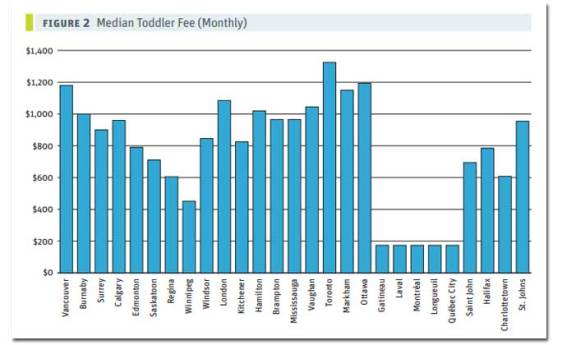
But despite what the Fraser Institute thinks, in reality, child care costs for Canadian families who actually have young children to worry about are still out of control:
childcarecosts-2015-02.jpg

Photo: robtowneo. Used under Creative Commons license. Shutterstock.

Source: Fraser Institute thinks sending your kid to university counts as “child care”
A national child care system… because “it’s 2015” – Broadbent Institute

The best line of the Trudeau government’s first day— widely reported and praised in the international media—was the new PM’s.

In response to a reporter’s question about why he’d chosen to create a gender-parity cabinet, he rather matter of factly observed “because it’s 2015”.  This ostensibly simple statement summed up a complexity of attitudes, beliefs and even world views in three words. For those feminists who remain doggedly optimistic after a decade nasty enough to slay the optimism of Anne of Green Gables, it raised hopes that the first day’s lustre could foreshadow more significant changes to come.

Mr. Trudeau’s observation aptly fits another feminist “ask”— one that’s been a pillar of the feminist agenda for 45 years. This is the kind of solid universal publicly-funded early childhood education and child care (ECEC) system that many other countries have; one well-designed so it simultaneously advances women’s equality, supports young families across the income spectrum and is good for children.

Feminists are but one of the constituencies who passionately believe that 45 years after the report of the Royal Commission on the Status of Women, the answer to why a coherent national child care system of high quality services is needed is simply “because it’s 2015”.

“Because it’s 2015” stands in for a host of no-brainer rationales. Child care is still the ramp to women’s equality in employment.  Economic research shows how child care helps stimulate the economy through mothers’ paid work. Child care helps “generation squeeze” mothers and fathers balance work and family and make ends meet. Without child care, it’s impossible to help families out of poverty or help newcomers settle. And substantial research has accumulated that shows that if it’s high quality and inclusive, early childhood education and  care provides a terrific environment in which young children thrive whether they’re middle class or low income, abled or disabled, francophone, Anglophone or Indigenous.

Most women with children —more than 77% with three to five year olds—are employed or  engaged in studying, language learning and other activities. Yet a crucial piece of the social infrastructure needed to support them is still missing in Canada in 2015. And many families who don’t “need” child care choose to have their children participate in early childhood programs for socialization and learning as children do from about age two and a half in many other countries.

Now that the dust from the election has settled and the new government gets down to work, it’s timely to review campaign commitments to child care. The Liberal platform stated:

“We will develop a child care framework that meets the needs of Canadian families, wherever they live”, and “we will meet with provinces, territories, and Indigenous communities to begin work on a new National Early Learning and Child Care Framework, to deliver affordable, high-quality, flexible, and fully inclusive child care for Canadian families. This work will begin in the first 100 days of a Liberal government and will be funded through our investments in social infrastructure. The framework we design together will be administered in collaboration with, and in respect of, provincial jurisdictions”.

The platform also made an explicit commitment to “research, evidence-based policy, and best practices in the delivery of early learning and child care”. As one of the world’s child care laggards, Canada is in a position to learn a great deal not only from our own experience but by using evidence  from other countries about best (and worst) ECEC policies and practices. The body of research and analysis could be important because there is now substantial evidence about the best ways to move forward on the universal, high quality, publicly funded and managed early childhood education and care system long sought in Canada.

In a video outlining directions on child care developed by the Liberal Party for last November’s ChildCare2020 conference, Mr. Trudeau declared that: “As a country, we need to prioritize access to child care for every family that needs it. It must be affordable, available, and of the highest quality possible. When we’re talking about our kids’ development, we can’t cut corners”. And on CBC Radio’s The House last spring: “We’re committed to making sure parents have affordable, quality early learning for their kids, there’s no question about it,” concluding with “I think there is a need for national leadership to make sure that early learning and child care happens”.

The child care platform is one of three components in a “Greater Economic Security for Middle Class Families” package. In addition to child care, it includes a new geared-to-income Canada Child Benefit which amalgamates the existing Canada Child Tax Benefit (CCTB) with the Harper government’s Universal Child Care Benefit (UCCB) cheques, and Flexible Work, including more flexible parental leave benefits. The funding for child care, however, which is part of the Social Infrastructure Fund, is not earmarked specifically for child care. Thus, the new government’s commitment to a national child care program—while it includes many of the key elements needed to make it work—still leaves important pieces to be fleshed out.

The 2015 federal election was the first in which child care was a major election issue and the first in which three of four political parties—for which 70% of Canadians voted— made commitments to a national child care program. Noting that it had primarily been the NDP championing child care in the campaign, the Toronto Star’s endorsement of Mr. Trudeau observed, “If he wins power, [a national child care program] ought to be on his agenda”. The Star noted that “a national child care program is something that is long overdue” and that it would be firmly within the Liberal Party’s tradition if revived, as “Paul Martin’s government first proposed such a national plan more than a decade ago”.

In 2015, it’s dreadfully evident that our patchwork, marketized child care situation fails just about everyone and that young Canadian families live in one of the few wealthy countries that fails to  support them well. While not a simple task, taking on the challenge of beginning to create a real evidence-based national child care program in 100 days when the new federal government meets with the provinces would be consistent with creating the gender-parity, diverse and talented cabinet revealed yesterday.

And it would be absolutely appropriate if for no other reason than simply…”because it’s 2015”.

Martha Friendly is Director of the Childcare Resource and Research Unit.

Source: A national child care system… because “it’s 2015” – Broadbent Institute