May 27, 2016
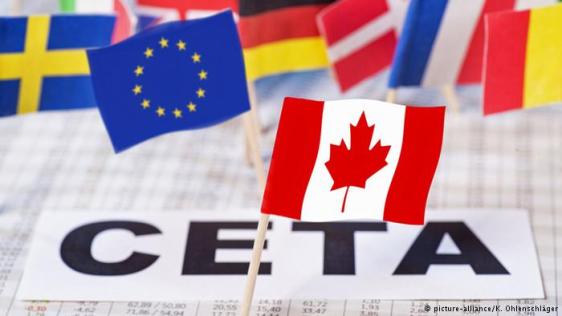
Canadians want their communities governed in the public interest. But increasingly, trade deals like the Comprehensive Economic and Trade Agreement (CETA) between Canada and the European Union and the Trans-Pacific Partnership (TPP) threaten municipal rights and powers in favour of the interests of multinational corporations.
While the Canadian government has signed the TPP and CETA, both can still be blocked during the upcoming ratification process. There are many reasons why the federal government should not ratify either of these deals.
Canada is a trading nation and international trade is vital to all levels of our economy. But trade agreements must put the interests of Canadians before corporate profits. Modern trade deals like CETA and the TPP are more about expanding corporate rights and powers, and less about trade.
In fact, trade between Canada and its 11 TPP partners is already 97 per cent tariff free. The TPP’s 6,000 pages are mainly focused on giving corporations the power to challenge laws and regulations which affect their investments – and profits – in signatory countries where they do business. Both the CETA and TPP would give corporations the right to challenge, and potentially overturn, Canadian laws and regulations.
Unlike the North American Free Trade Agreement (NAFTA), CETA will fully cover Canadian municipalities. While the TPP does not currently cover subnational governments, like provinces and municipalities, Article 15.24 mandates Canada to begin negotiations to expand coverage, including to subnational governments no later than three years after the deal comes into force.
Trading away our democracy
The TPP’s investor-state dispute settlement (ISDS) provisions, are similar to rules set out in NAFTA and CETA. The TPP’s investor arbitration rules will let transnational corporations bypass our public court system and sue governments over legislation or policies made in the public interest. The claims will be heard by secretive, pro-investor arbitration panels. It only takes two of three arbitrators – all corporate lawyers whose pay depends on the number of cases – to override legislation enacted by democratically-elected governments. This gives multinational corporations excessive power to undermine the authority of cities, provinces and the federal government to create reasonable rules and regulations such as environmental, health and labour safeguards; climate policy, food safety standards; protections for local jobs and businesses. As an example, when the Canadian government banned the import of a neuro-toxic gasoline additive called MMT, the US producer sued under NAFTA’s investment protections. Canada was forced to agree on a $13 million dollar settlement and reverse the ban.
CETA’s dispute settlement mechanism has recently been rebranded as Investor Court System (ICS) in order to make it sound more palatable. However, the accompanying cosmetic changes do little to prevent abuses from investors and arbitrators.
Locking in privatization and corporate profits
Under international trade rules, municipalities may find it expensive to bring a utility or service back in house, even if the costs of private delivery have sky-rocketed, or privatization has failed. Both CETA and the TPP ‘lock in’ privatization, and could make any attempt to bring contracted-out services back in house the target of an investor-state claim.
Similarly, living wage policies could trigger challenges. In 2012, the French utility company Veolia, present in some Canadian municipalities, launched a $115 million suit against the Egyptian government, under a bilateral investment treaty. The dispute stems from the City of Alexandria refusing to revise a waste disposal contract to meet higher costs, in part due to the introduction of a minimum wage.
Municipalities that want to favour local solar and wind energy over polluting fossil fuels may also face trade-related barriers. Under NAFTA, almost 40 per cent of investor claims using ISDS have challenged environmental regulations. A recent example is TransCanada Corporation suing the US government for $15 billion, after a democratically-elected president rejected the Keystone XL Pipeline over environmental concerns, and under mounting public pressure.
Driving up health, education costs
Major patent extensions in both CETA and the TPP will increase the price of prescription drugs as much as $2 billion per year, by some estimates. Drug costs are already the second-highest cost for provincial governments. Rising costs will mean pressure on municipal transfers and programs. Municipalities can also expect similar impacts on the costs of health benefit plans for employers.
Similarly, the TPP’s US-style copyright extensions will increase the time it takes for materials to fall into the public domain from 50 to 70 years. That will translate into up to $100 million per year in higher costs for municipal libraries, post-secondary libraries and public education more broadly.
Opening up municipal procurement
The total government procurement market in Canada is worth at least $100 billion per year. CETA will give access to provincial and municipal contracts and purchasing. The thresholds are so low (near $300,000 for goods and services contracts and $8 million for infrastructure projects) that most procurement contracts will be open to European firms. This will severely limit the ability of municipalities, school districts and other local authorities to establish ‘buy local’ or ‘buy Canadian’ policies. This would include banning measures that protect or promote local business opportunities and local jobs when municipalities contract for goods and services. Strategic purchasing strategies that promote local green jobs and local food policies may also be at risk.
Municipalities will likely also face increased costs associated with providing the federal government with information about their procurement activities. This includes publishing detailed notices and announcements of intended procurement, issuing tenders which comply with CETA procedures, and justifying procurement decisions to unsuccessful suppliers.
Need for more transparency and public debate
The investor protections and dispute settlement provisions included in both the TPP and CETA give too much power to corporations, at the expense of our democracy. Nobel Laureate and world-renowned economist Joseph Stiglitz recently described the TPP as “the worst trade deal ever.” And investor rights in CETA have sparked massive mobilizations across Europe.
Canada’s experience with NAFTA has meant the loss of between 300,000 and 400,000 well-paying manufacturing jobs, declining wages and a hollowing out of the middle class. Implementing the TPP and CETA will only entrench this new economic structure and further increase inequality.
More than 70 Canadian municipalities have passed resolutions expressing concern or asking to be exempted from CETA. Canadian municipalities are now beginning to pass resolutions raising similar concerns about the TPP. Cities and towns can use their voice at the table in provincial and federal forums to call for a real public debate and full, independent analysis of these trade agreements. Let’s ensure our public services, municipal rights and local democracy are not traded away.
For more information about CETA and the TPP visit cupe.ca/trade







 Andrew Phillip Chernoff