
Light drinkers, and non-alcohol drinkers, should watch for fatty liver disease

May 24, 2016 – 8:02pm

People who have reduced enzyme activity to breakdown active aldehyde, i.e., those who become easily inebriated, are more likely to develop fatty liver disease even if they do not drink alcohol. This discovery was made by a clinical research team from Kumamoto University in Japan.

It is generally understood that fatty liver is triggered by alcoholism or heavy drinking. Recently, however, the number of patients with non-alcoholic fatty liver disease (NAFLD), a type of liver function disorder caused by increasing neutral fat in the liver that is caused by overeating and lack of exercise, has increased.

NAFLD is easily overlooked because of the lack of associated symptoms, and it is often only found when it has progressed to an advanced stage, such as cirrhosis., It is therefore important to detect it early so that preventative measure may be implemented.
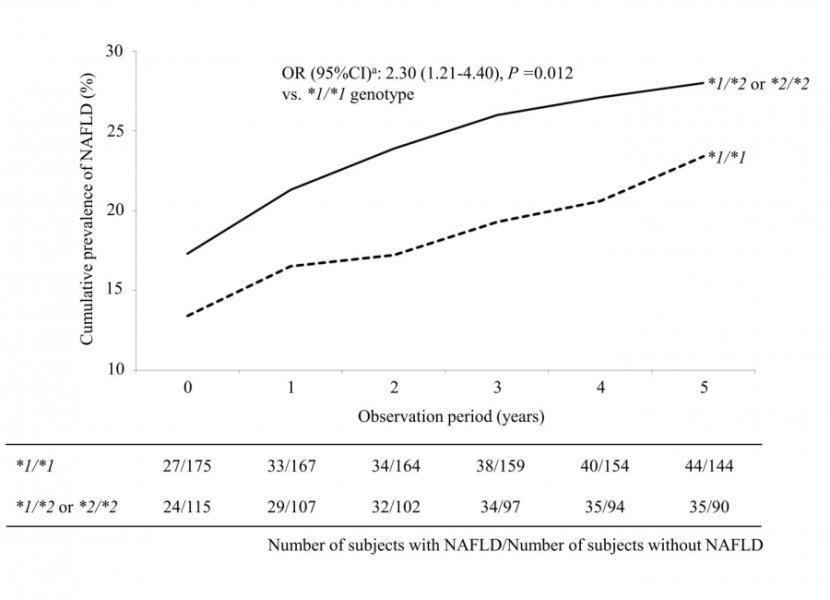
The risk of NAFLD was significantly higher in the ALDH2*2 allele carriers than in the non-carriers. Credit: Dr. Kentaro Oniki

When a person drinks, alcohol is changed to acetaldehyde in the liver. Acetaldehyde is toxic and contributes to sickness and hangovers in those who drink alcohol. Aldehyde dehydrogenase 2 (ALDH2) is a type of enzyme in stem cells that breaks down acetaldehyde and transforms it into other harmless substances. The action of the enzyme is determined genetically and affects the amount of alcohol that a person is able to consume without feeling sick.

Eastern Asia has an especially high population with low ALDH2 activity, in other words, light drinkers. Particularly in Japan where 40% of the people have low ALDH2 activity and 10% have no activity. People with low or no activity have a low risk of alcohol-related diseases, such as alcoholic fatty liver, because they drink little to no alcohol at all.

However, recent studies have reported that East Asian people with a genotype supporting low ALDH2 activity are at risk for cardiovascular disease. Further studies with mice found that ALDH2 activity reduced the accumulation of neutral fat in the liver and improved arteriosclerosis regardless of alcohol intake. Nevertheless, the association between the low activity ALDH2 genotype and NAFLD had not been made.

To determine that relationship, researchers of Kumamoto University began investigating the effects of various ALDH2 genotypes on NAFLD. A retrospective follow-up study of 341 Japanese health screening participants with no drinking habits was performed in the Japanese Red Cross Kumamoto Health Care Center. The researchers found that patients with a low activity ALDH2 genotype had a prevalence of NAFLD that was about twice as high as patients with a high activity genotype.

The patients’ gamma(γ)GTP, which is used in daily medical practice as an indicator of liver damage, was also assessed. A value of 25.5 IU/L is usually associated with the onset of NAFLD so the researchers focused on cases which had a combination of a low activity ALDH2 genotype and a γGTP level that was greater than 25.5 IU/L.

The results clearly showed that people with a low activity ALDH2 genotype who also had γGTP levels over 25.5 IU/L have a quadrupled risk of developing NAFLD compared to those with a high activity ALDH2 genotype and γGTP levels less than 25.5 IU/L. People who have a low activity ALDH2 genotype should be wary of developing NAFLD even if their γGTP levels are not very high.

“It is necessary for light or non-drinkers to pay attention to the possibility of NAFLD development,” said Assistant Professor Kentaro Oniki from Kumamoto University. “Even if you don’t drink much, it is recommended that you check your γGTP levels frequently to prevent NAFLD.”

Future research based on this study is expected to include treatment and early prediction of the disease.

source: Kumamoto University

Source: Even light drinkers should watch for fatty liver disease | Science Codex

BU study: Effects of obesity on death rates understated in prior research

(BOSTON) — Researchers from the Boston University School of Public Health and the University of Pennsylvania have found that prior studies of the link between obesity and mortality are flawed because they rely on one-time measures of body mass index (BMI) that obscure the health impacts of weight change over time.

The study, published online in the journal Proceedings of the National Academy of Sciences, maintains that most obesity research, which gauges weight at only a single point in time, has underestimated the effects of excess weight on mortality. Studies that fail to distinguish between people who never exceeded normal weight and people of normal weight who were formerly overweight or obese are misleading because they neglect the enduring effects of past obesity and fail to account for the fact that weight loss is often associated with illness, the researchers said.

When such a distinction is made, the study found, adverse health effects grow larger in weight categories above the normal range, and no protective effect of being overweight is observed.

“The risks of obesity are obscured in prior research because most of the studies only incorporate information on weight at a single point in time,” said lead author Andrew Stokes, assistant professor of global health at BUSPH. “The simple step of incorporating weight history clarifies the risks of obesity and shows that they are much higher than appreciated.”

Stokes and co-author Samuel Preston, professor of sociology at the University of Pennsylvania, tested a model that gauged obesity status through individuals’ reporting of their lifetime maximum weight, rather than just a ‘snapshot’ survey weight. They found that the death rate for people who were normal weight at the time of survey was 27 percent higher than the rate for people whose weight never exceeded that category.

They also found a higher prevalence of both diabetes and cardiovascular disease among people who had reached a higher-than-normal BMI and then lost weight, compared to people who remained in a high BMI category.

Stokes and Preston argue that using “weight histories” in studies of obesity and mortality is important for two reasons. One reason is that obesity at a particular age may predispose people to illness, regardless of subsequent weight loss. The other is that weight loss is often caused by illness.

The researchers used data from the large-scale 1988-2010 National Health and Nutrition Examination Survey, linking the data to death certificate records through 2011. The survey asked respondents to recall their maximum lifetime weight, as well as recording their weight at the time of the survey.

Of those in the normal-weight category at the time of the survey, 39 percent had transitioned into that category from higher-weight categories.

The study used statistical criteria to compare the performance of various models, including some that included data on weight histories and others that did not. The researchers found that weight at the time of the survey was a poor predictor of mortality, compared to models using data on lifetime maximum weight.

“The disparity in predictive power between these models is related to exceptionally high mortality among those who have lost weight, with the normal-weight category being particularly susceptible to distortions arising from weight loss,” the researchers said. “These distortions make overweight and obesity appear less harmful by obscuring the benefits of remaining never obese.”

The study comes amid controversy over the relationship between obesity and mortality, with some recent studies indicating that excess weight is a protective factor in health. One such study, a major meta-analysis in 2013 led by a researcher with the Centers for Disease Control and Prevention, indicated that being overweight was associated with lower mortality, and that slight obesity conferred no excess risk of death.

A number of past studies have shown that people who lose weight have higher rates of death than those who maintain their weight over time. Part of the reason for that disparity is that illness may be a cause of weight loss, through decreased appetite or increased metabolic demands. Few studies have adequately accounted for that source of bias, Stokes and Preston noted.

They urged more research using weight histories, saying such an approach had proven valuable in studies of smoking, which distinguish between former and current smokers and those who have never smoked.

Source: Boston University Medical Center

Source: BU study: Effects of obesity on death rates understated in prior research | Science Codex