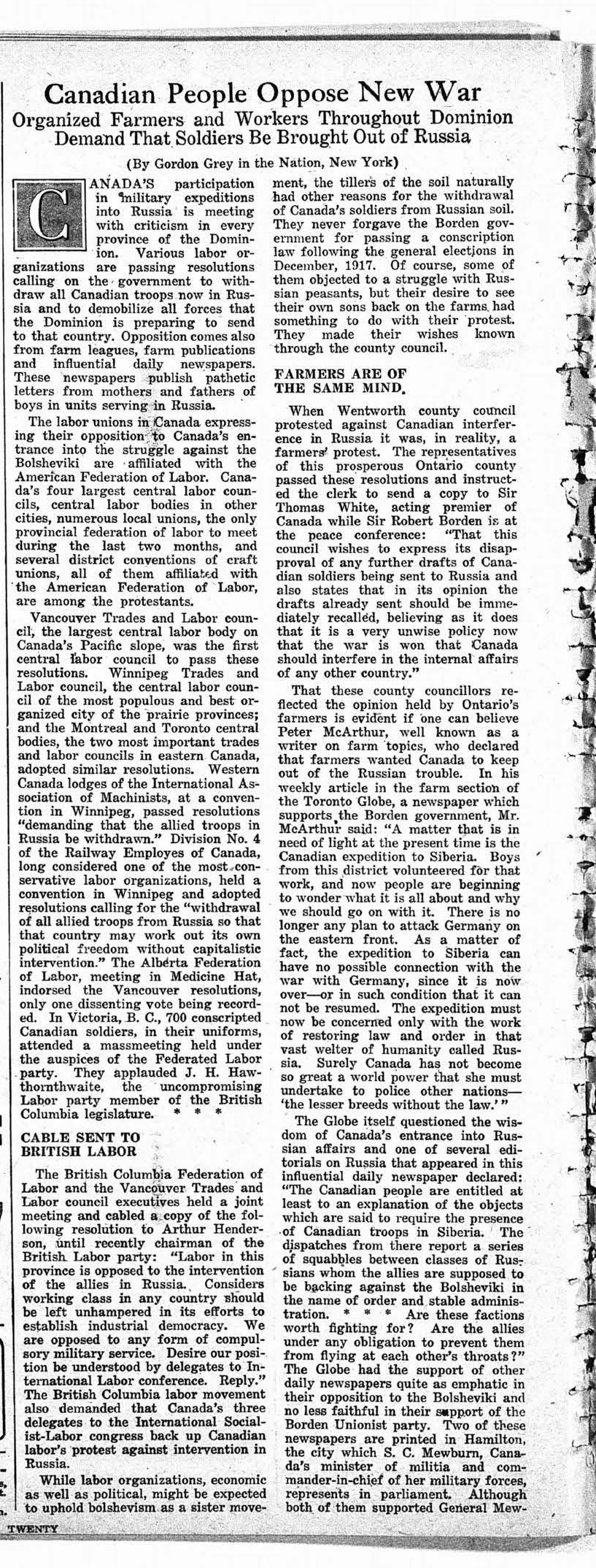
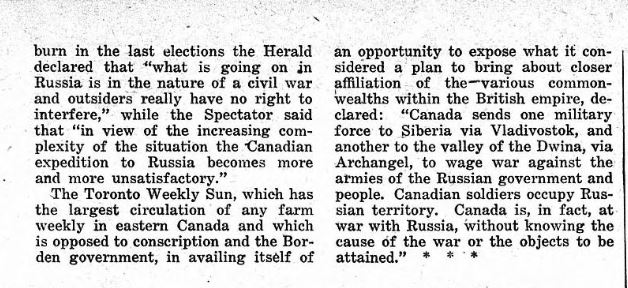
From: The Nonpartisan leader., February 24, 1919

June 13, 2014 http://rankandfile.ca

ByDavid Bush
For the first time in Canadian Labour Congress (CLC) history an incumbent presidential candidate was defeated. The house of labour has its first new president in 15 years, but what does that really mean for the labour movement?
Newly elected Hassan Yussuff used increasingly militant rhetoric throughout his campaign and began to speak about the need for more grassroots organizing, a change from former CLC president Ken Georgetti’s conservative approach to membership mobilization. Yussuff’s campaign was, no doubt, influenced by the rhetoric coming from Hassan Husseini’s presidential campaign, which was focused on restoring workers’ power at the CLC. For those who are concerned about rebuilding the trade union movement and empowering workers to engage in collective struggle, this change can be nothing but positive.
However, the change possible as a result of new leadership is limited. Many on the left, from social democrats to the far left, cling to a narrative that says those at the top dictate the direction of the labour movement. This can lead to problematic conclusions such as believing a new leader will bring about a new day for labour, or that weak leaders are holding the workers’ movement back.
Yes, we need better leaders; leaders who are willing to use their bully pulpit and open up the space for action. And yes, we need to organize to win local and national leadership contests on progressive terms. But in the absence of an organized rank and file willing to seize these opportunities, even the most radical labour leadership can do little.
Perhaps the most compelling story of the importance of grassroots organizing comes from the Chicago Teachers Union; its inspiring defense of public education was made possible by grassroots activists. Facing a conservative union leadership, teachers organized through the Caucus of Rank and File Educators began to organize a network of progressive teachers that eventually won leadership. CORE remained active and helped push their union towards a very strong strike mandate: of the 90 per cent of CTU members who voted, 98 per cent were in favour of striking. The successful strike reinvigorated activists in Chicago to fight against neoliberal policies that affect both schools and communities.
In Canada, despite union density remaining somewhat stable, the Canadian labour movement faces a challenging situation. The employer offensive has put unions on their back foot. We have seen an increasing number of lockouts, a higher frequency of legislative attacks, a pattern of concessionary bargaining at the table and a decline in days lost to strikes.
Objective economic and political factors explain the weak position that unions find themselves in: the decline of manufacturing, the restructuring away from larger workplaces (which are and have been bastions of high unionization), the growth of the service sector, the decline of the American labour movement, the ideological shift towards neoliberalism and so forth. But there are also subjective factors such as a move away from devoting resources to organizing, the entrenchment of a servicing culture within unions and the inability of unions to mobilize their membership around political goals beyond their own workplaces.
Union administration is often seen as a layer of individuals whose social position within the union structure leads them to be more conservative, no matter how great or progressive they are on an individual level. Analyses can collapse into simply blaming the bureaucracy: elected officials and staff are motivated to rein in the class struggle in order to preserve the material benefits and political voice their position affords them. The nature of their position also separates them from the day-to-day concerns on the shop floor.
This analysis doesn’t acknowledge deeper structural realities of trade unions in our society.
The trade union movement is the product of a deeply unjust and unequal economic system called capitalism that aims to squeeze as much profit from workers as possible. Unions were formed to defend and increase what little power workers had through collective action. Through many hard fought battles, labour activists won collective legal rights. This allowed unions to entrench more gains at the bargaining tables but it also created the conditions for the growth of bureaucratic structures to regulate and manage labour relations under the new and increasingly specialized legal framework.
To understand the trade union bureaucracy as only a layer of individuals whose social position is divorced from the rank and file rather than a structural product of the class struggle opens the door for a less than helpful understanding of the problems facing unions. It is not a matter of union leaders and bureaucrats simply holding back the union movement. In this regard, a certain leftist criticism of the union bureaucracy begins to dovetail with a very conservative reading of how change is enacted: everything focused on the top.
We must start to think about how change happens in the union movement.
Last February, when a UPS worker in Queens, New York, was unfairly fired, a union briefing turned into a wildcat strike of 90 minutes. After the wildcat, UPS made their intentions clear to fire all 250 workers involved, and started firing workers at random. Thanks to intense organizing, enough pressure was placed on UPS by their clients and other unions that they were forced to re-hire all threatened workers.
As Sarah Jaffe notes, “the wildcat action had to be backed up with organizing both inside the union and within the community.” Indeed, the militancy of the membership, and their willingness to place their jobs on the line to save a colleague’s won the day.
As a good friend of mine once told me, those who want the labour leadership to simply call for the most militant of tactics without actually doing the work of creating the conditions for this happen ourselves, want to substitute the power of workers for the pronouncements of leaders. You want to wildcat, go on general strike or occupy your workplace? Great, but if we can’t win that argument in our own workplace then why should we expect leadership to do the heavy lifting for us?
To make the union movement a stronger force for the whole working class, we must move beyond expecting leaders and bureaucrats to lead the charge, or blame them when militancy fails to materialize. The left must organize to empower the widest layer of workers to take action to better their lives. This means actively engaging with all unions, regardless of if they are deeply conservative.
Scapegoating the labour leadership for a variety of collective failures won’t turn the tide of the attacks. The only way we can begin to challenge the forces lined up against it is to reach out to and empower the broader working class to fight back.
This can only truly happen if rank and file activists organize from the bottom up.
This piece was first published on Rabble.ca
By Trinh Theresa Do, CBC News Posted: Nov 21, 2013 5:00 AM ET

Tony Clement says the labour reforms will “bring savings, streamline practices and bring them in line with other jurisdictions”

Tony Clement on public service right to strike 9:51
In a sign they have all but given up on talks with the Treasury Board over labour reforms proposed in the federal government’s budget bill, union leaders say they are taking matters into their own hands.
The Canadian Labour Congress quietly met with more than 100 representatives from unions across the country this week to plot a long-term strategy to engage both the public and union members in pressuring the government to reverse its proposed labour law changes. The CLC represents more than 3 million workers across the country.
The CLC has already wrapped up a series of television ads that ran over the past six weeks. Its next step is to reach out to each of its own members in a campaign that will detail how reforms in the budget bill will affect their bargaining rights.
And then, according to CLC secretary-treasurer Hassan Yussuff, union members must appeal directly to their MPs.
“They need to, of course, take direct responsibility to how they’re going to start speaking out on behalf of their union, on behalf of themselves,” said Yussuff. “And more importantly, in terms of the gains they have made to ensure this government doesn’t take that away.”
Yussuff said this offensive strategy will become the “new normal” unless policy changes are reversed.
“I think the government had declared war on us,” he said. “We didn’t start any of these measures — the government itself has done so. I think it’s fair for us to respond to their actions.”
If passed, Bill C-4 would make sweeping changes to a number of labour laws, including the Canada Labour Code and Public Service Labour Relations Act.
Among other things, it would streamline collective bargaining by allowing the government to determine which services are essential and make it illegal for those workers to strike. In situations where 80 per cent or more of workers in a bargaining unit are designated essential, the only dispute resolution method is arbitration.
In a statement sent to CBC News, Treasury Board president Tony Clement said the Public Service Labour Relations Act is being amended to ensure that the public service is modern and affordable.
“The proposed amendments will bring savings, streamline practices and bring them in line with other jurisdictions. Our government will sit at a bargaining table on behalf of the taxpayer where the rules are fair and balanced.”
Unions were not consulted in the drafting of the reforms. Labour leaders have since tried to meet with Clement to present counter-proposals, with little success.
Robyn Benson of the Public Service Alliance of Canada recently had a meeting with Clement during which she proposed he withdraw changes from the budget bill to allow for more consultation.
She wrote on her blog afterwards, “He stated bluntly that he had no intention of consulting with us, and that he wanted all his changes in place for the next round of collective bargaining — in fact, by Christmas.”
In response, Clement tweeted, “That’s also the meeting where you claimed co-governance with Parliament. Takes ‘union boss’ to a whole new level.”
By Trinh Theresa Do, CBC News Posted: Nov 21, 2013 5:00 AM ET
Tony Clement says the labour reforms will “bring savings, streamline practices and bring them in line with other jurisdictions”
Tony Clement on public service right to strike 9:51
In a sign they have all but given up on talks with the Treasury Board over labour reforms proposed in the federal government’s budget bill, union leaders say they are taking matters into their own hands.
The Canadian Labour Congress quietly met with more than 100 representatives from unions across the country this week to plot a long-term strategy to engage both the public and union members in pressuring the government to reverse its proposed labour law changes. The CLC represents more than 3 million workers across the country.
The CLC has already wrapped up a series of television ads that ran over the past six weeks. Its next step is to reach out to each of its own members in a campaign that will detail how reforms in the budget bill will affect their bargaining rights.
And then, according to CLC secretary-treasurer Hassan Yussuff, union members must appeal directly to their MPs.
“They need to, of course, take direct responsibility to how they’re going to start speaking out on behalf of their union, on behalf of themselves,” said Yussuff. “And more importantly, in terms of the gains they have made to ensure this government doesn’t take that away.”
Yussuff said this offensive strategy will become the “new normal” unless policy changes are reversed.
“I think the government had declared war on us,” he said. “We didn’t start any of these measures — the government itself has done so. I think it’s fair for us to respond to their actions.”
If passed, Bill C-4 would make sweeping changes to a number of labour laws, including the Canada Labour Code and Public Service Labour Relations Act.
Among other things, it would streamline collective bargaining by allowing the government to determine which services are essential and make it illegal for those workers to strike. In situations where 80 per cent or more of workers in a bargaining unit are designated essential, the only dispute resolution method is arbitration.
In a statement sent to CBC News, Treasury Board president Tony Clement said the Public Service Labour Relations Act is being amended to ensure that the public service is modern and affordable.
“The proposed amendments will bring savings, streamline practices and bring them in line with other jurisdictions. Our government will sit at a bargaining table on behalf of the taxpayer where the rules are fair and balanced.”
Unions were not consulted in the drafting of the reforms. Labour leaders have since tried to meet with Clement to present counter-proposals, with little success.
Robyn Benson of the Public Service Alliance of Canada recently had a meeting with Clement during which she proposed he withdraw changes from the budget bill to allow for more consultation.
She wrote on her blog afterwards, “He stated bluntly that he had no intention of consulting with us, and that he wanted all his changes in place for the next round of collective bargaining — in fact, by Christmas.”
In response, Clement tweeted, “That’s also the meeting where you claimed co-governance with Parliament. Takes ‘union boss’ to a whole new level.”
 Andrew Phillip Chernoff