Canadian Government Expenditure Monitor 2015-2016 Q3

Get the report
Expenditure Monitor 2015-2016 Q3.pdf

Get the data

Expenditure Monitor 2015-2016 Q3 – Figures_Data.xlsx

Summary
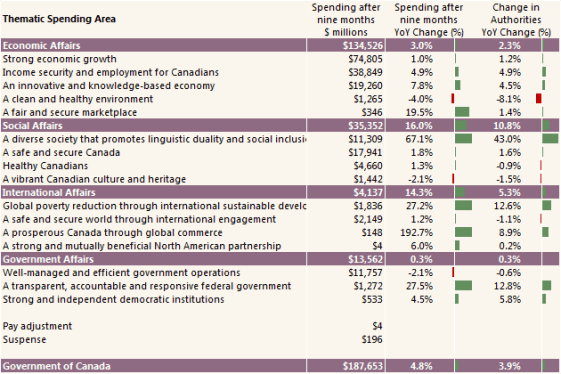
Government expenditures for the first nine months of 2015-16 were $187.7 billion, an increase of 4.8 per cent over the same period last year ($179.1 billion). This increase results from increased transfer payments for the unemployed and higher capital spending.

Employment Insurance (EI) benefits increased almost $1 billion (7.4 per cent) over the same period in 2014-15. According to Statistics Canada, the number of EI beneficiaries increased by 35,900 (7.1 per cent) between January 2015 and January 2016, largely attributable to increases in Alberta, and other energy dependent regions.  Concomitant with this, the national unemployment rate has risen to a three year high of 7.3 per cent in February.

Growth in capital spending is consistent with the $393 million in federal infrastructure investment promised in Budget 2015 for 2015-16. Budget 2016 also committed to spending a further $3.4 billion on federal assets over the next five years.

Overall, the spending pattern in this fiscal year is similar to the previous two fiscal years. PBO estimates that the Government will lapse $8.8 billion, including frozen allotments. This is higher than the most recent Department of Finance projection of $6.5 billion.

Source: Expenditure Monitor 2015-2016 Q3

The Canadian Government’s Expenditure Plan for 2016-17

Get the report
The Government’s Expenditure Plan for 2016-17

Get the data

Main Estimates Figures. xlsx

Summary
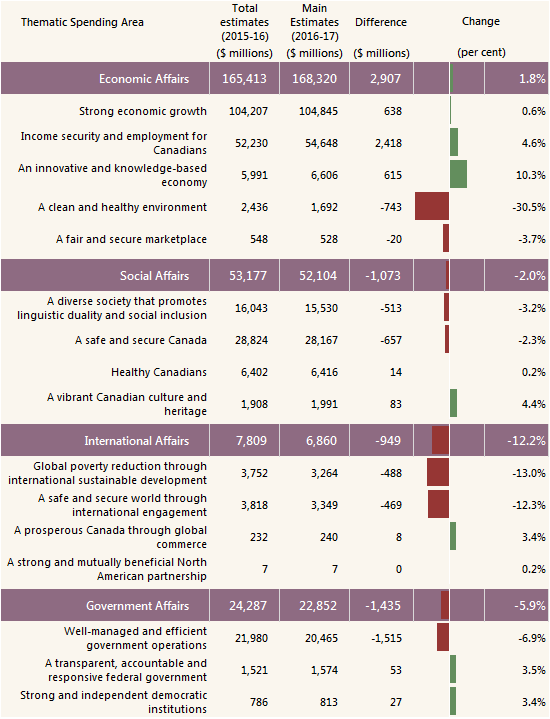
The Government’s Expenditure Plan and Main Estimates for 2016-17 outline $250.1 billion in budgetary spending authorities. This represents a decrease of approximately $550 million compared to total budgetary authorities outlined in 2015-16, mostly driven by decreases in direct program spending (DPS), partially offset by increases in major transfers to persons, and other levels of government.

The decline, in general, stems from the sun-setting of various initiatives, for example the remediation of contaminated sites. Some of these measures are likely to be re-announced sometime in the future. Associated with this are expectations of future requests for funds through the Supplementary Estimates process, later in the year.

The Government has also initiated a pilot project, providing parliamentarians the ability to approve Transport Canada’s grants and contributions at the program level. This move allows Parliament to provide greater scrutiny on the spending of funds, and builds on recent transparency initiatives, notably the TBS InfoBase and the publication of frozen allotments in Supplementary Estimates (C) 2015-16.

Spending by policy area

Source: The Government’s Expenditure Plan for 2016-17

Canadian Government Expenditures For The First Half of 2015-16

logo1

Get the report
Expenditure Monitor 2015-2016 Q2

Get the data
Expenditure Monitor 2015-16 Q2.xlsx

Summary
Total government expenditures for the first half of 2015-16 were $124.7 billion, an increase of 5.5 per cent over the same period last year ($118.2 billion). This is slightly higher than the 3.4 per cent increase in total program expenses outlined in Budget 2015. Most of this increase draws from the Government’s new enhanced Universal Child Care Benefit (UCCB). The first cheques for this enhanced benefit were delivered in July, adding $3.2 billion to the previous year’s UCCB payments.

Infrastructure spending is responsible for most of the remaining increase. Supplementary Estimates (A) 2015-16 requested over $1.1 billion for infrastructure renewal. The programs that were major recipients of these infrastructure funds have increased spending by $284 million compared to the previous year, an overall increase of 5.6 per cent. When combined with $151 million in increased spending by the Office of Infrastructure Canada’s Large Scale Infrastructure Investments program, this brings the investment in infrastructure renewal to $435 million by the end of the summer of 2015.

These spending increases are offset by lower interest rate costs on public debt. With the decline in the long-term bond yields, the Government’s average interest rate on public debt has fallen from 2.83 per cent in 2011 to 2.23 per cent in 2014. Further decreases have provided $327 million in savings from public debt interest in the first six months of 2015-16. These savings look set to continue until interest rates begin to rise.

Related reports

Supplementary Estimates (A) 2015-16

The Government Expenditure Plan and Main Estimates for 2015-16

Foreign workers doubled as joblessness peaked: report

Conference Board asks why Canada is still bringing in temporary foreign workers


Jul 23, 2013     http://www.cbc.ca

Despite an unemployment rate that spiked in 2009 and remains high, the number of temporary foreign workers in Canada has more than doubled over the last six years, according to the Conference Board of Canada.

In 2006, there were 150,000 temporary foreign workers employed in Canada. By December 2012, that number had more than doubled to 340,000.

The growth in the number of foreign workers continued throughout the 2009 recession, when the unemployment rate peaked at 8.6 per cent. In June of this year, unemployment stood at 7.1 per cent, though joblessness among young workers was stuck around 14.1 per cent.

The temporary foreign worker program has come under scrutiny in the last four months, since CBC reported that professional IT workers were being fired from their jobs at RBC so the employer could bring in temporary foreign workers.

The federal government amended the rules in late April, making it more difficult and more expensive for companies to turn to foreign workers to fill job vacancies in Canada. But the impact of those rule changes has yet to be seen, the Conference Board says.

Its report released Tuesday says that while Canadian youth were struggling to secure employment, especially that important first job after college or university, companies continued to bring in foreign workers in record numbers.

“This, justifiably, raises the question: if the unemployment rate remains relatively high and so many young and able Canadians are unable to find work, why are we still bringing in so many people under the TFW program?” the Conference Board asks.

There is no clear answer to that question, it concludes, pointing out that Alberta faced looming labour shortages in 2006. Employers in some parts of Alberta and Saskatchewan continue to have difficulty finding workers, despite the number of jobless in Canada.

A CBC report last month found the number of foreign workers in Canada had nearly tripled over the past 10 years.

The Conference Board blames a skills mismatch and the reluctance of Canadians to move long distances to find work for the inability of employers to attract Canadian workers to jobs. There also may be perception that foreign workers can be hired for less than their Canadian counterparts, the report said.

One of the key changes that Ottawa announced in April is a new fee that will be imposed on employers when they apply to the government for a labour market opinion (LMO). A positive labour market opinion must be obtained in order for employers to bring foreign workers to Canada. It takes a number of factors into consideration including what potential benefits hiring the foreign workers would have on the labour market and what efforts were made to hire Canadian workers for the positions.

The government also got rid of a rule that allowed employers to pay foreign workers up to 15 per cent less than the prevailing wage for a classification of job.

The Conference Board said it expects these changes to put “downward pressure” on the number of foreign workers in Canada — and lead to more employers seeking out domestic workers for jobs. However, it is too soon to tell if the measures will be effective in lowering the number of temporary workers in Canada while unemployment is high, the report said.