Federal Spending on Postsecondary Education

5 May 2016

Get the report
Federal Spending on Postsecondary Education.pdf

Get the data
Postsecondary Education –  Data.xls
Interactive Chart

Summary

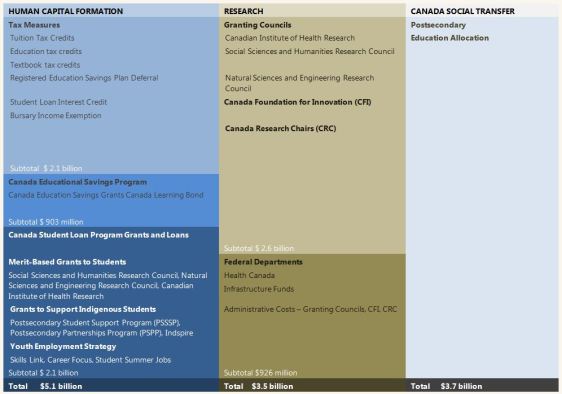
Table 1:  Federal Postsecondary Education Expenditure by Major Stream, 2013-14

This report analyzes federal spending on postsecondary education in Canada over the past 10 years; and, where possible, analyzes the distributional impacts of federal programs.  It also provides forward projections to 2020-21 taking into account recent Budget 2016 announcements.

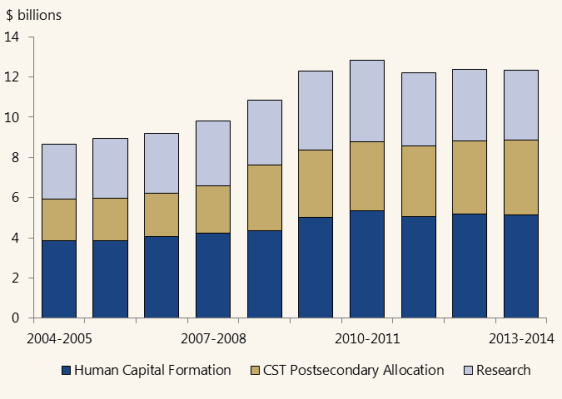
In 2013-14, total federal spending on postsecondary education reached an estimated $12.3 billion. This represents a decline from its peak of $12.8 billion in 2010-11. Over the past ten years, the greatest growth occurred in spending that supports human capital formation and the Canada Social Transfer (CST).

PBO estimates that roughly 60 per cent of postsecondary students belonged to higher-income families (that is, the two highest after-tax or disposable income quintiles).

Increases in federal funding targeted towards human capital formation have primarily benefited these families. This was due to a growing share of federal support provided through the tax system and the Canada Education Savings Program, Registered Educational Savings Plans.

Figure 1: Federal Expenditures on Postsecondary Education, by Area of Focus

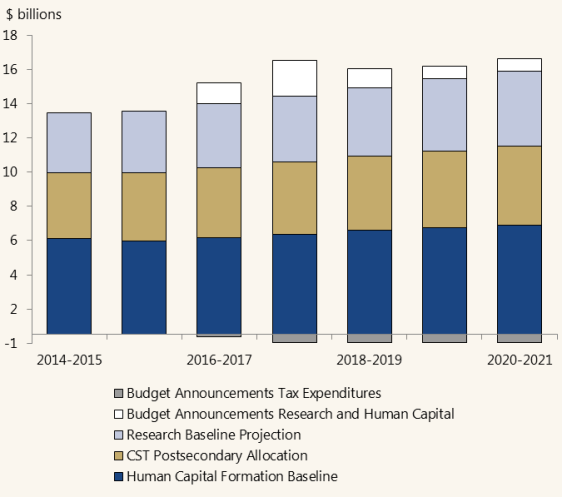
Taking into account recent Budget 2016 announcements, PBO estimates total federal spending on postsecondary education will exceed $15.7 billion by 2020-21. The re-allocation of education and textbook tax expenditure savings towards increases in student grants, loan repayment and student employment assistance (announced in Budget 2016) will likely make postsecondary education more affordable for some Canadians. These measures will not, however, significantly change the distribution of total federal spending on postsecondary education.

Figure 2: Expenditure Projections – Total Federal Expenditures on Postsecondary Education

Source: Federal Spending on Postsecondary Education

Minister Morneau’s First Budget Restores Hope for the Middle Class – Budget 2016

Main_eng

March 22, 2016 – Ottawa, Ontario – Department of Finance

The Minister of Finance, Bill Morneau, today tabled the new Government of Canada’s first federal budget, Growing the Middle Class, a plan that takes important steps to revitalize the Canadian economy, and delivers real change for the middle class and those working hard to join it.

A strong economy starts with a strong middle class. That is why building an economy that works for Canadians and their families is the top priority of this government.

Budget 2016 offers immediate help to those who need it most, and lays the groundwork for long-term economic growth. Most importantly, it focuses squarely on people and the things that matter most to them—things like strengthening the middle class, creating jobs, and growing the economy.

As of January 1st, the government’s Middle Class Tax Cut ensures roughly 9 million Canadians receive a bigger paycheque every payday.

Today, Minister Morneau builds on this progress with the introduction of the new Canada Child Benefit—a simpler, tax-free, more generous, targeted benefit that helps those who need it most: the middle class. Starting in July of 2016, nine out of ten families will receive more money than they did under the previous government.

Budget 2016 signals a new approach that will create jobs and improve the quality of life for Canadians, today and in the future. This includes historic new investments in infrastructure that total more than $120 billion over the next decade.

As an immediate first step, the government will invest $11.9 billion in modern and reliable public transit, water and wastewater systems, affordable housing, and in retrofits and repairs to protect existing projects from the effects of climate change.

Additional longer-term investments will help Canada become a low carbon economy, and create more vibrant cities, digitally connected rural areas, and safe, healthy, thriving communities.

Budget 2016 also provides significant new investments to support both students and post-secondary institutions, so that the next generation of Canadians is well-equipped to tackle the challenges of the future. In addition, the government will promote research, accelerate business growth, and support clean technology to better position Canada in the rapidly shifting global economy.

Recognizing that protecting the environment and growing the economy go hand in hand, the government will invest in clean technologies that address climate change, air quality, clean water, and clean soil. Budget 2016 also reiterates the government’s intention to establish a $2 billion Low Carbon Economy Fund.

To ensure that this growth is shared by all Canadians, Budget 2016 takes renewed steps to give all Canadians the same opportunities to succeed, no matter who they are, or where they come from. This includes unprecedented investments in First Nations, Inuit Peoples, and the Métis Nation—totalling $8.4 billion over five years—in areas that include education, infrastructure, and skills training. The government will ensure access to clean drinking water for every child, including those who live on reserves.

Investments in a more inclusive and fair Canada include efforts to: provide federal leadership in health care; help seniors realize the promise of a dignified and secure retirement; renew a commitment to enhance the Canada Pension Plan; and fulfill our sacred obligation to Canada’s veterans.

Budget 2016 also takes action to renew Canada’s place on the world stage. The government will provide international assistance for the most vulnerable, and welcome as many as 300,000 permanent residents in 2016 to foster sustainable growth and grow the middle class.

Growing the Middle Class comes at a time when the Government of Canada has both the capacity and the willingness to act. Budget 2016 takes action to revitalize the economy and create opportunity for all Canadians, by focusing on the middle class and those working hard to join it.

Quote

“Our plan will recapture the hope and optimism for the future that existed in previous generations, and put it to work for the next. Real change is not just about today or tomorrow. It is about revitalizing the economy in the years and decades to come, so that it works for the middle class and helps those working hard to join it.”

Bill Morneau, Minister of Finance

Related

Source: Budget 2016

2015-16 Supplementary Estimates (C)

Get the report

2015-16 Supplementary Estimates (C).pdf

Get the data

2015-16 Supplementary Estimate (C) Data.xls

Summary

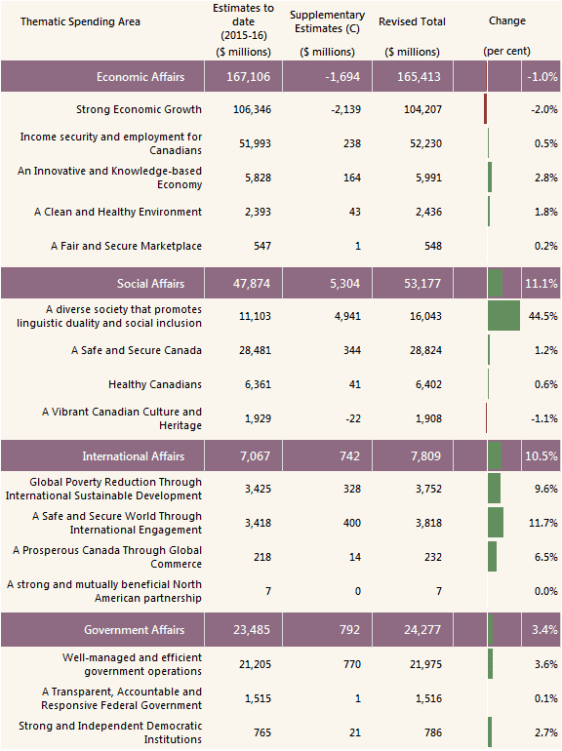
The third Supplementary Estimates for the 2015-16 fiscal year outline $5.1 billion of additional budgetary spending. This brings total planned budgetary spending for the year to $251 billion, 3.7 per cent higher than the previous year.

The request consists of an additional $2.8 billion of voted appropriations from Parliament and outlines an additional $2.3 billion in statutory spending.

Voted appropriations include a $435 million top up of the long-term disability insurance for members of the Canadian Armed Forces. The Government also wrote off $176 million in defaulted student loans and provided a $168 million grant to the Green Climate Fund.

Statutory spending increases stem from a $4.8 billion increase in Universal Child Care Benefit payments, which are partially offset by $2.6 billion of savings from lower interest payments on public debt.

Lastly, for the first time, these Supplementary Estimates (C) publish details regarding $5.1 billion of unspent funds, of which $1.8 billion are Treasury Board Central Votes, and $3.3 billion are frozen allotments. Frozen allotments are moneys approved by Parliament but held in escrow by the Treasury Board. Since 2004-05, frozen allotments have, on average, represented roughly two-fifths of annual “lapsed” funding. If the pattern from previous years holds, this would imply a total lapse higher than the Government projected in Budget 2015.  This would potentially result in lower than anticipated Direct Program Expenses.

Source: 2015-16 Supplementary Estimates (C)

BoC considers changing ‘core inflation’ tracking | The Chronicle Herald

HALIFAX — The Bank of Canada is examining alternatives to its “core inflation” method of tracking prices as it prepares to review its inflation-control agreement with the federal government next year.

Source: BoC considers changing ‘core inflation’ tracking | The Chronicle Herald

Step Change: Federal Policy Ideas Toward A Low-Carbon Canada: Broadbent Institute & Mowat Centre

header The Mowat Centre

With the United Nations Climate Conference in Paris next month, the Broadbent Institute has published, in partnership with the Mowat Centre, Step Change: Federal Policy Ideas Toward a Low-Carbon Canada, which comes at a crucial time with a new federal government leading Canada’s delegation.

The report’s message is clear: The federal government has a critical role to play in driving down greenhouse gas emissions beyond carbon pricing alone. Getting behind the package of seven policy measures outlined in the report will signal to the international community the seriousness of Canada’s commitment to taking action to tackle the climate crisis and transition toward a low-carbon economy.

It starts with you. You can read the report here and share it with your networks.

Executive Summary

Over the last few years, Canadian governments of different levels have taken first steps in the fight against climate change. With a new federal government in power and COP21 in Paris now on the horizon, Canada must calibrate its climate policies with a view to the long term. In addition to carbon pricing — a core policy idea that is gaining ground at the provincial and, increasingly, federal level — seven preliminary policy ideas can also help the federal government steer Canada toward a low-carbon economy:

Laying the Economic Foundation

1. Green Bank of Canada

A state-sponsored financial entity that promotes greater private-sector investment in the low-carbon economy through a variety of mechanisms, such as credit enhancements, guarantees, project aggregation and securitization.

2. Tax Code Retrofit

A suite of changes to the tax code in favour of energy efficiency, renewable energy, and other sustainable technologies, supported by a phase-out of remaining fossil fuel subsidies.

Promoting Low-Carbon Solutions

3. Accelerated Coal Phase-Out

Amendment to the Reduction of Carbon Dioxide Emissions from Coal-Fired Generation of Electricity Regulations, to accelerate the phase-out of remaining coal-fired power plants.

4. Green Building Compact

A packaged suite of federal energy efficiency and renewables policies, including a revamp of codes and standards, a National Deep Retrofit Program, and a renewable heating program.

5. ‘Lead by Example’ Mandate

A suite of ambitious initiatives for federal facilities and institutions, including on heat and power, transportation, and institutional investing.

6. Clean Transportation Strategy

A packaged suite of policies pertaining to transportation, including a progressive Vehicle Emissions Tax, a Zero Emission Vehicle mandate, and a revamp of infrastructure spending and transfer criteria to include GHG goals.

7. Bio Strategy

A suite of policies promoting best practices in the agricultural and forestry sectors, from cross-compliance with existing funding programs to voluntary initiatives in farming practices.

Considerable work is still required to refine these ideas and bring them to fruition, from costing to consultation. At this stage, this document offers a blueprint for policymakers in their search for the next step changes in federal climate action.