Nanos Nightly Ballot Tracking: Liberals win popular support – Canadians to decide how many seats they get (October 18th only)

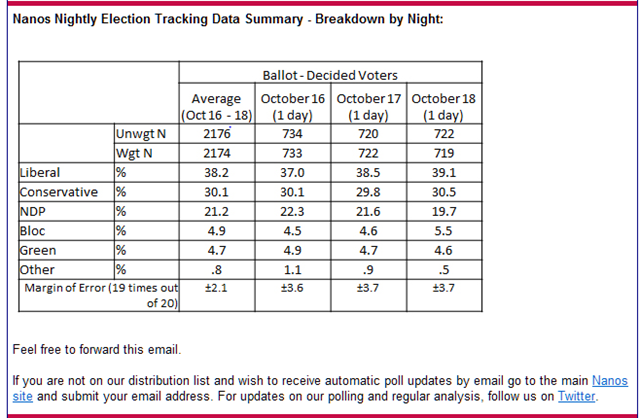
Sunday Only Numbers: Liberals 39.1%, Conservatives 30.5%, NDP 19.7%, Green Party 4.6%, Bloc 5.5%, Other 0.5%

Hope all is well.  To follow are the results of the last round of tracking that we have conducted on behalf of CTV News and The Globe and Mail.  Some key observations from a research standpoint on this election.

This was an election about change – The level of totally undecided opinion in the Nanos tracking was lower than usual throughout the campaign, but the proportion of Liberal-NDP switchers was exceptionally high.  This suggests that many Canadians had decided they were not voting for the Conservatives but were open to voting for either the Liberals or the NDP.

  • Who is the agent of change – The first 66 days of the campaign, much of which was characterized by a tight three-way race, was about Canadians contemplating who would be the agent of change. Once the numbers started breaking in favour of the Liberals, NDP change-driven support shifted to the Liberals and a two-horse race emerged.
  • Holiday weekend shift – Holidays in elections are often key junctures of opinion formation and this election was one of them.  Entering the Thanksgiving long weekend, it was a two-way race between the Liberals and Conservatives.  After it, the Liberals had the advantage which they maintained throughout the close of the campaign.
  • Impact of a long campaign – This longer-than-usual campaign benefitted the Trudeau Liberals. At the 37-day point, there was a three-way race without the change sentiment coalescing around  any one opposition party, resulting in a vote split between the Liberals and NDP.  The longer campaign allowed Trudeau to incrementally demonstrate he was not as risky as the Conservatives suggested.
  • Conservative ad campaign a bust – The longer campaign allowed Trudeau’s daily performance to invalidate the Conservative attack ads.  Also of note, the research suggested that the Conservatives were strong on fiscal issues, such as controlling government spending but not on their plan for the economy.  The Liberals significantly improved on this measure throughout the campaign.  One Conservative ad campaign pillar (“He’s just not ready”) was invalidated, while the other pillar (economic security) did not resonate.
  • Tom Mulcair and the New Democrats – Beneath the numbers for top ballot and preferred Prime Minister, the research suggests that Tom Mulcair’s personal brand remains strong (qualities of a good political leader question) and the proportion of Canadians that would consider voting NDP is still significant.  The NDP in this election was squeezed in a change movement manifested through the Liberals and Justin Trudeau.
  • Minority or majority – Nanos does not do seat projections.  Our focus is to estimate the popular support and to understand the dynamic of the campaign.  The research points to a Liberal victory. The magnitude of that victory — whether it be a minority, a strong minority or a majority government — will be decided by Canadians.
  • Nanos popular support projection – During the election, we ran a three-day rolling average of political sentiment of 1,200 Canadians (400 a night).  For the last three nights we doubled our sample to 800 Canadians a night.  In the table below we present the individual results for Friday, Saturday and Sunday as well as the three day average. In past elections we have found the Sunday numbers have best captured the political mood on election day.
  • Range of Support – Please note that estimates of popular support involve an upper and lower statistical range of outcomes (plus or minus, 19 times out of 20) which are detailed in the table below.

The team at Nanos in conjunction with Klipfolio have launched our new live political data portal where you run the numbers you want and can explore the trends and data you need.  This is part of our campaign, not only to provide the most reliable data to Canadians but to let them use it as they wish. We were the first to do nightly tracking and now we are the first research organization to post live public opinion data for Canadians.

We were the first to do nightly tracking and now we are the first research organization to post live public opinion data for Canadians. Here’s the link to check it out 

To view the detailed tracking stats please visit our website.

Methodology

A national random telephone (land + cell) survey using live agents of 1,200 Canadians is conducted by Nanos Research throughout the campaign over a three day period.  Each evening a new group of 400 eligible voters are interviewed. To update the tracking a new day of interviewing is added and the oldest day dropped. A double sample of 800 interviews, per night, were conducted on Friday, Saturday and Sunday.

The last day is based on a one day sample of 800 interviews. The margin of error for a survey of 800 respondents is ±3.5%, 19 times out of 20.

The respondent sample is stratified geographically and by gender.  The data may be weighted by age according to data from the 2011 Canadian Census administered by Statistics Canada.  Percentages reported may not add up to 100 due to rounding.  The research has been registered with the Marketing Research and Intelligence Association of which Nanos is a member.
image

Nanos Nightly Leadership Tracking – Preferred PM: Trudeau (35.5%), Harper (29.1%), Mulcair (18.9%), May (5.2%) – Three-day Tracking Ending October 18th

Nanos Nightly Election Tracking Highlights (3-day tracking ending October 18th)

Trudeau closes campaign ahead of Harper as preferred Prime Minister

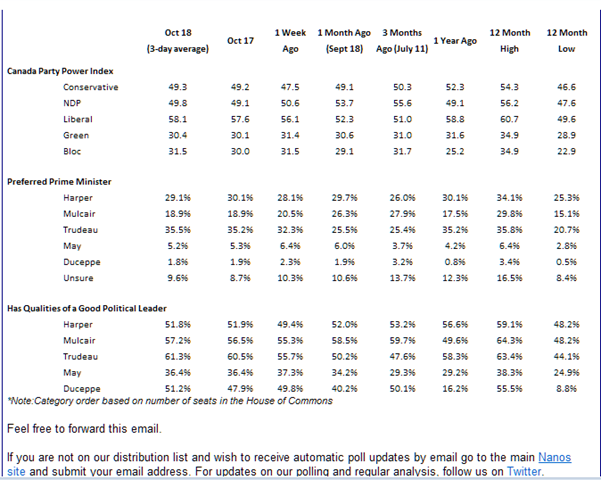
  • Leadership – Asked who they preferred as Prime Minister 35.5% said Trudeau, 29.1% said Harper, 18.9% said Mulcair, 5.2% said May, 1.8% said Duceppe and 9.6% of Canadians were unsure.
  • Nanos Party Power Index – The Index which is a composite of a series of questions including ballot preferences and impressions of the leaders had the Liberals at 58.1 out of a possible 100 points, the NDP with 49.8 points, the Conservatives with 49.3 points, the Greens with 30.4 points, and the BQ with 31.5 points in Quebec.

The team at Nanos in conjunction with Klipfolio have launched our new live political data portal where you run the numbers you want and can explore the trends and data you need.  This is part of our campaign, not only to provide the most reliable data to Canadians but to let them use it as they wish. We were the first to do nightly tracking and now we are the first research organization to post live public opinion data for Canadians.

We were the first to do nightly tracking and now we are the first research organization to post live public opinion data for Canadians. Here’s the link to check it out 

To view the detailed tracking visit our website.

Methodology

A national random telephone (land + cell) survey using live agents of 1,200 Canadians is conducted by Nanos Research throughout the campaign over a three day period.  Each evening a new group of 400 eligible voters are interviewed. A double sample of 800 interviews, per night, were conducted on Friday, Saturday and Sunday. Today’s daily tracking figures are based on a three-day rolling sample comprised of 2,400 interviews.  To update the tracking a new day of interviewing is added and the oldest day dropped. The margin of error for a survey of 2,400 respondents is ±2.0%, 19 times out of 20. 

The respondent sample is stratified geographically and by gender.  The data may be weighted by age according to data from the 2011 Canadian Census administered by Statistics Canada.  Percentages reported may not add up to 100 due to rounding.  The research has been registered with the Marketing Research and Intelligence Association of which Nanos is a member.
Results are based on the three day calling window October 16 to 18, 2015. The research was commissioned by CTV News and The Globe and Mail.

Nanos Nightly Election Tracking Data Summary for period ending October 18th, 2015:

image

Federal Election 2015: Voting Records Are Made To Be Broken: LET’S DO IT!!!—Just Saying….

October 19, 2015          Andrew Phillip Chernoff                Just Saying….

Image result for federal election 2015 voteJust-saying

“Paradigm Shift” Needed In Ottawa

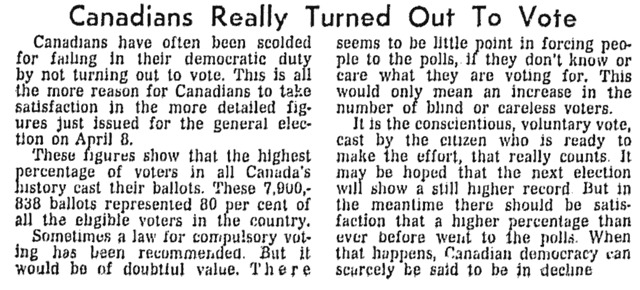
 On April 8, 1963, Canadians set a record unequaled or bettered since, with the highest percentage of voters in history when 80 per cent of all eligible voters in 1963 cast their ballots.

From: The Montreal Gazette – May 13, 1963:

canadalargestvote

Elections Canada reported on Oct. 14th, 2015:
According to the preliminary figures, some 3.6 million electors voted at the advance polls in this general election. This is a 71% increase from the 2,100,855 electors who voted in advance in the 2011 general election.

So far, Canadians from coast-to coast-to coast are going to the polls in record numbers.

Indeed, Canadian democracy can scarcely be said to be in decline it seems, as has been reported recently.

Let’s make this “paradigm shift” happen in Ottawa, David Herle, principal partner at The Gandalf Group, a Toronto-based research and consulting company, urges because Canadians need to feel connected to Parliament and Parliament needs to be seen as relevant to their lives, he outlined in the article, Democracy and the decline of Parliament,  published May 2, 2013.

“Only then can we begin to close the gap between voters and our political institutions with the goal of ultimately strengthening our democracy.”  Herle continued.

Star columnist Bob Hepburn who interviewed Herle for the article, started out by introducing his readers to Herle this way:

Since his days as Paul Martin’s campaign chairman ended, David Herle has given a lot of thought to the state of our democracy and the increasing disconnect between Parliament and Canadians.

And the more Herle studies the issue, the more the former prime minister’s strategist worries.

“There’s a growing gap that could have serious long-term implications for the health of our democracy” from voter turnout to policy formation, Herle says over coffee one recent afternoon in downtown Toronto.

“Voters look at Ottawa these days and feel the issues being debated up there have no impact on their daily lives,” he says.

“There’s also a serious decline in what people expect from government. As well, they’ve stopped looking to government for help and for the most part they don’t think it matters who is in power.”


Hepburn stated in the article that a poll in Fall 2012, “suggested barely 27 per cent of Canadians believe Ottawa is dealing with issues we really care about.”

Most people are worried about daily issues, such as their children’s education, looking after aging parents and getting decent health care. But other than writing cheques to the provinces, Ottawa has opted out of health care, education, transportation and other issues that affect our normal lives.

There are no bold new ideas emerging from Ottawa today that will engage Canadians and make them feel that what happens in Parliament really does play a role in their lives.

No longer is there serious talk in Ottawa of programs that would affect most Canadians directly, such as a national child care strategy, a national plan for big cities or an agreement for natives along the lines of the Kelowna Accord signed by Martin.

Instead, there is a narrow set of issues that Prime Minister Stephen Harper is pursuing and for the most part the opposition parties are adhering to them.

Because voters have stopped looking to Parliament for help, Ottawa has stopped responding to their needs, Herle believes.

Well, Canadians are engaged in this federal election.

The early voting poll results indicated that in resounding fashion.

Whether it is to solidify the Harper’s Conservatives hold on Canada, or to make a statement that change is on the way with an exclamation point; Canadians are alive and well, and have risen to affect what kind of Parliament will play a role in their lives.

The implications for democracy are huge in this federal election when so many Canadians have believed already it was not a waste of time to try to make a difference or to attempt at creating meaningful change through their democratic right to vote.

https://i0.wp.com/canadians.org/sites/default/files/publications/HowToVote-General.jpg

According to Hepburn, Herle is not alone in voicing similar concerns:

Conservative MP Michael Chong (Wellington-Halton Hills), writing in Policy Options magazine in 2010, predicted that “if Parliament is becoming increasingly irrelevant to Canadians and is not central to public debate in Canada, then public policy will be determined in an increasingly non-democratic fashion.”

Chong suggested that reforming question period, the insult-laden daily shouting match that is the only reference most Canadians have with politics, is a necessary first step to restoring Parliament’s relevance. He called for improved decorum, more time both for questions and answers and a requirement that ministers actually respond to questions directed at them.

Chong is correct about the possible consequences for democracy and the role of Parliament. That’s because if voters have given up on Parliament, it means they have lost faith in politicians to look after their interests.

To not exercise your  constitutional right to vote and support a democratic Canadian government, would as Herle suggests,  “provide the ruling party with enormous leeway to abuse parliamentary traditions and procedures.”

Let’s introduce fresh air into our parliament and federal government and take back what is ours as Canadians: our right to decide; thereby beginning to, as Hepburn writes, “… close the gap between voters and our political institutions with the goal of ultimately strengthening our democracy.”

Just Saying……..

…..What’s that??….Who won???…..Who won, what??……Ohhhhhh……

The 1963 federal election resulted in the defeat of the minority Progressive Conservative (Tory) government of Prime Minister John Diefenbaker

The Liberal Party of Lester Pearson ran on a platform promising that, if elected, they would begin their term with “60 Days of Decision” on questions such as introducing a new Canadian flag, reforming health care, and a public pension plan, along with other legislative reforms.

Despite winning 41% of the vote, which is usually sufficient for ensuring the election of a majority government, the Liberals fell five seats short of their target. The Liberals formed a minority government that was dependent on the support of the social democratic New Democratic Party (NDP) in order to pass legislation.

The social-democratic NDP had been formed in 1961 by a socialist party, the Co-operative Commonwealth Federation, and by the Canadian Labour Congress. The 1963 election was the second vote contested by the NDP. The party won slightly fewer votes, and two fewer seats, than they had received in the 1962 election. They were again disappointed by the failure of their new partnership with the labour movement to produce an electoral breakthrough, particularly in the province of Ontario, which has the largest population and the largest number of seats in the House of Commons.

Social Credit was unable to increase its representation in western Canada, and lost four of its Quebec seats – this despite gaining a slightly better share of the vote compared to 1962. Indeed, 1963 represented the highest share Social Credit would ever get. The continuing lop-sided result led to a split in the party when Thompson refused to step aside so that Caouette could become party leader. Caouette and his followers left the Social Credit Party to sit as a separate social credit caucus, the Ralliement des créditistes.=>https://en.wikipedia.org/wiki/Canadian_federal_election,_1963

Anybody see what I see…..I mean….does history really repeat itself???  Of course not….the 1963 Conservatives had a minority government….but a minority government is possible, is it not????? Who will it be….Check back on Tuesday, October 20, 2015.

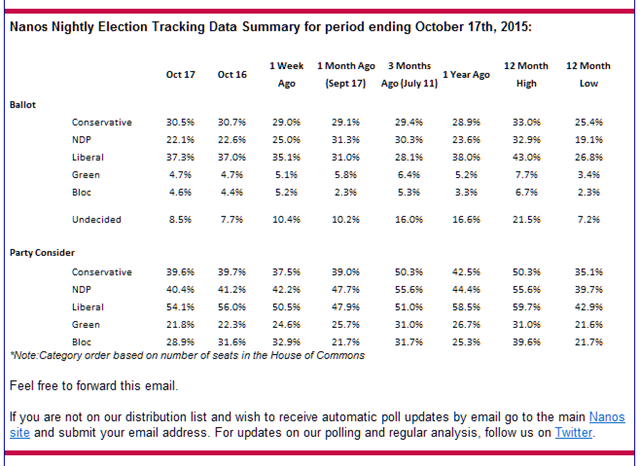
Nanos Nightly Ballot Tracking: Liberal (37.3%), Conservative (30.5%), NDP (22.1%), Green (4.7%) – Three-day Tracking Ending October 17th

Liberal seven point advantage continues over closing weekend

  • National Ballot – Tracking over the closing weekend has the Liberals with a seven point advantage over the Conservatives.  The Liberals have 37.3% support, the Conservatives 30.5%, the NDP 22.1%, and the Greens are at 4.7% nationally.
  • One Month Change – Compared to a month ago, the Liberals are up six points, the NDP are down nine points, and the Conservatives are up two points. The Liberals have been the primary beneficiaries of the decline in NDP support over the course of the campaign and over the past month the Liberal – NDP trend lines have been mirror images of themselves.
  • Larger Sample – Please note that today’s three day rolling average is based on 2,000 interviews (800 interviews Saturday, 800 interviews Friday and 400 interviews Thursday).
  • Last Report – Nanos will continue to do tracking today (Sunday) and will release its last election survey this evening ahead of the Elections Canada deadline.  No new polling can be released on Election Day but polls released prior to Election Day can be reported on Election Day (Section 328 of The Canada Elections Act).

The team at Nanos in conjunction with Klipfolio have launched our new live political data portal where you run the numbers you want and can explore the trends and data you need.  This is part of our campaign, not only to provide the most reliable data to Canadians but to let them use it as they wish. We were the first to do nightly tracking and now we are the first research organization to post live public opinion data for Canadians.

We were the first to do nightly tracking and now we are the first research organization to post live public opinion data for Canadians. Here’s the link to check it out

To view the detailed tracking stats please visit our website.

Methodology

A national random telephone (land + cell) survey using live agents of 1,200 Canadians is conducted by Nanos Research throughout the campaign over a three day period.  Each evening a new group of 400 eligible voters are interviewed. A double sample of 800 interviews, per night, were conducted on Friday and Saturday.  Today’s daily tracking figures are based on a three-day rolling sample comprised of 2,000 interviews.  To update the tracking a new day of interviewing is added and the oldest day dropped. The margin of error for a survey of 2,000 respondents is ±2.2%, 19 times out of 20.

The respondent sample is stratified geographically and by gender.  The data may be weighted by age according to data from the 2011 Canadian Census administered by Statistics Canada.  Percentages reported may not add up to 100 due to rounding.  The research has been registered with the Marketing Research and Intelligence Association of which Nanos is a member.

Results are based on the three day calling window October 15 to 17, 2015. The research was commissioned by CTV News and The Globe and Mail.

image