

By Maciej Onoszko
September 23, 2016
-
Currency is on track for a quarterly loss, its first in 2016
-
Probability of monetary easing this year rises to 18 percent
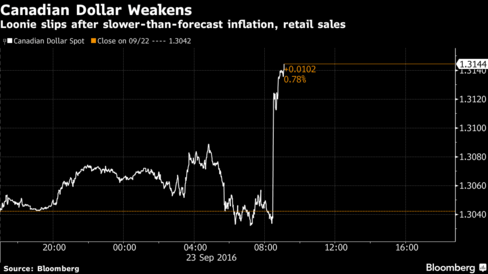
The Canadian dollar fell after the country’s August inflation rate trailed even the most bearish forecast, boosting bets that a slowdown in the economy may require added monetary stimulus.
The currency weakened versus most of its major peers.
The slowdown in inflation comes after Bank of Canada Governor Stephen Poloz said earlier this month that growth risks have tilted to the downside, in part because of slack in the broader economy linked to slow exports.
Further weakening the outlook for Canada’s economy, retail sales unexpectedly declined in July.
“The Bank of Canada flagging inflation risks was significant and the markets should factor in a greater chance still of a rate ease,” said Shaun Osborne, chief foreign-exchange strategist at Bank of Nova Scotia in Toronto. He sees risks for the Canadian dollar “skewed to the topside” toward C$1.33 to C$1.35 per U.S. dollar.
It fell 0.8 percent to C$1.3141 per U.S. dollar at 10:02 a.m. in Toronto, extending this quarter’s loss to 1.7 percent, the worst performance among Group-of-10 peers after the pound.
Chances for a Bank of Canada interest-rate cut this year rose to 16 percent from 13 percent on Thursday, according to overnight index swaps.
Hedge funds and other large speculators have been betting in the loonie’s favor since April, according to net-positioning data from the Commodity Futures Trading Commission.
The Canadian dollar will weaken to C$1.32 against its U.S. counterpart by the end of the year, according to forecasts compiled by Bloomberg.
Core inflation, which measures consumer prices excluding eight volatile items, slowed to a two-year low of 1.8 percent, down from July’s 2.1 percent rate.
The overall inflation rate decelerated to 1.1 percent, from 1.3 percent.
Both readings lagged behind the lowest forecast in Bloomberg economist surveys, and analysts predicted overall prices would accelerate on the month instead of slowing.
Retail sales for July fell 0.1 percent from the prior month, compared with projections for a 0.1 percent increase.
“The overall message is one of a slow-motion machine for both Canadian growth and inflation,” Bank of Montreal chief economist Douglas Porter wrote in a research note.
“This is far from enough to prompt the Bank of Canada off the sidelines, but the sag in core inflation does remove one potential obstacle if another nasty shock erupts and the BOC needs to respond.”
Source: Loonie Weakens as Inflation Data Raise Chance for BOC Rate Cut – Bloomberg



 Andrew Phillip Chernoff