Andrew Phillip Chernoff

The Outer Limits To The Inner Depths

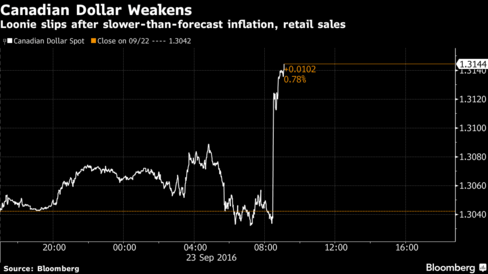
Loonie Weakens as Inflation Data Raise Chance for Bank Of Canada Rate Cut

By Maciej Onoszko

September 23, 2016

  • Currency is on track for a quarterly loss, its first in 2016
  • Probability of monetary easing this year rises to 18 percent

Lack of business investment could derail Canada’s economic growth

OTTAWA, May 30, 2016 /CNW/ – Business investment outside of the energy sector remains sluggish, despite many manufacturing industries being at or close to full capacity, according to a new briefing released by The Conference Board of Canada.

“For the past year, we at the Conference Board have stressed the need for a rebound in business investment to support Canada’seconomic growth,” said Matthew Stewart, Associate Director, Economic Forecasting and co-author of the briefing. “If non-energy investment does not rebound over the coming months, capacity constraints in some manufacturing industries could impact future growth.”

HIGHLIGHTS

  • In order for exports to continue to drive economic growth, a pickup in non-energy investment aimed at expanding productive capacity is needed.
  • Our current economic outlook assumes a modest increase in non-energy investment spending in the second quarter with a stronger pick up in the second half.
  • Current business investment intentions are much more pessimistic than what is included in our current economic outlook.
  • Most leading manufacturing industries have reached or nearly reached their capacity to continue to grow.
  • Manufacturing industries in particular are expected to reduce capital expenditures this year by an average of 10.9 per cent.
  • Without a pickup in investment, capacity constraints have the potential to upset recent economic momentum.

The transportation equipment, wood products, food, primary metal and paper industries have been the key drivers of manufacturing growth in Canada, accounting for 64 per cent of year-over-year increases in output. These manufacturing industries, which have been leading Canada’s rebound in exports, are at or fast approaching full capacity. In the fourth quarter of last year, the wood products manufacturing industry was operating at 99.3 per cent capacity. Paper manufacturing was not far behind, operating at 98.2 per cent and transportation equipment operated at 97.3 per cent of its capacity. Meanwhile, transportation equipment manufacturing recorded its highest capacity utilization rate in history in the third quarter of 2015.

Despite many manufacturing industries operating near capacity, businesses remain reluctant to invest. In fact, manufacturers across a range of industries expect to cut investment this year by an average of nearly 11 per cent. Moreover, the transportation equipment, wood products, food, primary metal and paper manufacturers are expected to post worse-than-average investment declines.

In the Conference Board’s Index of Business Confidence survey, business leaders cited weak market demand, government policies, a shortage of qualified staff, and the depreciation of the Canadian dollar (which increases the cost of imported technology and machinery) as reasons for not investing. While market demand should improve as the U.S. economy continues to strengthen, the remaining factors—government policies, a shortage of qualified staff, and the depreciation of the Canadian dollar—will likely continue to hold back investment.

While we still expect non-energy investment spending to pick up in the second half of the year as accelerating demand from the U.S. improves the incentive for firms to expand their capacity, the continued lack of investment has the potential to severely limit Canada’s future growth.

The executive briefing is available on The Conference Board of Canada’s e-library.

SOURCE Conference Board of Canada

Source: Lack of business investment could derail Canada’s economic growth

China turmoil pushes global stocks towards worst start to a year in at least 28 years

Global stocks headed for their worst start to a year in at least 28 years, with the Dow Jones Industrial Average dropping more than 350 points, as turmoil emanating from China spread around the world and billionaire George Soros warned that a larger crisis may be brewing.

The Toronto Stock Exchange lost nearly 2 per cent of its value Thursday morning amid fresh upheaval around the world following another early shutdown of two major Chinese stock markets.

The S&P/TSX composite index was down 222.36 points at 12,504.44 points at 10:30 a.m. after an hour of trading.

The Canadian dollar remained near 12 ½-year lows at 71.13 cents (U.S.) but rose 0.11 cent from Wednesday’s close.

At mid-afternoon, the S&P/TSX composite index had shed 256.14 points at 12,470.66. The Dow Jones Industrial Average had fallen 347.90 points at 16,558.61. The Nasdaq composite index lost 135.56 points at 4,700.20.

The Canadian dollar was trading at 70.98 cents US, down four-100ths from Wednesday’s close.

The world’s financial markets are being tossed by developments in China, where the central bank made a surprise move to adjust its currency rate and two major stock exchanges were closed early Thursday because of a sudden drop in stock prices.

“It is shaping up to be another (wildly) negative day in global equity markets,” said Douglas Porter, chief economist with BMO Financial Group, in a note to clients.

“Panic is at play here, and having the (People’s Bank of China) trying to stem the losses by imposing all sorts of rules and regulations does not help over the longer term.”

In New York, the Dow Jones was initially down more than 300 points but recovered somewhat to 16,711.09, down 195.42 points, or 1.2 peer cent. The S&P 500 index was down 23.42 points, or 1.2 per cent, at 1,966.84 and the Nasdaq fell by 71.36 points or 1.6 per cent at 4,372.62.

On the commodity markets, February contracts for crude oil reduced their earlier losses to 63 cents, trading at $33.34 per barrel, and gold futures rose $14.20 to $1,106.10 an ounce.

Earlier Thursday, trading on China’s Shanghai and Shenzen stock markets were pre-emptively halted for a second time this week after new “circuit breakers” were triggered when a benchmark stock index fell seven per cent.

The circuit breakers also kicked in Monday, the first day of trading since they were introduced on Jan. 1. The China Securities Regulatory Commission said after Thursday’s shutdown that the circuit breaker rule had been suspended.

Chinese markets have lurched up and down as regulators gradually withdraw emergency measures imposed after the main stock index plunged in June following an explosive rise.

A similar price plunge Monday triggered a sell-off on Wall Street and other global markets.

On Thursday, trading was suspended after a market index, the CSI 300, nosedived 7 per cent a half-hour after markets opened, triggering a “circuit breaker” that took effect Jan. 1.

Financial analysts have warned Chinese markets are likely to see extreme volatility for a few more months as they seek a stable level following last year’s rout.

The “circuit breaker” requires a 15-minute pause in trading if the CSI 300 falls 5 per cent within 30 minutes. But Thursday’s decline was so fast that before that could take effect, it hit the 7 per cent limit that ends trading for the day.

“China has a major adjustment problem,” influential investor Soros said Thursday at an economic forum in Colombo, Sri Lanka. “I would say it amounts to a crisis.

“When I look at the financial markets there is a serious challenge which reminds me of the crisis we had in 2008.”

Contagion from China helped wipe $2.5 trillion off the value of global equities in the first six days of this year as the nation’s tolerance for a weaker currency is viewed as evidence that policy-makers are struggling to revive an economy that’s the world’s biggest user of energy, metals and grains. The World Bank cut its global growth forecasts for this year and next as China’s slowdown prolongs a commodity slump and contractions endure in Brazil and Russia. The U.K.’s Chancellor of the Exchequer George Osborne says a “dangerous cocktail” of global threats faces the British economy this year.

European stocks fell for the third time in four days, mirroring declines that shook global equities in August, as they extended the worst start to a year since 2000 amid a China-fueled selloff in mining and energy shares.

European shares have tumbled 6.4 per cent in the first four days of the year as companies with the most sales in the world’s second-biggest economy bear the brunt of the decline. Anglo American Plc and Glencore Plc tumbled 6 per cent or more today, pushing a gauge of miners to its lowest level since 2009. Carmakers fell to a three-month low.

Equities around the world are in retreat as an eighth day of cuts in the yuan’s reference rate exacerbated concern that growth in China is slowing more than previously forecast. The declines are a setback for European equity bulls who had speculated that central-bank stimulus and a slowly improving economy would insulate the region from stress in Asia and North America.

“The Chinese economic outlook is getting bleaker,” said Daniel Weston, chief investment officer of Aimed Capital in Munich. “Chinese demand for European exports is weakening and the price of European goods and services is getting costlier for the Chinese. In August, the Chinese said it would be a ‘one off’ devaluation, but now the market knows it is much more than that.”

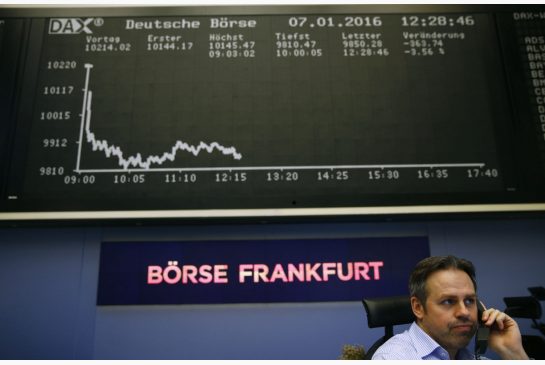
The Stoxx Europe 600 Index slid as much as 3.6 per cent, the most since August, before trading 3.3 per cent lower at 12:01 p.m. in London. All but seven stocks fell. Germany’s DAX Index lost 3.5 per cent to 9,858.15, trading below 10,000 for the first time since October.

The Stoxx 600 is on track for its worst week since August, when China’s yuan devaluation sparked a selloff that saw Europe’s benchmark plunge as much as 18 per cent from its record. The VStoxx Index measuring volatility expectations in euro-area shares jumped 17 per cent, heading for its biggest weekly advance since April.

The DAX, whose exporters have a greater exposure to China, has tumbled 8.3 per cent this week, heading for its worst loss since August 2011. It’s down 14 percent since a November high. The benchmark entered a bear market at the height of the summer rout, before rebounding as much as 21 percent.

The rout spread to the Middle East. Saudi Arabian stocks led a decline in Middle Eastern markets as the slump in oil prices deepened amid a global equity rout spurred by the financial turmoil in China.

The Tadawul All Share Index slid as much as 5 per cent before paring its decline to 4.8 per cent at 2:58 p.m. in Riyadh. The DFM General Index retreated 3.4 percent, the most in almost two months, to the lowest level since Dec. 15. The Bloomberg GCC 200 Index, a gauge that tracks the 200 largest stocks in the six-nation Gulf Cooperation Council, declined for a fifth day to the lowest since January 2013.

China is one of the biggest trading partners of Saudi Arabia, the world’s biggest oil exporter, and the United Arab Emirates, data compiled by Bloomberg show.

Saudi Basic Industries Corp. dropped 4.2 per cent. The company, one of the world’s largest chemicals manufacturers, was trading at the lowest level since September 2009. Three technical indicators were this week suggesting the share may be ready to rebound. The yield on Sabic’s 2.625 percent bonds due October 2018 rose six basis points to highest level since February 2014.

Saudi Cable Company, a Jeddah-based cable and reel manufacturer, was set for the lowest close since March 2003. The company said on Wednesday it expects a 3 percent impact on output costs from Saudi Arabia’s subsidy cuts.

Stocks in the region have been under further strain as relations between Shiite-majority Iran and Arab nations worsened. The Saudis on Saturday executed 47 people accused of terrorism-related activities, including a Shiite cleric, which prompted protesters to attack the kingdom’s embassy in Tehran. In turn, Saudi Arabia and a number of its allies cut diplomatic ties with the Islamic Republic.

“With oil going the way it is and China reacting the way it is reacting and the tension between Iran and Saudi, it was very much expected, long overdue,” Ahmed Shehada, executive director for advisory and institutions at NBAD Securities LLC, said by phone from Dubai. “The market is looking quite bearish.”

The yield on Dubai’s government bond due October 2020 rose eight basis points to the highest level since January 2015. Emaar Properties PJSC, the company with the biggest weighting on the emirate’s main stock index, was the largest contributor to the gauge’s retreat. The developer sank 5.4 percent, the most since Aug. 23.

Qatar’s QE Index slid 3 percent and Abu Dhabi’s ADX General Index lost 3.2 percent, the most since August. Kuwaiti stocks decreased 1.6 percent and Bahraini equities lost 0.7 percent. Oman’s MSM 30 Index dropped 0.5 percent.

Turkey’s Borsa Istanbul 100 Index fell, heading for the lowest level in more than three weeks. The lira weakened for a fifth day against the dollar and was among the worst-performing emerging market currencies on Thursday.

Israel’s TA-25 Index dropped 1.8 per cent. The declines were led by Opko Health Inc. and Teva Pharmaceutical Industries Ltd., tracking the losses of their U.S.-traded shares.

—with files from Bloomberg News

Source: China turmoil pushes global stocks towards worst start to a year in at least 28 years | Toronto Star

Oil, stock markets slide after IEA predicts even lower crude prices

Oil and markets continued to slide on Wednesday after the head of the International Energy Agency predicted a decline in crude prices and weaker oil investment in 2016.

Oil is at its lowest level since early 2009, with the West Texas Intermediate contract falling below $37 US a barrel today before recovering to $37.11 in mid-afternoon.

Brent oil for international delivery was down 21 cents to $40.

Fatih Birol, executive director of the Paris-based IEA, said oil prices could fall in 2016.

“When we look at 2016, I don’t see many reasons why we can see upward pressure on the prices… Demand is weaker and we may well see Iran come back [to the market] and there will be a lot of oil,” Birol said from the sidelines of the COP21 climate conference in Paris

The IEA monitors demand and supply of energy worldwide. He said falling oil prices could affect many oil-consuming countries’ resolve to switch away from fossil fuels.

Oil investment down 20%

Birol said that IEA estimates indicated that investment in the oil industry fell by more by 20 per cent in 2015 – the steepest decline in history. A further decline is seen in 2016.

The Canadian oilpatch has been hoping for higher prices, because much Canadian production is not economically viable at current price levels.

However, OPEC’s decision to leave output at current levels makes it less likely that the worldwide oversupply of oil will ease.

The Canadian dollar came down with the price of crude, falling to below 73.50 cents US in the morning before bouncing higher to 73.61.

Markets were down in Asia and Europe overnight after most commodities continued to fall in price because of fresh signs that the Chinese economy is slowing. Chinese exports fell by 6.5 per cent last month.

The TSX, which has fallen with energy stocks, was down six points to 12,916, its lowest level in two years.

New York’s Dow index fell 98 points to 17,467, while the broader S&P index was down four points to 2,043.

Source: Oil, stock markets slide after IEA predicts even lower crude prices – Business – CBC News

Canada’s next challenge – The Market Mogul

Canada has turned left in the recent federal election. People seeking for a complete change in their government have largely demonstrated their will by voting for the 43 year old Justin Trudeau, son of Pierre Trudeau, Canada’s greatest modern leader.

Source: Canada’s next challenge – The Market Mogul