“Workers’ Lot Can Be Better”—Labour Day Message From 1959 Relevant In 2013

From 1959, a Labour Day not so dissimilar to Labour Day 2013.

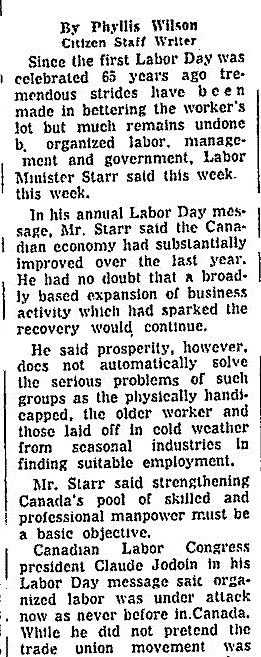
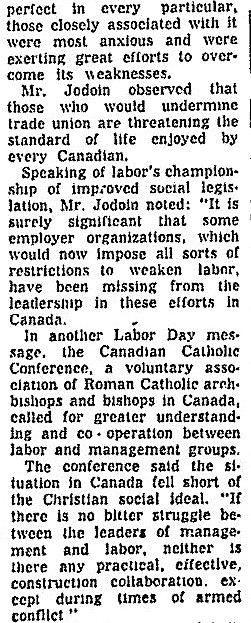
In 1959, Canada’s pool of skilled and professional manpower needed improvement; organized labour was under attack like never before in Canada; the union movement was exerting great effort to overcome its’ weaknesses; and those who were seeking to undermine the trade union movement, were threatening the standard of life enjoyed by every Canadian.

Labour’s spearheading of improved social legislation by 1959 were likewise under attack as is now in 2013. The writer observed then, what is the case now,

“It is surely significant that some employer organisations, which would now impose all sorts of restrictions to weaken labour, have been missing from the leadership in these efforts in Canada.”

I could not have said it better.

So from 1959, a Labour Day message. Enjoy.


From: The Ottawa Citizen, Ottawa, Ontario, September 5, 1959

Clip_3bClip_3cClip_2e

Department of Foreign Affairs and International Trade : Trans-Pacific Partnership Members Advance Negotiations in Brunei

08/30/2013 | 12:33pm US/Eastern   http://www.4-traders.com

Opening new markets and creating new sources of prosperity the Harper government’s focus as Canada continues to play important role in negotiations 

August 30, 2013 – The Honourable Ed Fast, Minister of International Trade, today marked the conclusion of the 19th round of Trans-Pacific Partnership (TPP) negotiations, which took place in Bandar Seri Begawan, Brunei, from August 22 to 30, 2013. Minister Fast was in Brunei last week to participate in a meeting of all TPP trade ministers.

“Opening new markets and creating good jobs, economic growth and greater prosperity for Canadian workers and families is why our government is pursuing deeper trade and investment ties in the fast-growing and dynamic Asia-Pacific region,” said Minister Fast. “The TPP negotiations are a key pillar of our government’s pro-trade plan, and I am pleased that Canada is playing a constructive and important role as we work to advance our interests and conclude an ambitious agreement in a timely manner.”

During the 19th round, negotiators built on the progress made to date in several areas, including on goods market access, rules of origin, investment, services, financial services, temporary entry, intellectual property, government procurement and environment.

Officials also wrapped up a technical meeting on labour provisions, which was held in Ottawa from August 26 to 29, 2013.

Twelve countries are currently participating in the TPP negotiations: Australia, Brunei, Canada, Chile, Japan, Malaysia, Mexico, New Zealand, Peru, Singapore, the United States and Vietnam. Canada formally joined the negotiations on October 8, 2012.

The TPP market represents more than 792 million people and a combined GDP of $27.5 trillion-more than 38 percent of the world’s economy. An ambitious agreement that greatly reduces barriers to trade will benefit workers and families in every region of Canada by providing greater access for Canadian exporters to large, dynamic and fast-growing markets. And as Canada is at the international forefront of trade liberalization, the TPP will also improve Canada’s international competitiveness by solidifying our participation in lucrative trading blocs with fast-growing economies.

For more information, please visit Trans-Pacific Partnership Free Trade Agreement Negotiations.

For further information, media representatives may contact:

Rudy Husny
Press Secretary
Office of the Honourable Ed Fast
Minister of International Trade
613-992-7332
rudy.husny@international.gc.ca


New Report: Entering the Energy & Environment Policy Frontier

Research suggests comfortable majority of Americans support approval of  Keystone XL pipeline.

Aug 26, 2013    By Nik Nanos

A new report from Wilson Center Public Policy Scholar Nik Nanos, Entering the Energy & Environment Policy Frontier, explores the changing energy landscape in the United States and Canada and identifies energy policy risks and opportunities.

As part of a scholar-in-residence program at the Woodrow Wilson International Center for Scholars in Washington, DC, between January and May 2013, Nik Nanos conducted energy policy research.

Using original public opinion research, in-depth interviews with experts and advocacy groups, and analysis of secondary data, Nanos suggests that the government should not pick energy winners and losers, but encourage competition among energy sources.

Furthermore, Nanos finds that decentralized sub-national environmental policy making, gridlock in Congress, and potential uncertainty in recoverable energy resources should result in greater caution in favoring one policy over another.

Promoting investment in a variety of technologies to recover and produce energy in an environmentally responsible manner will likely best minimize the long term energy and environmental policy risks.

Canada and the US need to have a frank discussion on carbon policy and the environment, according to Nik Nanos.

Downloads

Nanos Energy Report August 2013
2.28 MB

TPP Trade Ministers Press Briefing/Statement (Update from 19th Round of TPP Negotiations in Brunei)

By Krista Cox on 23. August 2013  http://keionline.org

On August 23, 2013, the TPP Ministerial meeting concluded with a press briefing. Stakeholders were not allowed to attend, but according to media sources, the briefing lasted only 20 minutes and reportedly the ministers only took a handful of questions before ending the briefing.

Apparently, Ambassador Froman confirmed that the October 2013 deadline was not possible, but that countries were now looking for “milestones” by October with the hope of concluding the agreement by the end of the year.

There have been no announcements regarding the location or date of the next TPP round, though there are rumours that it could be hosted by Mexico or Canada.

The joint press statement is copied below:

Joint Press Statement
TPP Ministerial Meeting
Bandar Seri Begawan, Brunei Darussalam
August 23, 2013

Brunei, Darussalam — The ministers of the Trans-Pacific Partnership (TPP) countries have met jointly and bilaterally on August 22 and 23, 2013 to consider how to address key outstanding issues as negotiations toward a comprehensive, high-standard regional trade and investment agreement enter the final stage.

Noting that the majority of issues are now at an advanced stage, the 12 countries — Australia, Brunei Darussalam, Canada, Chile, Japan, Malaysia, Mexico, New Zealand, Peru, Singapore, United States and Vietnam — have explored how to develop a mutually-acceptable package, including possible landing zones on remaining sensitive and challenging issues and sequencing of issues in the final talks. Particular areas of focus have included matters related to market access for goods, services/investment, financial services, and government procurement as well as the texts covering intellectual property, competition, and environmental issues. We also discussed the remaining outstanding issues on labor, dispute settlement, and other areas.

This meeting of TPP Ministers has taken place as the 19th round of TPP negotiations gets underway in order to offer guidance to negotiators and help drive the negotiations to conclusion on the 2013 timeframe instructed by our Leaders. We discussed how best to achieve an outcome consistent with our common goal of achieving an ambitious and balanced 21st-century agreement that will enhance trade and investment among us, promote innovation, economic growth and development, and support the creation and retention of jobs in our countries.

We have agreed to maintain our active engagement in the lead up to the APEC Leaders meeting in Bali, Indonesia, on the margins of which TPP Leaders are expected to meet as they have in past years. This meeting will be an important milestone as the 12 countries work intensively to conclude this landmark agreement.