
Source: Summary of the Trans-Pacific Partnership Agreement | United States Trade Representative
Tag Archives: canada
The Softwood Lumber Agreement is expiring. Here’s what you need to know
Glacier Melt And The Future Of Kokanee Beer In The Next Century….Just Saying….
September 25, 2015 Andrew Chernoff

The topic of this column is the B.C. glacier melt that has been scientifically proven to be accelerating and become a concern not only in Canada but the United States.
The CBC news article on May 18, 2014, Unprecedented B.C. glacier melt seeps into U.S. climate change concerns: Some B.C. glaciers losing 22 cubic kilometres of ice a year, or about 22 billion cubic metres of water. outlining not only the concerns but the affect and effects of this phenomenon.
There is further proof of this aggressive glacier melt in B.C., once again from CBC news on August 25, 2014, Decker Glacier lake at Whistler a sign of melt to come:Dramatic glacial retreats may not be typical, but are possible harbingers of a glacier-free future. The article illustrates with a picture the difference of Decker Glacier lake over an 8-year period. Take a look:

The increased melting of B.C.’s glaciers caught the attention of the University of Northern British Columbia.
 PhD student Matt Beedle (left) and professor Brian Menounos measure changes in glacier thickness using GPS
While glaciers are melting elsewhere in the world, a team of researchers at the university are focused on glacier melting in Western Canada.
According to the university:
A comprehensive study of the current state and future fate of glaciers in BC and Alberta is currently underway, and the early results are disturbing.
Imagine filling up BC Place Stadium with water. Then empty it. Now repeat the process 8300 times. This would require 22 billion cubic metres of water, the same amount that BC’s 17,000 glaciers are permanently losing EACH YEAR.
“Glaciers are sensitive indicators of climate, but they are also among western Canada’s most important freshwater resources. This project is allowing us to calculate the number, and total area, of glaciers in BC and Alberta. Even more importantly, we are able to assess – for the first time – how quickly these glaciers are melting in the current climate,” says Dr. Brian Menounos, a UNBC Geography professor who is leading the research program. Researchers from Universities in Alberta, BC, Washington State, in addition to scientists from the federal government are part of the study, which aims to document recent glacier retreat and the current health of glaciers to be able to predict what their fate will be up to 150 years from now.
The research team is focusing their efforts on several glaciers and icefields in BC. The list includes the Lloyd George Icefield west of Fort Nelson, Castle Creek Glacier near McBride, Klinaklini and Tiedemann glaciers in the Coast Mountains, and glaciers in the Columbia River Basin. At each site, meteorological measurements such as air temperature, wind speed, precipitation, and humidity are being taken to better understand the controls of glacier nourishment and melt. The researchers are also measuring changes in thickness, extent, volume, and movement of hundreds of glaciers throughout the mountain ranges of western Canada. This work requires the analysis of thousands of aerial photos, some of which go back 70 years.
 This image features a close-up of the moraines left behind by the Castle Creek Glacier as it receded.
But the Castle Creek Glacier is a significant research site for other reasons. As it has been melting, the glacier has left a series of rows of rock and earth (called moraines) that precisely indicate how much the glacier has retreated each year. Similar to tree rings, they extend into the valley 750 metres from the glacier’s current edge, providing a unique geological record of this glacier’s retreat over the past 50 years.
“We’ve never seen moraines like this outside of Iceland,” says Beedle, who has also worked on glaciers in Alaska. “These moraines allow us to see even subtle annual variations in glacial retreat. What a global treasure.”
The research team is about half-way through the five year project. By 2010, they’ll be able to predict the rate and magnitude of glacial retreat under various climate scenarios. Their results bear directly on how we manage our water resources, access fresh water, and even produce electricity in the near future.
The research is being funded by an investment of nearly $2.2 million from the Canadian Foundation for Climate and Atmospheric Sciences and cash contributions from universities and network partners such as BC Hydro and the Columbia Basin Trust. Other participating institutions include the University of British Columbia, Simon Fraser University, University of Alberta, University of Calgary, University of Victoria, University of Washington, federal and provincial governments, Natural Resources Canada, and the Columbia Basin Trust.
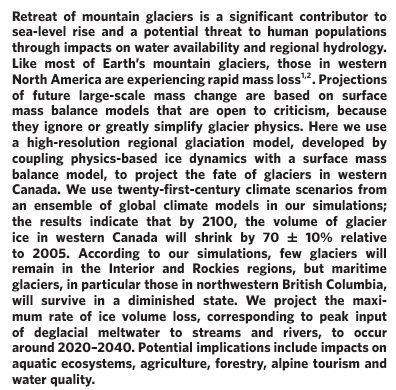
A study published in the International Weekly Journal of Science, on April 9, 2015, claims the Interior and Rockies regions, “ice area and volume losses will exceed 90 per cent,” except in the most optimistic climate change scenario considered, it says. Glaciers in coastal northwestern British Columbia are expected to “survive in a diminished state.”, according to CBC news, How Western Canada glaciers will melt away: B.C., Alberta glaciers will shrink 70% by 2100.
The following is a quote from a summary of their research paper:
Hold on though. Charlie Daniels has something to say. Charlie who, you ask….Charlie Daniels is a legendary American singer, song writer, guitarist, and fiddler famous for his contributions to country and southern rock music. Daniels has been active as a singer since the early 1950s. He was inducted into the Grand Ole Opry on January 24, 2008, and earlier in 2015 wrote an article on global warming, saying it is a scare tactic predicated on a lie.
Let me preface this column by first of all admitting that I don’t believe in man-made global warming – that the temperature of this and every other planet is controlled by the hand of the Creator – and that it is arrogant for man to think he could assume that role for either bad or good purposes.
I do not deny that the earth warms and cools, but that is a natural occurrence that has taken place since the earth was created and will continue as long as the world exists.
My source, The Holy Bible: “As long as the earth endures, seed time and harvest, cold and heat, summer and winter, day and night will never cease.” – Genesis 8:22.
Thus has it been, and thus shall it ever be, as long as earth endures. And though man can certainly contribute to making the earth a better place to live, he will never be able to bring the global temperature up or down by as much as one degree, greenhouse gases and other factors notwithstanding.
Maybe it is a matter of percentages then….over time….lots of time…….lots and lots and lots and lots…..of time….the earth can get warmer…..warm enough to melt glaciers…..and then over time……lots of time……lots and lots and lots and lots….of time….the earth can get colder and if the conditions return like they did, like they did before, glaciers could return.
Genesis 8:22 does not give specifics of how long the earth will endure…..how long or short seed time and harvest will be…..how much cold will be in the world and when; or how much heat will be in the world and when; does not claim to say how long summer and winter, day and night will be in length of time……just that it will never cease. We all know their is a relationship between the earth and the sun, that even Daniel’s cannot deny, as well.
So, it is a natural occurrence that has taken place, that takes place, since the earth was created, and will, according to Charlie Daniels opinion, will continue as long as the world exists.
Well, this natural occurrence sucks and is having dire consequences on B.C. glacier melting and the future of Kokanee Beer, and other glacier made beer in British Columbia, and I want it stopped. Now!!!!!
Even Kokanee Beer company is feeling the heat, and the board of directors sweating under their collars, about this occurrence, so much so, they are putting money where they have never gone before..
Yes, the Kokanee Beer company has decided to assist in glacier research as they have agreed to contribute $10,000 dollars to fund glacier research by Dr. Brian Menounos at the University of Northern British Columbia. After all, Gods plan to have the glaciers melting be accelerated has Kokanee beer company concerned about its longevity into the next century.
According to Glacierhub.org, on September 23, 2015,:
In exchange for five liters of meltwater from 1962, the Kokanee Beer company agreed to contribute $10,000 dollars to fund glacier research by Dr. Brian Menounos of the University of Northern British Columbia. The money has been given with no strings attached, Menounos told GlacierHub.
“We don’t endorse products but welcome any industry to contribute to funding research,” he said. “Glaciers are a shared resource and if we can get the word out about why the public should care about them, all the better.”
Kokanee beer will contribute further to this research with the funding. The exchange also allows the company to revive its beginnings.
“Because we were able to grab some of the remaining ice from Dr. Menounos, we were able to, in spirit, look at recreating one of the first-ever batches of Kokanee,” Candy Lee, Kokanee brand manager, told CBC news.
I am disturbed more now than ever, that the accelerated melting of our glaciers in B.C. is having such a dramatic and appalling affect….on our glacier fresh water that is so instrumental behind Kokanee made beer!!!
The future of our B.C. glaciers, the affect on the future of British Columbia are of concern for sure…..but the glacier freshness of Kokanee beer is being threatened…..the glacier melting is threatening a provincial treasure, an iconic beer, a world-wide export with world acceptance and world acclaim.
Wake me up from this nightmare….make it not so….tell me its a trick of the B.C. Liberals and the Federal Conservatives, the World Government…..that it is just part of the cyclical nature of the weather of Planet Earth….and that the future of all glacier B.C. beer just may be a good one into the next century, the pundits being wrong and the cyclical nature of the weather changing in time to save BC glacier made beer…..Just saying…..asking, too….
Britain’s FBI wants ‘Five Eyes’ cosy hookups with infosec outfits
http://www.theregister.co.uk/2015/09/17/nca_colocation_security_businesses/
El Reg blows lid on NCA’s ‘colocation’ dream with IT security bods
17 Sep 2015 at 22:21, Alexander J Martin
Cloudsec The UK’s National Crime Agency – Blighty’s equivalent of the FBI – wants its staff to “colocate” with private-sector IT security companies around the world. In other words, investigators and infosec employees placed alongside each other to sniff out cyber-criminals.
This will apparently help the agency reach across jurisdictions, and bust underworld gangs around the planet. This is according to a keynote address delivered on Thursday at the Cloudsec event in London – a presentation the media was banned from attending.
Speaking at the conference, Oliver Gower, Head of Strategy, Partnerships, and Transformation for the NCA’s National Cyber Crime Unit (NCCU), said a globally scaled security threat required a globally scaled security response.
Such a response should emulate the cosy Five Eyes spy relationship between America, the UK, Australia, Canada and New Zealand, said Gower, in that agents and employees in friendly countries and businesses should work shoulder-to-shoulder to combat cyber-crime.
He is keen to get beneath the sheets with information security outfits amid this international tie-up – having already bagged memorandums of understanding with Trend Micro and Intel Security.
As well as lauding the trans-jurisdictional efforts of the Joint Cybercrime Action Taskforce and the European Cybercrime Task Force, Gower mentioned a model the NCA was especially keen to copy:
The US’s National Cyber-Forensics and Training Alliance (NCFTA), which is based in Pittsburgh, and “colocates” law enforcement agents with private sector security companies.
As the alliance states: “The NCFTA is a productive environment because we operate as one unit with our private and public sector partners. Our partners are located both on-site and off-site, and come from private industry, law enforcement, academia, and government.”
Noted in a single slide of Gower’s talk was the Five Eyes Law Enforcement Group. Known previously as the Strategic Alliance Group Principals’ Meeting, the shadowy organization was formed post-Snowden to “seek to reduce the international threat and impact of organised crime.”
Although its methodology is unclear, it is, we’re told, not a counter-terrorism intelligence partnership, though membership of the group is comprised of the anglophone Five Eyes nations.
Running a trans-jurisdictional effort to combat organized crime is more difficult than you’d imagine, Gower suggested. Police investigators struggle to accept their technical limitations, and need the help of talented information security types to keep up with progress.
Deconfliction between difference police forces is increasingly an issue for crime-busting coalitions, too. The possibility of undercover cyber-cops having their investigations blown by blue-on-blue bungling – an officer in one country interrupting and scuppering the work of another – is increasingly an issue.
Data glut
Gower also confessed that the NCA is struggling to deal with the volumes of data and intelligence it receives. The agency increasingly gets its information and evidence from “seized media” – confiscated memory cards, server hard drives, and so on, we assume.
Now these piles of data are mounting up and straining resources – putting pressure particularly on officers investigating pedophiles handling child-abuse images.
As a result of these “resource challenges,” house visits by officers are not always possible. Some miscreants – such as those launching denial-of-service attacks against websites – simply receive warning emails. These missives are shared in cybercrime forums, usually accompanied with the usual prison-rape jokes, much to the delight of the agency: it means the miscreants are spreading the cops’ message for them.
The NCA is also keeping a close eye on mobile malware and Tinba – or the Tiny Banker Trojan. Ranging from a mere 20KB to 100KB in size, the bank-account-raiding software nasty surfaced in 2012.
Interestingly, he also asked: “Can government take action to systematically remove malware from everybody’s computers without them knowing it?”
“Probably not,” came his firmly comforting reply.
The Register was told by the Cloudsec organisers that the agency wouldn’t allow journalists in its session. Which is odd given that the keynote slides were widely photographed and tweeted by attendees without issue. Of course, this vulture pulled up a pew anyway and watched on. ®
Back To The Future: Canada’s Future From The Past=> The Five Eyes
The United Kingdom – United States of America Agreement (UKUSA, /juːkuːˈsɑː/ ew-koo-SAH)[1][2] is a multilateral agreement for cooperation in signals intelligence between the United Kingdom, the United States, Canada, Australia, and New Zealand. The alliance of intelligence operations is also known as Five Eyes.[3][4][5][6][7] In classification markings this is abbreviated as FVEY, with the individual countries being abbreviated as GBR, USA, CAN, AUS, and NZL respectively.[8]
Emerging from an informal agreement related to the 1941 Atlantic Charter, the secret treaty was renewed with the passage of the 1943 BRUSA Agreement, before being officially enacted on 5 March 1946 by the United Kingdom and the United States. In the following years, it was extended to encompass Canada, Australia and New Zealand. Other countries, known as “third parties”, such as West Germany, the Philippines and several Nordic countries also joined the UKUSA community.[9][10]
Much of the sharing of information is performed via the ultra-sensitive STONEGHOST network, which has been claimed to contain “some of the Western world’s most closely guarded secrets”.[11] Besides laying down rules for intelligence sharing, the agreement formalized and cemented the “Special Relationship” between the UK and the USA.[12][13]
Due to its status as a secret treaty, its existence was not known to the Prime Minister of Australia until 1973,[14] and it was not disclosed to the public until 2005.[13] On 25 June 2010, for the first time in history, the full text of the agreement was publicly released by Britain and the United States, and can now be viewed online.[9][15] Shortly after its release, the seven-page UKUSA Agreement was recognized by Time magazine as one of the Cold War‘s most important documents, with immense historical significance.[13]
Currently, the global surveillance disclosure by Edward Snowden has shown that the intelligence-sharing activities between the First World allies of the Cold War are rapidly shifting into the digital realm of the Internet.[16][17][18
The Five Eyes are cooperating with various 3rd Party countries in at least two groups:
- The “Nine Eyes”, consisting of the Five Eyes plus Denmark, France, the Netherlands and Norway.
- The “Fourteen Eyes”, consisting of the same countries as the Nine Eyes plus Germany, Belgium, Italy, Spain and Sweden.[44] The actual name of this group is SIGINT Seniors Europe (SSEUR) and its purpose is coordinating the exchange of military signals intelligence among its members.[45]
In 2013, Canadian federal judge Richard Mosley strongly rebuked the Canadian Security Intelligence Service (CSIS) for outsourcing its surveillance of Canadians to overseas partner agencies. A 51-page ruling says that the CSIS and other Canadian federal agencies are illegally enlisting U.S. and British allies in global surveillance dragnets, while keeping domestic federal courts in the dark.[56][57][58]
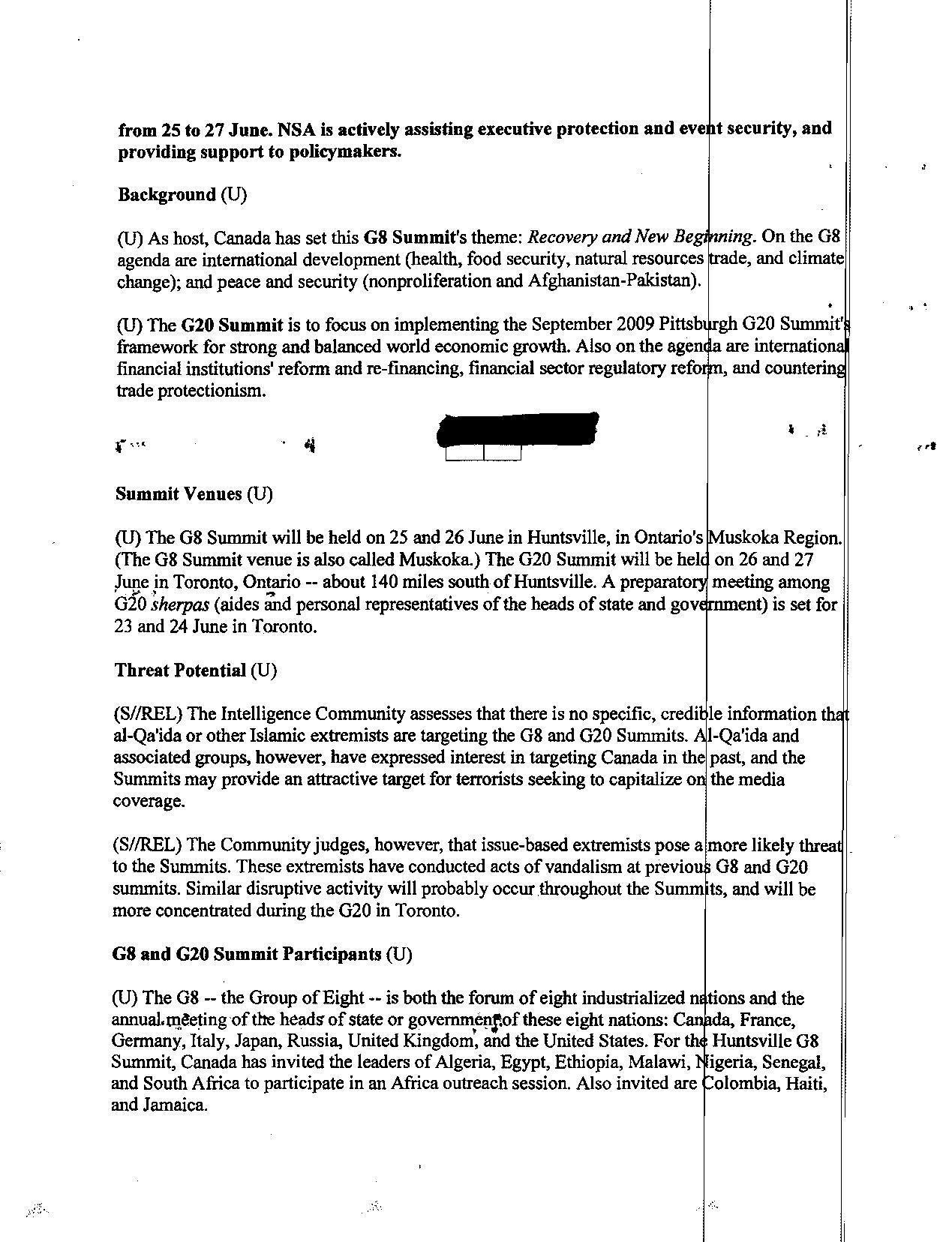
NSA’s relationship with Canada’s CSEC
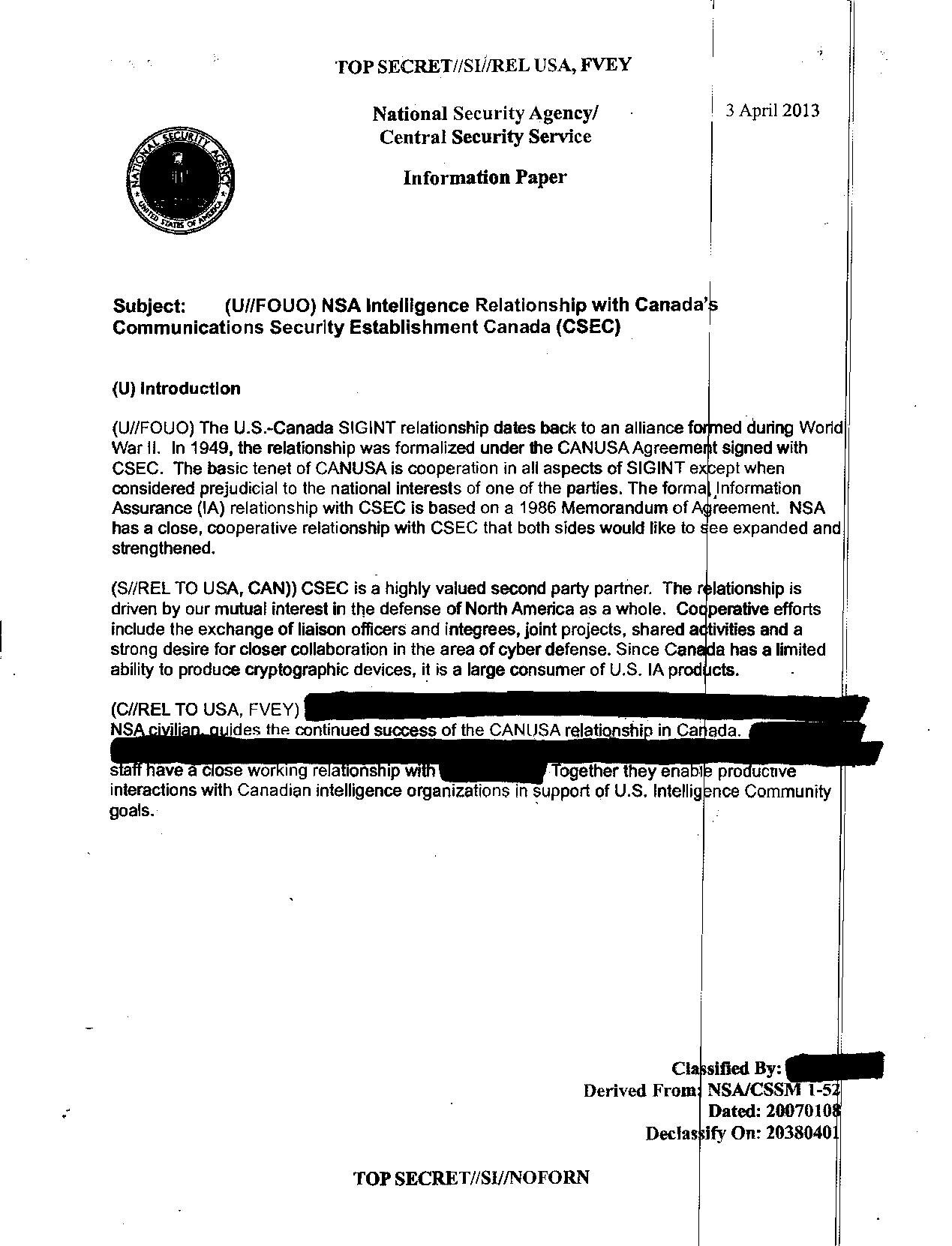
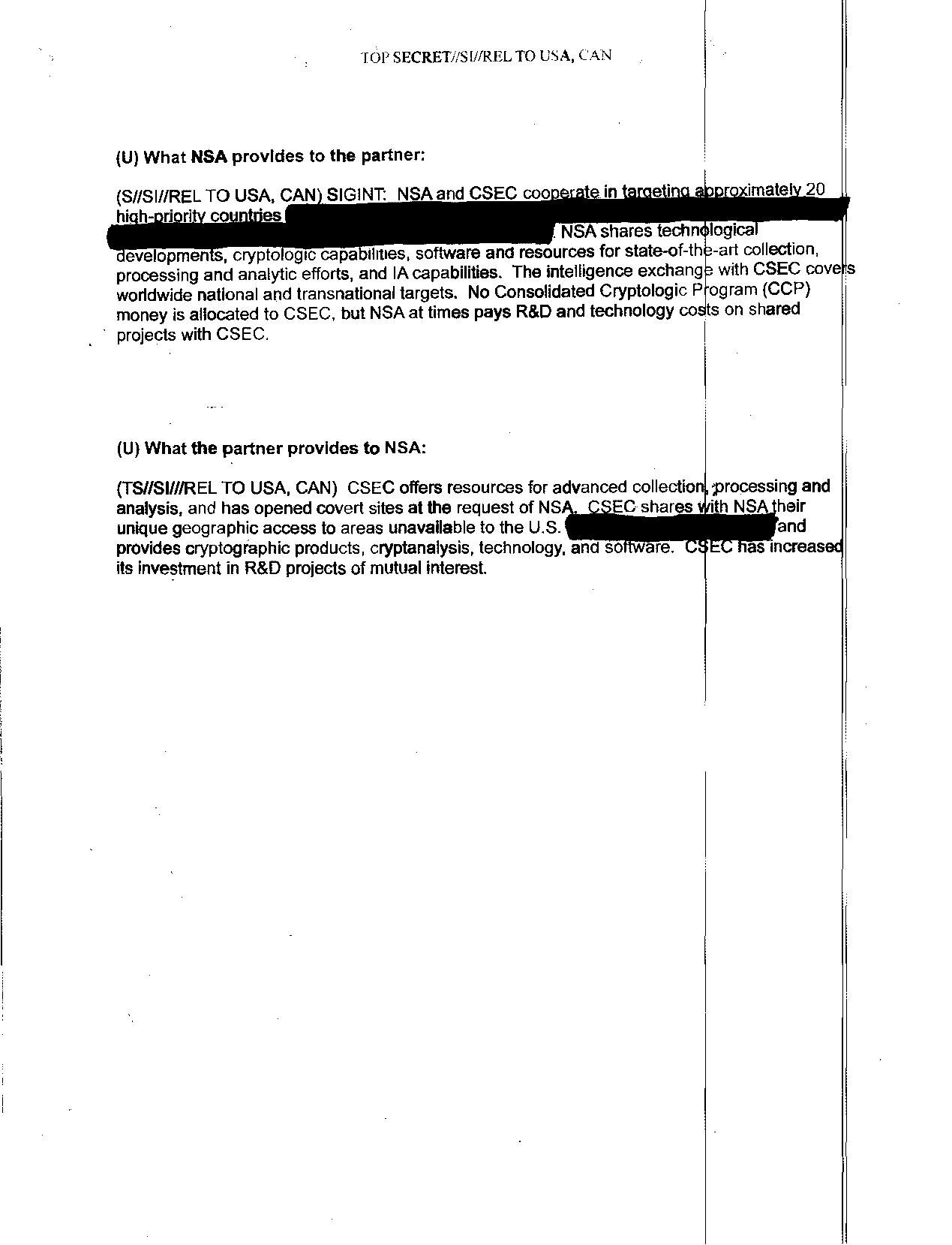
NSA document on a joint espionage operation with Canada’s CSEC agency during the G8 and G20 summits in Toronto in 2010



 Andrew Phillip Chernoff