

Canada’s Fiscal Sustainability Report 2016

28 June 2016

Get the report
Fiscal Sustainability Report 2016.pdf

Get the data
FSR 2016 – Figures.xlsx

Summary
Medium-term budget plans are insufficient to evaluate the long-term prospects for public debt under current fiscal policy. This report extends PBO’s medium-term analysis to assess the fiscal sustainability of Canada’s federal government, subnational governments and public pension plans.

Fiscal sustainability means that government debt does not grow continuously as a share of the economy. The goal is to identify if policy changes are required to avoid unsustainable public debt accumulation, after considering the economic and fiscal impacts of population ageing.

Government sector net debt over the long term
% of GDP
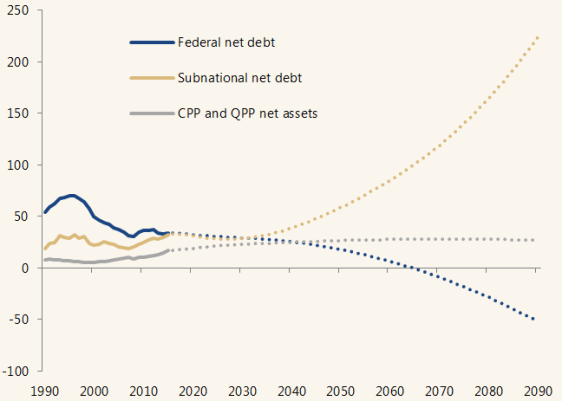
Sources:  Statistics Canada and Parliamentary Budget Officer.

Federal government

PBO’s 2015 Fiscal Sustainability Report concluded that the federal government had room to increase spending or reduce taxes. Measures in Budget 2016 have reduced this room. However, the government continues to have flexibility to expand policy while maintaining fiscal sustainability.

To maintain net debt at its current level of 33.7 per cent of gross domestic product (GDP) over the long term, PBO estimates that the federal government could permanently increase spending or reduce taxes by 0.9 per cent of GDP ($19.2 billion in current dollars). This is down from 1.4 per cent in last year’s assessment.

PBO’s federal sustainability assessment concludes:

  • Federal fiscal room has been reduced as a result of reversing the increase in the age of eligibility for the Old Age Security program. The higher long-run cost as a result of the change is expected to reduce federal fiscal room by 0.2 per cent of GDP.
  • Removing existing children’s benefits and introducing the Canada Child Benefit are expected to reduce fiscal room by 0.1 per cent of GDP. However, a complete picture of the impact is uncertain, as no details have been announced describing the indexation of benefits or eligibility thresholds beyond the medium term. Parliamentarians may wish to seek further clarification.
  • The impact of other Budget 2016 spending measures, including Phase 1 and Phase 2 of Canada’s New Infrastructure Plan, is 0.1 per cent of GDP.

Subnational governments

The outlook for subnational governments (that is, combined provincial, territorial, local and Aboriginal governments) is little changed from last year’s assessment. Permanent policy actions amounting to 1.5 per cent of GDP ($30.2 billion in current dollars) would be required to stabilize the subnational government net debt-to-GDP ratio at its current level (32.5 per cent) over the long term. The required fiscal consolidation has increased marginally from 1.4 per cent in last year’s assessment.

PBO’s subnational government sustainability assessment concludes:

  • The slight increase in the fiscal gap is the result of higher-than-projected program spending in 2015.
  • Health care spending outpaced nominal GDP growth in 2015. This, along with historical revisions to the national accounts, has raised PBO’s projection for excess cost growth.  Excess cost growth refers to the increase in health spending that cannot be accounted for by general inflation, real per capita income growth, population growth and ageing.
  • Although provinces cannot meet the challenges of population ageing under current policy, the required fiscal consolidation is not insurmountable if compared to previous consolidation episodes. Furthermore, the changes do not need to occur immediately. However, the longer they are delayed, the greater the adjustment that is required.

Canada Pension Plan and Quebec Pension Plan

The fiscal gap for the public pension sector represents the immediate and permanent change in contributions and/or expenses that returns the net asset-to-GDP ratio to its current level over the long term. PBO estimates that public pension plans are sustainable over the long term.

The long-term projection of the Canada Pension Plan (CPP) does not incorporate the agreement in principle signed by Canada’s Finance Ministers on 20 June 2016. PBO will assess the changes to the CPP when further details on implementation are released.

Total general government sector

The total general government sector in Canada (that is, the combined federal and subnational governments and public pension plans) is not fiscally sustainable without permanent increases in revenues or reductions of at least 0.6 percentage points of GDP.

Changes could be made at any level of government to eliminate the total government fiscal gap. However, ensuring the sustainability of each government sector on its own would require a consolidation at the subnational level and/or higher transfers from the federal government.

Related posts

  • 21 July 2015

    This report provides an assessment of the long-term sustainability of government finances for three government sub-sectors: the federal government; subnational governments consisting of provinces, territories, local, and aboriginal governments; and, the Canada and Quebec Pension Plans.    [PDF]

Source: Fiscal Sustainability Report 2016

Leave no one behind in CPP expansion: Mark Hancock

June 16, 2016

A growing number of business and financial sector voices with histories of strong opposition to expanding the Canada Pension Plan have suddenly accepted that our public, not-for-profit, pension system should grow. Their newfound support, however, comes with many caveats. Their strategy now focuses on ensuring any expansion of the CPP is overly narrow and extremely modest.

Various Chambers of Commerce, financial industry lobby groups, and the Canadian Life and Health Insurance Association argue that CPP expansion should: 1) not apply to low-income workers, 2) only apply to some middle-income workers and 3) not be the focus for new saving among higher-income earnings, who, in their view, are presumably better served by the for-profit private pension system. The small number of workers remaining who would be affected would only see a “modest” increase to CPP benefits.

These carve-outs would have significant consequences.

All workers currently participate on an equal basis in the CPP. Adding new exceptions for workers at certain income levels would make it more complicated and costly to operate the plan. More contributions would be used to pay administrative and compliance costs instead of being invested. A simple universal expansion of CPP is the more efficient solution.

Cutting low-income workers out of CPP expansion will also encourage employers to game the system. If new CPP contributions and benefits only applied on earnings above $27,500 as some are suggesting, employers would have yet another incentive to offer lower-wage, lower-hours jobs – keeping total earnings below this threshold would keep payroll costs down. This would lead to a new incentive to split full-time positions into precarious part-time positions. Canada’s governments should not be encouraging precarious employment by building these incentives into the CPP. Canadian workers deserve more good jobs and our governments should be fighting to keep them.

If Finance Ministers are concerned with the retirement prospects of low-income Canadians, CPP expansion should not be carved up. Low-income Canadians would see their retirement incomes rise like others under a bigger CPP. If Finance Ministers are concerned about the impact of the GIS clawback on these workers, they should address that particular mechanism rather than undermine the universal CPP.

Polling shows Canadians of all income levels, including low-income Canadians, strongly support CPP expansion. This federal government clearly campaigned on commitment to expand the CPP without reference to any new caveats.

As the salespeople for many for-profit private retirement products, Canada’s insurance industry has a long track record in lobbying against CPP reform.  Canadians pay the highest mutual fund fees in the world in their RRSPs and these companies like it that way.

The insurance industry ran a massive campaign that tried to kill the CPP before it was born in the 1960s. The Canadian labour movement, on the other hand, was rightly skeptical that most workers would be able to achieve a pension plan at work, leading to our call for CPP benefits to be set at a much higher level. A middle ground was ultimately chosen, establishing a public pension plan with overly modest benefits. Political leaders at the time believed workplace pension plans would grow – enough to fill the gap left by the modest CPP. This hasn’t happened, and the basic benefit target of the CPP remains basically the same as when it was established.

Unions pushed for a doubling of CPP benefits in the 1980s,as the private pension system was not working for most Canadian workers. The insurance industry and other business groups successfully quashed CPP expansion, arguing that workplace pension coverage and private savings vehicles would grow and expand over coming decades.

These business groups were proven spectacularly wrong. Workplace pension coverage has been on a decline ever since. It’s no surprise we are facing a retirement crisis.

If we had listened to the insurance industry in the 1960s, we wouldn’t have a CPP today. If we hadn’t listened to them in the 1980s, Canadian baby boomers would be retiring with bigger CPP benefits today, instead of the justified anxiety of the retirement insecurity our failed system has left them with. The picture for their children looks even bleaker – unless something is done today.

Our Finance Ministers should reflect on this history next week as they weigh the latest, flawed advice from the insurance industry about CPP.

The labour movement’s message has been simple for the past 50 years: the CPP works very well in terms of coverage, benefit security and inflation protection. Its only flaw is that its benefits are too modest. It should be expanded for all Canadian workers. Relying too heavily on our private, for-profit retirement system has not and will not work for most Canadians.

Canadians are overwhelmingly behind the simple idea of setting aside a bit more today for a decent and secure retirement. Our Finance Ministers have an obligation to listen to Canadians, and universally expand the CPP.

Mark Hancock is national president of the Canadian Union of Public Employees. Representing over 635,000 members across the country, it is Canada’s largest union.

Home

Source: Leave no one behind in CPP expansion: Mark Hancock

The True Meaning of Labour Day

Paul Moist Paul Moist

National President, Canadian Union of Public Employees

08/30/2013    http://www.huffingtonpost.ca

Labour Day is a time to celebrate the role of workers in the economy and address the real economic issues of our time.

Labour Day is about more than a well-deserved day off. It is a time to celebrate the important contributions working people make to our economy. It is also a good time to reflect on what is needed to improve the economic and social well-being for all workers.

Working people are the engine of the economy. The work we do, the services we provide and the money we spend drive the economy. But, in 2013 the economy is failing working people. Downward pressure on wages and government austerity programs are resulting in layoffs, contracting out, privatization of public services while families struggle to make ends meet. The rich are getting richer and the debt load of working people is increasing. It is no wonder our economy is experiencing such slow growth.

Economic recovery is being undermined by federal government actions over the last two years that erode workers wages, including: exploitation and fast-tracking approval for business to employ temporary foreign workers at wages below market rates; cuts to Employment Insurance and forcing workers to work at lower wages, continuous interference in the collective bargaining process on the side of employers, as well as attacks on unions and labour rights. These measures all need to be reversed and replaced by policies that support, rather than undercut real wage increases for workers.

At the same time, workers need a retirement security system in Canada to support our economy and provide economic security after a lifetime of work. It is a central economic problem today. Without adequate retirement incomes, we will pay with reduced living standards and an increase in seniors’ poverty. These outcomes, will, in turn, cost taxpayer money through programs like the federal Guaranteed Income Supplement and provincial and territorial income support and social assistance programs.

But, study after study shows that Canadians are not saving enough for retirement, and that this problem will only get worse as future generations retire. These troubling projections demonstrate the shortcomings of an increasingly individualized retirement income system. Working people are increasingly told their retirement security is their own problem. Save more for your own retirement at the same time your real wages are declining and debt level increasing?

The answer is clear. The economy needs a raise — disposable incomes need to rise to increase demand and create good jobs and economic growth. And we need to build an economy that sustains jobs with decent incomes for the next generation.

As we celebrate Labour Day this year, let’s really celebrate the contribution of working people by continuing to press for economic change to reverse growing income inequality. Press for economic change to drive the economy through higher wages and economic change to ensure all Canadians can retire in dignity.

Workers can count on the labour movement to do just that. We do that through collective bargaining and political action on behalf of all working people. And on this labour day, as national president of Canada’s largest union, I repeat my call to the government of Canada to convene a national pension summit where we can roll up our sleeves and address the affordability issues with defined benefit pension plans and re-tool the Canada Pension Plan so that it will continue to provide economic security for all Canadian retirees for generations to come.

Canada’s Top Labour Leaders Call on Premiers to Oppose Harper’s Low-wage Agenda


NIAGARA-ON-THE-LAKE, ONTARIO–(Marketwired – July 25, 2013) – At a meeting with Canada’s premiers, labour leaders from across the country called for unity among the provinces in rejecting Prime Minister Stephen Harper’s low-wage agenda. While the premiers gather for their Council of the Federation meeting in Niagara-on-the-Lake this week, the presidents of Canada’s provincial and territorial federations of labour are hosting parallel meetings where jobs, pensions and healthcare are the big-ticket items.

The labour federation presidents called on the premiers to put pressure on the federal government to double the Canada Pension Plan and renew the 2004 Health Accord, but the main focus of their talks was on jobs, training, the Temporary Foreign Worker Program, Employment Insurance and Canada’s labour market.

“The Harper government is driving down wages and working conditions for all Canadians,” said Lana Payne, President of the Newfoundland and Labrador Federation of Labour. “The latest changes to Employment Insurance be terrible for the labour market and damaging for the economy as well. They will hurt industries and employers in some regions of the country but they will hit the most vulnerable workers hardest, with fewer and fewer unemployed workers being eligible for benefits.”

The federation of labour presidents encouraged all the premiers to call on the federal government to scrap the Employment Insurance changes.

Today 1.4 million Canadians are unemployed while the country faces many labour market challenges, including the rise of precarious work, the exploitation of migrant workers, cuts to Employment Insurance and reduced investment in job training programs for vulnerable workers – all of which highlight the need for a renewed focus on creating jobs for Canadians.

“The provinces must reject this low-wage agenda,” said Sid Ryan, President of the Ontario Federation of Labour. “The premiers have an opportunity to use their leadership to engage in substantive dialogue and take action to make sure that Canadians have good jobs. One way they can do this is by establishing Labour Market Partners Forums in every province to provide vision, collaboration and leadership on job creation.”

Already established in Québec and Newfoundland and Labrador, a Labour Market Partners Forum is a tripartite body that would facilitate collaboration and dialogue between government, labour and employers, particularly on employment strategies. This coming together of stakeholders would help to develop economic strategies that would allow the provinces and territories to compete in a global economy on the basis of high productivity and quality rather than low wages.

There is no shortage of labour market issues to be discussed in this kind of tripartite forum, including job training programs, support for unemployed persons, regular increases to the minimum wage and protections for migrant workers.

“The Temporary Foreign Worker Program is being used to fundamentally transform our country’s labour market in ways that are detrimental to the interests of ordinary Canadians,” said Gil McGowan, President of the Alberta Federation of Labour. “Provincial governments should follow Manitoba and Saskatchewan in implementing legislation that protects migrant workers from abuse and exploitation. The provinces should join the growing chorus of critics calling on the federal government to scrap the low-skill stream of the Temporary Foreign Worker Program. These workers are being used as pawns to drive down wages and displace Canadians, while also allowing employers to shirk their responsibility to train Canadians. The Premiers need to stand up to the Harper government on this important issue.”

Together, Canada’s provincial and territorial labour federations give voice to over three million workers, represented by the Alberta Federation of Labour, British Columbia Federation of Labour, Canadian Labour Congress, Manitoba Federation of Labour, New Brunswick Federation of Labour, Newfoundland and Labrador Federation of Labour, Northern Territories Federation of Labour, Nova Scotia Federation of Labour, Ontario Federation of Labour, Prince Edward Island Federation of Labour, Fédération des travailleurs et travailleises du Québec, Saskatchewan Federation of Labour and Yukon Federation of Labour.

The time for pension leadership is now: Georgetti calls on Premiers to move forward with an expanded Canada Pension Plan

Wednesday, 24 July 2013  http://www.canadianlabour.ca


OTTAWA ― The Canadian Labour Congress is pleased Ontario has pledged to continue to press for an expanded Canada Pension Plan at this week’s Council of the Federation meetings. 

Ken Georgetti, the President of the Canadian Labour Congress says he was pleased to learn that Ontario Premier Kathleen Wynn is keeping CPP expansion on the agenda for the premiers to discuss.  The leadership of provincial governments have been a key factor building majority support in favour of increasing the amount that Canadians save through the CPP to avoid a future retirement income crisis.

“While the federal government drags its feet, it falls on the provinces to lead the way to ensure that Canadians have enough  for a decent retirement after a lifetime of work.  The future cost of caring for those who don’t have a workplace pension to help them save for retirement – housing, health care, community and social services – will be our children’s to bear, if government fails to act now,” says Georgetti.

According to Georgetti, it’s time for the Premiers to make it crystal clear to the federal government that the formula required to expand the CPP already exists and it’s time to get on with the work to make it a reality.

“The time for excuses is over. We’ve got 40 years of experience with voluntary pooled pension schemes, whether you call them RRSPs or PRPPs.  The bottom line is they don’t get the job done.  They are an inadequate and expensive savings vehicle for the vast majority of Canadians, and the federal government knows it. They just need to stop listening to financial industry lobbyists and the selective arguments of some selfish business interests.” he said.

A recent Harvard University study echoed the Canadian government’s own findings earlier this year that showed improving taxpayer subsidies (deductions for PRPP or RRSP contributions and Tax Free Savings Accounts) only benefit people who are already actively saving for retirement, whereas automatic contributions (like CPP premiums) greatly increase the savings of passive savers – the large majority of people who need a retirement plan like the CPP.

Georgetti says “The choice for today’s political leaders is stark – you can help business save a little more today by dragging your feet on retirement income security or you can take steps to prevent a retirement income crisis that will result in a generation of impoverished seniors whose care will come at a very high social and economic cost to the Canadian public and business alike.”

The Canadian Labour Congress, the national voice of the labour movement, represents 3.3 million Canadian workers. The CLC brings together Canada’s national and international unions along with the provincial and territorial federations of labour and 130 district labour councils. Web site: www.canadianlabour.ca Follow us on Twitter @CanadianLabour
