Canada’s Fiscal Sustainability Report 2016

28 June 2016

Get the report
Fiscal Sustainability Report 2016.pdf

Get the data
FSR 2016 – Figures.xlsx

Summary
Medium-term budget plans are insufficient to evaluate the long-term prospects for public debt under current fiscal policy. This report extends PBO’s medium-term analysis to assess the fiscal sustainability of Canada’s federal government, subnational governments and public pension plans.

Fiscal sustainability means that government debt does not grow continuously as a share of the economy. The goal is to identify if policy changes are required to avoid unsustainable public debt accumulation, after considering the economic and fiscal impacts of population ageing.

Government sector net debt over the long term
% of GDP
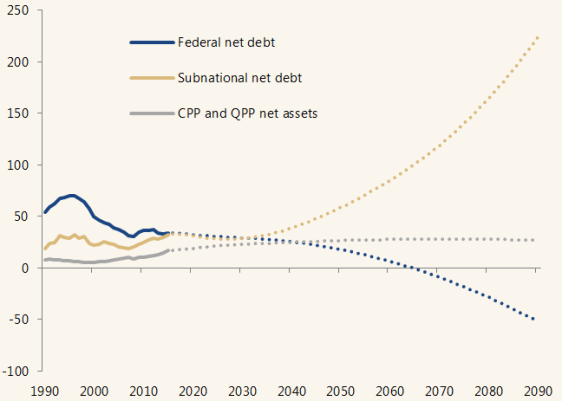
Sources:  Statistics Canada and Parliamentary Budget Officer.

Federal government

PBO’s 2015 Fiscal Sustainability Report concluded that the federal government had room to increase spending or reduce taxes. Measures in Budget 2016 have reduced this room. However, the government continues to have flexibility to expand policy while maintaining fiscal sustainability.

To maintain net debt at its current level of 33.7 per cent of gross domestic product (GDP) over the long term, PBO estimates that the federal government could permanently increase spending or reduce taxes by 0.9 per cent of GDP ($19.2 billion in current dollars). This is down from 1.4 per cent in last year’s assessment.

PBO’s federal sustainability assessment concludes:

  • Federal fiscal room has been reduced as a result of reversing the increase in the age of eligibility for the Old Age Security program. The higher long-run cost as a result of the change is expected to reduce federal fiscal room by 0.2 per cent of GDP.
  • Removing existing children’s benefits and introducing the Canada Child Benefit are expected to reduce fiscal room by 0.1 per cent of GDP. However, a complete picture of the impact is uncertain, as no details have been announced describing the indexation of benefits or eligibility thresholds beyond the medium term. Parliamentarians may wish to seek further clarification.
  • The impact of other Budget 2016 spending measures, including Phase 1 and Phase 2 of Canada’s New Infrastructure Plan, is 0.1 per cent of GDP.

Subnational governments

The outlook for subnational governments (that is, combined provincial, territorial, local and Aboriginal governments) is little changed from last year’s assessment. Permanent policy actions amounting to 1.5 per cent of GDP ($30.2 billion in current dollars) would be required to stabilize the subnational government net debt-to-GDP ratio at its current level (32.5 per cent) over the long term. The required fiscal consolidation has increased marginally from 1.4 per cent in last year’s assessment.

PBO’s subnational government sustainability assessment concludes:

  • The slight increase in the fiscal gap is the result of higher-than-projected program spending in 2015.
  • Health care spending outpaced nominal GDP growth in 2015. This, along with historical revisions to the national accounts, has raised PBO’s projection for excess cost growth.  Excess cost growth refers to the increase in health spending that cannot be accounted for by general inflation, real per capita income growth, population growth and ageing.
  • Although provinces cannot meet the challenges of population ageing under current policy, the required fiscal consolidation is not insurmountable if compared to previous consolidation episodes. Furthermore, the changes do not need to occur immediately. However, the longer they are delayed, the greater the adjustment that is required.

Canada Pension Plan and Quebec Pension Plan

The fiscal gap for the public pension sector represents the immediate and permanent change in contributions and/or expenses that returns the net asset-to-GDP ratio to its current level over the long term. PBO estimates that public pension plans are sustainable over the long term.

The long-term projection of the Canada Pension Plan (CPP) does not incorporate the agreement in principle signed by Canada’s Finance Ministers on 20 June 2016. PBO will assess the changes to the CPP when further details on implementation are released.

Total general government sector

The total general government sector in Canada (that is, the combined federal and subnational governments and public pension plans) is not fiscally sustainable without permanent increases in revenues or reductions of at least 0.6 percentage points of GDP.

Changes could be made at any level of government to eliminate the total government fiscal gap. However, ensuring the sustainability of each government sector on its own would require a consolidation at the subnational level and/or higher transfers from the federal government.

Related posts

  • 21 July 2015

    This report provides an assessment of the long-term sustainability of government finances for three government sub-sectors: the federal government; subnational governments consisting of provinces, territories, local, and aboriginal governments; and, the Canada and Quebec Pension Plans.    [PDF]

Source: Fiscal Sustainability Report 2016

Government of Canada highlights improved support for Veterans and their families

Budget 2016 reaffirms commitment to Veterans

REGINA, May 24, 2016 /CNW/ – The Honourable Kent Hehr, Minister of Veterans Affairs and Associate Minister of National Defence, spoke with Veterans and community leaders in Regina today to highlight the Government of  Canada’s support for Canada’s ill and injured Veterans and how Budget 2016 will enhance that support.

To help Veterans and their families as they transition from military to civilian life, Veterans Affairs Canada will build on an existing suite of programs and supports with enhancements to financial benefits, restored access to critical services and more front-line staff.

An increase to the Disability Award to a maximum of $360,000 will mean more money in the pockets of Veterans who suffer from illnesses such as post-traumatic stress disorder (PTSD) as a result of service.

Increasing the Earnings Loss Benefit to 90% of a Veteran’s pre-release salary will ensure former members undergoing rehabilitation have the financial support they need.

Expanding access to the Permanent Impairment Allowance by introducing an individualized assessment will ensure Veterans are more appropriately compensated for the impact of a service-related impairment on their career.

Finally, Veterans Affairs Canada will re-open nine offices across the country and hire additional case managers so that each serves no more than 25 individuals. Additionally, a new office will open in Surrey, B.C., and outreach to Veterans in the North will be expanded by working with local partners.

Budget 2016 delivers $5.6B in additional benefits and takes historic steps to treat Veterans with care, compassion and respect.

Quick Facts

  • The Government of Canada will make it easier for Veterans’ families to access the Funeral and Burial Program for a dignified burial. The Department plans to increase the estate exemption from $12,015 to $35,279 and also apply an annual cost of living adjustment to this amount.
  • Plans are also underway to expand the scope of the Commemorative Partnership Program to allow funding for the building of new community war memorials and to streamline the application process.
  • The new Have Your Say consultation tool, available on the Veterans Affairs Canada website, invites Veterans, stakeholders and Canadians to their provide feedback on Veterans’ issues and priorities.
  • The Minister of Veterans Affairs remains committed to all items in his mandate letter, including pensions for life.

Quote


“The Government of Canada is taking historic steps to ensure Canadian Veterans and their families are treated with care, compassion and respect. Budget 2016 reaffirmed our intent to give back to Veterans and deliver on our promises to restore critical access to services and improve the long-term financial security and independence of disabled Veterans and their families.”

The Honourable Kent Hehr, Minister of Veterans Affairs and Associate Minister of National Defense

Associated Links


SOURCE Veterans Affairs Canada

For further information: Media Relations, Veterans Affairs Canada, 613-992-7468 1

RELATED LINKS
www.veterans.gc.ca

Source: Government of Canada highlights improved support for Veterans and their families

Budget 2016: Key Issues for Parliamentarians

Get the report
Budget 2016: Key Issues for Parliamentarians.pdf

Summary
The presentation of the fiscal plan

The Government has made changes to the presentation of its fiscal plan that have made it more difficult for parliamentarians to scrutinize public finances.

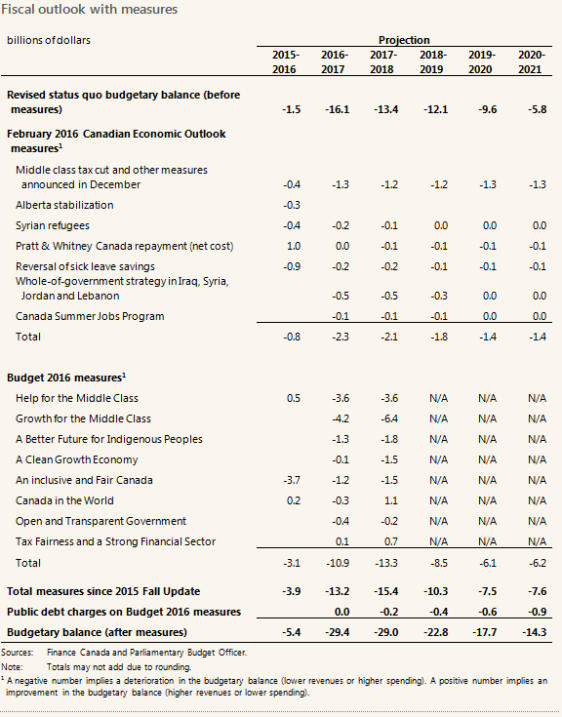
  • The Government did not provide detailed tables that identify the impact of changes to its adjustment to the private sector forecast and the effect of policy measures.
  • Budget 2016 shortened the time horizon of cost estimates from 5 years to 2 years.
  • Key fiscal information is being released outside of the budget and Fall Update with no reconciliation between the main documents.

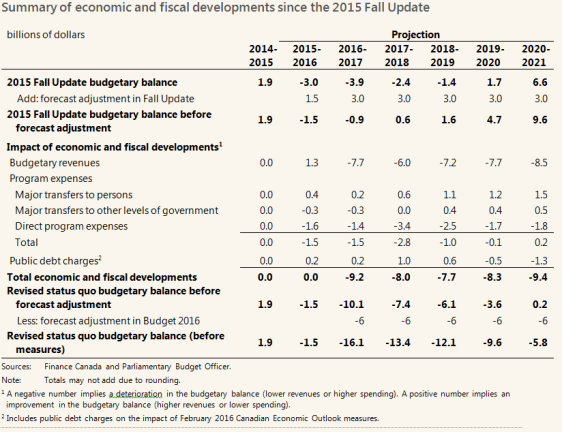
To maintain consistency with past presentation practices, PBO has attempted to compile the standard fiscal planning tables for Budget 2016. However, PBO is unable to provide completed tables due to the lack of information provided in Budget 2016. PBO requested the necessary data from Finance Canada in order to publish completed tables for parliamentarians.

The Government’s adjustment to private sector economic assumptions

Budget 2016 highlights that the use of private sector economic forecasts for fiscal planning “introduces an element of independence in the Government’s fiscal forecast.” However, in Budget 2016, the Government judged it appropriate to lower the private sector forecast of nominal gross domestic product (GDP)—the broadest single measure of the tax base—by $40 billion per year over 2016 to 2020. This forecast adjustment translates into a fiscal impact of $6 billion annually over 2016-17 to 2020-21.

Based on historical experience, PBO believes that the $40 billion per year forecast adjustment to the February 2016 private sector forecast of nominal GDP in 2016 and 2017 is excessive. Indeed, based on the past performance of private sector forecasters, it is likely that the actual outcome for nominal GDP in 2016 and 2017 will exceed the levels used for fiscal planning purposes, resulting in smaller-than-expected budgetary deficits in 2016-17 and 2017‑18, all else being equal.

PBO believes that the Government’s adjustments to the private sector forecast (particularly when the adjustments are excessive and always in the same direction) erode the “element of independence” that is introduced into the fiscal plan by using the average private sector forecast.

PBO is, however, encouraged by the inclusion of alternative growth scenarios in Budget 2016 to gauge the sensitivity of the fiscal track. Budget 2016 also commits the Government to develop alternative growth scenarios and their fiscal implications, communicating the analysis “to Canadians as projections are updated.”

Finance Canada’s estimates of the economic impacts of Budget 2016 measures

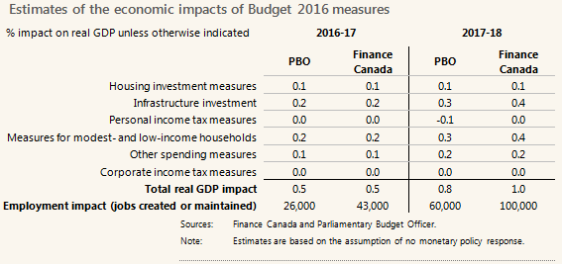
Finance Canada has provided estimates of the economic impacts of measures contained in Budget 2016 based on its macroeconomic and fiscal model. However, unlike previous analyses, Finance Canada did not conduct an external assessment of its estimates. For instance, in Budget 2009, to gauge the sensitivitiy of its estimates, Finance Canada asked private sector organizations to calculate comparable fiscal multipliers.

To provide parliamentarians with an independent estimate of the economic impacts of Budget 2016 measures, PBO has used its own macroeconomic and fiscal model. On balance, these estimates are somewhat smaller than Finance Canada’s.

PBO’s estimates assume that measures in Budget 2016 will be implemented as scheduled and as targeted. Aside from the uncertainty surrounding fiscal multiplier estimates, differences in timing (for example by lapsing funds) or in the targeted sector would impact these results.

Source: Budget 2016: Key Issues for Parliamentarians

Minister Morneau’s First Budget Restores Hope for the Middle Class – Budget 2016

Main_eng

March 22, 2016 – Ottawa, Ontario – Department of Finance

The Minister of Finance, Bill Morneau, today tabled the new Government of Canada’s first federal budget, Growing the Middle Class, a plan that takes important steps to revitalize the Canadian economy, and delivers real change for the middle class and those working hard to join it.

A strong economy starts with a strong middle class. That is why building an economy that works for Canadians and their families is the top priority of this government.

Budget 2016 offers immediate help to those who need it most, and lays the groundwork for long-term economic growth. Most importantly, it focuses squarely on people and the things that matter most to them—things like strengthening the middle class, creating jobs, and growing the economy.

As of January 1st, the government’s Middle Class Tax Cut ensures roughly 9 million Canadians receive a bigger paycheque every payday.

Today, Minister Morneau builds on this progress with the introduction of the new Canada Child Benefit—a simpler, tax-free, more generous, targeted benefit that helps those who need it most: the middle class. Starting in July of 2016, nine out of ten families will receive more money than they did under the previous government.

Budget 2016 signals a new approach that will create jobs and improve the quality of life for Canadians, today and in the future. This includes historic new investments in infrastructure that total more than $120 billion over the next decade.

As an immediate first step, the government will invest $11.9 billion in modern and reliable public transit, water and wastewater systems, affordable housing, and in retrofits and repairs to protect existing projects from the effects of climate change.

Additional longer-term investments will help Canada become a low carbon economy, and create more vibrant cities, digitally connected rural areas, and safe, healthy, thriving communities.

Budget 2016 also provides significant new investments to support both students and post-secondary institutions, so that the next generation of Canadians is well-equipped to tackle the challenges of the future. In addition, the government will promote research, accelerate business growth, and support clean technology to better position Canada in the rapidly shifting global economy.

Recognizing that protecting the environment and growing the economy go hand in hand, the government will invest in clean technologies that address climate change, air quality, clean water, and clean soil. Budget 2016 also reiterates the government’s intention to establish a $2 billion Low Carbon Economy Fund.

To ensure that this growth is shared by all Canadians, Budget 2016 takes renewed steps to give all Canadians the same opportunities to succeed, no matter who they are, or where they come from. This includes unprecedented investments in First Nations, Inuit Peoples, and the Métis Nation—totalling $8.4 billion over five years—in areas that include education, infrastructure, and skills training. The government will ensure access to clean drinking water for every child, including those who live on reserves.

Investments in a more inclusive and fair Canada include efforts to: provide federal leadership in health care; help seniors realize the promise of a dignified and secure retirement; renew a commitment to enhance the Canada Pension Plan; and fulfill our sacred obligation to Canada’s veterans.

Budget 2016 also takes action to renew Canada’s place on the world stage. The government will provide international assistance for the most vulnerable, and welcome as many as 300,000 permanent residents in 2016 to foster sustainable growth and grow the middle class.

Growing the Middle Class comes at a time when the Government of Canada has both the capacity and the willingness to act. Budget 2016 takes action to revitalize the economy and create opportunity for all Canadians, by focusing on the middle class and those working hard to join it.

Quote

“Our plan will recapture the hope and optimism for the future that existed in previous generations, and put it to work for the next. Real change is not just about today or tomorrow. It is about revitalizing the economy in the years and decades to come, so that it works for the middle class and helps those working hard to join it.”

Bill Morneau, Minister of Finance

Related

Source: Budget 2016