Workplace Democracy–Broadbent Institute

Workplace democracy speaks to an ever-present need to advance the fundamental rights of employees to associate freely and to have some say over business decisions that affect their lives. It also speaks to the need to respect the expertise that employees develop day in and day out on the job and, importantly, to strengthen protections and extend rights to marginalized workers who are bearing the brunt of the shift to low-wage, insecure, precarious work.

In this discussion paper, authors Rafael Gomez, Professor & Director of the Centre for Industrial Relations and Human Resources at the University of Toronto and Juan Gomez, Senior Partner, Policy and Public Affairs at ThinkTank Toronto, offer recommendations on a path forward.

As part of the Institute’s effort to renew a national dialogue on workplace democracy, we will be publishing responses to this discussion paper from a diversity of perspectives throughout the summer. Stay tuned for responses on our blog.

document.png

Download Workplace Democracy

https://andrewphillipchernoff.ca/wp-content/uploads/2016/06/logo.png

Source: Workplace Democracy

National Executive Board Highlights – March 2016 | Canadian Union of Public Employees

Our National Executive Board met March 21–23, 2016 in Ottawa. These are the highlights of their deliberations and decisions.

In Memory

The National Executive Board (NEB) observed a minute of silence to reflect upon the loss of members in our CUPE family. Remembered were: Brother Elwin “Sonny” Kalynchuk, Local 474; Brother Leonard Sarnosky, Local 941; Brother Thierry Leroux, Local 5153 (workplace fatality); Brother Claude Davidson, Local 3333 (workplace fatality); Sister Linda Hildebrand, Local 1858; retirees Sister Margaret Churchward, Brother Thomas Osborn, Brother Pierre Thériault; and CUPE Nova Scotia President Brother Mike McNeil. The NEB also remembered victims of the violent attacks in Belgium that morning.

Broadbent Institute

The NEB met with Ed Broadbent and Rick Smith of the Broadbent Institute and discussed the work they have undertaken and their priorities for the coming year, including income inequality and democratic renewal. It was an honour to have Mr. Broadbent’s presence on his 80th birthday, and he was appropriately feted.

NEB Resolution – Electoral Reform

The NEB adopted a strong resolution which commits CUPE to support the introduction of proportional representation for federal elections, develop materials for internal use to explain and promote it, and work with civil society partners to engage in the conversation about democratic reform in Canada. View the full resolution at: http://cupe.ca/neb-resolution-proportional-representation.

The NEB also voted to join the Every Voter Counts Alliance: http://www.everyvotercounts.ca/

Support for Striking Workers

In solidarity with 61 members of the Halifax Typographical Union who have been on strike at the Halifax Herald since January 23, 2016, the NEB approved a donation in the amount of $10,000.

The NEB also approved a donation of $7,000 to seven members of the Nova Scotia Union of Public and Private Employees who have been on strike against Canadian Blood Services in Prince Edward Island for more than six months.

2016 Federal Budget

CUPE economist Toby Sanger joined the NEB on March 23 to provide an overview of the federal budget, which had been introduced the previous day. There was some good news in the budget, including some improvements to Employment Insurance (EI), measures to start combating climate change, investments in infrastructure, and new funding for Canada’s indigenous communities especially on education.

However, there are still significant improvements needed to EI; there was no commitment to expanding the Canada Pension Plan, no commitment on the creation of affordable and accessible child care. And while the Minister pledged in his speech to negotiate a new health accord with the provinces and territories, there is no new money to do so.

CUPE Fightback Fund

The NEB approved a request from SCFP-Québec for financial support in order to fend off an unprecedented attack on the province’s municipal workers, in anticipation of legislation that would undermine the right of these workers and their unions to free and fair negotiations.

A request from CUPE Nova Scotia, for financial support to mount a provincial fightback campaign in response to legislation that removes free collective bargaining in the provincial public service and mandates the terms of a public sector agreements, also received NEB approval.

Financial Support

The NEB approved 15 cost shares for a total of $762,089.46. The NEB also received and approved 14 requests for legal/arbitration costs for $508,933.

Source: National Executive Board Highlights – March 2016 | Canadian Union of Public Employees

Canadian government should create a uniquely Canadian version of a Green Entrepreneurial State, Broadbent Institute Encourages

header

Canada’s First Ministers are meeting in Vancouver this week to develop a framework to tackle climate change. The stakes for our planet are high and the opportunities to transform our economy are immense.

A Green Entrepreneurial State as Solution to Climate Federalism, authored by one of our policy fellows, Brendan Haley, argues that market approaches like carbon pricing, though vital and necessary to reducing emissions, cannot do the job alone. Government and public investment must play an important role in shaping the direction of technological innovation towards a low carbon future.

Help us get out the message that we need strong federal leadership with a policy focus on developing specific green technologies and industries that play to this country’s regional strengths and can ensure a green transition.

Download:  A Green Entrepreneurial State as Solution to Climate Federalism

Thanks for all your help with this,

Jonathan Sas
Director of Research
Broadbent Institute


OECD Study: The gap between Canada’s rich and poor is significantly bigger than previously thought

It looks like inequality in Canada is much higher than previously thought.

A recent study published by the Organisation for Economic Co-operation and Development, a major voice on global economic policy representing 34 developed countries, suggests past measures of inequality have failed to capture the true scale of the growing gap between the rich and the poor.

The study, authored by OECD economists Nicolas Ruiz and Nicolas Woloszko, explains that past measures of income inequality relied on data from household surveys that, although useful, are “well-known” to under-report top incomes, something that “can lead to [a] large bias in the measurement of inequality.”

To get a clearer picture of how rich the wealthy truly are, the OECD looked at tax data to fill in the gaps for top incomes.

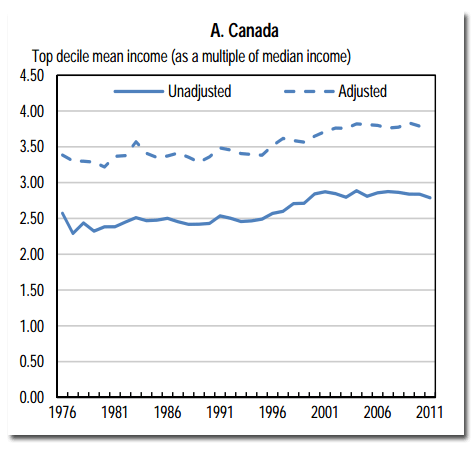
The results? Canada’s top 10% of income earners were previously thought to earn around three times more than median income earners, but the OECD’s new numbers suggest they’re actually earning closer to four times more than those in the middle:

oecd-inequality-canada.png

The same also rings true of top earners around the world.

“The results point to a significant increase of the level of inequality measured by standard statistics based on official figures,” the OECD study concludes.

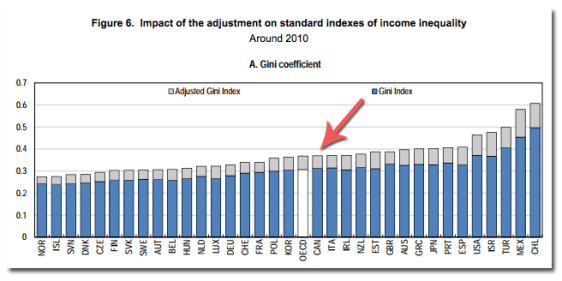
Using the Gini coefficient (a commonly used measure of inequality), the OECD finds inequality in Canada ranks slightly above the average in other OECD countries:

oecd-inequality-world-arrow.png

A 2014 survey commissioned by the Broadbent Institute found Canadians “vastly underestimate how skewed the distribution of wealth actually is.”

Apparently the income gap is bigger than previously thought too.

Photo: Pixabay. Used under Creative Commons license.

Source: OECD Study: The gap between Canada’s rich and poor is significantly bigger than previously thought

A national child care system… because “it’s 2015” – Broadbent Institute

The best line of the Trudeau government’s first day— widely reported and praised in the international media—was the new PM’s.

In response to a reporter’s question about why he’d chosen to create a gender-parity cabinet, he rather matter of factly observed “because it’s 2015”.  This ostensibly simple statement summed up a complexity of attitudes, beliefs and even world views in three words. For those feminists who remain doggedly optimistic after a decade nasty enough to slay the optimism of Anne of Green Gables, it raised hopes that the first day’s lustre could foreshadow more significant changes to come.

Mr. Trudeau’s observation aptly fits another feminist “ask”— one that’s been a pillar of the feminist agenda for 45 years. This is the kind of solid universal publicly-funded early childhood education and child care (ECEC) system that many other countries have; one well-designed so it simultaneously advances women’s equality, supports young families across the income spectrum and is good for children.

Feminists are but one of the constituencies who passionately believe that 45 years after the report of the Royal Commission on the Status of Women, the answer to why a coherent national child care system of high quality services is needed is simply “because it’s 2015”.

“Because it’s 2015” stands in for a host of no-brainer rationales. Child care is still the ramp to women’s equality in employment.  Economic research shows how child care helps stimulate the economy through mothers’ paid work. Child care helps “generation squeeze” mothers and fathers balance work and family and make ends meet. Without child care, it’s impossible to help families out of poverty or help newcomers settle. And substantial research has accumulated that shows that if it’s high quality and inclusive, early childhood education and  care provides a terrific environment in which young children thrive whether they’re middle class or low income, abled or disabled, francophone, Anglophone or Indigenous.

Most women with children —more than 77% with three to five year olds—are employed or  engaged in studying, language learning and other activities. Yet a crucial piece of the social infrastructure needed to support them is still missing in Canada in 2015. And many families who don’t “need” child care choose to have their children participate in early childhood programs for socialization and learning as children do from about age two and a half in many other countries.

Now that the dust from the election has settled and the new government gets down to work, it’s timely to review campaign commitments to child care. The Liberal platform stated:

“We will develop a child care framework that meets the needs of Canadian families, wherever they live”, and “we will meet with provinces, territories, and Indigenous communities to begin work on a new National Early Learning and Child Care Framework, to deliver affordable, high-quality, flexible, and fully inclusive child care for Canadian families. This work will begin in the first 100 days of a Liberal government and will be funded through our investments in social infrastructure. The framework we design together will be administered in collaboration with, and in respect of, provincial jurisdictions”.

The platform also made an explicit commitment to “research, evidence-based policy, and best practices in the delivery of early learning and child care”. As one of the world’s child care laggards, Canada is in a position to learn a great deal not only from our own experience but by using evidence  from other countries about best (and worst) ECEC policies and practices. The body of research and analysis could be important because there is now substantial evidence about the best ways to move forward on the universal, high quality, publicly funded and managed early childhood education and care system long sought in Canada.

In a video outlining directions on child care developed by the Liberal Party for last November’s ChildCare2020 conference, Mr. Trudeau declared that: “As a country, we need to prioritize access to child care for every family that needs it. It must be affordable, available, and of the highest quality possible. When we’re talking about our kids’ development, we can’t cut corners”. And on CBC Radio’s The House last spring: “We’re committed to making sure parents have affordable, quality early learning for their kids, there’s no question about it,” concluding with “I think there is a need for national leadership to make sure that early learning and child care happens”.

The child care platform is one of three components in a “Greater Economic Security for Middle Class Families” package. In addition to child care, it includes a new geared-to-income Canada Child Benefit which amalgamates the existing Canada Child Tax Benefit (CCTB) with the Harper government’s Universal Child Care Benefit (UCCB) cheques, and Flexible Work, including more flexible parental leave benefits. The funding for child care, however, which is part of the Social Infrastructure Fund, is not earmarked specifically for child care. Thus, the new government’s commitment to a national child care program—while it includes many of the key elements needed to make it work—still leaves important pieces to be fleshed out.

The 2015 federal election was the first in which child care was a major election issue and the first in which three of four political parties—for which 70% of Canadians voted— made commitments to a national child care program. Noting that it had primarily been the NDP championing child care in the campaign, the Toronto Star’s endorsement of Mr. Trudeau observed, “If he wins power, [a national child care program] ought to be on his agenda”. The Star noted that “a national child care program is something that is long overdue” and that it would be firmly within the Liberal Party’s tradition if revived, as “Paul Martin’s government first proposed such a national plan more than a decade ago”.

In 2015, it’s dreadfully evident that our patchwork, marketized child care situation fails just about everyone and that young Canadian families live in one of the few wealthy countries that fails to  support them well. While not a simple task, taking on the challenge of beginning to create a real evidence-based national child care program in 100 days when the new federal government meets with the provinces would be consistent with creating the gender-parity, diverse and talented cabinet revealed yesterday.

And it would be absolutely appropriate if for no other reason than simply…”because it’s 2015”.

Martha Friendly is Director of the Childcare Resource and Research Unit.

Source: A national child care system… because “it’s 2015” – Broadbent Institute