UN monitoring mission eyes Site C dam impact on Wood Buffalo National Park

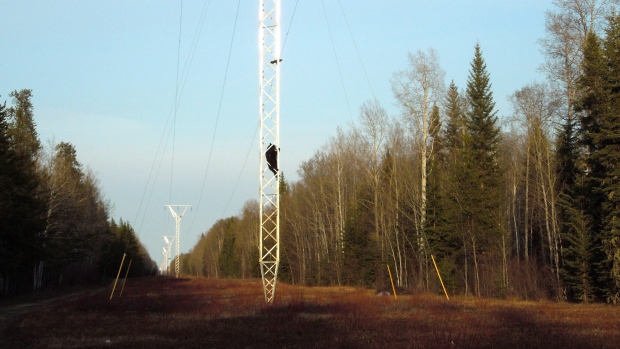
A bear climbs down after raiding a raven’s nest atop of power transmission tower in Wood Buffalo National Park in this Sunday May 10, 2015 handout image provide by hunter Linda Powell of O.F. Mossberg and Sons, Inc. (THE CANADIAN PRESS/HO)

By Bruce Cheadle, The Canadian Press

Sunday, September 25, 2016

OTTAWA — A United Nations monitoring mission to a world heritage site in northern Alberta appears likely to focus more attention on the contested Site C hydroelectric project next door in British Columbia.

Wood Buffalo National Park, a UNESCO world heritage site since 1983, is under review this week at the request of the Mikisew Cree First Nation, who petitioned the world body in 2014 to list the park as being under threat from various developments.

The park is at the convergence of the Peace and Athabaska rivers and is considered the largest freshwater boreal delta on the planet.

Conservationists and local First Nations are concerned about how two existing hydro dams on the Peace River are affecting the hydrology of the park — a problem they say will be compounded by B.C.’s massive Site C dam that’s going ahead on the Peace River.

The World Heritage Centre concluded in 2015 that a review of cumulative effects on Wood Buffalo National Park was warranted, and in the meantime asked that Canada not make any other development decisions that “would be difficult to reverse.”

Nonetheless, the Trudeau government issued federal fisheries permits this summer to allow construction to go ahead on Site C, which will dam an 83-kilometre long reservoir on the Peace River.

The 10-day “reactive monitoring mission” of Wood Buffalo by a committee of international UNESCO experts got underway Sunday, after being postponed earlier in the year due to the wildfires around Fort McMurray, Alta.

The park review opens a new front in the battle over Site C, which is already being challenged in Federal Court by two B.C. First Nations.

The federal permits quietly issued in late July further inflamed the debate, with Perry Bellgarde, the national chief of the Assembly of First Nations, publicly stating this month that the hydro project is not being handled in keeping with Canada’s constitution nor with the UN Declaration on the Rights of Indigenous Peoples.

Those concerns about indigenous consultation dovetail with the complaints over the management of Wood Buffalo National Park.

The World Heritage Committee’s decision to go ahead with the review noted “with concern the lack of engagement with indigenous communities in monitoring activities, as well as insufficient consideration of traditional ecological knowledge.”

Federal Environment Minister Catherine McKenna welcomed the UNESCO monitoring mission, which could only come with the invitation of the federal government.

“The government of Canada is committed to preserving our national parks, some of which are recognized World Heritage sites, and doing so in partnership with local communities, Indigenous peoples and other stakeholders,” McKenna said in a statement Friday.

Source: UN monitoring mission eyes Site C dam impact on Wood Buffalo National Park | CTV News
Taxpayers as bagholders – In-Sights

By on August 25, 2016

Normzig, “No matter how many speeches are made or how many permits are issued and how many rainbow forecasts are shown, the only way BC is getting LNG plants anytime soon is if they build them with taxpayer money.”

Reuters, Clyde Russell, Launceston, Australia, June 9, 2016

Conventional wisdom in the liquefied natural gas (LNG) sector is that no new projects will be built for several years, given the vast cost can’t be reconciled with the current low prices.

The wave of LNG building in recent years has seen eight projects being built in Australia, with five now operating and the remaining three nearing completion, and five in the United States, the first of which has starting shipping cargoes.

The era of mega-LNG projects appears to be over, at least for now.

The average breakeven cost for the recent projects is $12.60 per mmBtu, a price well above the current levels.

Substantial volumes of additional LNG that can come to market in the coming years from existing facilities at considerably lower prices when compared to the huge cost of developing new plants …

lng

LNG World News, August 23, 2016:

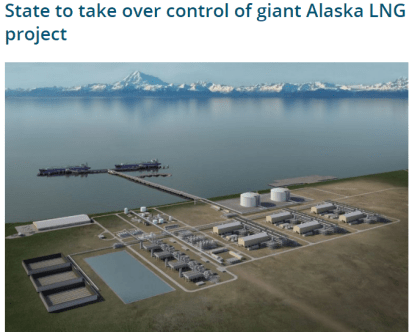
The Alaska Gasline Development Corp, owned by the state of Alaska, said it plans to assume full management of the $45 billion-plus Alaska LNG Project by the end of this year.

…Once transitioned, the Alaska Gasline Development Corporation will be responsible for managing the project going forward including applying for regulatory approval, securing the commercial commitments from gas sellers, shippers, and buyers necessary to acquire the equity and debt financing that will be required to complete the project and prepare to start.

industry

Translation:

When we initiate creative ways for taxpayers to subsidize oil and gas, there’s nothing better than having another of their senior people help us transfer investment risks to the public while still ensuring that profits stay with the industry.

taxpayer

Source: Taxpayers as bagholders – In-Sights

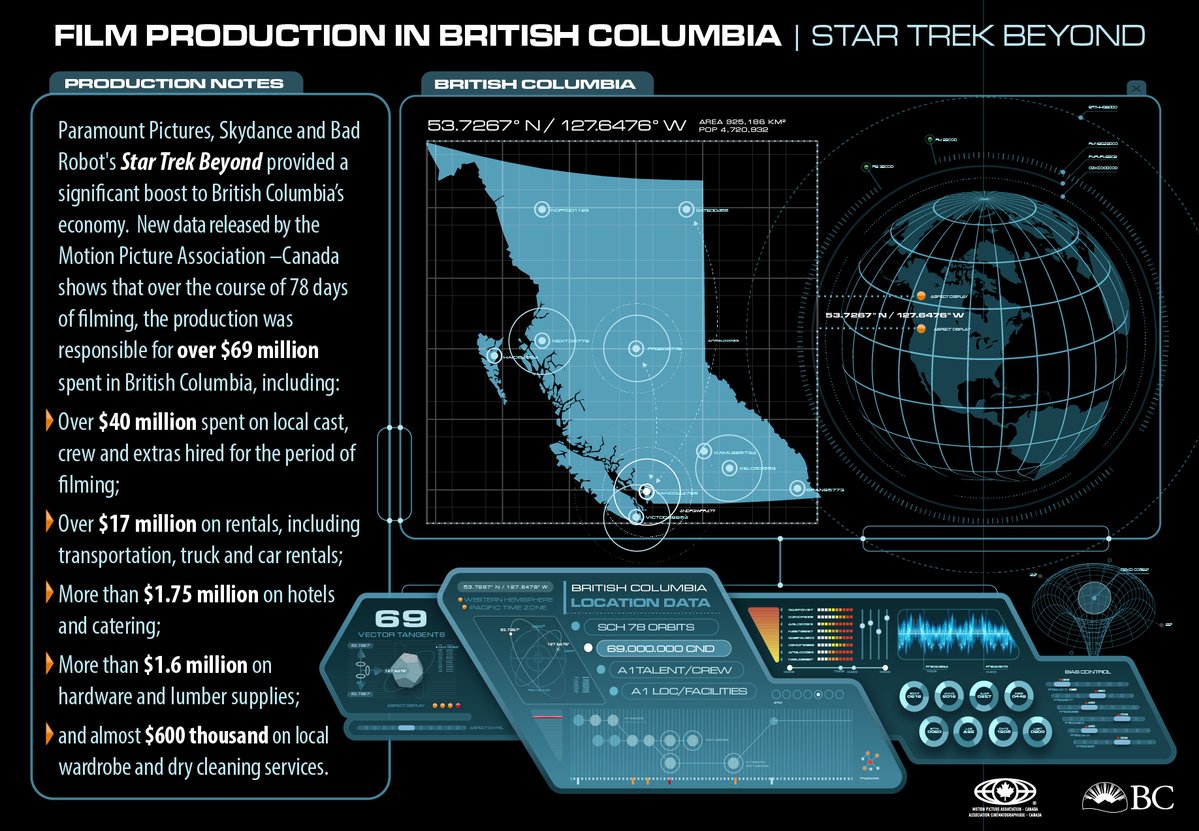
Paramount Pictures, Skydance and Bad Robot’s Star Trek Beyond spent over $69 million in British Columbia and created 3,925 jobs

CoAiyj_VMAAIWgt

VANCOUVER, BRITISH COLUMBIA – July 22, 2016 – Paramount Pictures, Skydance and Bad Robot’s Star Trek Beyond, out in theatres today, provided a significant boost to British Columbia’s economy.

New data released today shows that over the course of 78 days of filming, the production was responsible for over $69 million spent in British Columbia.

From the construction of the U.S.S. Enterprise at Vancouver Film Studios to filming at the beautiful Squamish Boulders, British Columbia continues to benefit from the economic boost of local productions like Star Trek Beyond.

Over $40 million was spent on local cast, crew, and extras hired for the period of filming. Some of the production’s other local expenditures include:

  • Over $17 million on rentals, including transportation, truck and car rentals;
  • More than $1.75 million on hotels and catering;
  • More than $1.6 million on hardware and lumber supplies; and
  • Almost $600 thousand on local wardrobe and dry cleaning services.

“The film and television industry is a creative and economic engine for British Columbia, benefiting local businesses, thousands of cast and crew, and communities across the province,” said Wendy Noss, President, Motion Picture Association-Canada.

“The data released today demonstrates the significant impact the industry continues to have both provincially and nationally.”

“Filming Star Trek Beyond in Vancouver and the surrounding areas provided us diverse filming locations and outstanding film studios, but beyond that we had access to amazing local cast and crew,” said Lee Rosenthal, President of Physical Production, Paramount Pictures.

“We are thankful for British Columbia’s hospitality and the numerous local businesses and vendors who were great to work with.”

“Vancouver Film Studios was thrilled to provide state of art production facilities for the filming of Star Trek Beyond,” said Peter Mitchell, President & Chief Operating Officer, Vancouver Film Studios and Board Member, Motion Picture Production Industry Association.

“With 12 purpose-built sound stages on 35 acres in the City of Vancouver and over $200 million invested, we have established our reputation as a leading film and television studio facility. British Columbia has become a key destination for film and television investment and we are excited to play our part in that success.”

“Congratulations to the more than 3,900 British Columbians who helped bring Star Trek Beyond to audiences around the world!” said Shirley Bond, Minister of Jobs, Tourism and Skills Training, and Minister Responsible for Labour.

“British Columbia has a talented workforce, world-class infrastructure, and stunning diverse filming locations and because of these advantages, B.C. has earned its reputation as one of North America’s busiest centres for screen entertainment production.”

Source: http://www.mpa-canada.org