Negative pressure on Canadian consumer confidence continues into holiday season (released December 29, 2015)

Bloomberg-Nanos Economic Banner

Bloomberg Nanos Weekly Consumer Confidence Tracking

Canadian consumer sentiment in the holiday season continues to show negative pressure according to the Bloomberg Nanos Canadian Confidence Index with declines in main index and the forward looking Expectations Sub-indice.

“Of note, there has been noticeable downward pressure on positive views on the value of real estate over the past week,” said Nanos Research Group Chairman Nik Nanos.

“Consumers have reacted to the extremely low level of interest rates with a worrisome imbalance between housing market speculation and traditional household investment. It seems likely that consumer expectations and spending might suffer until labor-market displacement issues are addressed and households can repair their balance sheets”, said Robert Lawrie of Bloomberg Economics.

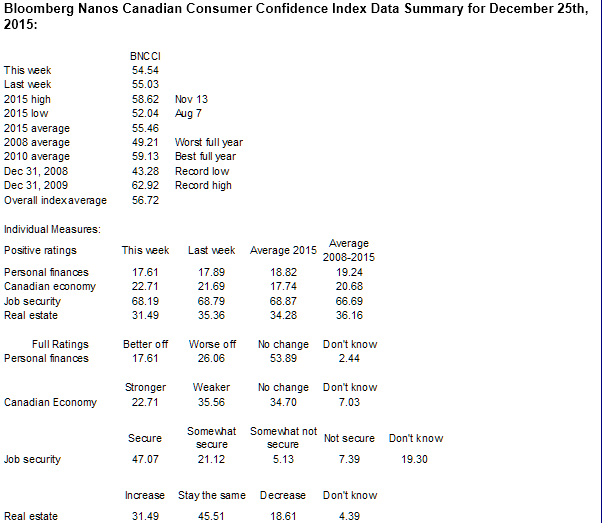
The BNCCI, a composite of a weekly measure of financial health and economic expectations, registered at 54.54 compared with last week’s 55.03. The twelve month high stands at 58.62.

The Bloomberg Nanos Pocketbook Index is based on survey responses to questions on personal finances and job security. This sub-indice was at 59.06 this week compared to 59.49 the previous week. The Bloomberg Nanos Expectations Index, based on surveys for the outlook for the economy and real estate prices, was at 50.01 this week (compared to 50.58 last week).

The average for the BNCCI since 2008 has been 56.72 with a low of 43.28 in December 2008 and a high of 62.92 in December 2009. The index has averaged 55.46 this year.

To view the weekly tracking visit our website.

Methodology

The BNCCI is produced by the Nanos Research Corporation, headquartered in Canada,  which operates in Canada and the United States.  The data is based on random telephone interviews with 1,000 Canadian consumers (land- and cell-lines), using a four week rolling average of 250 respondents each week, 18 years of age and over. The random sample of 1,000 respondents may be weighted by age and gender using the latest census information for Canada and the sample is geographically stratified to be representative of Canada. The interviews are compiled into a four week rolling average of 1,000 interviews where each week, the oldest group of 250 interviews is dropped and a new group of 250 interviews is added. The views of 1,000 respondents are compiled into a diffusion index from 0 to 100. A score of 50 on the diffusion index indicates that positive and negative views are a wash while scores above 50 suggest net positive views, while those below 50 suggest net negative views in terms of the economic mood of Canadians.

A random telephone survey of 1,000 consumers in Canada is accurate 3.1 percentage points, plus or minus, 19 times out of 20.

All references or use of this data must cite Bloomberg Nanos as the source.
screenshot-{domain} {date} {time}

Slide in consumer confidence continues with Canada’s energy-rich Prairies leading the pessimism (released December 21, 2015)

Bloomberg-Nanos Economic Banner

Bloomberg Nanos Weekly Consumer Confidence Tracking

The Prairie provinces, once the most bullish region in terms of consumer sentiment continues to slide, driving down the national confidence numbers and hitting yet another new regional 12 month low according to the Bloomberg Nanos Canadian Confidence Index.

“Of note, perceptions related to job security and the future strength of the Canadian economy realized negative pressure this week,” said Nanos Research Group Chairman Nik Nanos.

“The decline in commodity prices continues to depress the Canadian dollar — which briefly traded at C$/US$ 1.40 for the first time since 2003 — while having an indirect impact on consumer sentiment in the commodity-dependent provinces. Market expectations are for stabilization of the C$ near this low level in the months ahead, with interest-rate differentials continuing to work against the C$ as the Fed begins its policy normalization process and the Bank of Canada maintains a more accommodative policy stance”, said Robert Lawrie of Bloomberg Economics.

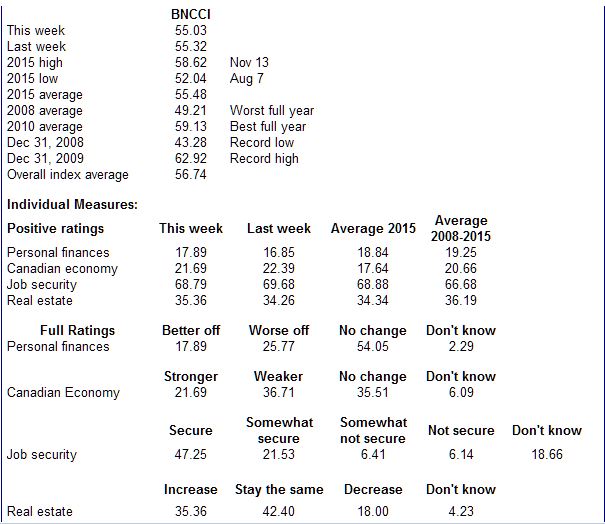
The BNCCI, a composite of a weekly measure of financial health and economic expectations, registered at 55.03 compared with last week’s 55.32. The twelve month high stands at 58.62.

The Bloomberg Nanos Pocketbook Index is based on survey responses to questions on personal finances and job security. This sub-indice was at 59.49 this week compared to 59.60 the previous week. The Bloomberg Nanos Expectations Index, based on surveys for the outlook for the economy and real estate prices, was at 50.58 this week (compared to 51.04 last week).

The average for the BNCCI since 2008 has been 56.74 with a low of 43.28 in December 2008 and a high of 62.92 in December 2009. The index has averaged 55.48 this year.

To view the weekly tracking visit our website.

Methodology

The BNCCI is produced by the Nanos Research Corporation, headquartered in Canada,  which operates in Canada and the United States.  The data is based on random telephone interviews with 1,000 Canadian consumers (land- and cell-lines), using a four week rolling average of 250 respondents each week, 18 years of age and over. The random sample of 1,000 respondents may be weighted by age and gender using the latest census information for Canada and the sample is geographically stratified to be representative of Canada. The interviews are compiled into a four week rolling average of 1,000 interviews where each week, the oldest group of 250 interviews is dropped and a new group of 250 interviews is added. The views of 1,000 respondents are compiled into a diffusion index from 0 to 100. A score of 50 on the diffusion index indicates that positive and negative views are a wash while scores above 50 suggest net positive views, while those below 50 suggest net negative views in terms of the economic mood of Canadians.

A random telephone survey of 1,000 consumers in Canada is accurate 3.1 percentage points, plus or minus, 19 times out of 20.

All references or use of this data must cite Bloomberg Nanos as the source.

Bloomberg Nanos Canadian Consumer Confidence Index Data Summary for December 18th, 2015:

bloom

Consumer confidence in Canada continues to slide in most of country – Energy-rich Prairie provinces hit new 12 month low in confidence (released December 14, 2015)

c7b6bc28-5306-484c-a3d8-9d8998ff23c8

Bloomberg Nanos Weekly Consumer Confidence Tracking

Perceptions on the future strength of the Canadian economy slide a noticeable three points in one week according to the Bloomberg Nanos Canadian Confidence Index.

“The energy-rich Prairie provinces, once a powerhouse of positive economic sentiment hit a new 12 month low,” said Nanos Research Group Chairman Nik Nanos.

“Canadian consumers appear to be hedging their bets; for every factor having a positive effect on household pocketbooks – i.e., declining energy prices and borrowing rates that remain extremely low – there are enough displacement issues and global uncertainties to go around. One would expect a long lag before the benefits of the drop in the Canadian dollar and the prospective fiscal stimulus filter through to household expectations”, said Robert Lawrie of Bloomberg Economics.

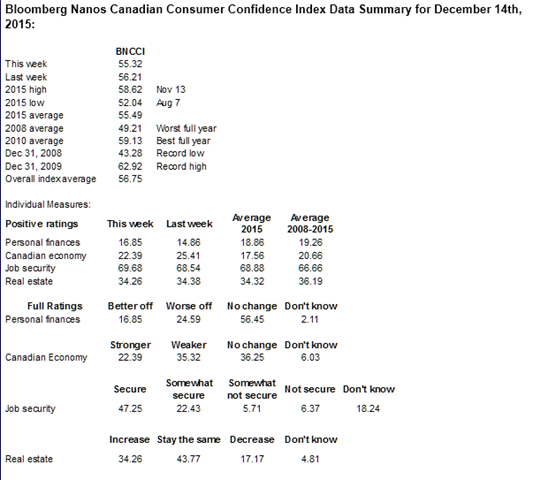
The BNCCI, a composite of a weekly measure of financial health and economic expectations, registered at 55.32 compared with last week’s 56.21. The twelve month high stands at 58.62.

The Bloomberg Nanos Pocketbook Index is based on survey responses to questions on personal finances and job security. This sub-indice was at 59.60 this week compared to 59.11 the previous week. The Bloomberg Nanos Expectations Index, based on surveys for the outlook for the economy and real estate prices, was at 51.04 this week (compared to 53.30 last week).

The average for the BNCCI since 2008 has been 56.75 with a low of 43.28 in December 2008 and a high of 62.92 in December 2009. The index has averaged 55.49 this year.

To view the weekly tracking visit our website

Methodology

The BNCCI is produced by the Nanos Research Corporation, headquartered in Canada,  which operates in Canada and the United States.  The data is based on random telephone interviews with 1,000 Canadian consumers (land- and cell-lines), using a four week rolling average of 250 respondents each week, 18 years of age and over. The random sample of 1,000 respondents may be weighted by age and gender using the latest census information for Canada and the sample is geographically stratified to be representative of Canada. The interviews are compiled into a four week rolling average of 1,000 interviews where each week, the oldest group of 250 interviews is dropped and a new group of 250 interviews is added. The views of 1,000 respondents are compiled into a diffusion index from 0 to 100. A score of 50 on the diffusion index indicates that positive and negative views are a wash while scores above 50 suggest net positive views, while those below 50 suggest net negative views in terms of the economic mood of Canadians.

A random telephone survey of 1,000 consumers in Canada is accurate 3.1 percentage points, plus or minus, 19 times out of 20.

All references or use of this data must cite Bloomberg Nanos as the source. 

nano

Three week slide in Canadian consumer confidence according to Bloomberg Nanos tracking – Perceptions of value of real estate slide (released December 7, 2015)

c7b6bc28-5306-484c-a3d8-9d8998ff23c8

Bloomberg Nanos Weekly Consumer Confidence Tracking

Consumer confidence continues to slide according to the Bloomberg Nanos Canadian Consumer Confidence Index.  Of note, perceptions on the future value of real estate took a noticeable decline over the past week.

“British Columbia and Quebec were the two Canadian provinces which realized a dip in consumer confidence over the past week”, said Nanos Research Group Chairman Nik Nanos.

“The Atlanta Fed’s GDPNow model is calling for 1.4% fourth-quarter U.S. growth, which would be expected to have negative implications for the Canadian recovery. The Bank of Canada is looking for Canadian growth to moderate in the fourth quarter as well, which suggests that Canadian household expectations and consumption could very well continue their downtrends”, said Robert Lawrie of Bloomberg Economics.

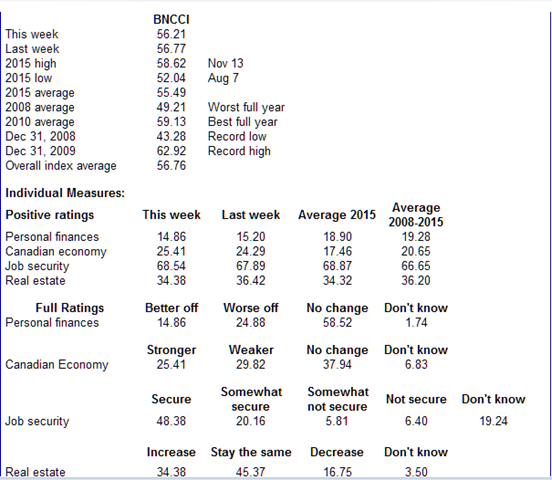
The BNCCI, a composite of a weekly measure of financial health and economic expectations, registered at 56.21 compared with last week’s 56.77. The twelve month high stands at 58.62.

The Bloomberg Nanos Pocketbook Index is based on survey responses to questions on personal finances and job security. This sub-indice was at 59.11 this week compared to 59.24 the previous week. The Bloomberg Nanos Expectations Index, based on surveys for the outlook for the economy and real estate prices, was at 53.30 this week (compared to 54.30 last week).

The average for the BNCCI since 2008 has been 56.76 with a low of 43.28 in December 2008 and a high of 62.92 in December 2009. The index has averaged 55.49 this year.

To view the weekly tracking visit our website

Methodology

The BNCCI is produced by the Nanos Research Corporation, headquartered in Canada,  which operates in Canada and the United States.  The data is based on random telephone interviews with 1,000 Canadian consumers (land- and cell-lines), using a four week rolling average of 250 respondents each week, 18 years of age and over. The random sample of 1,000 respondents may be weighted by age and gender using the latest census information for Canada and the sample is geographically stratified to be representative of Canada. The interviews are compiled into a four week rolling average of 1,000 interviews where each week, the oldest group of 250 interviews is dropped and a new group of 250 interviews is added. The views of 1,000 respondents are compiled into a diffusion index from 0 to 100. A score of 50 on the diffusion index indicates that positive and negative views are a wash while scores above 50 suggest net positive views, while those below 50 suggest net negative views in terms of the economic mood of Canadians.

A random telephone survey of 1,000 consumers in Canada is accurate 3.1 percentage points, plus or minus, 19 times out of 20.

All references or use of this data must cite Bloomberg Nanos as the source. 

image

Two month positive run in Canadian consumer sentiment halts (released November 23, 2015)

Bloomberg-Nanos Economic Banner

Bloomberg Nanos Weekly Consumer Confidence Tracking

After two months of climbing positive sentiment, the Bloomberg Nanos Canadian Consumer Confidence Index registered a decline in the weekly tracking.

“Of note, the tracking on perceptions on the forward strength of the Canadian economy dropped three percentage points in one week”, said Nanos Research Group Chairman Nik Nanos.

“Consumers might now be reacting to the prospect of a correction in the housing market, which would undoubtedly have an impact on households–although a varying one based on home ownership status. Owners have been considerably more optimistic than renters regarding pocketbook issues until just recently. During the oil-price crisis, however, owners have displayed lower expectations than renters, with the difference now at an all-time low,” said Robert Lawrie of Bloomberg Economics.

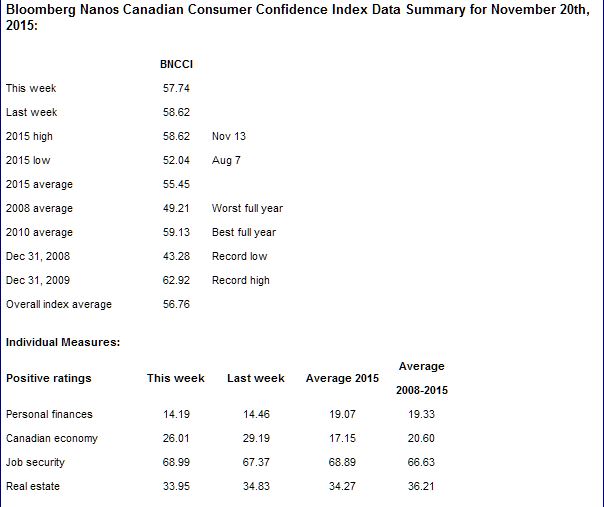
The BNCCI, a composite of a weekly measure of financial health and economic expectations, registered at 57.74 compared with last week’s 58.62. The twelve month high stands at 58.62.

The Bloomberg Nanos Pocketbook Index is based on survey responses to questions on personal finances and job security. This sub-indice was at 59.65 this week compared to 59.69 the previous week. The Bloomberg Nanos Expectations Index, based on surveys for the outlook for the economy and real estate prices, was at 55.83 this week (compared to 57.56 last week).

The average for the BNCCI since 2008 has been 56.76 with a low of 43.28 in December 2008 and a high of 62.92 in December 2009. The index has averaged 55.45 this year.

To view the weekly tracking visit our website.

Methodology

The BNCCI is produced by the Nanos Research Corporation, headquartered in Canada,  which operates in Canada and the United States.  The data is based on random telephone interviews with 1,000 Canadian consumers (land- and cell-lines), using a four week rolling average of 250 respondents each week, 18 years of age and over. The random sample of 1,000 respondents may be weighted by age and gender using the latest census information for Canada and the sample is geographically stratified to be representative of Canada. The interviews are compiled into a four week rolling average of 1,000 interviews where each week, the oldest group of 250 interviews is dropped and a new group of 250 interviews is added. The views of 1,000 respondents are compiled into a diffusion index from 0 to 100. A score of 50 on the diffusion index indicates that positive and negative views are a wash while scores above 50 suggest net positive views, while those below 50 suggest net negative views in terms of the economic mood of Canadians.

A random telephone survey of 1,000 consumers in Canada is accurate 3.1 percentage points, plus or minus, 19 times out of 20.

All references or use of this data must cite Bloomberg Nanos as the source.

Capture344