2016 High hit on Canadian consumer confidence – real estate the key driver (released June 3, 2016)

Bloomberg-Nanos Economic Banner

Bloomberg Nanos Weekly Consumer Confidence Tracking

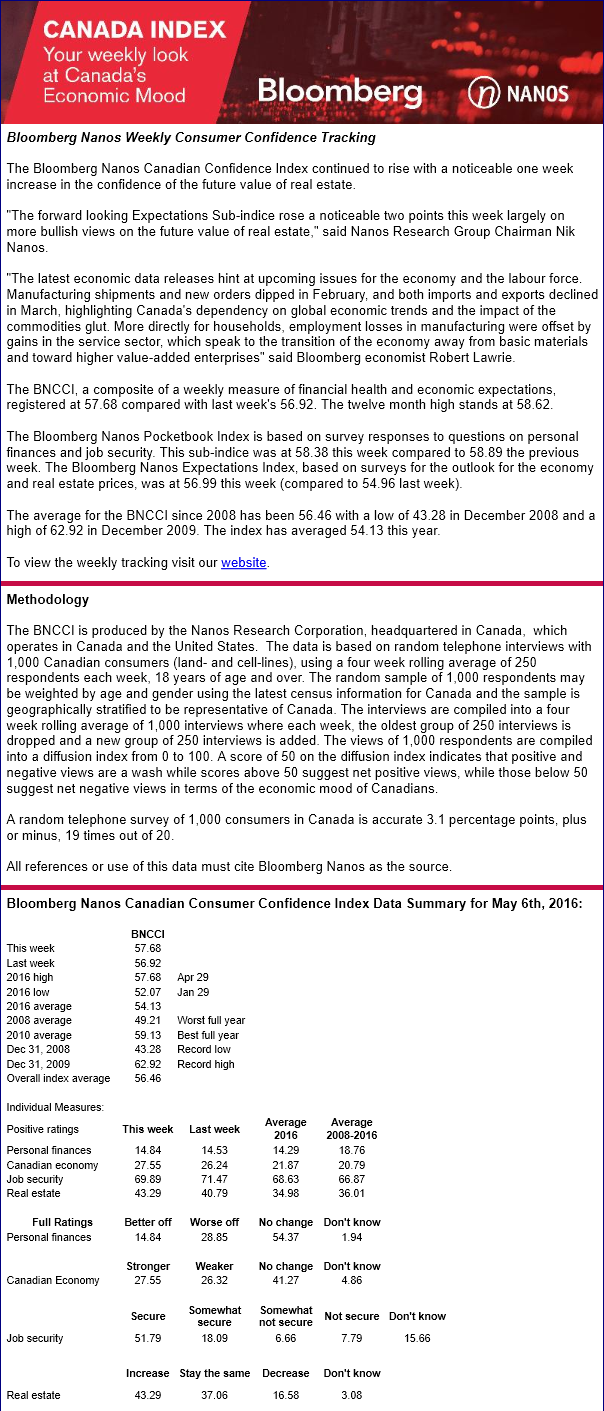
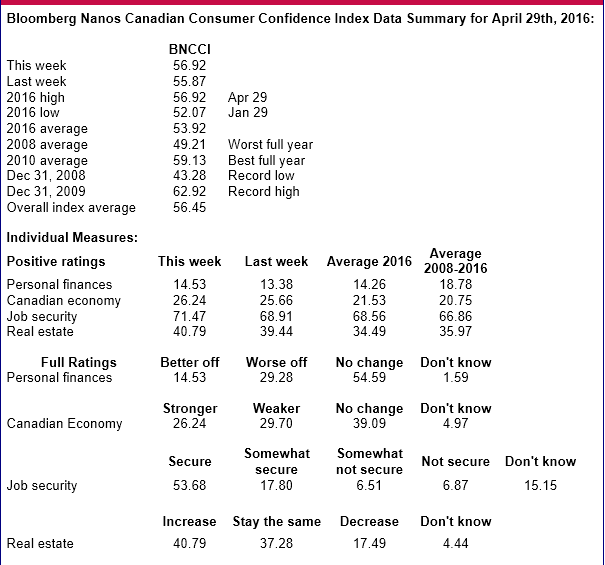
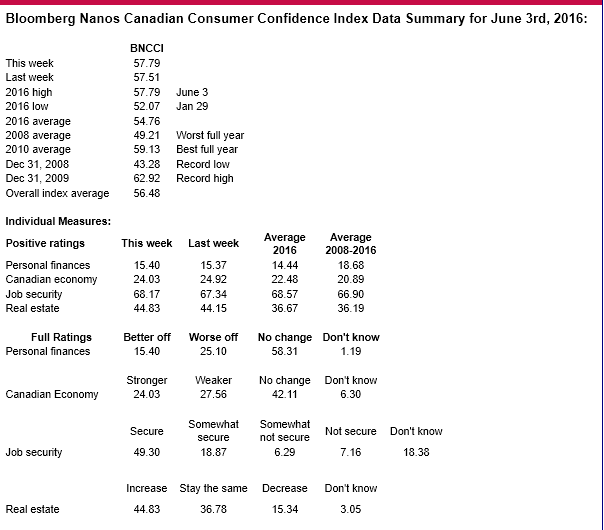
The Bloomberg Nanos Canadian Confidence Index hit a new high for 2016 largely on positive sentiment related to real estate.

“The bullish sentiment on the value of real estate continues in the Bloomberg Nanos tracking,” said Nanos Research Group Chairman Nik Nanos. “Positive views on the value of interest hit a level not seen since July 2014.

“To the extent that consumer sentiment is signaling a housing bubble, the monetary authorities might need to balance the necessity of extremely low interest rates during the economy’s period of adjustment with policies that tighten the availability of household credit and dampen the domestic demand for housing”, said Bloomberg economist Robert Lawrie.

The BNCCI, a composite of a weekly measure of financial health and economic expectations, registered at 57.79 compared with last week’s 57.51. The twelve month high stands at 58.62.

The Bloomberg Nanos Pocketbook Index is based on survey responses to questions on personal finances and job security. This sub-indice was at 58.08 this week compared to 58.23 the previous week. The Bloomberg Nanos Expectations Index, based on surveys for the outlook for the economy and real estate prices, was at 56.49 this week (compared to 56.78 last week).

The average for the BNCCI since 2008 has been 56.48 with a low of 43.28 in December 2008 and a high of 62.92 in December 2009. The index has averaged 54.76 this year.

To view the weekly tracking visit our website.

Methodology

The BNCCI is produced by the Nanos Research Corporation, headquartered in Canada,  which operates in Canada and the United States.  The data is based on random telephone interviews with 1,000 Canadian consumers (land- and cell-lines), using a four week rolling average of 250 respondents each week, 18 years of age and over. The random sample of 1,000 respondents may be weighted by age and gender using the latest census information for Canada and the sample is geographically stratified to be representative of Canada. The interviews are compiled into a four week rolling average of 1,000 interviews where each week, the oldest group of 250 interviews is dropped and a new group of 250 interviews is added. The views of 1,000 respondents are compiled into a diffusion index from 0 to 100. A score of 50 on the diffusion index indicates that positive and negative views are a wash while scores above 50 suggest net positive views, while those below 50 suggest net negative views in terms of the economic mood of Canadians.

A random telephone survey of 1,000 consumers in Canada is accurate 3.1 percentage points, plus or minus, 19 times out of 20.

All references or use of this data must cite Bloomberg Nanos as the source.
FireShot Screen Capture #304 - '' - _C__Users_apchernoff_Desktop_2016%20High%20hit%20on%20Canadian%20consumer%20confidence%20-%20real%20estate%20%20th

Positive trajectory for consumer confidence flattens – still near high for 2016 (released May 30, 2016)

Bloomberg-Nanos Economic Banner

Bloomberg Nanos Weekly Consumer Confidence Tracking

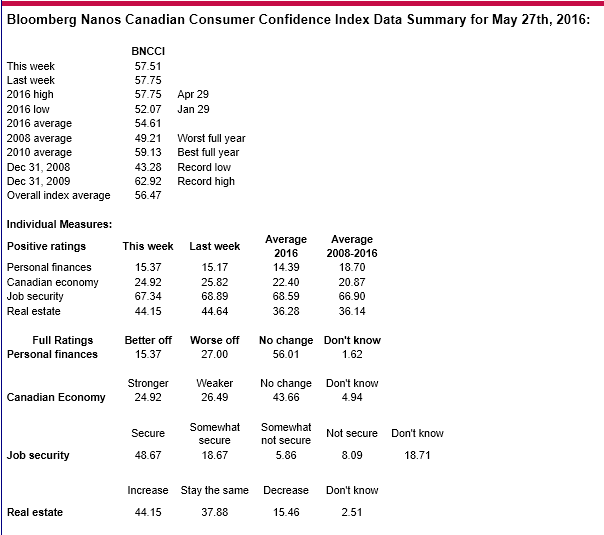
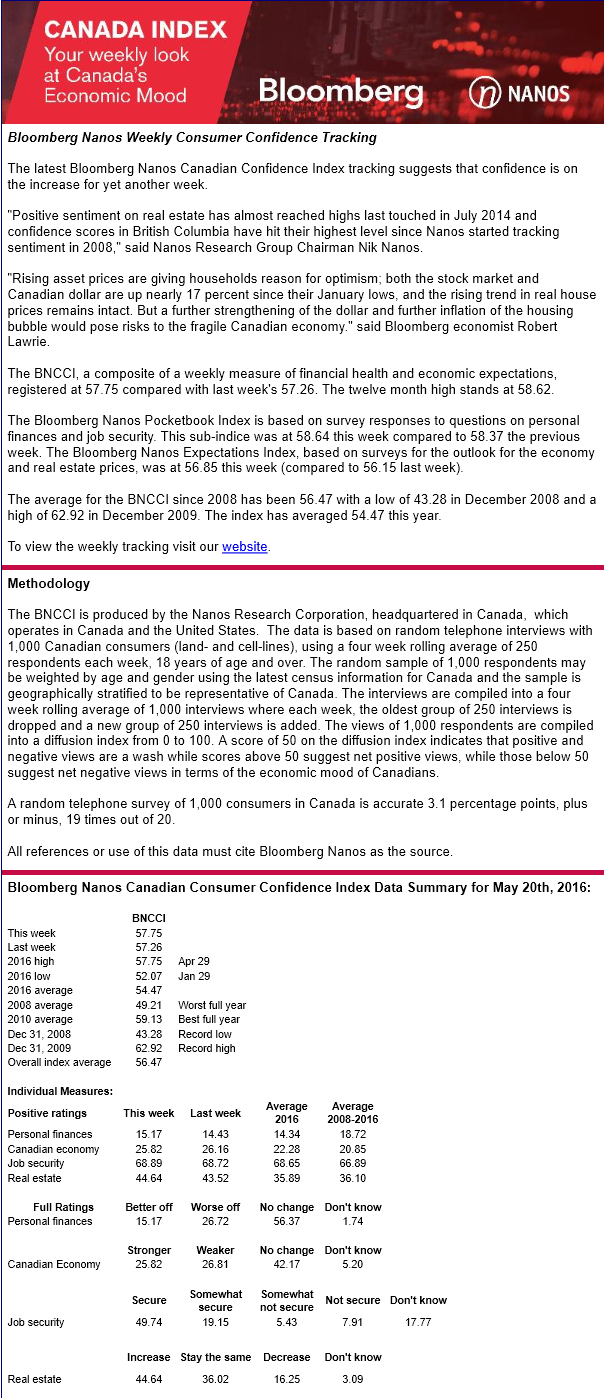
After a positive series of weeks in the Bloomberg Nanos Canadian Confidence Index – the index remained steady in the week over week numbers.

“Even with the one week abatement, overall confidence remained near a high for 2016,” said Nanos Research Group Chairman Nik Nanos.

“Long-term demographic trends, labour market displacements, and a deficit of business investment continue to weigh on the economy’s potential output, according to recent analysis. Add to that the direct and indirect effects of the economic shocks on household balance sheets. Still, the trend in consumer expectations continues to be positive, which suggests an extended honeymoon period for the new government and the prospect of a fiscal stimulus”, said Bloomberg economist Robert Lawrie.

The BNCCI, a composite of a weekly measure of financial health and economic expectations, registered at 57.51 compared with last week’s 57.75. The twelve month high stands at 58.62.

The Bloomberg Nanos Pocketbook Index is based on survey responses to questions on personal finances and job security. This sub-indice was at 58.23 this week compared to 58.64 the previous week. The Bloomberg Nanos Expectations Index, based on surveys for the outlook for the economy and real estate prices, was at 56.78 this week (compared to 56.85 last week).

The average for the BNCCI since 2008 has been 56.47 with a low of 43.28 in December 2008 and a high of 62.92 in December 2009. The index has averaged 54.61 this year.

To view the weekly tracking visit our website.

Methodology

The BNCCI is produced by the Nanos Research Corporation, headquartered in Canada,  which operates in Canada and the United States.  The data is based on random telephone interviews with 1,000 Canadian consumers (land- and cell-lines), using a four week rolling average of 250 respondents each week, 18 years of age and over. The random sample of 1,000 respondents may be weighted by age and gender using the latest census information for Canada and the sample is geographically stratified to be representative of Canada. The interviews are compiled into a four week rolling average of 1,000 interviews where each week, the oldest group of 250 interviews is dropped and a new group of 250 interviews is added. The views of 1,000 respondents are compiled into a diffusion index from 0 to 100. A score of 50 on the diffusion index indicates that positive and negative views are a wash while scores above 50 suggest net positive views, while those below 50 suggest net negative views in terms of the economic mood of Canadians.

A random telephone survey of 1,000 consumers in Canada is accurate 3.1 percentage points, plus or minus, 19 times out of 20.

All references or use of this data must cite Bloomberg Nanos as the source.
Bloomberg Nanos Canadian Consumer Confidence Index Data Summary for May 27th, 2016:

nanos

Consumer confidence in Canada shows positive pressure (released May 1, 2016)

Bloomberg-Nanos Economic Banner

Bloomberg Nanos Weekly Consumer Confidence Tracking

The Bloomberg Nanos Canadian Confidence Index showed positive pressure overall on each of the four sub-components in the past week.

“All indicators showed a positive direction and this was especially the case for perceptions on job security.,” said Nanos Research Group Chairman Nik Nanos.

“The upturn in consumer sentiment coincides with a robust first quarter. This level of growth will likely be short-lived, however, considering the effects of lower commodity prices, the loss of traditional manufacturing, and the recent appreciation of the Canadian loonie against the U.S. greenback”, said Bloomberg economist Robert Lawrie.

The BNCCI, a composite of a weekly measure of financial health and economic expectations, registered at 56.92 compared with last week’s 55.87. The twelve month high stands at 58.62.

The Bloomberg Nanos Pocketbook Index is based on survey responses to questions on personal finances and job security. This sub-indice was at 58.89 this week compared to 57.89 the previous week. The Bloomberg Nanos Expectations Index, based on surveys for the outlook for the economy and real estate prices, was at 54.96 this week (compared to 53.84 last week).

The average for the BNCCI since 2008 has been 56.45 with a low of 43.28 in December 2008 and a high of 62.92 in December 2009. The index has averaged 53.92 this year.

To view the weekly tracking visit our website.

Methodology

The BNCCI is produced by the Nanos Research Corporation, headquartered in Canada,  which operates in Canada and the United States.  The data is based on random telephone interviews with 1,000 Canadian consumers (land- and cell-lines), using a four week rolling average of 250 respondents each week, 18 years of age and over. The random sample of 1,000 respondents may be weighted by age and gender using the latest census information for Canada and the sample is geographically stratified to be representative of Canada. The interviews are compiled into a four week rolling average of 1,000 interviews where each week, the oldest group of 250 interviews is dropped and a new group of 250 interviews is added. The views of 1,000 respondents are compiled into a diffusion index from 0 to 100. A score of 50 on the diffusion index indicates that positive and negative views are a wash while scores above 50 suggest net positive views, while those below 50 suggest net negative views in terms of the economic mood of Canadians.

A random telephone survey of 1,000 consumers in Canada is accurate 3.1 percentage points, plus or minus, 19 times out of 20.

All references or use of this data must cite Bloomberg Nanos as the source.
screenshot-{domain} {date} {time}