Forward looking Expectations Sub-indice declines for sixth week in succession – Post election exuberance wanes (released January 4, 2016)

c7b6bc28-5306-484c-a3d8-9d8998ff23c8

Bloomberg Nanos Weekly Consumer Confidence Tracking

The negative prospective mood on the state of the Canadian economy continues as 2015 is closed out. Canada’s energy rich Prairies, once again have hit a new 12 month low on the Bloomberg Nanos Canadian Confidence Index (BNCCI).

“After period of economic exuberance following the Canadian federal election we are now entering a period of greater pessimism in terms of the future strength of the Canadian economy ,” said Nanos Research Group Chairman Nik Nanos.

“Canadian households have endured labor-market upheavals and a loss of wealth in 2015. For working-age cohorts, the unemployment rate — which had improved to a cyclical low of 6.6% in January — rose to 7.1% in November. For older and higher-income households, expectations were dashed as the equity market fell 16% from 2014 peak levels”, said Robert Lawrie of Bloomberg Economics.

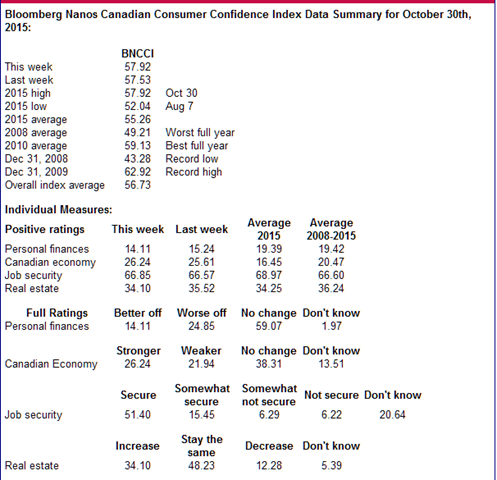
The BNCCI, a composite of a weekly measure of financial health and economic expectations, registered at 53.77 compared with last week’s 54.54. The twelve month high stands at 58.62.

The Bloomberg Nanos Pocketbook Index is based on survey responses to questions on personal finances and job security. This sub-indice was at 59.08 this week compared to 59.06 the previous week. The Bloomberg Nanos Expectations Index, based on surveys for the outlook for the economy and real estate prices, was at 48.47 this week (compared to 50.01 last week).

The average for the BNCCI since 2008 has been 56.71 with a low of 43.28 in December 2008 and a high of 62.92 in December 2009. The index has averaged 55.42 this year.

To view the weekly tracking visit our website.

Methodology

The BNCCI is produced by the Nanos Research Corporation, headquartered in Canada, which operates in Canada and the United States. The data is based on random telephone interviews with 1,000 Canadian consumers (land- and cell-lines), using a four week rolling average of 250 respondents each week, 18 years of age and over. The random sample of 1,000 respondents may be weighted by age and gender using the latest census information for Canada and the sample is geographically stratified to be representative of Canada. The interviews are compiled into a four week rolling average of 1,000 interviews where each week, the oldest group of 250 interviews is dropped and a new group of 250 interviews is added. The views of 1,000 respondents are compiled into a diffusion index from 0 to 100. A score of 50 on the diffusion index indicates that positive and negative views are a wash while scores above 50 suggest net positive views, while those below 50 suggest net negative views in terms of the economic mood of Canadians.

A random telephone survey of 1,000 consumers in Canada is accurate 3.1 percentage points, plus or minus, 19 times out of 20.

All references or use of this data must cite Bloomberg Nanos as the source.
screenshot-{domain} {date} {time}

Consumer confidence in Canada continues to slide in most of country – Energy-rich Prairie provinces hit new 12 month low in confidence (released December 14, 2015)

c7b6bc28-5306-484c-a3d8-9d8998ff23c8

Bloomberg Nanos Weekly Consumer Confidence Tracking

Perceptions on the future strength of the Canadian economy slide a noticeable three points in one week according to the Bloomberg Nanos Canadian Confidence Index.

“The energy-rich Prairie provinces, once a powerhouse of positive economic sentiment hit a new 12 month low,” said Nanos Research Group Chairman Nik Nanos.

“Canadian consumers appear to be hedging their bets; for every factor having a positive effect on household pocketbooks – i.e., declining energy prices and borrowing rates that remain extremely low – there are enough displacement issues and global uncertainties to go around. One would expect a long lag before the benefits of the drop in the Canadian dollar and the prospective fiscal stimulus filter through to household expectations”, said Robert Lawrie of Bloomberg Economics.

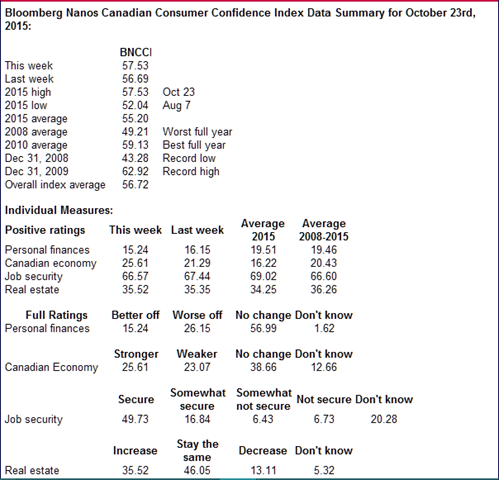
The BNCCI, a composite of a weekly measure of financial health and economic expectations, registered at 55.32 compared with last week’s 56.21. The twelve month high stands at 58.62.

The Bloomberg Nanos Pocketbook Index is based on survey responses to questions on personal finances and job security. This sub-indice was at 59.60 this week compared to 59.11 the previous week. The Bloomberg Nanos Expectations Index, based on surveys for the outlook for the economy and real estate prices, was at 51.04 this week (compared to 53.30 last week).

The average for the BNCCI since 2008 has been 56.75 with a low of 43.28 in December 2008 and a high of 62.92 in December 2009. The index has averaged 55.49 this year.

To view the weekly tracking visit our website

Methodology

The BNCCI is produced by the Nanos Research Corporation, headquartered in Canada,  which operates in Canada and the United States.  The data is based on random telephone interviews with 1,000 Canadian consumers (land- and cell-lines), using a four week rolling average of 250 respondents each week, 18 years of age and over. The random sample of 1,000 respondents may be weighted by age and gender using the latest census information for Canada and the sample is geographically stratified to be representative of Canada. The interviews are compiled into a four week rolling average of 1,000 interviews where each week, the oldest group of 250 interviews is dropped and a new group of 250 interviews is added. The views of 1,000 respondents are compiled into a diffusion index from 0 to 100. A score of 50 on the diffusion index indicates that positive and negative views are a wash while scores above 50 suggest net positive views, while those below 50 suggest net negative views in terms of the economic mood of Canadians.

A random telephone survey of 1,000 consumers in Canada is accurate 3.1 percentage points, plus or minus, 19 times out of 20.

All references or use of this data must cite Bloomberg Nanos as the source. 

nano

Expectations Sub-indice in Canada hits one year high, sentiment up in every region except energy-rich Prairie provinces (released November 9, 2015)

 image

Bloomberg Nanos Weekly Consumer Confidence Tracking

Consumer sentiment in Canada continues to trend upward in the post election period according to the Bloomberg Nanos Canadian Consumer Confidence Index.  The main index, sub-indices and each individual variable realized upward pressure this week in the Nanos tracking for Bloomberg.

“Consumer sentiment was up this week in every region of the country in Canada except the energy-rich Prairie provinces”, said Nanos Research Group Chairman Nik Nanos.

“The prospect of a fiscal stimulus and recent economic news–including upticks in the labor market and upside momentum in Canada’s non-energy exports–have been adding to the improvement in household expectations. Household attitudes toward spending are lagging, however, and less likely to improve until there are signs of wage growth”, said Robert Lawrie of Bloomberg Economics.

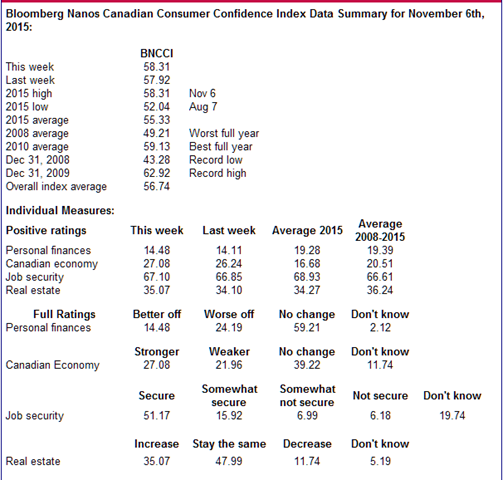
The BNCCI, a composite of a weekly measure of financial health and economic expectations, registered at 58.31 compared with last week’s 57.92. The twelve month high stands at 58.31.

The Bloomberg Nanos Pocketbook Index is based on survey responses to questions on personal finances and job security. This sub-indice was at 59.50 this week compared to 59.31 the previous week. The Bloomberg Nanos Expectations Index, based on surveys for the outlook for the economy and real estate prices, was at 57.11 this week (compared to 56.53 last week).

The average for the BNCCI since 2008 has been 56.74 with a low of 43.28 in December 2008 and a high of 62.92 in December 2009. The index has averaged 55.33 this year.

To view the weekly tracking visit our website

Methodology

The BNCCI is produced by the Nanos Research Corporation, headquartered in Canada,  which operates in Canada and the United States.  The data is based on random telephone interviews with 1,000 Canadian consumers (land- and cell-lines), using a four week rolling average of 250 respondents each week, 18 years of age and over. The random sample of 1,000 respondents may be weighted by age and gender using the latest census information for Canada and the sample is geographically stratified to be representative of Canada. The interviews are compiled into a four week rolling average of 1,000 interviews where each week, the oldest group of 250 interviews is dropped and a new group of 250 interviews is added. The views of 1,000 respondents are compiled into a diffusion index from 0 to 100. A score of 50 on the diffusion index indicates that positive and negative views are a wash while scores above 50 suggest net positive views, while those below 50 suggest net negative views in terms of the economic mood of Canadians.

A random telephone survey of 1,000 consumers in Canada is accurate 3.1 percentage points, plus or minus, 19 times out of 20.

All references or use of this data must cite Bloomberg Nanos as the source.
image

Positive consumer sentiment continues to rise in wake of majority Liberal win (released November 2, 2015)—Bloomberg-Nanos

c7b6bc28-5306-484c-a3d8-9d8998ff23c8

Bloomberg Nanos Weekly Consumer Confidence Tracking

In the wake of a Liberal majority win, forward looking consumer sentiment hit a one year high in the Expecations Sub-indice which is a subset of the Bloomberg Nanos Canadian Consumer Confidence Index.

“Perceptions related to job security and the future strength of the Canadian economy are realizing positive pressure in the period initially following the Liberal majority win in the recent Canadian election”, said Nanos Research Group Chairman Nik Nanos.

“Canada’s economy is growing again and economists are now anticipating a healthy third-quarter increase, which coincides with the jump in consumer expectations. Nevertheless, Canada’s real GDP growth remains well below long-term trends, and the output gap is not expected to close for another year and a half”, said Robert Lawrie of Bloomberg Economics.

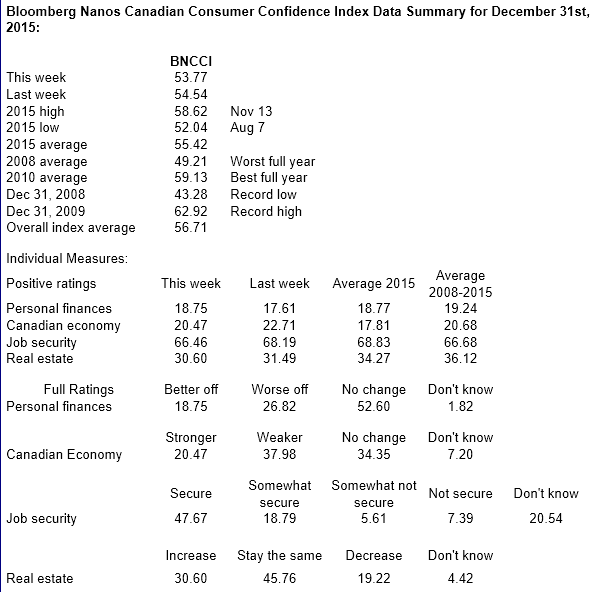
The BNCCI, a composite of a weekly measure of financial health and economic expectations, registered at 57.92 compared with last week’s 57.53. The twelve month high stands at 57.99.

The Bloomberg Nanos Pocketbook Index is based on survey responses to questions on personal finances and job security. This sub-indice was at 59.31 this week compared to 58.83 the previous week. The Bloomberg Nanos Expectations Index, based on surveys for the outlook for the economy and real estate prices, was at 56.53 this week (compared to 56.24 last week).

The average for the BNCCI since 2008 has been 56.73 with a low of 43.28 in December 2008 and a high of 62.92 in December 2009. The index has averaged 55.26 this year.

To view the weekly tracking visit our website

Methodology

The BNCCI is produced by the Nanos Research Corporation, headquartered in Canada,  which operates in Canada and the United States.  The data is based on random telephone interviews with 1,000 Canadian consumers (land- and cell-lines), using a four week rolling average of 250 respondents each week, 18 years of age and over. The random sample of 1,000 respondents may be weighted by age and gender using the latest census information for Canada and the sample is geographically stratified to be representative of Canada. The interviews are compiled into a four week rolling average of 1,000 interviews where each week, the oldest group of 250 interviews is dropped and a new group of 250 interviews is added. The views of 1,000 respondents are compiled into a diffusion index from 0 to 100. A score of 50 on the diffusion index indicates that positive and negative views are a wash while scores above 50 suggest net positive views, while those below 50 suggest net negative views in terms of the economic mood of Canadians.

A random telephone survey of 1,000 consumers in Canada is accurate 3.1 percentage points, plus or minus, 19 times out of 20.

All references or use of this data must cite Bloomberg Nanos as the source.

image

Bloomberg Nanos Weekly Consumer Confidence Tracking: October 23, 2015

Bloomberg-Nanos Economic Banner


Every region in Canada posted positive movement in the Bloomberg Nanos Canadian Consumer Confidence Index over the week following the Trudeau Liberals winning a majority national government.

“Positive sentiment on the economy trended up as the election pointed to a Liberal win”, said Nanos Research Group Chairman Nik Nanos.

“There is now the prospect of a fiscal partner to the Bank of Canada’s extremely accommodative monetary policy stance, and that should keep consumer expectations on its uptrend. Of note, both the money market and the consensus of economic analysts is assigning little probability to a change in monetary policy until the end of 2016, which should continue to help consumer spending–the main driver of growth at the moment”, said Robert Lawrie of Bloomberg Economics.

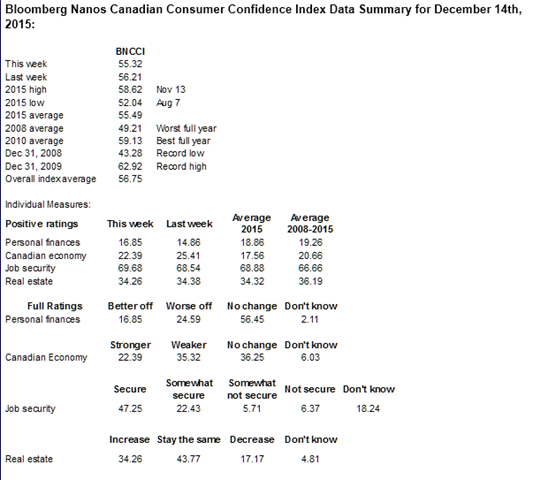
The BNCCI, a composite of a weekly measure of financial health and economic expectations, registered at 57.53 compared with last week’s 56.69. The twelve month high stands at 57.99.

The Bloomberg Nanos Pocketbook Index is based on survey responses to questions on personal finances and job security. This sub-indice was at 58.83 this week compared to 58.78 the previous week. The Bloomberg Nanos Expectations Index, based on surveys for the outlook for the economy and real estate prices, was at 56.24 this week (compared to 54.59 last week).

The average for the BNCCI since 2008 has been 56.72 with a low of 43.28 in December 2008 and a high of 62.92 in December 2009. The index has averaged 55.20 this year.

To view the weekly tracking visit our website.

Methodology

The BNCCI is produced by the Nanos Research Corporation, headquartered in Canada,  which operates in Canada and the United States.  The data is based on random telephone interviews with 1,000 Canadian consumers (land- and cell-lines), using a four week rolling average of 250 respondents each week, 18 years of age and over. The random sample of 1,000 respondents may be weighted by age and gender using the latest census information for Canada and the sample is geographically stratified to be representative of Canada. The interviews are compiled into a four week rolling average of 1,000 interviews where each week, the oldest group of 250 interviews is dropped and a new group of 250 interviews is added. The views of 1,000 respondents are compiled into a diffusion index from 0 to 100. A score of 50 on the diffusion index indicates that positive and negative views are a wash while scores above 50 suggest net positive views, while those below 50 suggest net negative views in terms of the economic mood of Canadians.

A random telephone survey of 1,000 consumers in Canada is accurate 3.1 percentage points, plus or minus, 19 times out of 20.

All references or use of this data must cite Bloomberg Nanos as the source.
Bloomberg Nanos Canadian Consumer Confidence Index Data Summary for October 23rd, 2015:


image