
Insects Other Than Bees are Important Crop Pollinators, Say Scientists

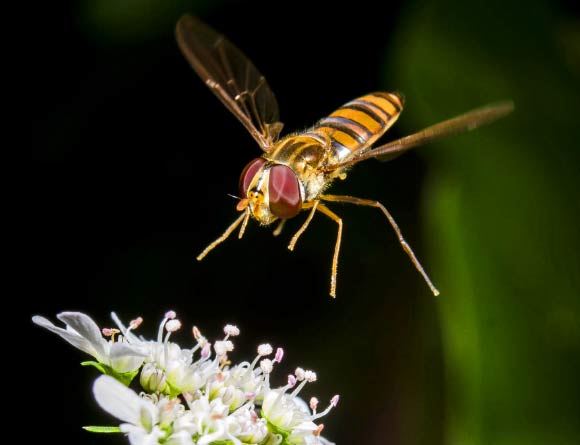
This image shows a syrphid fly, a common non-bee crop pollinator. Image credit: Tobias Smith.

This image shows a syrphid fly, a common non-bee crop pollinator. Image credit: Tobias Smith.

Dec 1, 2015 by Natali Anderson

According to a large multinational team of scientists led by University of New England researcher Dr Romina Rader, non-bee insects – flies, beetles, moths, butterflies, wasps, and ants – are efficient pollinators providing 39 percent of visits to crop flowers.

“Non-bee insects are an insurance against bee population declines,” said team member Dr Margie Mayfield, of the University of Queensland.

“We are trying to get the message out there to use scientific findings such as these to promote a change in agricultural practices.”

Dr Rader, Dr Mayfield and their colleagues analyzed data from 480 fields for 17 crops examined in 39 studies on five continents.

They discovered that non-bee insects performed around 39% of the total number of flower visits.

“Although non-bees were less effective pollinators than bees per flower visit, they provided slightly more visits,” Dr Rader explained.

“These two factors compensated for each other, resulting in pollination services similar to bees.”

She added: “non-bee insect pollinators had other advantages. Fruit set in crops increased with non-bee insect visits, independently of bee visitation rates, indicating that non-bee insects provide a unique benefit not provided by bees.”

“We also found that non-bee pollinators were less sensitive to habitat fragmentation than bees.”

The findings were published this week in the journal Proceedings of the National Academy of Sciences.

“A shift in perspective from a bee-only focus is needed for assessments of crop pollinator biodiversity and the economic value of pollination,” the scientists said.

“These studies should also consider the services provided by other types of insects – important pollinators that are currently overlooked.”

_____

Romina Rader et al. Non-bee insects are important contributors to global crop pollination. PNAS, published online November 30, 2015; doi: 10.1073/pnas.1517092112

Source: Insects Other Than Bees are Important Crop Pollinators, Say Scientists | Biology | Sci-News.com
More bad news for bees: This is going to be a rough winter

While you’re complaining about sub-zero temperatures this winter, just be happy you’re not a bee.

Despite recent efforts by the White House, the forecast for bee health this winter is not a good one, reports Agri-Pulse. In a blog post, Dick Rogers, the head scientist at the Bayer Bee Care Center in North Carolina, writes that his hive evaluations this year revealed “the vast majority of hives contained mite infestations well above the threshold level of concern.”

Rogers is referring to the Varroa mite, one of several causes of a recent massive decline in honeybee populations. Mites are like bee vampires, sucking bees’ bloodlike fluid hemoplymph from their bodies and weakening their immune systems. While manmade problems like pesticide use and the loss of bee habitat are also linked to the pollinators’ falling numbers, Varroa mites are “public enemy number one,” as Keith Delaplane, director of the University of Georgia Honey Bee Program told Quartz in June.

Though winters are always challenging for beekeepers, this year will be even worse. Through his 30 years of experience, Rogers says he has identified a threshold level of three mites per 100 bees as a sign that “the colony is in trouble.” (A colony can easily have 40,000 bees, making that a lot of parasites.)

The US Department of Agriculture and the Bee Informed Partnership, he says, has confirmed his own recent findings, seeing a national infestation average of seven to eight mites per 100 bees, this year.

In the US, pollinators like bees and monarchs are responsible for an estimated $15 billion in crop value annually—a mite infestation could have devastating consequences on beekeepers, who need to restock their dying hives so they can continue pollinating.

While Rogers says that the commonly used treatment for mites isn’t quite working like it once did, he says scientists are working hard to bring new varroacides to market, while other researchers are trying to breed hardier bees that will tolerate the mites better. Those solutions, though, will not be immediately helpful.

“For now,” he writes, “there is little beekeepers can do to change the hand they’ve been dealt.”

Source: More bad news for bees: This is going to be a rough winter – Quartz