BC Hydro 2005-2016 IPP Purchases Result In $835million Profit To Private Power Producers

by Norman Farrell   September 19, 2016

BC Hydro has three particularly important types of customers. These consumers, all inside British Columbia, are categorized as:

  1. Residential,
  2. Commercial and light industry,
  3. Heavy industry.

There are others outside the province but BC power users shouldn’t be subsidizing their needs by delivering electricity at a fraction of today’s marginal cost.

In the past year, the utility began reporting certain sales outside BC as if these were domestic consumption. BC Hydro wants to show a greater need for power to rationalize increased IPP purchases and addition of generating facilities.

It is manipulation intended to hide BC Hydro’s growing surplus of power. It makes no sense to add yet more capacity or purchase power at high prices if it is to be dumped outside British Columbia for a fraction of what new power costs.

That is precisely what happens because BC Hydro’s three types of domestic customers bought the same quantity of power in fiscal year 2016 as they did in fiscal year 2005.

However, IPP purchases in 2016 were 222% more by volume and 312% more by dollar value than in 2005.  That means 835 million additional dollars went from the pockets of ratepayers to the accounts of private power producers, most of whom are not owned by British Columbians.

In addition to throwing billions at IPPs, BC Hydro has been spending money like a drunken lottery winner. And, we know where they get the cash that’s being thrown around.  What isn’t being taken through higher electricity rates is borrowed, to be recovered by even larger price rises.

We had ten years without power rate increases (1993 to 2003), then years of modest increases (2004 to 2010). However, in 2011, Christy Clark returned. Although Premier Gordon Campbell set the stage and began doing the dirty deals, Clark’s Government avoided every opportunity to avoid or moderate the losses.

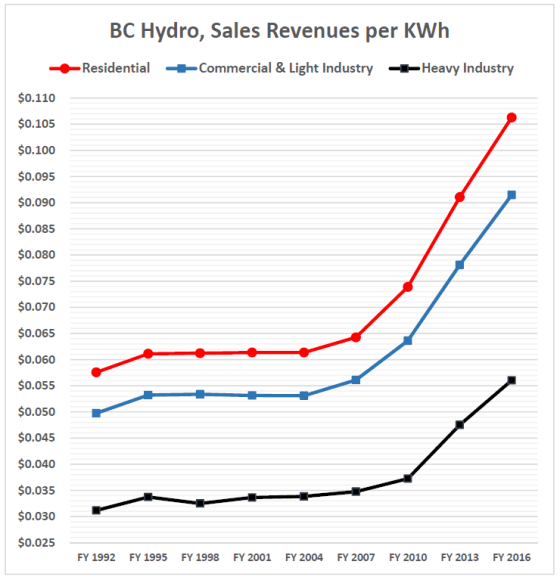
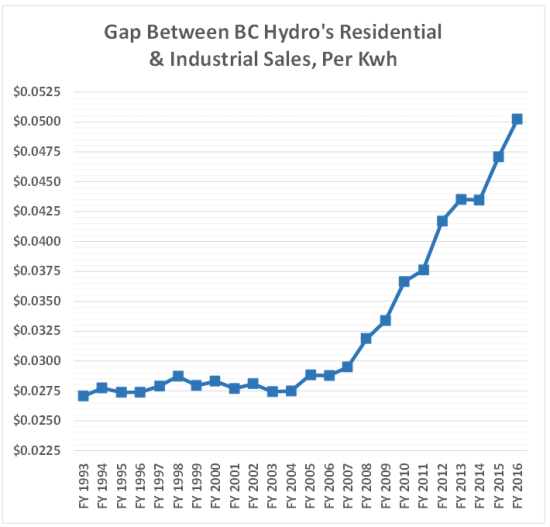
In addition, they spun out yet more benefits for their special friends, particularly big contributors in the resource industries.  Here is a look at electricity prices over 25 years. Obviously, residential users carry the largest burden.
bc-hydro

gap1

Source: 2005→2016 IPP purchases ↑↑ $835m

BC Hydro Regarding From Public Interest To Private Profits – Update

By Norman Farrell    Sept 15, 2016

At my Tyee article BC Hydro: From Public Interest to Private Profits, a couple of commenters associated with BC Hydro and the Liberal Party dispute statistics. However, the numbers I use are from BC Hydro reports. My files contain financial and operating statistics dating back to 1975.

There are billions of dollars at stake here so it was no surprise that political operatives aim to undermine confidence in numbers they don’t control.

The Legislative Library has electronic versions of BC Hydro Annual Reports for fiscal years 1997 and 1999 to 2016. I approached the utility a number of times, trying to get copies from prior years. The didn’t refuse; they just didn’t deliver.

BC Hydro wouldn’t send copies by email but did promise twice to mail optical disks containing the requested files. The first disk arrived empty; the second had corrupt files. Apparently, they had no real intention of assisting so I went to Vancouver’s Main Library.

Librarians happily gathered materials from storage archives and I took photocopies and created spreadsheets that allow me to compare and track data over 40 years.

Consumption numbers – or electricity sales – reported in my work are taken from Annual and Quarterly Reports. Dollar amounts are audited each year by external accountants and provide the best evidence available. While the numbers of gigawatt hours sold to consumers are not audited directly, they have to tie into sales revenues and production reports.

The charts below recapitulate simple but fundamental information. Most important is the record of consumption by residential, commercial and industrial consumers. It’s been flat for a dozen years. That seems surprising until we consider improved efficiency and the elimination of heavy industries.

sales

Secondly, we have to consider that once profitable export markets have disappeared. U.S. energy consumption has also been flat for more than a decade but the nation, particularly in the west, has been adding new power sources, particularly solar and wind.

Despite no market growth, BC Hydro is buying increasing amounts of private power at prices that escalated 50% in 12 years.

ipp-purchases-and-trade-sales

Amazingly, with more private power entering the grid and less power being traded outside the province, BC Hydro has been adding capacity to its production and distribution systems.

Assets in 2016 are 250% of what they were in 2005 but they are still growing. Based on current commitments, the total will hit $45 billion with completion of the Site C dam. Of course, asset growth is fueled by new debt.

assets

Private power producers are pocketing billions of dollars above the free market value of their product. Foreign contractors and suppliers extract billions for adding unneeded capacity. A handful of favoured mining companies get power without payment while other industries buy it below average cost.

Government policies create corporate winners and one affluent political party but there are millions of losers. They are the citizens who work and live in BC and the small and medium sized enterprises that are the engines of our economy. If we are not among the wealthy beneficiaries of BC Liberal energy policy, we share the financial burden of BC Hydro’s destruction.

The question to consider is why this simple, truthful information is brought to you by one simple blogger and not by the hundreds employed in corporate media and not by the watchdogs in the Finance Ministry or the Auditor General of British Columbia who is charged with ensuring the province “is achieving its objectives effectively, economically and efficiently.”

Above all, we must ask BC Liberal MLAs why they are letting this happen. Do they lack nerve?

Or, is it a lack of principle and a tolerance of larceny?


ADDENDA

From the title page of Ira Basen’s Spin Cycles, a 6-part series for CBC Radio:

Shocking as it may sound, sometimes politicians and leaders have their best interests at heart, and not our own.


It’s comforting for voters to blame others for situations that are so obviously wrong. But a sine panel by Walt Kelly provided a simple truth:

pogo

Source: Norman Farrell  URL: http://wp.me/p7pPCB-4fB


$4.9 billion extra generated by IPPs, updated — In-Sights

BC Hydro has been managed to deliver billions of dollars in benefits to independent power producers. Had IPPs been left to sell their product to the same free market that BC Hydro trades into, they would have gained 4.9 billion fewer revenue dollars since 2003.

via $4.9 billion extra generated by IPPs, updated — In-Sights

BC Hydro – destruction in progress – In-Sights

By on July 30, 2016

In 2001, for each dollar of assets, BC Hydro had 63¢ in electricity sales. In 2016, the number fell to 17¢.

In 2005, BC Hydro sold more electricity to residential, commercial and industrial customers in BC than the utility did in 2016 and it did that with assets worth 40% of today’s value.

Shockingly, the company is embarked on a program of capital expenditure that will add about $15 billion to its list of assets.

By any measure, the management of BC Hydro has been a colossal failure, incompetence made worse by flawed policy objectives.

For more on this news story, follow the link:

BC Hydro – destruction in progress

Source: BC Hydro – destruction in progress – In-Sights

Site C Project Far From Clean and Green, Finds New UBC Report

By Carol Linnitt • Monday, July 18, 2016

The Site C dam, advanced as the province’s showcase clean energy project by the B.C. government, according to a new report from the University of British Columbia.

Authored by Rick Hendriks from Camerado Energy Consulting, the report found Site C, a BC Hydro megadam proposed for the Peace River near Fort St. John, will not provide energy at a lower greenhouse gas (GHG) emission rate than other alternative energy projects.

The government stated that the unprecedented level of significant adverse environmental effects from Site C are justifiable, in part, because the project delivers energy and capacity at lower GHG emissions than the available alternatives,” Hendriks, an energy consultant with more than 20 years experience analyzing large-scale hydropower projects, said.

Our analysis indicates this is not the case.”

Comparing BC Hydro’s own data on Site C and alternative energy scenarios, the report found the megadam provides no substantial benefit over other renewable sources like wind and solar.

I feel like the discussion in the public has made a few assumptions about the Site C dam that merit reexamination,” Karen Bakker, professor of geography at UBC and Canada Research Chair in Political Ecology, told DeSmog Canada.

The assumption that Site C is clean and green is one that we actually need to scrutinize rather than assume,” she said.

Bakker, who oversaw the new greenhouse gas analysis, is one of several scholars who recently found the Site C project represents the largest amount of significant adverse environmental impacts ever reviewed under the Canadian Environmental Assessment Act since its introduction into law.

She said although the joint federal-provincial review panel tasked with considering the Site C project did some good work, they were limited in resources and scope when it came to a fulsome project analysis. The panel did not consider the greenhouse gas emissions associated with the project.

That’s the simple way to sum up why we’re doing what we’re doing,” she said.

Bakker said the report did not conduct an independent review of BC Hydro’s own greenhouse gas estimates for the project, but said, “even using their own numbers Site C is not cleaner or greener than other renewables.”

Our analysis suggests that other renewables like wind and solar would help Canada achieve its climate change goals more quickly and cheaply and with much lower environmental impact than Site C.”

Bakker said the new report highlights the need for more thorough analysis of Site C’s environmental impacts. She added more research, which doesn’t rely on BC Hydro’s estimates, needs to be conducted.

There’s much more to be done,” she said. “It would be great if this had been studied and geothermal had been examined as well.”

The Site C dam will power a proposed 1100-megawatt electricity facility, producing far more electricity than B.C. is projected to need for roughly two decades.

Local farmers, landowners and First Nations say the dam, which will flood 107 kilometres of the Peace River valley, will unnecessarily destroy wildlife habitat, First Nations archaeological and hunting sites and some of the province’s most productive agricultural land.

The chair of the Site C Joint Review Panel, Harry Swain, has come out against the project, saying B.C.’s domestic electricity demand has not significantly increased since 2007, meaning the province has no need for the estimated $9-billion project.

I think we’re making a big mistake, a very expensive one,” Swain recently told DeSmog Canada. “Of the $9 billion it will cost, at least $7 billion will never be returned. You and I as rate payers will end up paying $7 billion bucks for something we get nothing for.”

There is no need for Site C,” Swain said. “If there was a need, we could meet it with a variety of other renewable and smaller scale sources.”

Source: Site C Project Far From Clean and Green, Finds New UBC Report | DeSmog Canada