BC Hydro 2005-2016 IPP Purchases Result In $835million Profit To Private Power Producers

by Norman Farrell   September 19, 2016

BC Hydro has three particularly important types of customers. These consumers, all inside British Columbia, are categorized as:

  1. Residential,
  2. Commercial and light industry,
  3. Heavy industry.

There are others outside the province but BC power users shouldn’t be subsidizing their needs by delivering electricity at a fraction of today’s marginal cost.

In the past year, the utility began reporting certain sales outside BC as if these were domestic consumption. BC Hydro wants to show a greater need for power to rationalize increased IPP purchases and addition of generating facilities.

It is manipulation intended to hide BC Hydro’s growing surplus of power. It makes no sense to add yet more capacity or purchase power at high prices if it is to be dumped outside British Columbia for a fraction of what new power costs.

That is precisely what happens because BC Hydro’s three types of domestic customers bought the same quantity of power in fiscal year 2016 as they did in fiscal year 2005.

However, IPP purchases in 2016 were 222% more by volume and 312% more by dollar value than in 2005.  That means 835 million additional dollars went from the pockets of ratepayers to the accounts of private power producers, most of whom are not owned by British Columbians.

In addition to throwing billions at IPPs, BC Hydro has been spending money like a drunken lottery winner. And, we know where they get the cash that’s being thrown around.  What isn’t being taken through higher electricity rates is borrowed, to be recovered by even larger price rises.

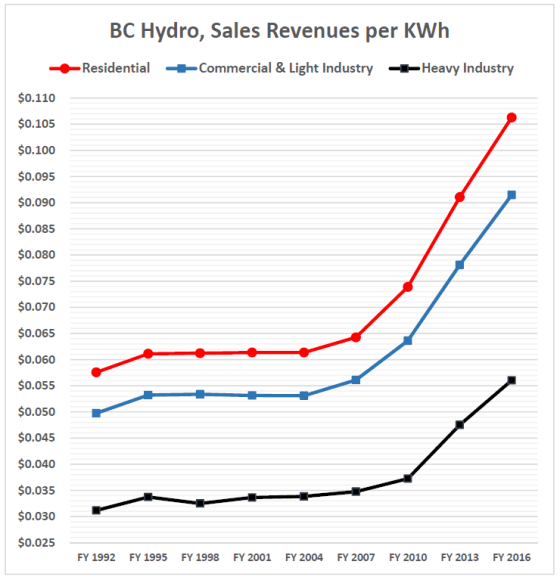
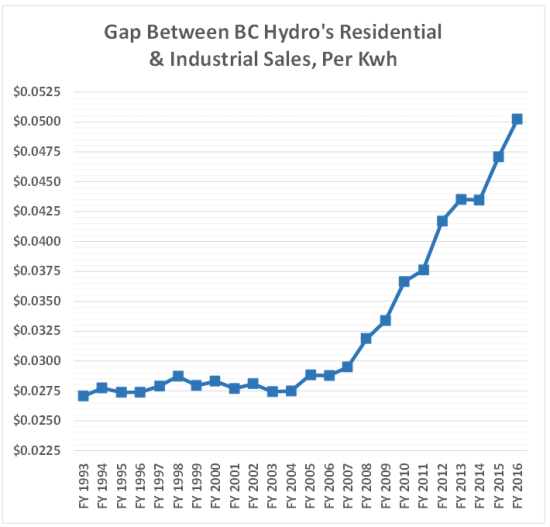
We had ten years without power rate increases (1993 to 2003), then years of modest increases (2004 to 2010). However, in 2011, Christy Clark returned. Although Premier Gordon Campbell set the stage and began doing the dirty deals, Clark’s Government avoided every opportunity to avoid or moderate the losses.

In addition, they spun out yet more benefits for their special friends, particularly big contributors in the resource industries.  Here is a look at electricity prices over 25 years. Obviously, residential users carry the largest burden.
bc-hydro

gap1

Source: 2005→2016 IPP purchases ↑↑ $835m

Teachers may begin full-scale strike after losing LRB decision on 10 per cent pay cut

Teachers to vote on Monday and Tuesday

By Tracy Sherlock, Postmedia News June 4, 2014 8:28 PM

Teachers across B.C. could embark on a full-scale strike within the next two weeks after a vote next Monday and Tuesday, their leader said Wednesday after the Labour Relations Board ruled a 10-per-cent pay cut would stand.

“Even before the LRB ruling, the BCTF executive decided last night that it’s time to apply the maximum pressure,” said Jim Iker, president of the B.C. Teachers’ Federation. “The vote itself will apply pressure to both sides. There is still time for the government to act to prevent a full strike.”

The Labour Relations Board on Wednesday dismissed the B.C. Teachers’ Federation’s application to declare the employer’s lockout and 10-per-cent wage cut illegal.

“ … Subject to the designation of essential services, the Employer is free to engage in lockout activities including imposing new terms of employment in order to pressure the Union into reaching a new collective agreement,” LRB vice-chairman Richard Longpre wrote in his decision.

“I do not accept the suggestion that once a designation has been issued by the Board and regardless of the scope of that designation, the parties must comply with the terms and conditions of the collective agreement until such time as either party applies to the Board to amend the order.”

The teachers could still refer the measures to arbitration and all decisions of the LRB can be appealed within 15 days.

Teachers have been holding rotating strikes since May 26, with several school districts closed each day. The partial lockout restricts teachers from working during recess or lunch hours, or from arriving at school any earlier than 45 minutes before classes start, or staying 45 minutes after they end, and includes the pay cut.

At issue are wages, class size, class composition and the number of specialist teachers. The employer is offering a 7.3-per-cent wage increase over six years. Teachers on Tuesday reduced their ask by one per cent, now calling for 12.75 over four years. The BCTF also says it moved on several other issues on Tuesday, including benefits, pay for teachers on call and preparation time.

BC Teacher Collective Bargaining: Latest bargaining proposals from the union and the government

http://www.bcpsea.bc.ca   June 4, 2014

Provincial bargaining with the BC Teachers’ Federation resumed on October 30, 2013. Facilitator Mark Brown is assisting the parties.

Employers’ Partial Lockout Notice

Consolidated Questions and Answers on matters related to the BCTF Strike and the Employers’ Partial Lockout

Question and Answers

Backgrounders

For the Record
BCPSEA Responses to BCTF Statements

Proposals

BCPSEA Proposals
BCTF Proposals Tabled June 3, 2014

Discussion/Resource Papers

B.C. Teachers’ Contract: Government Threatens Wage Cut

     By Keven Drews and Tamsyn Burgmann

05/16/2014

VANCOUVER – The B.C. government is threatening to cut teachers’ wages by five per cent if a new contract agreement isn’t reached by the end of the school year, but the union representing those teachers vows it will take that threat to the Labour Relations Board.

Peter Cameron, chief negotiator of the BC Public School Employers’ Association, the organization representing the provincial government, also said Friday that teachers will receive a $1,200 signing bonus if both sides reach an agreement by the end of June.

The incentives and disincentives placed on the table by the government were the latest details to emerge from a year of contentious labour relations between the B.C. Teachers Federation and the provincial government that included a 89 per cent strike vote and involved a B.C. Supreme Court judgment.

Both sides remain firmly divided over issues related to wages, class size, the composition of those classes and the length of the contract term.

“The proposal we have on the table to try and get a settlement, and the disincentives that we are putting in place are all aimed at getting a deal, and in fact the disincentives will rise if there’s further job action,” said Cameron. “So if they do move to Stage 2 we will, it’s pretty well definite that we’ll have a further response to that.”

The purpose of the government’s actions, he added, is not to try and provoke further strike action but to “provoke a settlement.”

Both sides were back at the bargaining table Friday, and B.C. Teachers’ Federation president Jim Iker said his members will deal with the threat of the five per cent pay cut at the Labour Relations Board.

He said the government still hasn’t addressed issues related to class size and composition and specialist teachers, and the government’s offer of a 6.5-per-cent pay hike over six years isn’t enough. On Thursday, Education Minister Peter Fassbender announced the provincial government was dropping its demand of a 10-year contract.

“They need to put some proposals to get us closer to a deal, including preparation time,” said Iker. “Bargaining is about compromise, and we want a compromise.

But Cameron said teachers are demanding a pay raise of 15.9 per cent over four years. With increased benefits and other factors taken into consideration, the total compensation package demanded by teachers is about 21 per cent, he added.

“We need to see some movement from the union now to come into the ball park because they’re at this point still far, far away from the settlement pattern of all the other unions.”

On Thursday, the B.C. government and the 11-union, 47,000-strong Facilities Bargaining Association announced a tentative deal that would see unionized workers receive a 5.5 per cent over five years.

The teachers have been without a contract since last June. In early March, some 26,051 members of the B.C. Teachers’ Federation voted overwhelmingly in favour of job action, and in April, the union began Stage 1 of its job action.

Teachers stopped supervising students outside the classroom or communicating in writing with administrators, which prompted about a dozen school districts to cancel recess.

A B.C. Supreme Court decision in January awarded the federation $2 million in damages and declared the province’s removal of class size and composition from contract negotiations unconstitutional.

BC Government Leaving School Districts In No Win Situation


Just-saying

April 23, 201 4

By Andrew Chernoff     https://andrewchernoff.wordpress.com                                   

It should be clear by now. Talk is cheap.

The BC government is not open for business. The doors are closed and their ears are plugged.

The headlines say it all:

From angry teachers, to fuming Cupe education workers, boisterous parents, and frustrated school trustees, it is clear it is not working.

Can civil disobedience be far off the horizon? Just saying….

Or are all these headlines just full of talk, emotion, frustration with no real substance or desire to make real change….to make a real difference…to actually act and put it all on the line, in the streets, on the provincial legislature?

HELLO???!!!!!

For what should be a galvanizing issue….it sure is lonely out here all alone….just saying.