The BC economy’s unbalanced and inequitable growth : Policy Note

Jul 22, 2016     By

Skyrocketing property transfer tax revenues have been in the news the past few days, but the bigger story, well-documented in a recent Huffington Post article, is how dependent the entire BC economy is on the unsustainable and socially damaging housing market.

It is instructive to reread the 2012 BC Jobs Plan to see how far the economy has diverged from what was intended.

The core of the Jobs Plan was natural resource development, with more efficient regulatory processes and the pursuit of new markets in Asia. It was, at its core, all about LNG, mining and other resource sectors.

Though well masked by the housing bubble, there clearly is the need for a new economic development strategy in BC.

However Statistics Canada data clearly shows that didn’t take place.

There has been growth in the BC economy over the last four years, but over one quarter of the total growth in BC’s gross domestic product (the standard measure of total output in the economy) has been in real estate services. And real estate services combined with residential construction has accounted for over one third of the entire growth in the economy over the last four years.

Resource industries have made no significant contribution to the growth of the BC economy. Output in agriculture, forestry and fishing has been flat, and in mining and energy there has been a decline in output since the Jobs Plan went into effect.

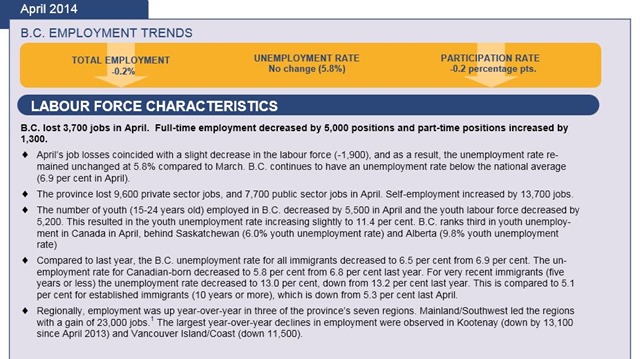
What we are witnessing is not just unsustainable, but also unbalanced growth. The table below, showing unemployment rates by region in the province, clearly indicates the disparity between regions benefiting from the housing boom and the rest of the province:

  • Unemployment rates in the south coastal region over the last four years have fallen to very low levels, but have increased everywhere else.
  • In the Northeast the rate of unemployment is as high or higher than what Alberta is experiencing.

Unemployment Rates by Region
(Statistics Canada Labour Force Survey)

June 2013 June 2014 June 2015 June 2016
Vancouver Island / Coast 6.3 6.6 6 5.1
Lower Mainland 6.6 5.8 6 5.3
Thompson-Okanagan 6.5 5.7 4.9 7
Kootenay 5.8 6.7 7.3 7.5
Cariboo 5.6 7.1 7.9 7.8
North Coast / Nechako 7 9.8 7.5 8.1
Northeast 4.8 5.9 6.1 9.2

In addition to being regionally imbalanced, the growth we are experiencing in British Columbia is, by any measure, extraordinarily inequitable:

  • People who own homes are doing very well. They are realizing more in capital gains than they or other workers (except perhaps those in real estate and other housing related industries) could ever hope to earn in labour income.
  • Those who do not own homes—particularly those who live in Vancouver, Victoria or other urban centres with rapidly rising costs of housing—are seeing their real disposable income after housing costs sharply decline.

It truly is not what governments of any political stripe would want for the population as a whole.

Though well masked by the housing bubble, there clearly is the need for a new economic development strategy in BC.

It is not just that the bubble will eventually burst, it is that growth from the bubble is leaving too many regions and people behind.

Source: The BC economy’s unbalanced and inequitable growth : Policy Note

Smyth: NDP still vulnerable on economy, a year after election debacle

By Michael Smyth, The Province May 12, 2014

Smyth: NDP still vulnerable on economy, a year after election debacle

John Horgan, the new leader of B.C.’s NDP, must find a way to assure voters that his party will not damage the economy in its efforts to protect the environment from damage by megaprojects such as the Site C dam.


One year ago today, pundits and pollsters everywhere predicted the imminent demise of Premier Christy Clark and her Liberal government.

One year ago tomorrow, those same political prognosticators sat down to a super-sized meal of humble pie, as Clark pulled off the greatest comeback in B.C. history.

The election of May 14, 2013 — exactly one year ago Wednesday — confounded analysts mesmerized by the 20-point lead in pre-election polls enjoyed by Adrian Dix and the NDP.

How did the NDP blow such an advantage? One year after the shocker, a couple of answers emerge.

For one thing, despite what voters might tell pollsters before an election, most people don’t make up their minds on how to vote until the sustained heat and glare of a campaign.

It’s clear now that most of those voters didn’t think much of Dix once they took a good look at him. One image that sticks in my mind: the way Dix slouched against his lectern during the televised election debate. Not a good look for him.

But perhaps the greatest lesson of last year’s election-night surprise was the proof it provided for an old political axiom: It’s the economy, stupid.

From the beginning of the campaign, Clark hammered home an optimistic message of private-sector investment, thousands of new jobs and unparalleled prosperity for B.C.

Will even a fraction of her grandiose promises — such as a trillion-dollar natural-gas gold rush and enough riches to wipe out the province’s $60-billion debt — come true?

It’s still too early to say, but enough voters dared to believe Clark’s utopian vision to give the Liberals another majority-government mandate.

A year later, it’s easy to see how the Liberals plan a repeat performance in the next election: by painting themselves as the party of prosperity, and the NDP as the party that will say No to jobs and investment.

Clark will continue to promote her liquefied-natural-gas miracle. And now the government appears poised to back another megaproject: the $8-billion Site C dam on the Peace River.

On Monday, new NDP leader John Horgan attacked Site C in the legislature, insisting B.C. doesn’t need the new power it would generate.

While Horgan demands that the project be turned over to the B.C. Utilities Commission for more study, it appears Clark’s Liberals will push ahead with it anyway.

And that’s just the way Clark likes it: The Liberals saying “Yes” and the NDP saying “No” all over again.

Here is Horgan’s new challenge: If he chooses to fight controversial megaprojects such as the Site C dam, the Prosperity mine, and the Enbridge and Kinder Morgan pipelines, he must find a way to simultaneously reassure voters that the NDP will not damage the economy.

Horgan must also learn another lesson from Clark’s victory of a year ago: Attack ads work, and the New Democrats can’t go easy on her.

Horgan has vowed to “highlight the shortcomings of the Liberals,” saying the NDP’s failure to do that was a “singular failing” of the 2013 election campaign.

A year later, Horgan has only begun to fight. Clark will be ready for him.