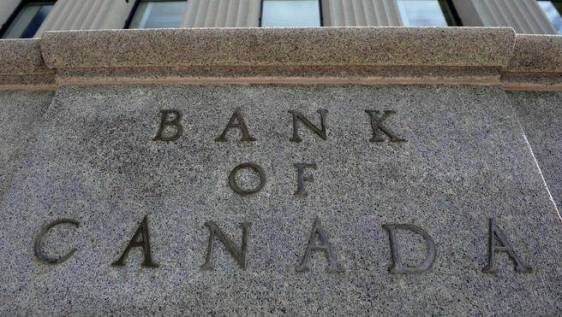
Canada housing sector cools as households hit record debt

reuters.com

Thursday September 15, 2016

By Andrea Hopkins

OTTAWA, Sept 15 (Reuters) – Canada’s most expensive housing market braked sharply in August and the nation’s long housing boom had begun to cool, while consumer debt levels hit a new record in the second quarter, separate data showed on Thursday.

While a housing slowdown could be the start of a long-feared housing crash or a much-needed moderation, the bump up to fresh highs in household debt will reinforce the Bank of Canada’s concern about financial instability in a country where expensive housing has pushed consumers to the brink.

To read more, click the link:  WRAPUP 1-Canada housing sector cools as households hit record debt | Kitco News

Bank of Canada maintains overnight rate target at 1/2 per cent

OTTAWA, 25 May 2016 /CNW/ – The Bank of Canada today announced that it is maintaining its target for the overnight rate at 1/2 per cent. The Bank Rate is correspondingly 3/4 per cent and the deposit rate is 1/4 per cent.

The global economy is evolving largely as the Bank projected in its April Monetary Policy Report (MPR). In the United States, despite weakness in the first quarter, a number of indicators, including employment, point to a return to solid growth in 2016. Financial conditions remain accommodative, with ongoing geopolitical factors contributing to fragile market sentiment. Oil prices are higher, in part because of short-term supply disruptions.

In Canada, the economy’s structural adjustment to the oil price shock continues, but is proving to be uneven. Growth in the first quarter of 2016 appears to be in line with the Bank’s April projection, although business investment and intentions remain disappointing. The second quarter will be much weaker than predicted because of the devastating Alberta wildfires. The Bank’s preliminary assessment is that fire-related destruction and the associated halt to oil production will cut about 1 1/4 percentage points off real GDP growth in the second quarter. The economy is expected to rebound in the third quarter, as oil production resumes and reconstruction begins. While the Canadian dollar has been fluctuating in response to shifting expectations of US monetary policy and higher oil prices, it is now close to the level assumed in April.

Inflation is roughly in line with the Bank’s expectations. Total CPI inflation has risen recently, largely due to movements in gasoline prices, but remains slightly below the 2 per cent target. Measures of core inflation remain close to 2 per cent, reflecting the offsetting influences of past exchange rate depreciation and excess capacity.

Canada’s housing market continues to display strong regional divergences, reinforced by the complex adjustment underway in the economy. In this context, household vulnerabilities have moved higher. Meanwhile, the risks to the Bank’s inflation projection remain roughly balanced. Therefore, the Bank’s Governing Council judges that the current stance of monetary policy is still appropriate, and the target for the overnight rate remains at 1/2 per cent.

Information note:

The next scheduled date for announcing the overnight rate target is 13 July 2016. The next full update of the Bank’s outlook for the economy and inflation, including risks to the projection, will be published in the MPR at that time.

SOURCE Bank of Canada

For further information: Media Relations, 613 782-8782

RELATED LINKS
http://www.bank-banque-canada.ca

Source: Bank of Canada maintains overnight rate target at 1/2 per cent

BoC considers changing ‘core inflation’ tracking | The Chronicle Herald

HALIFAX — The Bank of Canada is examining alternatives to its “core inflation” method of tracking prices as it prepares to review its inflation-control agreement with the federal government next year.

Source: BoC considers changing ‘core inflation’ tracking | The Chronicle Herald

Bank of Canada Trims Economic Outlook, As Decline In Commodity Prices Deteriorates Growth

Image result for bank of canada

Special Reports | Written by ActionForex.com | Oct 22 15 03:48 GMT

The BOC meeting turned out to be more dovish than expected. While leaving the overnight rate at 0.5%, the central bank trimmed its growth forecast for 2016 and 2017, and pushed backward the timing of the economy’s expected return to full capacity to mid-2017. Domestically, the BOC acknowledged that the economy has rebounded as projected in July. However, weakened dynamics in global growth should affect the country’s economic expansion which highly reliant on exports. Canadian dollar plunged more than -1% against US dollar. The loonie had strengthened against greenback over the past 3 weeks.

Policymakers acknowledged that global economic growth has been ‘a little weaker than expected this year’. Yet, they believed that the momentum pointing to a pickup in 2016 and 2017 remains ‘largely intact’. Regarding Canada’s largest trading partner, the US, the central bank noted that US’ economy is expected to ‘continue growing at a solid pace with particular strength in private domestic demand, which is important for Canadian exports’. On China, policymakers admitted that ‘uncertainty about China’s transition to a slower growth path has contributed to further downward pressure on prices for oil and other commodities’. We will discuss in the next paragraph that how the concerns over China have led to BOC’s downgrade of growth outlook.

Domestically, the BOC indicated that the economy ‘has rebounded, as projected in July’. For non-resource sectors, the ‘looked-for signs of strength are more evident, supported by the stimulative effects of previous monetary policy actions and past depreciation of the Canadian dollar’. What concerned policymakers the most is that a persistent decline in commodity prices would result in a downgrade to potential growth at least for the next year or two. As mentioned in the statement, the BOC noted that ‘lower prices for oil and other commodities since the summer have further lowered Canada’s terms of trade and are dampening business investment and exports in the resource sector’. This is the key reason for the central bank to downgrade its growth forecasts for 2016 and 2017. The Bank now projects real GDP will expand +1.1% in 2015, before accelerating to about +2% in 2016 and then +2.5% in 2017. The economy is now expected to return to full capacity, and inflation sustainably to target, around mid-2017.

On inflation, the BOC suggested that ‘total CPI inflation remains near the bottom of the Bank’s target range, owing to declines in consumer energy prices. Core inflation is close to +2% as the transitory effects of the past depreciation of the Canadian dollar are roughly offsetting disinflationary pressures from economic slack, which has increased this year. The Bank judges that the underlying trend in inflation continues to be about 1.5 to 1.7%’.

The BOC currently believes that the global economic slowdown and a rapid moderation in China’s growth might lend external support to Canada’s economic expansion. While the central bank now expects the economy to return to full capacity at around mid-2017, we see the potential for upside surprises after factoring in the planned increase in infrastructural spending by the newly election Liberal government.