An increase so small it keeps B.C. minimum wage workers in poverty : Policy Note

By Iglika Ivanova    http://www.policynote.ca

September 20, 2016

Today, BC’s lowest paid workers get a 40-cent raise. The latest increase of the provincial minimum wage—now $10.85 per hour for most workers isn’t much to celebrate. It works out to an extra $16 per week for someone working full-time – and that doesn’t stretch far in a province with such high cost of living.

In fact, minimum wage workers continue to earn less than the poverty line even if they work full-time 52-weeks a year.

It’s not just minimum wage earners who face the threat of working poverty. Making a dollar or two above than the minimum wage is still a poverty wage for a full-time, full-year worker. Even three dollars above the minimum wage barely clears today’s poverty line for a single person, and falls short of the poverty line for a single parent with one child.

Nearly half a million British Columbians—a quarter of all paid employees in the province—work for $15 or less per hour. And they would all benefit from a $15 minimum wage.

Critics like to argue that the minimum wage doesn’t matter for working poverty because too few people earn exactly the minimum. But they seem to forget that nearly half a million British Columbians—a quarter of all paid employees in the province—work for $15 or less per hour. And they would all benefit from a $15 minimum wage.

Some people mistakenly believe that low-wage jobs are filled mainly by teenagers and youth who work part-time after school, live with their parents, and are on their way to a better-paying job after graduation. But Statistics Canada data reveal a very different reality for the low-wage workforce earning less than $15.

The majority of BC’s low-wage workers are adults between the ages of 25 and 64 (53%). Few are (21%). Most are supporting a household (58%). And most are women (58%). students

The majority of low-wage workers also have full-time jobs (59%), and just over half work for corporations with more than 100 employees.

And while there is some truth to the belief that for youth, low-wage jobs are a stepping stone to higher-paying careers, many low-wage workers over 25 face a real risk of getting stuck in their jobs with little opportunity to earn more. Almost half of BC workers over 25 who earn less than $15 have been in the same job for longer than three years (45%).

Studies also indicate that recent immigrants and persons of colour are likely to be overrepresented among the low-wage workforce.

BC’s economy relies on these workers but it’s failing to provide them with a path out of poverty. The consequences are far reaching: from chronic stress and health problems to poorer school performance for children – and, fundamentally, lost human potential. At the end of the day this isn’t just a problem for low-wage workers and their families – it affects us all.

It’s also why a growing number of cities in the US, including Seattle, San Francisco and Los Angeles are moving to a $15 minimum wage. Washington DC, New York State and California have also approved gradual increases to reach a $15 minimum wage, and a number of other states are considering similar measures.

Closer to home, Alberta’s provincial government officially passed regulations to raise the minimum wage to $15 by 2018, and is eliminating its lower “liquor servers” wage.

BC’s economy relies on these workers but it’s failing to provide them with a path out of poverty.

Any proposal to increase the minimum wage by any amount seems to be met with dire warnings of massive job losses and impending economic doom. But neither history nor academic research supports these claims.

Just last year, the CCPA published a report by UBC economics professor David Green, whose analysis indicates that the likely impact of a $15 minimum wage on job losses would be much lower than feared. His research found that the overall benefits of meaningfully raising the minimum wage through a series of staged increases would far outweigh the costs.

A $15 minimum wage would significantly boost the income of low-wage workers as a group and, unlike today’s small minimum wage increase, would be enough to lift full-time workers out of poverty.

An often-overlooked benefit of higher minimum wages is that they make low-wage, high-turnover business models more expensive, thus creating incentives for employers to offer better, more stable jobs.

The evidence is clear: sticking with BC’s poverty-level minimum wage just doesn’t make sense.

This piece was originally published in The Province.

Source: An increase so small it keeps minimum wage workers in poverty : Policy Note

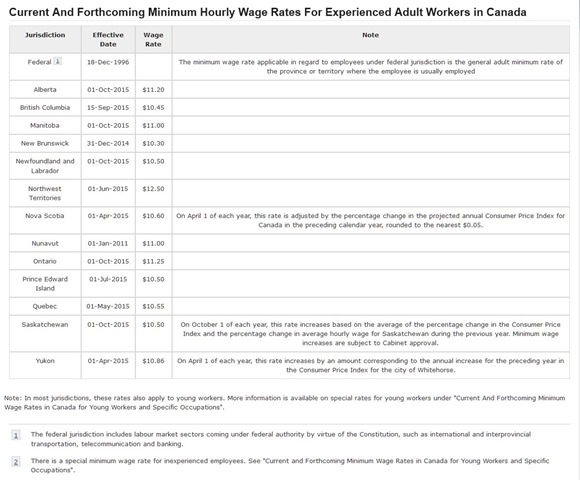
B.C.’s Minimum Wage Ranks Second From Worst In Canada

By Andrew Chernoff

Over 1 in 7 British Columbians Living In Poverty

Tying Minimum Wage To The CPI Essentially Is Indexing Poverty

In September, when B.C.’s minimum wages saw a few pennies raise, Irene Lanzinger, president of the B.C. Federation of Labour told the Georgia Straight, in a interview with  Travis Lupick that the increase in the minimum wage would do little to get British Columbians out of poverty in the province.

Lanzinger said an insufficient increase to the minimum wage is half the problem. The other half, she continued, is that B.C. simultaneously pegged the province’s minimum wage to the Consumer Price Index (CPI), a statistical estimate similar to a measure of inflation.

By itself, Lanzinger said, that would be a good thing that provides predictability to both employees and employers. However, she asserted, tying the minimum wage to the CPI coupled with that modest bump of 20 cents means the bottom of the country is where B.C.’s new minimum wage will remain.

“We are essentially indexing poverty,” she said. “We’ve got people earning poverty wages at our current minimum wage, and they will never get out of poverty. If you are going to peg it to something, you need to raise it above the poverty line first.”

In British Columbia the lack of a provincial poverty reduction strategy, income inequality, a fair tax system, and a minimum wage above the poverty line, in the last 10-years, has resulted in, “the average household income of the top 1% in B.C. has increased by 36% while, for the rest of us, real median incomes have stagnated, even though we’re working harder.”, according to the BC Poverty Reduction Coalition:

This isn’t just about market forces. Government policies keep incomes at the bottom low and give tax breaks to those at the top. Our welfare rates are completely inadequate at $610 a month for a single person. And the final minimum wage rate of $10.25 an hour will not put a worker above the poverty line in Vancouver and other large cities in B.C. But the view from the top is pretty rosy, with the top 1% of B.C. households paying a lower overall tax rate than others. In fact, provincial income tax cuts introduced since 2001 have delivered, on average, $41,000 to the top 1%.

Poverty is concentrated in specific populations, such as Aboriginal people, people with disabilities, recent immigrants, lone-mother households and single senior women, so the negative effects of inequality are more likely to be experienced by these groups.

Let’s get to the heart of the problem. Economic growth doesn’t make societies more equal; in fact, it may do the opposite. A poverty reduction strategy and a fair tax system would make our society more equal and our communities healthier, both physically and socially.

In December, 2014 when the last poverty stats from StatsCan were released, the BC Poverty Reduction Coalition reacted in its article titled, Latest poverty stats show BC still has one of the highest poverty rates in Canada. Trish Garner, the Community Organizer with the BC Poverty Reduction Coalition, a broad-based network of over 400 organizations throughout BC calling on the government to implement a poverty reduction plan,wrote:

The latest poverty statistics were released by Statistics Canada last Wednesday, and the data once again shows that BC has one of the highest poverty rates in Canada.

Using the Low Income Cut-Off – After Tax (LICO-AT) as the poverty line, 1 in 10 British Columbians are living in poverty. That’s 469,000 people struggling to make ends meet. In relation to the rest of the country, BC is tied third with Quebec after Ontario and Manitoba.

As always, there’s a two-year delay in the data from Statistics Canada so these numbers describe the situation from 2012. However, this year there’s also another challenge with the data – it’s produced from a new survey so we cannot compare to previous years. The silver lining perhaps is that it may stop the government from saying that we’ve seen a dramatic reduction in poverty by choosing their reference year from the past as that which had the highest poverty rate, (neglecting to mention that it spiked due to government cuts at the time).

So, we can’t say whether we’re improving or slipping backwards but, whichever way the trend might be going, 1 in 10 people living in poverty should be a concern for government and should drive serious action.

While the LICO-AT is a useful measure, in part because it gives us one of the most conservative estimates of poverty and because the government themselves have begun to use it, it has some big problems. For one, the base year from which the relative family expenditure underlying the data is drawn is 1992 and family spending on food, shelter and clothing in relation to their income has changed significantly since then. It also does not capture any geographical changes in the cost of living, which are especially significant in Metro Vancouver.

So let’s look at the Market Basket Measure (MBM), which is based on up-to-date costs of an adequate standard of living and reflects regional differences in living costs. As Statistics Canada describes, it “attempts to measure a standard of living that is a compromise between subsistence and social inclusion…The MBM represents the cost of a basket that includes: a nutritious diet, clothing and footwear, shelter, transportation, and other necessary goods and services (such as personal care items or household supplies).”

Using the MBM as a poverty line, we find over 1 in 7 British Columbians living in poverty. That’s a shocking 670,000 people. BC now has the second highest poverty rate in Canada after Nova Scotia.

Breaking the data down by age reveals a very interesting feature of the landscape of poverty in BC. While BC is in the middle of the pack in relation to other provinces in terms of child and senior poverty rates, we have the very highest poverty rate in Canada for working age people (18-64 years) across all poverty measures provided. This highlights that there is much more support needed for this age group, many of which are the working poor.

However, this new survey, as with most others, does not count “persons living on reserves and other Aboriginal settlements in the provinces,” and while these exclusions are said to be less than 3% of the total population, it is worth noting that the age demographics of the Aboriginal population might make this more important in counting poverty among the younger ages.

If we add this to the mounting evidence I documented here, including the recently published BC 2014 Child Poverty Report Card based on a different (taxfiler) data source that found 1 in 5 BC children are poor, there clearly continues to be an urgent need for a comprehensive poverty reduction plan for BC with legislated targets and timelines.

Despite the numbers and the heart-rending stories behind them, BC is now the very last province without a poverty reduction plan. It’s time for the government to listen up!

minwages

Federal Minister says child poverty not Ottawa’s problem

James Moore says child poverty falls under provincial jurisdiction

Sara Norman December 15, 2013 http://www.news1130.com

VANCOUVER (NEWS1130) – It was a disturbing milestone for BC this year–child poverty watchdogs announced our province is in the number one spot when it comes to kids in need. But it seems the Federal Government won’t be helping out.

“Is it my job to feed my neighbour’s child? I don’t think so.” That from Federal Minister of Industry James Moore who is also the Member of Parliament for Port Moody—Westwood—Port Coquitlam. He says it’s the responsibility of the provinces to deal with child poverty, and Ottawa has no plans to step in.

The Federal Government has been criticized for not meeting a unanimous motion passed in the House of Commons back in 1989 to end poverty by the year 2000. Nothing was done, but the motion was renewed in 2009. Child Poverty Watchdog Campaign 2000 says to this date there has been no movement from Ottawa on helping the estimated 1 in 7 kids living in poverty in our country.

Here in BC, thousands of kids go to school hungry every day because they’re not getting enough to eat. Of late, schools across Metro Vancouver have been left with the difficult decision on whether to put already strained resources into creating lunch and breakfast programs for students in need.

“Certainly we want to make sure that kids go to school full bellied, but is that always the government’s job to be there to serve people their breakfast?” Moore says Ottawa is helping keep kids fed by creating more jobs, and while unemployment was up in BC last month, joblessness across Canada was down.

“We’ve never been wealthier as a country than we are right now. Never been wealthier,” Moore claimed at an event Friday. He says how poverty is defined is not the same across the country.