
Source: Summary of the Trans-Pacific Partnership Agreement | United States Trade Representative
Tag Archives: australia
Britain’s FBI wants ‘Five Eyes’ cosy hookups with infosec outfits
http://www.theregister.co.uk/2015/09/17/nca_colocation_security_businesses/
El Reg blows lid on NCA’s ‘colocation’ dream with IT security bods
17 Sep 2015 at 22:21, Alexander J Martin
Cloudsec The UK’s National Crime Agency – Blighty’s equivalent of the FBI – wants its staff to “colocate” with private-sector IT security companies around the world. In other words, investigators and infosec employees placed alongside each other to sniff out cyber-criminals.
This will apparently help the agency reach across jurisdictions, and bust underworld gangs around the planet. This is according to a keynote address delivered on Thursday at the Cloudsec event in London – a presentation the media was banned from attending.
Speaking at the conference, Oliver Gower, Head of Strategy, Partnerships, and Transformation for the NCA’s National Cyber Crime Unit (NCCU), said a globally scaled security threat required a globally scaled security response.
Such a response should emulate the cosy Five Eyes spy relationship between America, the UK, Australia, Canada and New Zealand, said Gower, in that agents and employees in friendly countries and businesses should work shoulder-to-shoulder to combat cyber-crime.
He is keen to get beneath the sheets with information security outfits amid this international tie-up – having already bagged memorandums of understanding with Trend Micro and Intel Security.
As well as lauding the trans-jurisdictional efforts of the Joint Cybercrime Action Taskforce and the European Cybercrime Task Force, Gower mentioned a model the NCA was especially keen to copy:
The US’s National Cyber-Forensics and Training Alliance (NCFTA), which is based in Pittsburgh, and “colocates” law enforcement agents with private sector security companies.
As the alliance states: “The NCFTA is a productive environment because we operate as one unit with our private and public sector partners. Our partners are located both on-site and off-site, and come from private industry, law enforcement, academia, and government.”
Noted in a single slide of Gower’s talk was the Five Eyes Law Enforcement Group. Known previously as the Strategic Alliance Group Principals’ Meeting, the shadowy organization was formed post-Snowden to “seek to reduce the international threat and impact of organised crime.”
Although its methodology is unclear, it is, we’re told, not a counter-terrorism intelligence partnership, though membership of the group is comprised of the anglophone Five Eyes nations.
Running a trans-jurisdictional effort to combat organized crime is more difficult than you’d imagine, Gower suggested. Police investigators struggle to accept their technical limitations, and need the help of talented information security types to keep up with progress.
Deconfliction between difference police forces is increasingly an issue for crime-busting coalitions, too. The possibility of undercover cyber-cops having their investigations blown by blue-on-blue bungling – an officer in one country interrupting and scuppering the work of another – is increasingly an issue.
Data glut
Gower also confessed that the NCA is struggling to deal with the volumes of data and intelligence it receives. The agency increasingly gets its information and evidence from “seized media” – confiscated memory cards, server hard drives, and so on, we assume.
Now these piles of data are mounting up and straining resources – putting pressure particularly on officers investigating pedophiles handling child-abuse images.
As a result of these “resource challenges,” house visits by officers are not always possible. Some miscreants – such as those launching denial-of-service attacks against websites – simply receive warning emails. These missives are shared in cybercrime forums, usually accompanied with the usual prison-rape jokes, much to the delight of the agency: it means the miscreants are spreading the cops’ message for them.
The NCA is also keeping a close eye on mobile malware and Tinba – or the Tiny Banker Trojan. Ranging from a mere 20KB to 100KB in size, the bank-account-raiding software nasty surfaced in 2012.
Interestingly, he also asked: “Can government take action to systematically remove malware from everybody’s computers without them knowing it?”
“Probably not,” came his firmly comforting reply.
The Register was told by the Cloudsec organisers that the agency wouldn’t allow journalists in its session. Which is odd given that the keynote slides were widely photographed and tweeted by attendees without issue. Of course, this vulture pulled up a pew anyway and watched on. ®
Back To The Future: Canada’s Future From The Past=> The Five Eyes
The United Kingdom – United States of America Agreement (UKUSA, /juːkuːˈsɑː/ ew-koo-SAH)[1][2] is a multilateral agreement for cooperation in signals intelligence between the United Kingdom, the United States, Canada, Australia, and New Zealand. The alliance of intelligence operations is also known as Five Eyes.[3][4][5][6][7] In classification markings this is abbreviated as FVEY, with the individual countries being abbreviated as GBR, USA, CAN, AUS, and NZL respectively.[8]
Emerging from an informal agreement related to the 1941 Atlantic Charter, the secret treaty was renewed with the passage of the 1943 BRUSA Agreement, before being officially enacted on 5 March 1946 by the United Kingdom and the United States. In the following years, it was extended to encompass Canada, Australia and New Zealand. Other countries, known as “third parties”, such as West Germany, the Philippines and several Nordic countries also joined the UKUSA community.[9][10]
Much of the sharing of information is performed via the ultra-sensitive STONEGHOST network, which has been claimed to contain “some of the Western world’s most closely guarded secrets”.[11] Besides laying down rules for intelligence sharing, the agreement formalized and cemented the “Special Relationship” between the UK and the USA.[12][13]
Due to its status as a secret treaty, its existence was not known to the Prime Minister of Australia until 1973,[14] and it was not disclosed to the public until 2005.[13] On 25 June 2010, for the first time in history, the full text of the agreement was publicly released by Britain and the United States, and can now be viewed online.[9][15] Shortly after its release, the seven-page UKUSA Agreement was recognized by Time magazine as one of the Cold War‘s most important documents, with immense historical significance.[13]
Currently, the global surveillance disclosure by Edward Snowden has shown that the intelligence-sharing activities between the First World allies of the Cold War are rapidly shifting into the digital realm of the Internet.[16][17][18
The Five Eyes are cooperating with various 3rd Party countries in at least two groups:
- The “Nine Eyes”, consisting of the Five Eyes plus Denmark, France, the Netherlands and Norway.
- The “Fourteen Eyes”, consisting of the same countries as the Nine Eyes plus Germany, Belgium, Italy, Spain and Sweden.[44] The actual name of this group is SIGINT Seniors Europe (SSEUR) and its purpose is coordinating the exchange of military signals intelligence among its members.[45]
In 2013, Canadian federal judge Richard Mosley strongly rebuked the Canadian Security Intelligence Service (CSIS) for outsourcing its surveillance of Canadians to overseas partner agencies. A 51-page ruling says that the CSIS and other Canadian federal agencies are illegally enlisting U.S. and British allies in global surveillance dragnets, while keeping domestic federal courts in the dark.[56][57][58]
NSA’s relationship with Canada’s CSEC
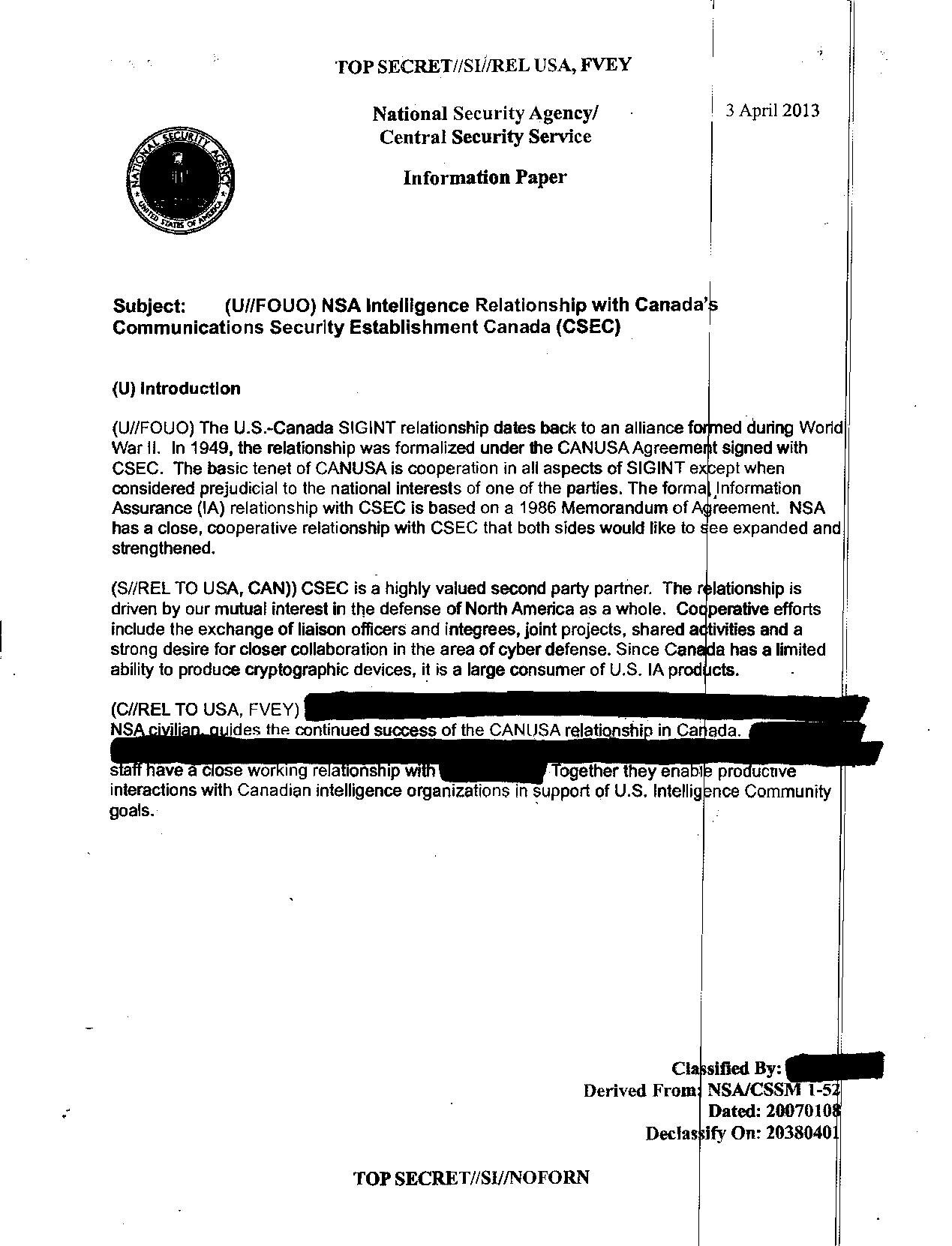
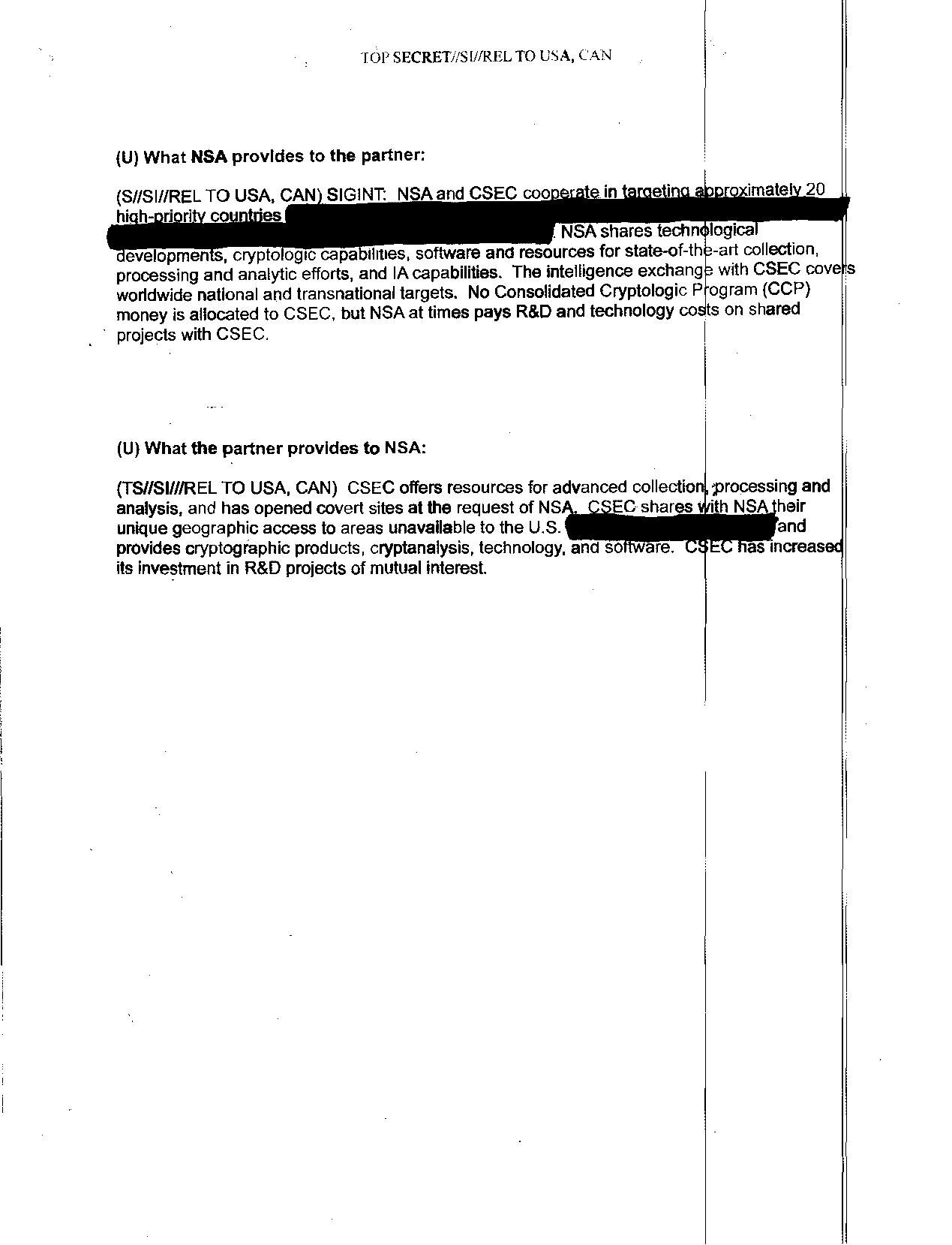
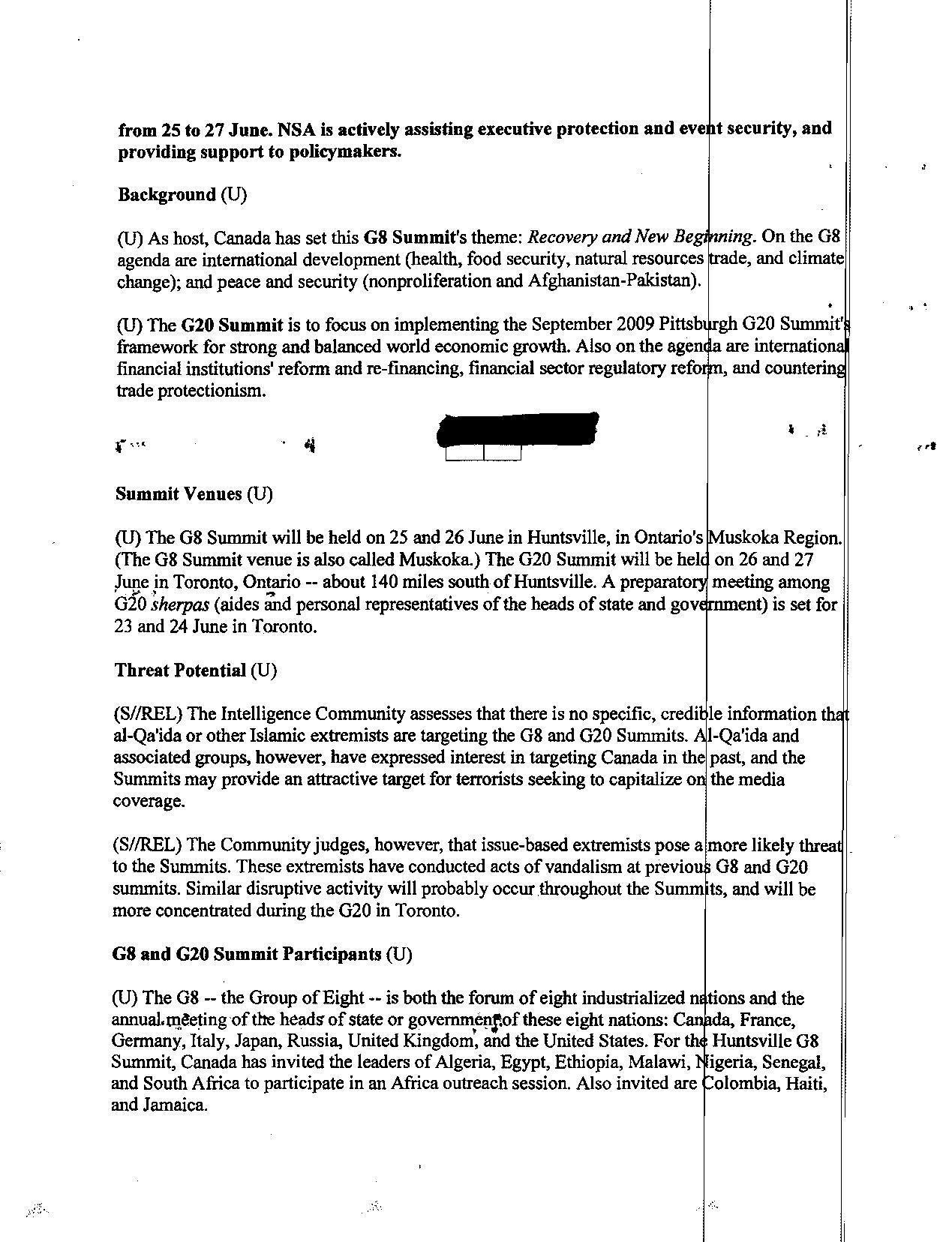
NSA document on a joint espionage operation with Canada’s CSEC agency during the G8 and G20 summits in Toronto in 2010



The U.S. has a $7.25 minimum wage. Australia’s is $16.88
By Dylan Matthews, Published: August 19 http://www.washingtonpost.com
Minimum wage advocates love to point to Australia’s $16.88 an hour minimum as evidence that a very high wage floor needn’t stifle a country’s growth. After all, Australia hasn’t had a recession in 20 years. But Australia is hardly an outlier. Most developed countries have a higher minimum wage than we do, as this chart from Business Insider’s Matthew Boesler — using data from the ConvergEx Group — shows:

This holds up if you compare the minimums to the median wage in the country in question, as the OECD did. Here’s what they found:

The U.S., unsurprisingly, is on the bottom but it’s tied with Japan. And Australia isn’t on top; that goes to France, which has a lower average wage than Australia, which makes up for a lower minimum wage and leads to a higher ratio.
The Center for American Progress has proposed setting the minimum wage at half the average wage (mean, not median as used above) for production and non-supervisory workers; at the current level, that means a $10.07 minimum. If we were to adopt France’s 60 percent ratio, that’d put us at about $12.08.
Of course, there are all kinds of pros and cons to that kind of increase. I went through many of them here. And it’s worth noting that Australia’s minimum wage comes with all kinds of exceptions, especially for younger workers.
Update: Another point, which Guan Yang reminded me of on Twitter – a large number of countries, including Denmark, Germany, Italy, Norway, Singapore, Sweden, and Switzerland, don’t have minimum wages at all. Most of them make up for it with widespread collective bargaining, which sets de facto minimums.
In economics we should do what works, and austerity doesn’t.
August 6, 2013 · by Elliot Brice From: http://donotgogentleblog.com
Economics is often said to be more of an art than a science. This is because, unlike in the sciences, it is very hard to draw solid conclusions from empirical data. This might be the case; nonetheless you’d be stupid not to try and draw some conclusions from the experiences of others. And when we look at the experiences of various national economies right now there are definitely some lessons to be drawn.
The biggest lesson is: ‘don’t be Europe’. Europe is bad and going backwards. Don’t do what they did. The failure of European economic policies have clear implications for economic theory and the economic policies of Australia and the rest of the world.
So what is the nature of the mess Europe finds itself in? Even answering that question is controversial; everyone agrees Europe is in a mess, but it’s not even clear what exactly the mess is. Is the mess a debt crisis fueled by dangerously high sovereign debt? Or is it an employment crisis fueled by low and negative growth? The governments of the Euro zone have clearly identified the crisis as a debt crisis because their solution has been austerity – slash government spending to cut back their respective deficits. However a good 3 years of austerity has failed to solve the crisis.
In the UK, government debt as a percentage of GDP only continues to rise and is now above 90 percent. French debt to GDP is also up around the dreaded 90 percent mark and rising. Spain lives in the mid 80s and is on an upwards trajectory, as is the debt to GDP ratio of Portugal, Ireland and most other European countries. Greek debt to GDP has fallen slightly but years of austerity have barely made a dent; their ratio still lies above 150 percent. See here and here.
So what’s going on here, why has government spending failed to stop the crisis? Perhaps because the crisis is not really a debt crisis. Sure debt is part of the problem, but the debt crisis and the growth crisis are two sides of the same coin. And by ignoring the other side of the coin, European governments have offered misdirected solutions that have only made the crisis worse. They have sacked public servants, slashed government welfare, increased the cost of things like university education, and put an end to many government services and programs that people depended upon in the process destroying countless lives and creating a lost generation who will never enjoy the opportunities their parents had.
They must be doing something wrong. We might get a clue at what they are doing wrong by having another think about that ratio that austerity nuts are obsessed with – debt to GDP. One way to reduce it is obviously by reducing debt; but that only works if GDP stays the same. The problem with that is that slashing billions of dollars of services, firing people and generally withdrawing cash from the economy almost inevitably results in a reduction in GDP. This explains why the debt to GDP of most European countries is not going down, despite harsh austerity. They are cutting spending, but that is resulting in lower growth. In fact it is resulting in negative growth. And that negative growth is sending companies out of business and driving people out of work.
Greece, Italy, Spain, Belgium, France and the Euro-zone as a whole remain in recession. The UK has experienced some slight economic growth in recent times but they are not exactly a success story having very nearly gone through three recessions over the period of time since the global financial crisis hit.
So I contend that trying to address debt to GDP through austerity is not a great idea.
If you are really concerned about debt to GDP then have a look at the other side of the ratio. You can reduce debt to GDP by increasing GDP. Even if you spend more and increase debt, the ratio of debt to GDP will still go down as long as GDP goes up by an even greater amount. And that is fairly likely to happen given the multiplier effect of spending: if the government spends 50,000 dollars employing someone, then that individual might spend 20,000 of that on a new car. Then the owner of the car shop might spend her new 20,000 dollars on a holiday to another city in the same country. Then the tourism operators in that city will spend their new 20,000 dollars on food, clothes etc. And the food and clothes sellers in the area will collectively have 20,000 new dollars to spend on something. This will go on and on; clearly the 50,000 the government has spent has resulted in more than 50,000 dollars worth of economic stimulus.
The above example has already resulted in over 80,000 dollars worth of stuff being bought. You might respond that in an economic downturn the government employee is likely to save their income rather than buy a new car. It is true that well off people will save in a downturn but less well off people tend to spend their money; which is why it is much more efficient to stimulate the economy through welfare for the poor rather than tax cuts for the rich. Furthermore, obviously (if the government has established a decent tax collecting structure – something Greece and Italy never did) then all of this new economic spending will result in more tax revenues, which will – guess what! – reduce the debt.
Slash and burn austerity hawks commonly used a 2010 study by Carmen Reinhart and Kenneth Rogoff to justify their policies. It argued that if a country has 90 percent debt to GDP or above, then economic growth will slow significantly. Of course a second study by Thomas Herndon, Michael Ash and Robert Pollin claimed to discredit the 2010 study, saying it was based on faulty calculations. Yet I would argue that even if the math wasn’t wrong, there is more explaining to do. After all, correlation doesn’t equal causation. And just because on average countries with 90 percent debt to GDP levels had much lower economic growth rates, that doesn’t mean high debt to GDP causes low economic growth. In fact based on what I was arguing above, it would seem to me that, if anything, low economic growth causes high debt to GDP. So what is more important than cutting debt? Stimulating growth!
The European economic crisis is not a debt crisis at all, it is a growth crisis and an unemployment crisis. Debt is the symptom but not the cause. And even if it was the cause, austerity is not the solution.
Karl Marx argued that capitalism lurches from crisis to crisis. You don’t have to be a communist to realise that this is a powerful insight. We have booms (that are often bubble’s waiting to burst) and we have busts; no one can deny it. Marx argued that it lurches from crisis to crisis because when there is an economic boom and demand for labour is high, workers will, according to the law of supply and demand, only work for high wages. This will result in high inflation (which is bad for business) and obviously will also directly dent the profits of businesses. As a result businesses will need to downsize and an economic crisis will ensue. This is the problem that the Hawke/Keating government’s Accord sought to address by asking unions to temper their demands for high wage growth.
On the flip side (which is the relevant side at the moment), when there is excess supply of labour (high unemployment), businesses can get away with paying low wages (as the law of supply and demand shows). This might seem like it would be good for business (and right wingers often argue that low wages would lead to full employment) but if wages are low for most people then savings will be low; once workers have spent their money on the essentials they won’t have much left over to buy any non-essential products. And so the businesses selling non-essential items, like TVs and antique furniture and tickets to rock concerts, will be in trouble. Businesses will start to close and an economic crisis ensues. So, Marx argues, we can’t win either way; capitalism is doomed to fail.
Businesses might try to get around this latter scenario by searching for new markets, especially in developing countries, finding new people to buy their stuff. This worked for a while; even though workers in Detroit couldn’t afford to buy the cars they were making, Chrysler found some rich people in China and Africa to buy their stuff. Eventually though the crisis came; once the banks stopped lending to people, and credit cards were maxed out, incomes weren’t high enough to keep buying things -and the great recession hit. I don’t think the solution to this problem is to do away with the system, because there is no credible alternative. Yet what we do need to do is to smooth the business cycle – it is in no one’s interest to lurch from crisis to crisis, bubbles and busts.
What I get from Marxian economics (as opposed to Marxist economics) is that the extremes of capitalism – bubbles and busts – cause severe crises; and an extreme response to an economic crisis will only create another crisis. A crisis results from either a bubble – excessive growth – or a bust.
Austerity is an example of an extreme response; it takes money away from those that need it, causes higher unemployment, lower wages and hence sends us hurtling towards another crisis. And that is how Europe finds itself now, lurching from serious crisis to serious crisis.
Marx also reminds us that extreme inequality, which austerity fosters, is bad for economic growth. Extreme inequality leads to the situation above, where most wealth is concentrated in the hands of the few while most workers have little money to spend on luxury goods, leading to a slump in business activity and an economic crisis.
The solution to Europe’s crisis then must involve a path forward that reduces wealth inequality, does not lead to significantly lower wages or higher unemployment; nor should it involve unsustainable wage growth built upon a bubble. The solution is to have prudent economic management that aims for sustainable wage growth, sensible government intervention in the economy to boost spending when necessary, a progressive taxation system that reduces inequality and a strong safety net that helps people get back on their feet and prevents an excess supply of labour. This Keynesian approach might not eliminate all booms and busts – they may indeed be an inevitable feature of capitalism as Marx said. Yet it can reduce the extreme volatility of capitalism and make crises less likely. This is the approach Australian Labor governments have largely followed. It is also the approach Obama has tried to follow (though he has had to negotiate with ideologically blinded austerity obsessed Congress). And the results in Australia and even the US are far more promising than Europe.
Any attempt by a potential future Abbott government in Australia to change from this path more towards an austerity path should be a cause for concern. It would be a triumph of small government ideology over doing what works. Europe has shown that the game is up for austerity hawks. Economic theory now needs to shift to the left, in line with what works.
Elliot Brice has studied economics at the University of Melbourne and is currently studying to be a high school teacher at the same institution. He also has an Honours degree in philosophy.
 Andrew Phillip Chernoff