El Nino ‘reaching its peak’ In Much Of Australia

THE El Nino bringing drought conditions to much of Australia may be reaching its peak but is now one of the strongest on record.

THE Bureau of Meteorology says the El Nino, a warming of sea surface temperatures in the central and eastern tropical Pacific Ocean that tends to bring drier weather to Australia, now matches the strength of record El Ninos in 1997/98 and 1982/83.

Both of those events brought severe droughts to eastern Australia, and the 1982/83 drought was a major factor in the Ash Wednesday bushfires that killed 71 people in Victoria and South Australia on February 16, 1983.

“The (current El Nino) event is comparable to the record events of 1997/98 and 1982/83,” the BOM’s latest fortnightly El Nino Southern Oscillation Wrap Up says.

“International climate models suggest that El Nino sea surface temperatures are approaching their peak, and will decrease in the first quarter of 2016.

“With such warm sea surface temperatures, models suggest the tropical Pacific is unlikely to return to neutral until at least autumn 2016, although impacts on Australian climate are likely to decline prior to this.

” The influence of El Ninos varies at this time of year, depending on how quickly they begin to break down, but most deliver below-average rainfall and a continuing drying influence on southeastern Australia but more rain in inland Western Australia.

Meanwhile, a warming of Indian Ocean sea surface temperatures known as the Indian Ocean Dipole is decaying rapidly, the BOM says. It set sea surface temperature records in October and offset some of the drying influence of the El Nino during winter.

WHAT IS AN EL NINO?

* Warming of sea surface temperatures in eastern and central tropical Pacific Ocean that disrupts weather patterns across the Pacific

* Can cause ocean cooling in the western Pacific and around northern Australia

* Can deliver more rain to the west coast of North and South America

* Can disrupt trade winds that blow moisture-laden air towards eastern Australia

WHAT ARE THE EFFECTS IN AUSTRALIA?

* Lower rainfall through winter and spring, especially in the north and east

* Temperature extremes

* Warmer-than-average weather, particularly in southern Australia in the second half of the year

* Decreased cloud and low rainfall

* Worsening heat extremes for cities such as Adelaide and Melbourne, increase in extreme hot days and heatwaves further north

* Increased frost

* Increased bushfire risk

* Fewer tropical cyclones, especially for Queensland

* Later northern monsoon rains

* Below-average wet season rains early

* Reduced winter snowfall

(Source: Bureau of Meteorology)

Source: El Nino ‘reaching its peak’: BOM | Breaking National News and Australian News | NT News
Extreme weather continues for South Australia, total fire bans declared

South Australia is set for another day of extreme pre-summer heat, with temperatures again expected to exceed 40 degrees Celsius in some parts and a top of 39C expected in Adelaide.

Total fire bans have been imposed for 12 districts across the state and a cool change is not expected to arrive until late in the week.

“On Thursday, temperatures will exceed 40C in the north and east of South Australia ahead of a cool change,” meteorologist Matt Collopy said.

“Cooler conditions will spread across western and southern parts of the state on Thursday then extend to remaining parts on Friday.”

Overnight temperatures are expected to remain in the low to mid 20s for many parts of SA.

Mr Collopy warned of continuing high fire danger, after crews tackled a number of scrub and stubble blazes on Tuesday.

Country Fire Service crews are working to contain a fire at Kyeema, east of Hope Forest, south of Adelaide.

The fire has burnt through about 75 hectares of scrub with strike teams working overnight to try to gain the upper hand before temperatures soar again.

The CFS said the fire was not threatening any homes, but it is causing smoke at Willunga, Aldinga Beach, Sellicks Beach and surrounding areas.

“The combination of the very hot conditions and fresh north-westerly winds will result in severe to extreme fire weather conditions across much of the state on Wednesday and Thursday,” he said.

Adelaide hit a top temperature of 36C on Tuesday, which was 10C above the mid-November average, and the Bureau of Meteorology warned parts of South Australia could expect maximum temperatures about 12C above their averages today.

“Similar temperatures are expected on Thursday ahead of a cool change extending across western and southern parts of the state during the day,” Mr Collopy said.

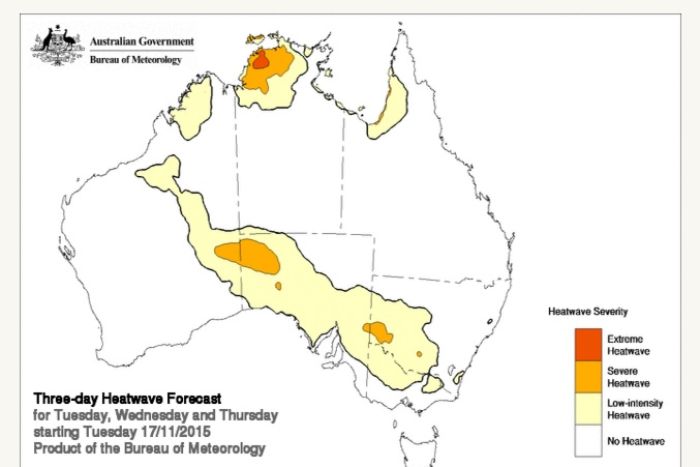
Heatwave forecast map for Tuesday 17-Thu 19 November 2015

Photo: Heatwave forecast map for Tuesday 17-Thu 19 November 2015 (Bureau of Meteorology)

Source: Extreme weather continues for South Australia, total fire bans declared – ABC News (Australian Broadcasting Corporation)

Buyers Have Upper Hand In Liquefied Natural Gas Market

(MENAFN – Gulf Times) Next year, on a remote island off Australia’s western coast, the world’s most expensive liquefied natural gas export terminal will start shipping cargoes into a market that has changed vastly since 2009, when the project was approved.

Chevron’s 54bn Gorgon LNG facility, initially budgeted at 31bn, was supposed to have begun operations in 2014. Labour disputes have delayed it, and lower LNG prices have potentially reduced its profitability. LNG producers no longer have the bargaining power they once did.

Weakening demand in Asia combined with an increase in LNG supply is giving the world’s biggest buyers not only cheaper gas but also more say on how contracts are designed.

“The buyers have the upper hand,” says Neil Beveridge, an analyst at Sanford C Bernstein.

LNG suppliers have historically been able to lock customers into 20-year contracts, with clauses that restrict the resale of gas. In Japan, the world’s largest LNG market, two of the country’s largest utilities have teamed up to gain leverage and demand more flexibility. Jera, a joint venture of Tokyo Electric Power and Chubu Electric Power, says it will no longer sign contracts that give producers control over the destination of the product.

If buyers succeed in negotiating better terms, the LNG market could become more like the one for crude oil, where producers, suppliers, and traders all compete for profits through constant buying and selling. That would require a fully functioning spot market, where supplies are traded for immediate delivery, a development that’s still a decade away, Beveridge says.

By then, Australia could be the world’s top LNG exporter. For the first time in eight years, exports from Qatar shrank in 2014. Qatar still provides about a third of the world’s LNG, but customers are also lining up for new supplies from Australia and the US.

Gorgon will join three other LNG megaprojects that have been completed recently along Australia’s east coast and will tap the country’s vast gas deposits.

In the US five LNG projects under construction will export cheap natural gas unlocked by the shale boom. The first will begin exports in 2016. Over the next decade the US is likely to become a net exporter of natural gas and compete with Australia to be the world’s leading LNG supplier.After these projects come online, it may be a while before any others are built.

“LNG is the last of those sectors where we’re seeing a wave of new projects hit the market,” says Daniel Hynes, a commodity strategist at Australia & New Zealand Banking Group.

“It’s coming at a time when demand is weakening across the board. It’s clearly a tough market.”

Source: It’s a buyer’s market as new supplies flow from US, Australia | MENAFN.COM

Small business shunned for bigger stores in Australia

A growing number of consumers are shunning family-run local shops in favour of large businesses, a situation Small Business Minister Kelly O’Dwyer warns could put jobs at risk.

Attending the official launch of ‘Shop Small’ in Melbourne on Monday, Ms O’Dwyer says without small businesses half of the private sector workforce could find themselves unemployed.

Source: Small business shunned for bigger stores

Climate policy looms as Turnbull’s greatest economic challenge – The Drum (Australian Broadcasting Corporation)

With the Paris climate summit nearing, will Malcolm Turnbull be able to bring a rational economic approach to climate policy? It is likely to be his greatest challenge as Prime Minister.

Source: Climate policy looms as Turnbull’s greatest economic challenge – The Drum (Australian Broadcasting Corporation)