
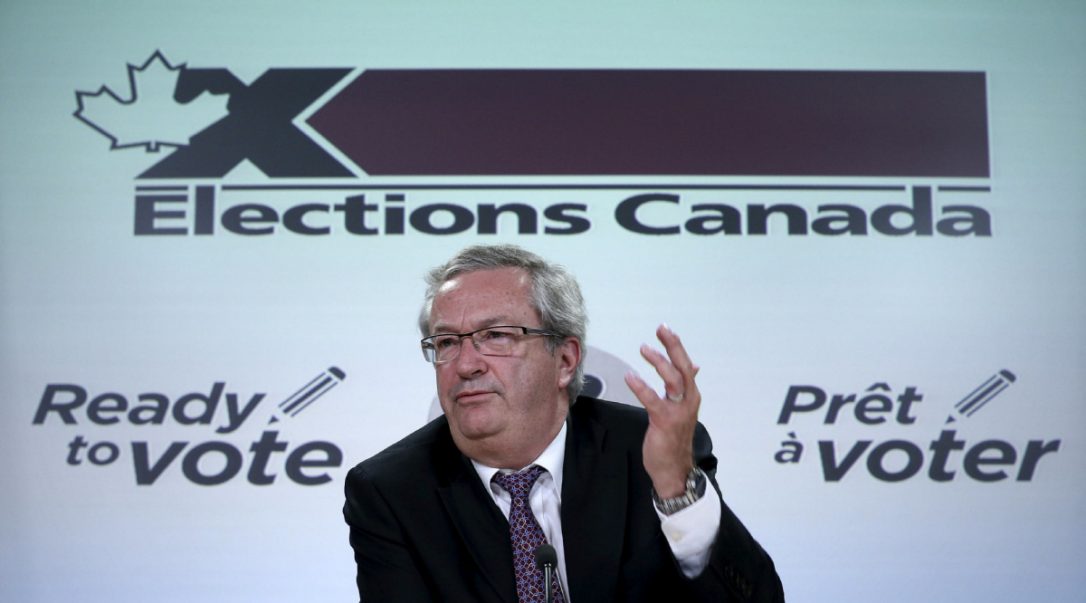
 Canada’s Chief Electoral Officer Marc Mayrand says Elections Canada had hoped last year’s fixed election date would bring some predictability to their planning for the 2015 vote. But after then-prime minister Stephen Harper asked Gov. Gen. David Johnston to dissolve Parliament, Elections Canada had to deploy its field operations immediately, causing challenges.(CHRIS WATTIE / REUTERS)
By
September 21, 2016
OTTAWA—Elections Canada experienced some headaches dealing with the longest federal campaign in modern Canadian history, says a new report from the chief electoral officer.
Chief electoral officer Marc Mayrand said Elections Canada had hoped last year’s fixed election date would bring some predictability to their planning for the 2015 vote.
That went out the window, however, when then-prime minister Stephen Harper asked Gov. Gen. David Johnston to dissolve Parliament on Aug. 2, kicking the campaign into gear more than a month earlier than expected.
“The absence of a fixed start date, or a specified time range within which to conduct the election, resulted in significant deployment challenges and delays,” said the report released Wednesday.
Elections Canada plans to make recommendations on how to better define the duration of an election period in its upcoming report to Parliament, expected within the next two weeks.
The report said Elections Canada had been anticipating that the campaign period for the Oct. 19 election would be officially launched in mid-September.
The plan was to begin deploying field operations Sept. 1, which included finalizing temporary office leases, arranging for computer and telephone services, ordering election materials and hiring local office staff.
When the campaign got underway a full month earlier than expected, Elections Canada had to review its planning and deploy its field operations immediately.
That meant many returning officers had to renegotiate new leases for the 78-day writ period, with 107 of them having to find new office locations entirely.
The report said about 95 per cent of the returning offices were open within eight days of the election call, with the last one opened Aug. 18 and the last satellite office opened the next day.
For the 2011 election, all offices were up and running within three days of the start of the writ period, the report noted.
“There is no doubt that, for the first few days of the election campaign, some electors and political entities did not get the level of service they had been accustomed to in previous elections,” said the report.
It also said moving more of their services online might have eased the impact.
The report also outlines issues with voting on First Nations reserves, where 14 polling places in nine ridings ran low on ballots on election day.
A total of 13 voters, all from the same polling place, were unable to cast a ballot when election officers were uncomfortable with photocopied ballots and refused to give them to voters, contrary to instructions issued by Mayrand.
“Elections Canada sincerely regrets that these electors could not exercise their franchise,” said the report.
The report said a contributing factor was the low rate of voter registration, which caused officers to underestimate the turnout on election day.
“Returning officers will take this into account to improve their planning for the next general election.”
Mayrand said his upcoming report to Parliament will include suggested changes to the Canada Elections Act that would give the independent agency the flexibility it needs to modernize the voting process, including by increasing the use of technology.
“Electors increasingly want to vote when and where it suits them — no longer just on election day at a designated polling station,” Mayrand wrote.
It is unlikely, however, that Mayrand will recommend a wholesale move to online voting.
He expressed concerns about its risks when he appeared before the House of Commons committee studying electoral reform in July, saying that Elections Canada was not currently planning to introduce it for 2019 and asked the committee to consider limiting its scope, at least at first, to Canadian living abroad or with mobility issues.
Source: Federal campaign in 2015 caused headaches for Elections Canada: report | Toronto Star

 Andrew Phillip Chernoff