Are you a caregiver to an aging family member? Do you know any other CUPE members who provide care for a relative while holding down a job?
Caregiving is especially taxing when you are also engaged in paid employment. It becomes a balancing act that often results in higher levels of work-life conflict, as well as emotional and physical strain.
CUPE advocates for a healthy workplace and evidence based policies. These pieces all come together in the National Survey on Balancing Work, Family and Caregivingcurrently being undertaken on behalf of the Canadian Consortium on Neurodegeneration in Aging (CCNA) by Dr. Linda Duxbury, Professor at the Sprott School of Business at Carleton, University in Ottawa.
Dr. Duxbury is a Canadian expert in the field of work-life balance and we are pleased to be able to assist her with this research effort.
This is your opportunity to contribute to research that aims to increase awareness at both public policy and employer level of the challenges faced by employed caregivers.
We would encourage you to participate and share this survey with CUPE members in your local.
As a person who is employed and with family caregiver responsibilities, your participation will help to provide much needed evidence on this developing topic. In addition, the researchers have agreed to share the key findings from our members with CUPE. Your individual response will be kept in strict confidence. Only summary results will be published.
For more information please contact Margot Young at myoung@cupe.ca.
Summary
The member for Rimouski-Neigette-Temiscouata-Les Basques, Mr. Guy Caron, requested that the Parliamentary Budget Officer analyze the fiscal and distributional impact of two changes to the federal personal income tax (PIT) regime announced by the government in December 2015:
1. Introducing a 33.0 per cent PIT rate on taxable income over $200,000, effective January 1, 2016.
2. Reducing the PIT rate on the second tax bracket (taxable income of $45,283 to $90,563 in 2016) from 22.0 per cent to 20.5 per cent, effective January 1, 2016.
The member also requested that the change to the second bracket be compared to an alternative:
Reducing the PIT rate on the first income tax bracket from 15.0 per cent to 14.0 per cent (up to $45,282 of taxable income in 2016), starting on January 1, 2016.
PBO estimates the net primary impact as the increase (or decrease) in federal revenues and expenses resulting from tax rate changes applied to the existing tax base. PBO further estimates a behavioural response of taxfilers to the new lower (or higher) marginal tax rates based on assumptions for the elasticity of taxable income. The net primary impact in combination with the behavioural response is equal to the expected net fiscal impact on the government’s budget balance.
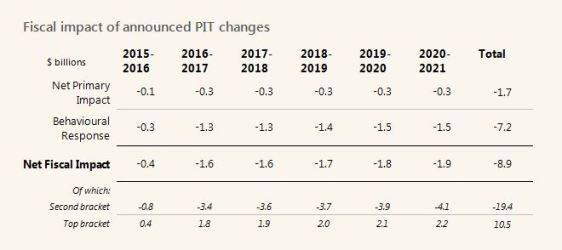
PBO estimates that the net fiscal impact of the first two changes will reduce PIT revenues by $0.4 billion in 2015-16 and about $1.7 billion annually on average from 2016-17 to 2020-21. That is, the estimated revenue gains from introducing a new tax rate of 33.0 per cent on taxable income over $200,000 fall short of covering the estimated loss in revenues from reducing the PIT rate on the second tax bracket by $8.9 billion from 2015-16 to 2020-21. Reducing the first personal income tax rate from 15.0 to 14.0 per cent would reduce revenue by $0.9 billion in 2015-16 and about $4.1 billion on average annually from 2016-17 to 2020-21.
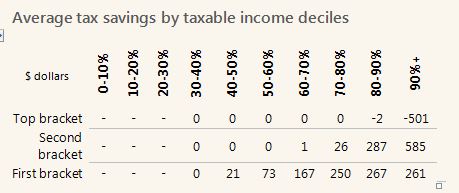
Introducing the new tax bracket for taxable income over $200,000 at a rate of 33.0 per cent will affect taxpayers in the top decile. The top 1.4 per cent of taxpayers will pay an additional $5,255 on average. The second bracket change will affect 43 per cent of taxpayers, and primarily the top 30 per cent of earners. The first bracket change will affect the most number of taxpayers with tax savings distributed across the top 60 per cent of earners.
Summary
This report reviews the evolution of household indebtedness in Canada and assesses prospects for household financial vulnerability over the medium term. The assessment, however, is based on financial indicators that represent economy-wide averages, which can mask wide variation across households. An assessment of financial vulnerability based on household microdata is beyond the scope of this report.
The indebtedness of Canadian households continues to trend higher. In the third quarter of 2015, total household debt (i.e., credit market debt plus trade payables) reached 171 per cent of disposable income. In other words, for every $100 of disposable income, households had debt obligations of $171. This is the highest level recorded since 1990.
Among G7 countries, Canada has experienced the largest increase in household debt relative to income since 2000. Households in Canada have become more indebted than any other G7 country over recent history.
Measured relative to household assets, household debt has moderated in recent years. In the third quarter of 2015, household debt accounted for 17.0 per cent of household assets. But this was still above the average of 15.4 per cent prior to the global financial crisis.
Analysis conducted at the Bank of Canada suggests that low interest rates, higher house prices and financial innovation have contributed to the increase in household indebtedness.
Policymakers continue to express concern about the vulnerability of households to economic shocks, such as unexpected job loss or higher-than-expected interest rates. While the household debt-to-income ratio provides an indication of household indebtedness and facilitates international comparisons, it provides a limited measure of household financial vulnerability.
What matters more for financial vulnerability is not so much the level of the debt relative to income, but rather the capacity of households to meet their debt service obligations. A financially vulnerable household is one that is required to devote a substantial portion of its income to service its debt. It faces greater exposure to negative income and interest rate shocks, and is more likely to be delinquent in its debt payments.
Financial vulnerability is typically measured by the debt service ratio (DSR), that is, household debt payments expressed relative to disposable income. In this report, we adopt Statistics Canada’s concept and measure of obligated debt payments, which includes required principal and interest payments, but excludes debt prepayments.
Based on PBO’s November 2015 Economic and Fiscal Outlook, we project that household debt will continue to rise, reaching 174 per cent of disposable income in late 2016, before returning close to current levels by the end of 2020.
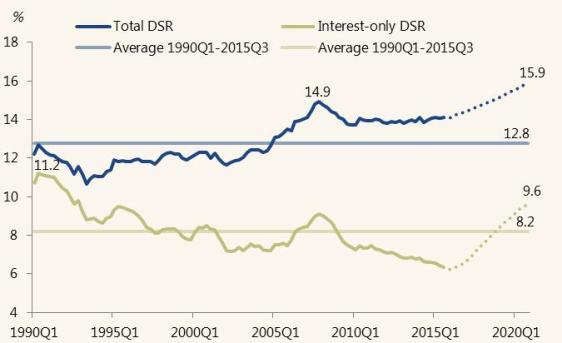
Household debt-servicing capacity will become stretched further as interest rates rise to “normal” levels over the next five years. By the end of 2020, the total household DSR, that is principal plus interest, is projected to increase from 14.1 per cent of disposable income in the third quarter of 2015 to 15.9 per cent.
Household debt service ratios
Based on PBO’s projection, the financial vulnerability of the average household would rise to levels beyond historical experience.
The projected increase in the total DSR to 15.9 per cent would be 3.1 percentage points above the long-term historical average of 12.8 per cent (from 1990Q1 to 2015Q3). It would also be almost one full percentage point above its highest level over the past 25 years, 14.9 per cent, which was reached in 2007Q4.
Analysis conducted at the Bank of Canada (see Djoudad (2012)) indicates that an increase in the DSR “would imply that households are more vulnerable to negative shocks to income or to interest rates, making household balance sheets more precarious and having a negative impact on financial institutions”.
CANUCKS BANTER By Andrew Chernoff January 21, 2016
The Vancouver Canucks (19-17-11) play the fifth game of their 6-game road trip tonight against the Boston Bruins ( 24-16-5) at TD Garden.
The Canucks are going for their third win of the road trip, after losing in Washington in regulation and the Rangers in overtime; defeating Carolina in overtime, and the Islanders in a shoot out.
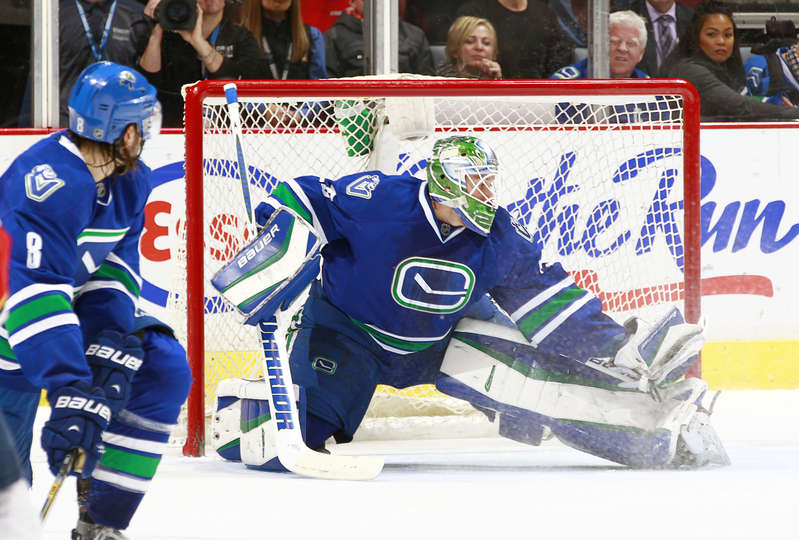
Coach Desjardins confirmed this morning that Jacob Markstrom starts in net and both Jake Virtanen & Mike Zalewski will be in the lineup tonight in Boston.
The Boston Bruins will try to extend their current winning streak to four games. The Bruins are 10-11-2 on home ice.
The Bruins are looking to win four straight games for the 1st time since a season-high 5-game win streak from November 19-27; and are looking to win consecutive home games for the first time since winning 3 straight on home ice from November 19-27.
The Canucks have recorded consecutive wins just once in its past 10, going 5-5.
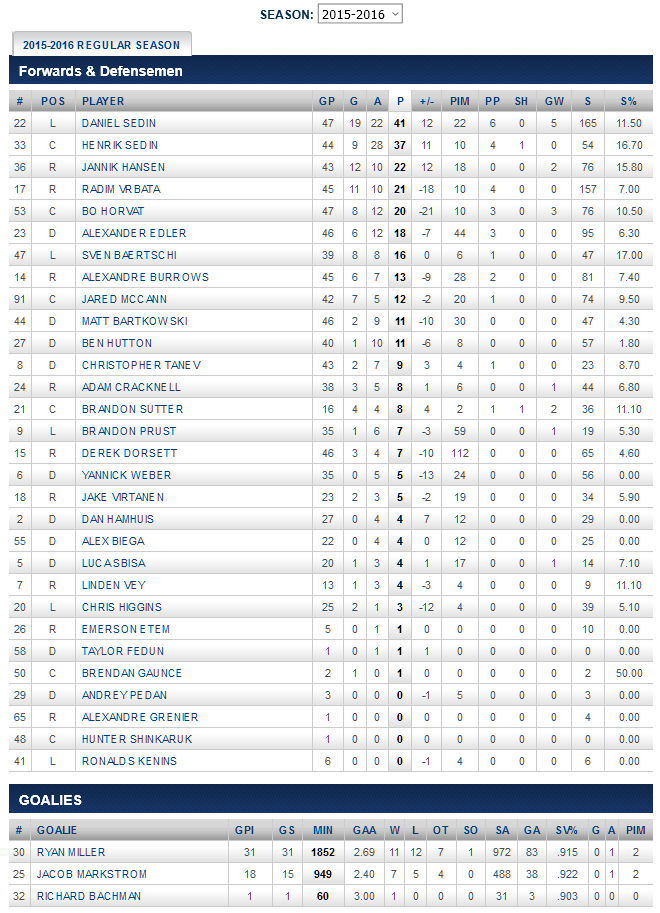
Vancouver’s Bo Horvat has been red hot in 2016, and sits tied for 8th place in NHL scoring with 10 points (6-4=10 PTS), courtesy of points in 7 of this last 8 games of the year. He is also tied for 3rd in most goals in the New Year with his 6 goals, with three others.
The Canucks are 8-3-3 in their last 14 games; and 4-1-2 on the road in their last 7 games.
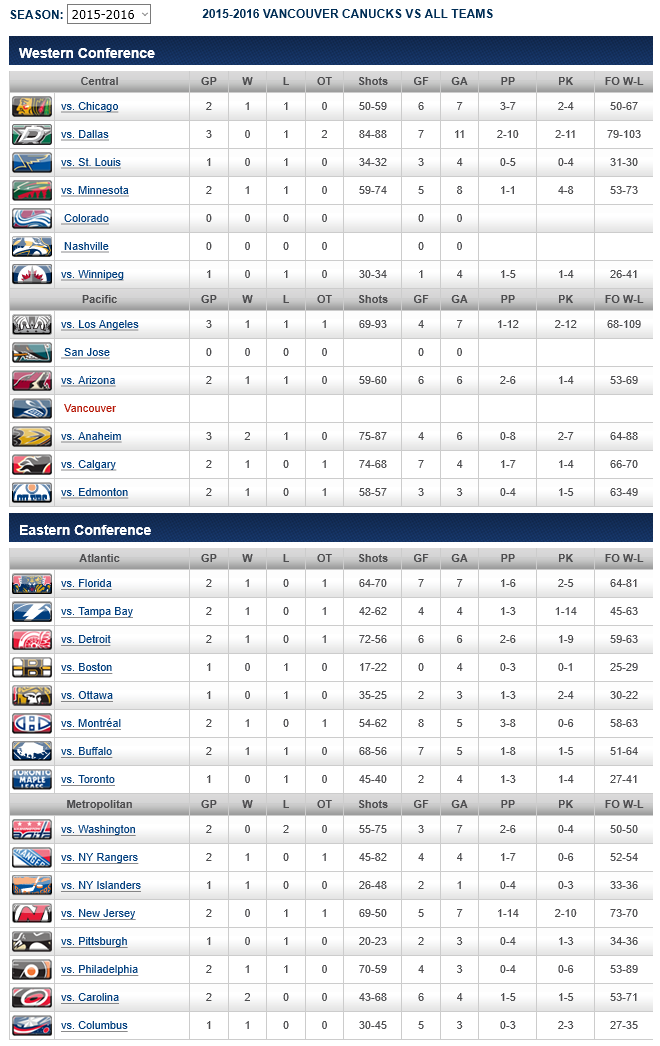
Vancouver is 11-9-6 against Eastern Conference teams; and 5-4-4 against the Atlantic division.
The Bruins are 3-1-3 vs. Pacific Division teams and are 5-6-3 vs. Western Conference opponents.
Goalie Ryan Miller is 1-1-1 in three starts during the road trip and has stopped 129 of 136 shots (.948 save percentage).
VANCOUVER, BC – JANUARY 11: Christopher Tanev #8 of the Vancouver Canucks turns to watch Jacob Markstrom #25 of the Canucks make a save against the Florida Panthers during their NHL game at Rogers Arena January 11, 2016 in Vancouver, British Columbia, Canada. Vancouver won 3-2. (Photo by Jeff Vinnick/NHLI via Getty Images)
“It’s not that our guys haven’t battled,” he said. “They have blocked shots, guys have worked hard. It’s a matter of playing with confidence. It seems we are not confident when [we are] going to make a play and as a result we are hesitating a little bit.”–Coach Willie Desjardins
Source: canucks.nhl.com
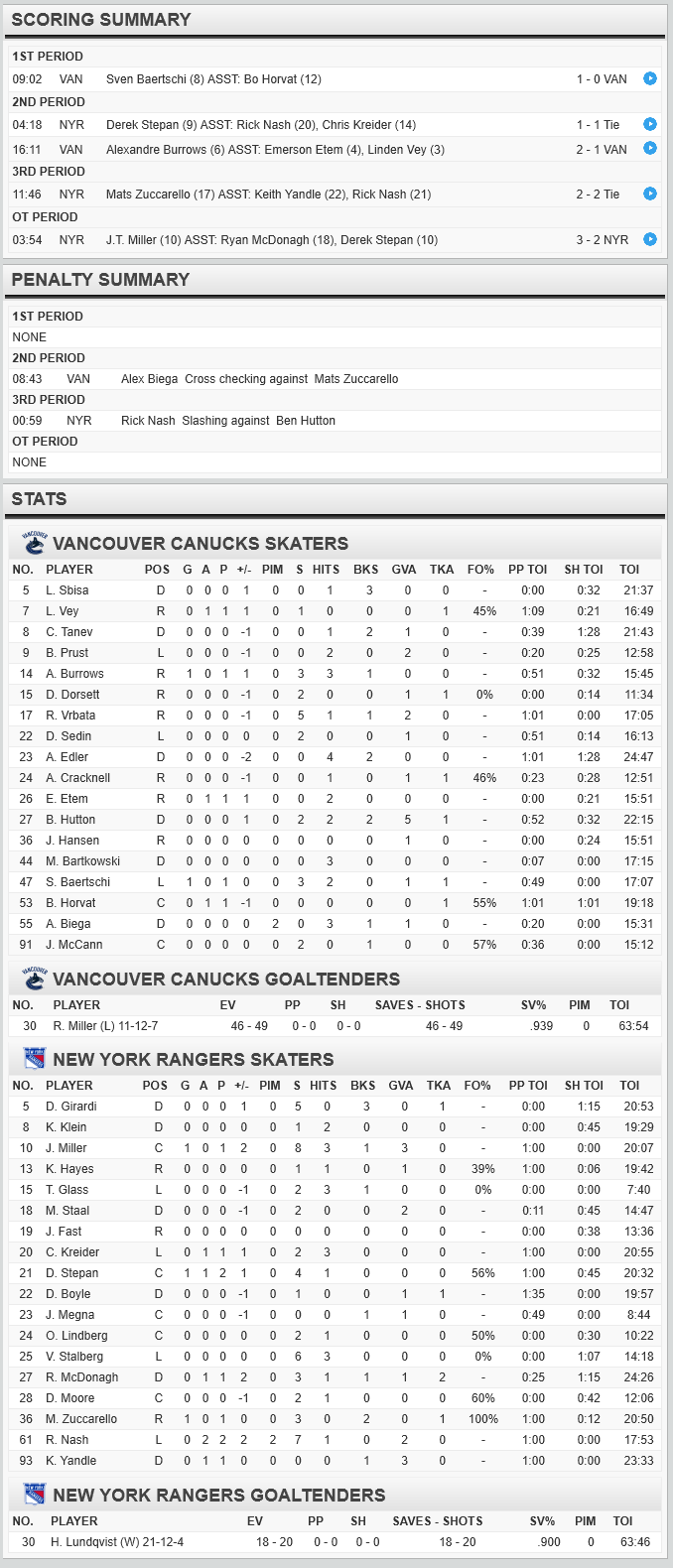
In their last game, Ryan Miller made 46 saves for the Canucks, but it was not enough, as the Rangers tied the game up at 2-2 late in the game, forcing overtime, where the Rangers scored, to take the game 3-2.
The Canucks had goals from Sven Baertschi and Alex Burrows.
For Burrows, it was his first goal in 26 games. Bo Horvat, got his 10th point in his last 7 games (6-4=9); Sven Baertschi, notched his 3rd goal in his last 6 games (3-2=5). And Emerson Etem registered his first point in his 5th game as a Canuck, against his old team.
Ryan Miller was the first NHL goaltender to face at least 48 SOG in each of two consecutive team games (Jan. 17 at NYI and Jan. 19 at NYR) in one season since the Kings’ Kelly Hrudey did so on Dec. 3-5/91. He was the first to do that in each of two consecutive personal games in one season since Florida’s Tomas Vokoun on Dec. 23 and Dec. 31/10 (Courtesy Elias Sports)
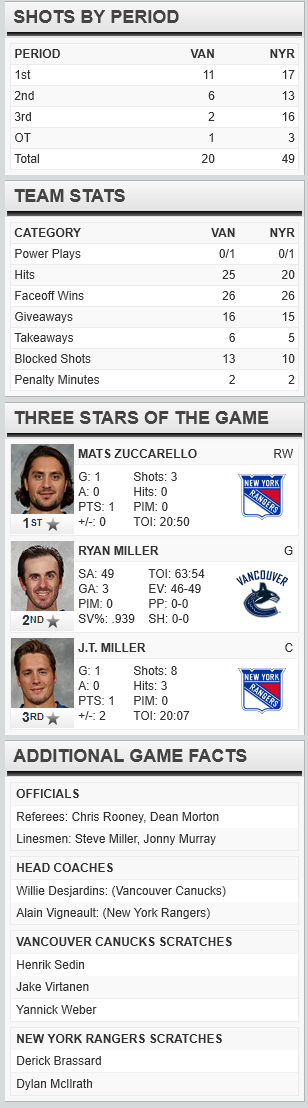
Vancouver allowed an average of 30.1 shots and gave up 40 or more five times prior to this trip, during which it’s yielded 44.3 while going 2-1-1. Two nights after giving up a season-high 48 in a 2-1 shootout win over the New York Islanders, the Canucks allowed 49 shots in Tuesday’s 3-2 overtime loss to the Rangers.
The 97 shots are the second-highest total in the league in a two-game span dating to 1989-90. Vancouver has allowed at least 40 shots in four straight games, its most since at least the start of that 1989-90 season.
The Canucks surrendered 10 goals on the trip and have killed off 8 of 9 penalties for 88.9 percent. They are also averaging 1.75 goals and 24.5 shots per game, on the road trip, with two games left. Canucks power play is 1 for 8, 12.5 percent.
CANUCKS JOTTINGS
In 2016, so far:
Bo Horvat has 10 points in 9 games (6-4=10)
Horvat has scored 37.5% of the Canucks’ goals in this span.
Henrik Sedin has 4 points in 8 games (0-4=4)
Sven Baertschi has 5 points in 7 games (3-2=5)
Chris Tanev has 4 points in 9 games (1-3=4)
Daniel Sedin has 4 points in 9 games (3-1=4)
Daniel Sedin has 3 goals in 9 games.
Canucks record in 2016:
5-2-2=12 PTS in 9 games played (tied for 5th best in the NHL)
They have 18 goals for; 19 goals against.
They are 5 for 24 on the power play for 20.8 percent (9th best in the NHL)
Their penalty killing is 17 for 20, 85.0 ( 14th best in the NHL)
Face-off winning percentage is 43.9 percent.
Canucks are averaging 2.40 goals per game. For an 82 game schedule the estimate is Vancouver will finish with 197 goals. The least number of goals ever scored by a Vancouver team in a full season of 82 games are 192 by the 1998-99 Canucks.
Canucks penalty kill is a killer at 26 for 30, 86.7 percent in their last 8 road games. And 41 for 54 in their last 14 road games, 75.9 percent.
Vancouver’s power play is 1 for 19, 5.3 percent in their last 10 road games.
Vancouver has points in 15 of its last 24 (10-9-5=25 pts) & 20 of its last 34 games (13-14-7=33 pts).
Vancouver had scored a power play goal in five straight games, where they have had at least one man advantage; they were 5 for 16 during that stretch, 31.3 percent, which ended against the Islanders.
Canucks power play is 5 for 21 in their last 7 games, for 23.8 percent.
Radim Vrbata collected his 41st career shootout goal Jan. 17/16 at NYI. He shares the lead for most shootout goals in League history with Frans Nielsen. 13 of those have been GDG, which ranks t-9th in League history.
Alex Edler leads the team in time on ice per game (24:35) and has led the team in that category in 42 of 46 games he’s played, including 22 games where he’s led all skaters in TOI. He currently ranks 17th in the NHL in TOI/GP
Chris Tanev leads the team and ranks seventh in the League in blocked shots with 105. His defence partner Alex Edler ranks 11th in the NHL with 99 blocked shots
Canucks players aged 23 or younger that have appeared in the lineup thus far (Baertschi, Horvat, Hutton, Virtanen, McCann, Gaunce, Shinkaruk, Pedan and Etem) have accounted for 22.5% of points (66), 24.8% of goals (27), 21.2% of assists (39), and 22.5% of shots (303) for the team this season
The Canucks have registered at least a point in 12 of 13 games where Sven Baertschi has notched at least a point (6-1-6).
Vancouver has had 152 power play opportunities to date, sixth most of any team in the League; they have won 157 draws while on the power play, t-fifth most in the NHL
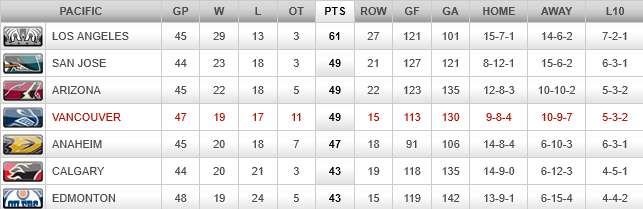
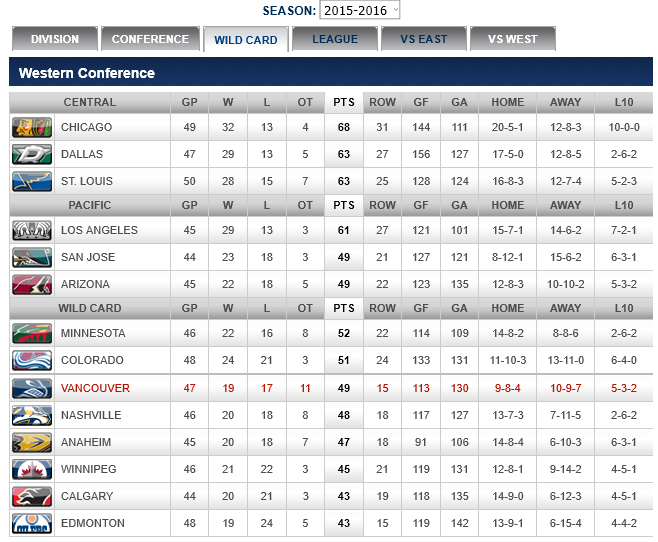
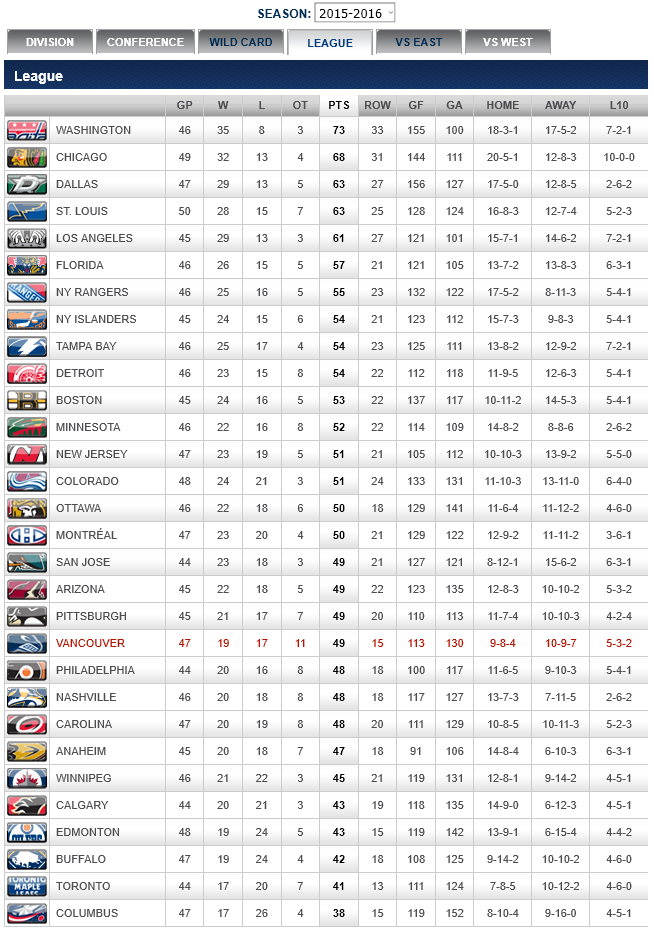
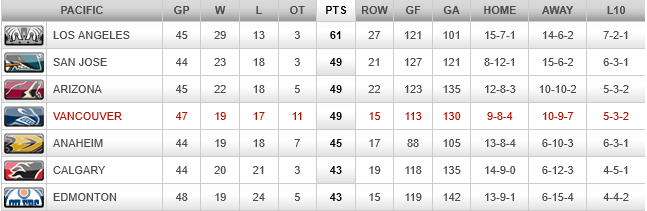
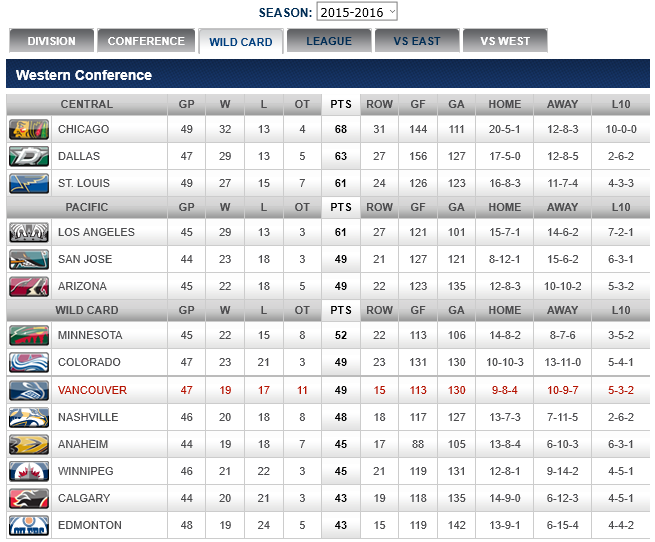
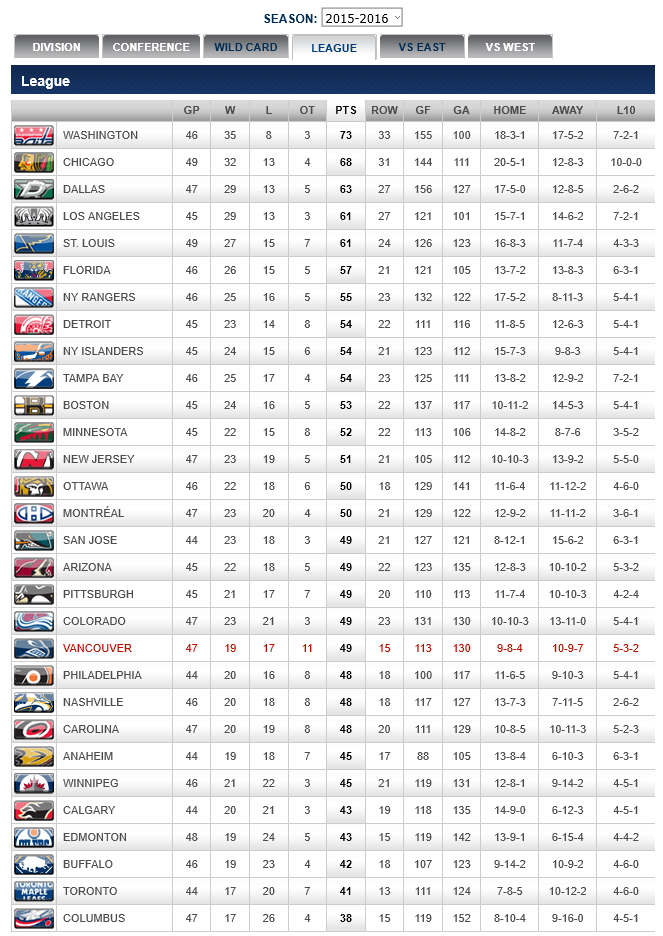
The Canucks are in 4rth place in the Pacific division of the Western Conference, tied with Arizona and San Jose for 2nd place with 49 points. Vancouver are 2 points in front of Anaheim and 12 points behind the first place Los Angeles Kings.
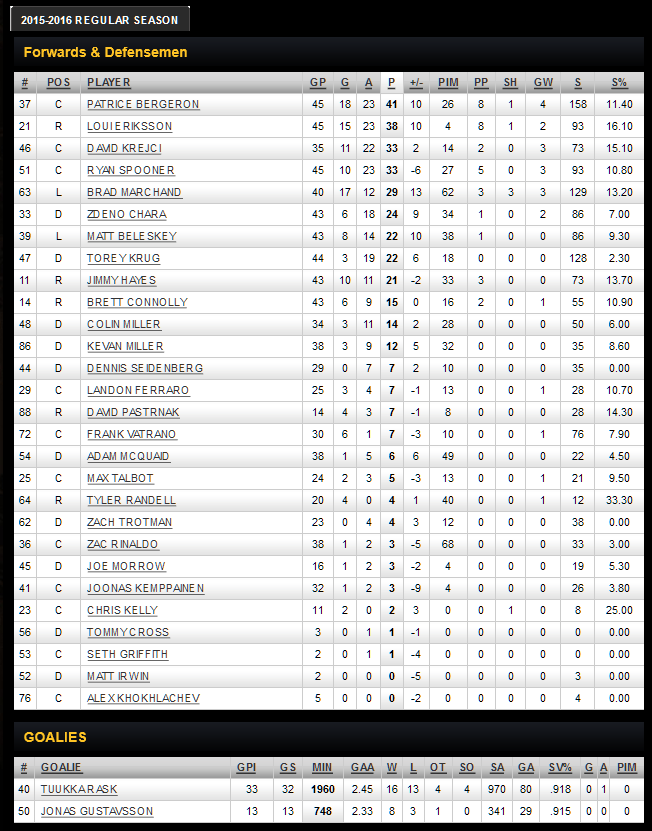
In their last game, the Bruins defeated the Montreal Canadians 4-1 on January 19 in Montreal for their third straight win for the first time since mid-December. For the Canadiens, the loss marked their fifth straight defeat. Tuukka Rask, made 38 saves on 39 shots.
Max Talbot had a goal, Patrice Bergeron potted the game-winner, David Pastrnak added an assist and an insurance goal; and Brad Marchand made it 4-1 win with an empty-netter.
Boston has outscored opponents by an 11-4 margin on its current winning streak, ending a stretch in which it posted just two wins in its previous 10 games, including just one victory in its past five on home ice.
BOSTON BRUINS NOTES
Bruins are 9-3-3 in their last 15 road contests.
Point Streaks
BRAD MARCHAND (2-1-3 / 3 Games)
PATRICE BERGERON (3-0-3 / 2 Games)
The Bruins have allowed two power play goals over their last 19 games and are 53 for 55 for a 96.4% penalty killing proficiency over that span.
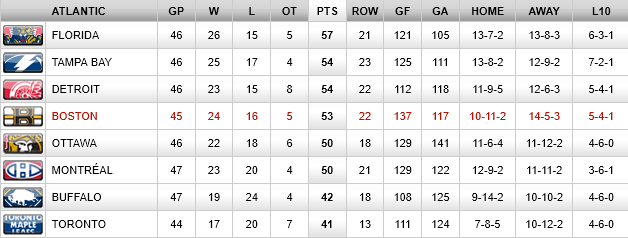
The Bruins are in 4rth place in the Atlantic division of the Eastern Conference, with 53 points, a point behind Detroit and Tampa Bay who occupy 3rd and 2nd respectively with 54 points each. Florida is in 1rst place, 4 points in front of Boston. Ottawa and Montreal are three points back of the Bruins with 50 points each.
ON THE ROAD AGAIN
The Canucks 6-game road trip has been visiting Eastern Conference opponents:
Thursday, January 14 against the Washington Captials: 1-4 Loss
Friday, January 15 against the Carolina Hurricanes: 3-2 OT Win
Sunday, January 17 against the New York Islanders: 2-1 SO Win
Tuesday, January 19 against the New York Rangers: 2-3 OT Loss
Tonight, January 21 against the Boston Bruins
Saturday, January 23 against the Pittsburgh Penguins
CANUCKS BANTER By Andrew Chernoff January 20, 2016
Burrows Ends Goalless Streak
Etem Records First Point As Canuck
Ryan Miller Makes 46 Saves
The Vancouver Canucks (19-17-11) played their fourth game of their 6-game road trip last night against the New York Rangers ( 25-16-5) at Madison Square Garden.
Vancouver were going for their third win of the road trip, after losing in Washington and defeating Carolina in overtime, and the Islanders in a shoot out.
The Rangers were looking for their 17 win at home in 24 games (17-5-2 in 24 home games).
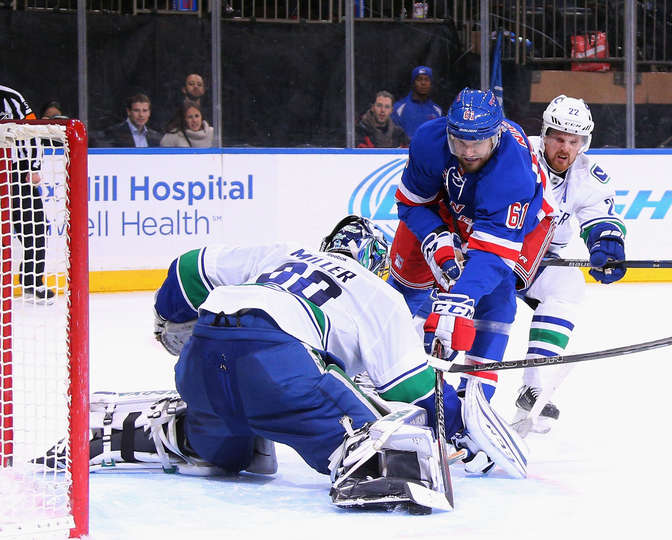
NEW YORK, NY – JANUARY 19: Ryan Miller #30 of the Vancouver Canucks stops Rick Nash #61 of the New York Rangers during the overtime period at Madison Square Garden on January 19, 2016 in New York City. The Rangers defeated the Canucks 3-2 in overtime. (Photo by Bruce Bennett/Getty Images)
Ryan Miller made 46 saves for the Canucks, but it was not enough, as the Rangers tied the game up at 2-2 late in the game, forcing overtime, where the Rangers scored, to take the game 3-2.
The Canucks have allowed 40 or more shots in each of the first four games on its current six-game road trip, and the 9th time this season, to lead the NHL. Vancouver also fell to 3-9 in games decided in overtime this season.
The Canucks are now 2-1-1 on their road trip.
Mats Zuccarello scored to make it 2-2 with 8:14 remaining in regulation play and J.T. Miller scored on a wraparound with 1:06 left in overtime.
Derek Stepan scored the other Ranger goal and Henrik Lundqvist made 18 saves for the Rangers as they out shot the Canucks 49-20 and had five shots go off the post.
The Canucks had goals from Sven Baertschi and Alex Burrows.
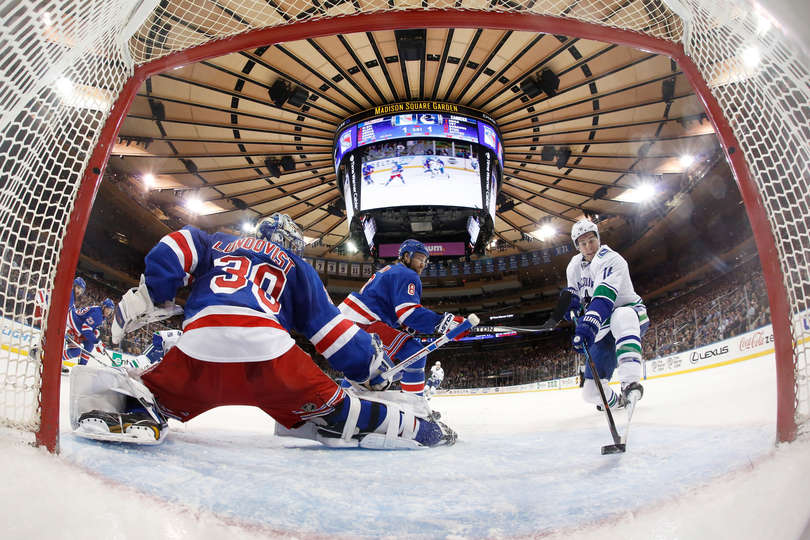
NEW YORK, NY – JANUARY 19: Alex Burrows #14 of the Vancouver Canucks redirects the puck into the net past Henrik Lundqvist #30 of the New York Rangers for a goal in the second period at Madison Square Garden on January 19, 2016 in New York City. (Photo by Jared Silber/NHLI via Getty Images)
For Burrows, it was his first goal in 26 games. Bo Horvat, got his 10th point in his last 7 games (6-4=9); Sven Baertschi, notched his 3rd goal in his last 6 games (3-2=5). And Emerson Etem registered his first point as a Canuck against his old team.
The game started with the Rangers flying out of the starting gate, and getting a few shots, including a goalpost. Deju Vu New York Islanders.
Canucks would put on a show of their own with good puck possession in the Ranger end.
So as both teams approached the four minute mark, there was a good pace to the game and opportunities by both teams to score the first goal.
For the third straight game, the Canucks would score first, as Sven Baertschi, on a pass from Bo Horvat, would make it 1-0 at 9:02.
NEW YORK, NY – JANUARY 19: Sven Baertschi #47 of the Vancouver Canucks (r) celebrates his goal at 9:02 of the first period against the New York Rangers at Madison Square Garden on January 19, 2016 in New York City. (Photo by Bruce Bennett/Getty Images)
Baertschi, on a snap shot, his 8th goal of the season from Bo Horvat (12).
For Horvat, that is 10 points in his last 7 games (6-4=9). For Baertschi, it is 5 points in his last 6 games (3-2=5).
The period would end 1-0 Canucks.
After one period:
Rangers out shoot Canucks 17-11. Faceoffs 6 for 12 Canucks. Hits, 9 to 7 Rangers.
Both teams had 2 giveaways and 2 takeaways. Blocked shots were 4 to 3 Rangers.
Burrows, Vrbata, Sedin, and Baertschi had 2 shots each.
Horvat, 3 for 5 on faceoffs; Adam Cracknell, 2 for 4.
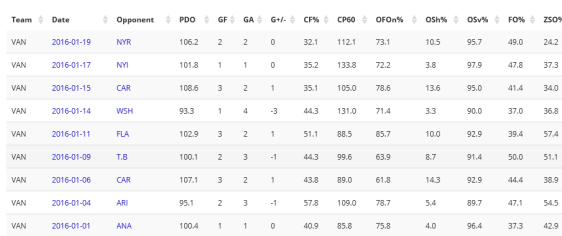
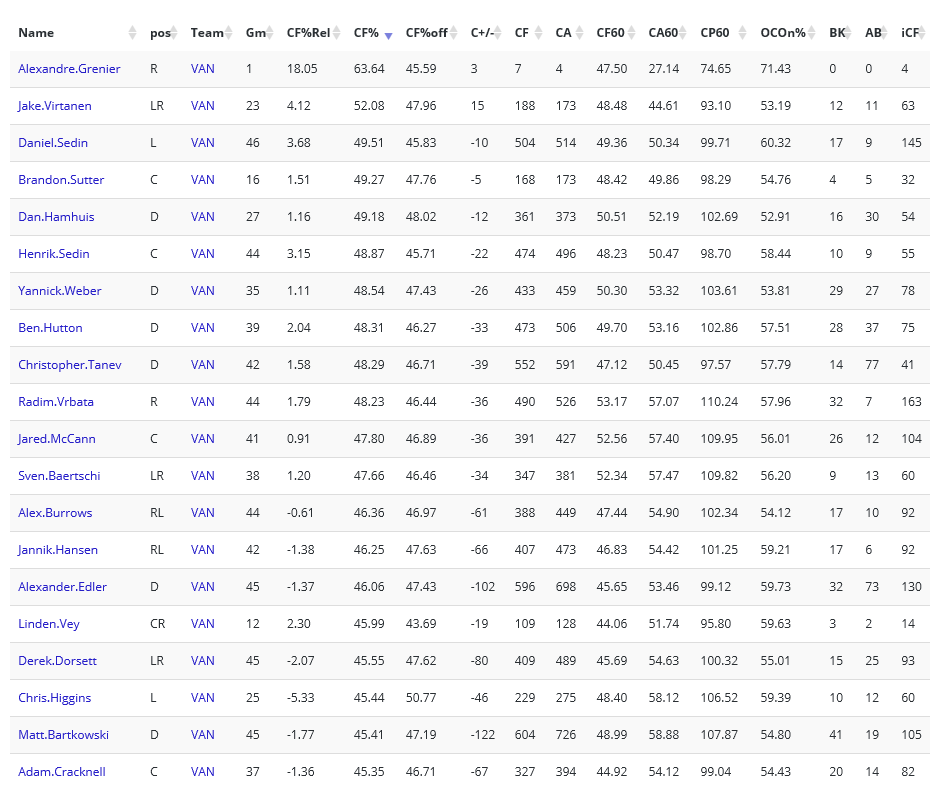
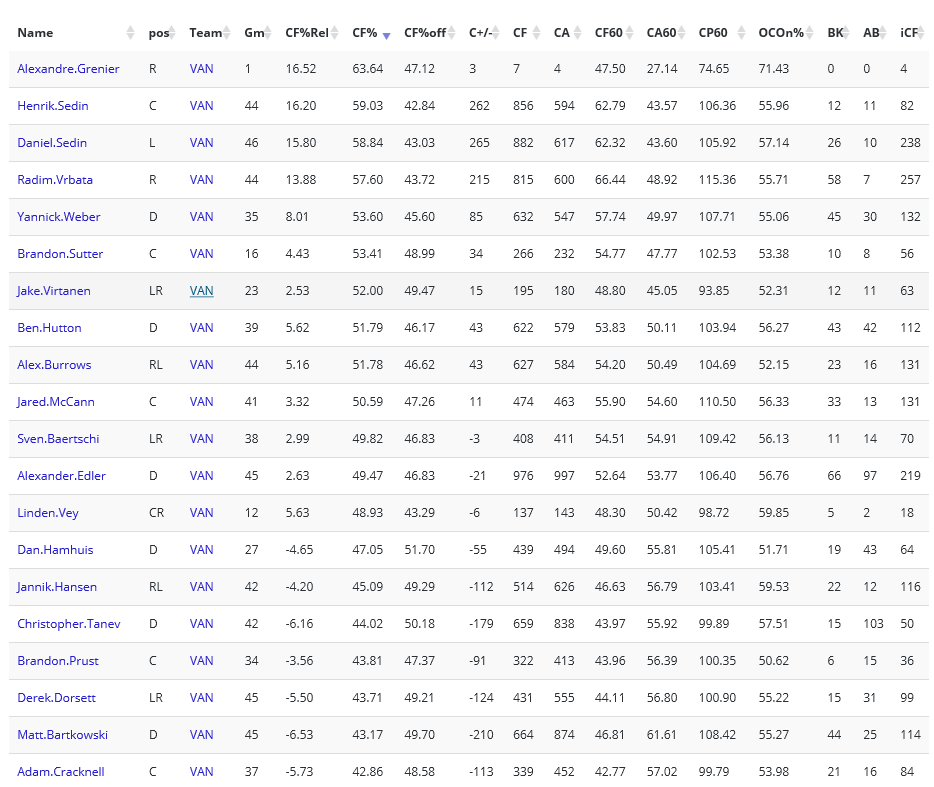
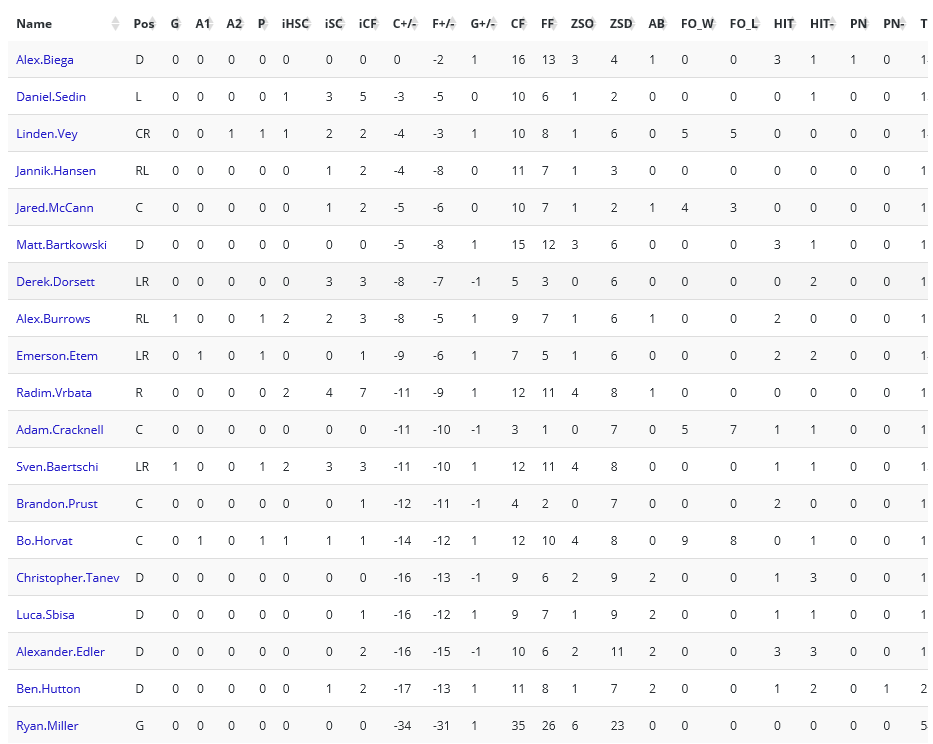
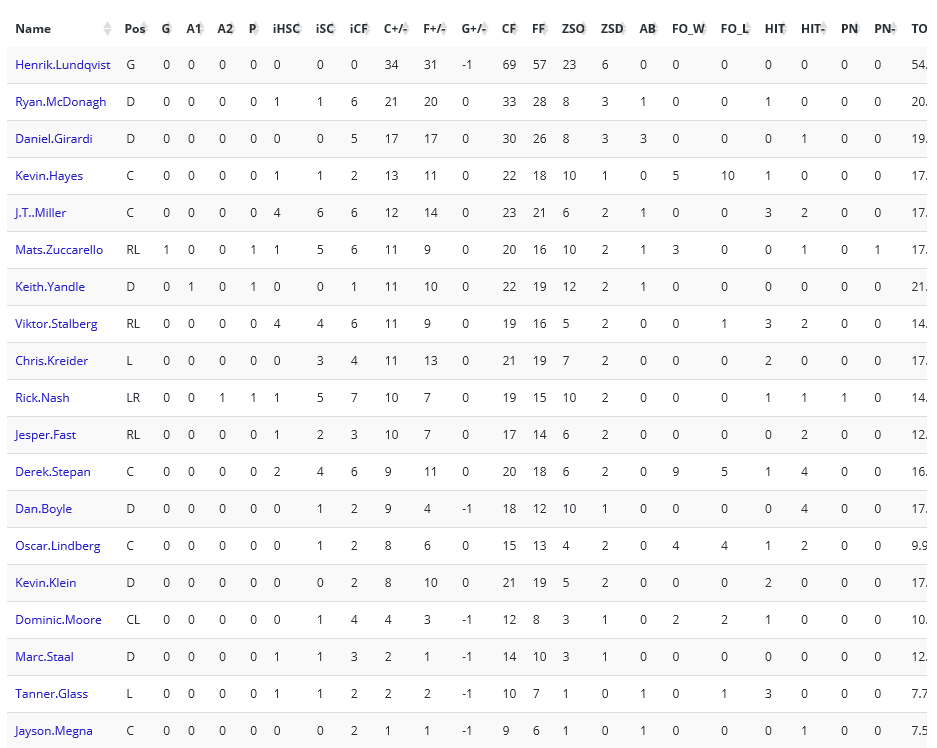
Corsi For: Even Strength 5v5: Rangers-23; Canucks-17. All Situations: Rangers-23; Canucks-17.
Alex Biega: CF +5
Matt Bartkowski: CF +5
Radim Vrbata: CF +2
Sven Baertschi: CF +1
In the second period, the Rangers would keep pushing for the equalizing goal, and they got it.
At 4:18, Derek Stephan, his 9th goal, on a wrist shot, would score, on a delayed penalty, with the 6th attacker on the ice. Assisted by Rick Nash (20) and Chris Kreider (14).
The first power play would go to the Rangers at 8:43 as Alex Biega would visit the sin bin for cross checking Mats Zuccarello. Penalty kill would be 1 for 1.
Alex Burrows would score his first goal in 25 games, off a pass from Emerson Etem, to give Vancouver a 2-1 lead. It would also be Etem’s first point as a Canuck.
Burrows, on a tip in, his 6th goal of the season, assisted by Emerson Etem (4) and Linden Vey (3) at 16:11.
Desjardins would use his timeout to give the Canucks a rest with less than three minutes left in the period. After the timeout, the Canucks were caught on a line change which resulted in a great opportunity for the tying goal for the Rangers.
After two periods:
Rangers out shooting Canucks: 30 to 17. Faceoffs, 17 for 30 Canucks. Hits, 15 to 12 Rangers.
Giveaways 8 to 7 Rangers; Takeaways, 5 to 2 for Rangers. Blocked shots, 8 to 7 Canucks.
Burrows, Vrbata and Baertschi had 3 shots each; Dorsett, McCann and Sedin, 2 shots each.
Horvat, 9 for 12 on faceoffs; Cracknell, 5 for 9; McCann, 3 for 4.
The Canucks would get their first power play opportunity early in the third period as Rick Nash would be sent off for slashing Ben Hutton at 0:59 seconds.
But it would be the Rangers with a great scoring opportunity to start the Canucks power play that would almost score. Power play would be 0 for 1.
With 11 minutes left in the period, the Rangers were out shooting Canucks 10-0 in the period, and 40-17 in the game.
Radim Vrbata would get the first Canuck shot of the period with 8:48 left in the game on a pass from Bo Horvat.
After the deluge of shots, and unable to get the puck out of their end, the Rangers persistance would pay off to the tying goal, when Matt Zuccarello, would get his 17th goal of the season from Keith Yandle (22) and Rick Nash (21) at 11:46.
The game would go into overtime 2-2 as neither team could end the game in regulation play.
For the Canucks, it would be their 18th overtime of the season. A record of 3-8 in the OT part of the game.
After the deluge of shots, and unable to get the puck out of their end, the Rangers persistence would pay off to the tying goal, when Matt Zuccarello, would get his 17th goal of the season from Keith Yandle (22) and Rick Nash (21) at 11:46, Rangers winning 3-2 in overtime.
The Canucks are in 4rth place in the Pacific division of the Western Conference, tied with Arizona and San Jose for 2nd place with 49 points. Vancouver are 4 points in front of Anaheim and 12 points behind the first place Los Angeles Kings.




 CANUCKS BANTER By Andrew Chernoff January 21, 2016







 Andrew Phillip Chernoff