Human rights trump jobs by 2 to 1 in Saudi arms deal
According to a recent survey conducted by Nanos Research on behalf of the Globe and Mail, Canadians have an overall negative impression of the Government of Saudi Arabia and feel Canada should sell arms only to countries that respect human rights.
Impression of the Government of Saudi Arabia – More than four fifths of Canadians say that they have either a negative (54%) or somewhat negative (33%) opinion of the Government of Saudi Arabia, while almost one in ten (9%) are undecided. Only five percent of Canadians say they have a somewhat positive (four percent) or positive opinion (one percent).
Armament sales to Saudi Arabia – Nearly three fifths of Canadians (58%) say that it is more important to ensure that Canada only sells arms to countries that respect human rights than to create the 3,000 jobs needed to build the light armoured vehicles in Canada (30%) to sell to Saudi Arabia. Twelve percent of Canadians are unsure.
Demographic differences – It should be noted that women (67%) are significantly more likely to say that Canada should only sell arm to countries that respect human rights than men (49%). Likelihood to agree with this statement also decreases with age, as two thirds (66%) of those aged 18 to 29 said that selling arms to countries who respect human rights was more important than the jobs created, while only half (50%) of those aged 60 plus said the same. No other significant differences can be noted.
The full survey results can be found by visiting our website
Methodology
Nanos conducted an RDD dual frame (land- and cell-lines) hybrid telephone and online random survey of 1,000 Canadians between January 30th and February 1st, 2016 as part of a Canadian omnibus survey.
Participants were randomly recruited by telephone using live agents and administered a survey online. The sample included both land- and cell-lines across Canada. The results were statistically checked and weighted by age and gender using the latest Census information and the sample is geographically stratified to be representative of Canada. The research was commissioned by the Globe and Mail.
The margin of accuracy for a random sample of 1,000 Canadians is 3.1 percentage points, plus or minus, 19 times out of 20.
CANUCKS BANTER By Andrew Chernoff FEBRUARY 5, 2016
CANUCKS LET IMPORTANT POINT SLIP AWAY
The Vancouver Canucks (20-19-12) hosted the Columbus Blue Jackets (20-28-5) last night at Rogers Place, in-game two of a three game home stand.
Columbus visited Vancouver in the second of a three game Western Canada road trip that started Tuesday night against Edmonton, with a 5-1 loss, and finishes tonight against Calgary.
VANCOUVER, BC – FEBRUARY 4: Joonas Korpisalo #70 of the Columbus Blue Jackets makes a save on Alexandre Burrows #14 of the Vancouver Canucks during their NHL game at Rogers Arena February 4, 2016 in Vancouver, British Columbia, Canada. (Photo by Jeff Vinnick/NHLI via Getty Images)
Linden Vey scored his 2nd goal of the season (2-3=5 in last 8 games played); Bo Horvat had an assist (7-6=13 in last 12 games played); Sven Baertschi picked up a helper (4-3=7 in last 11 games played); and Ryan Miller stopped 27 of 28 shots for a .964 Sv%., but it was not enough as the Canucks ended the game on the short end of the score, losing 2-1 to Columbus in a shoot out; their second straight loss on their current 3-game home stand.
Miller is now 1-3-2 in his last 6 game starts, with a 2.27 GAA, and .934 Sv%. Last 8 game starts at home, he is 4-3-1 with a 2.01 GAA, and .930 Sv%.
The Blue Jackets took the game to the Canucks from the opening face-off, getting the first shots of the game and getting scoring chances on Miller.Columbus outhitting Canucks 6-1, out shooting Vancouver 2-0 after five minutes played.
Canucks were getting shots, but missing the net as the period continued but with 12:18 left, Canucks were out shot 3-1; out hit, 6-1, losing face-offs 3-1;had 2 giveaways; 3 blocked shots.
Vancouver got their first break of the game when the first power play of the game went to the Canucks as Cam Atkinson hooked Ben Hutton at 7:42.
Canucks would score on power play as Linden Vey, his 2nd goal of the season from Sven Baertschi (9) and Bo Horvat (14) at 9:05, put Vancouver up 1-0.
The rest of the period saw the Canucks take their game to the Blue Jackets as they eventually took the lead on shots, and started to be competitive in the face-off circle.
The Canucks would hold the lead after the opening period, 1-0.
After one period:
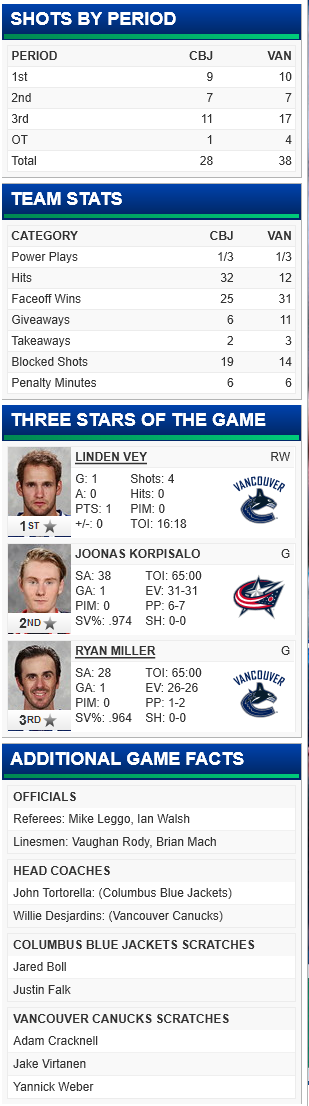
Team Shots On Net: 10-9 Canucks; Team Hits: 13-2 Columbus; Team Face-offs: 8-6 Columbus
Team Blocked Shots: 5-3 Canucks; Team Takeaways: 0-0; Team Giveaways: 4-1 Canucks
Power Play: 1 for 1 Canucks; Penalty Kill: 0 for 1 Columbus; Individual Shots: Edler, Hutton, Sutter, Vey: 2 shots each
Individual Hits: Edler,Vrbata: 1 hit each; Individual Face-offs: Horvat, 2 for 4; H.Sedin, 2 for 6.
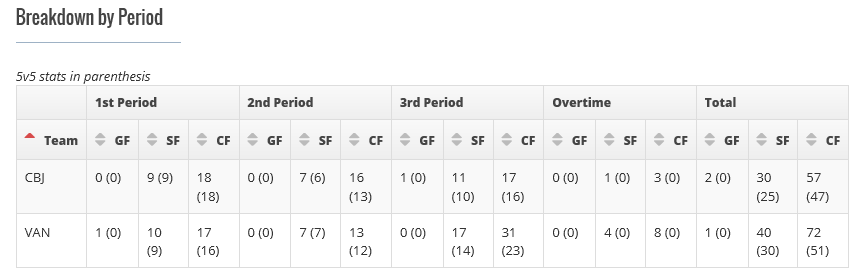
Teams Corsi For: EV 5v5—> 18 Columbus; 16 Canucks; Teams Corsi For: All Strengths—> 18 Columbus; 17 Canucks
In the middle frame, the Canucks received their first penalty of the game on a sloppy change at 1:44 for too many men on the ice. Sven Baertschi would serve the bench minor.
The Canucks killed the penalty but soon after, Columbus got a great scoring opportunity and the Blue Jackets drew a Canuck penalty on the play.
Sven Baertschi went off at 4:16 for holding Boone Jenner. Vancouver would kill off the shorthand situation for a perfect 2 for 2 on the penalty kill.
The Canucks spent the majority of the opening minutes of the second period shorthanded and it allowed Columbus to get the momentum in the game.
Blue Jackets continued to dominate the Canucks on hits and face-off wins, and eventually started to out shoot Vancouver as they neared the halfway point of the middle frame.
With under five minutes left in the period, the Blue Jackets were dominating the Canucks in their end, when the Canucks would break out and spend some time in the Columbus zone trying to go up by two goals in the game. Both teams would exchange time on the offense but shots were few and the period ended without any goals.
Canucks still leading after two period, 1-0.
After two periods:
Team Shots On Net: 7-7; Team Hits: 22-7 Columbus; Team Face-offs: 14-12 Canucks
Team Blocked Shots: 9-8 Canucks; Team Takeaways: 3-1 Canucks; Team Giveaways: 8-2 Canucks
Power Play: 1 for 1 Canucks; Penalty Kill: 2 for 2 Canucks; 0 for 1 Columbus
Individual Shots: Vey and Edler, 4 shots each; Individual Hits: Edler, 3 hits; Biega, 2 hits
Individual Face-offs: Sutter, 4 for 4; Horvat, 5 for 7; Vey, 2 for 5; H.Sedin, 2 for 9.
Teams Corsi For: EV 5v5—>Columbus-31; Canucks-28; Teams Corsi For: All Strengths—>Columbus-34; Canucks-30
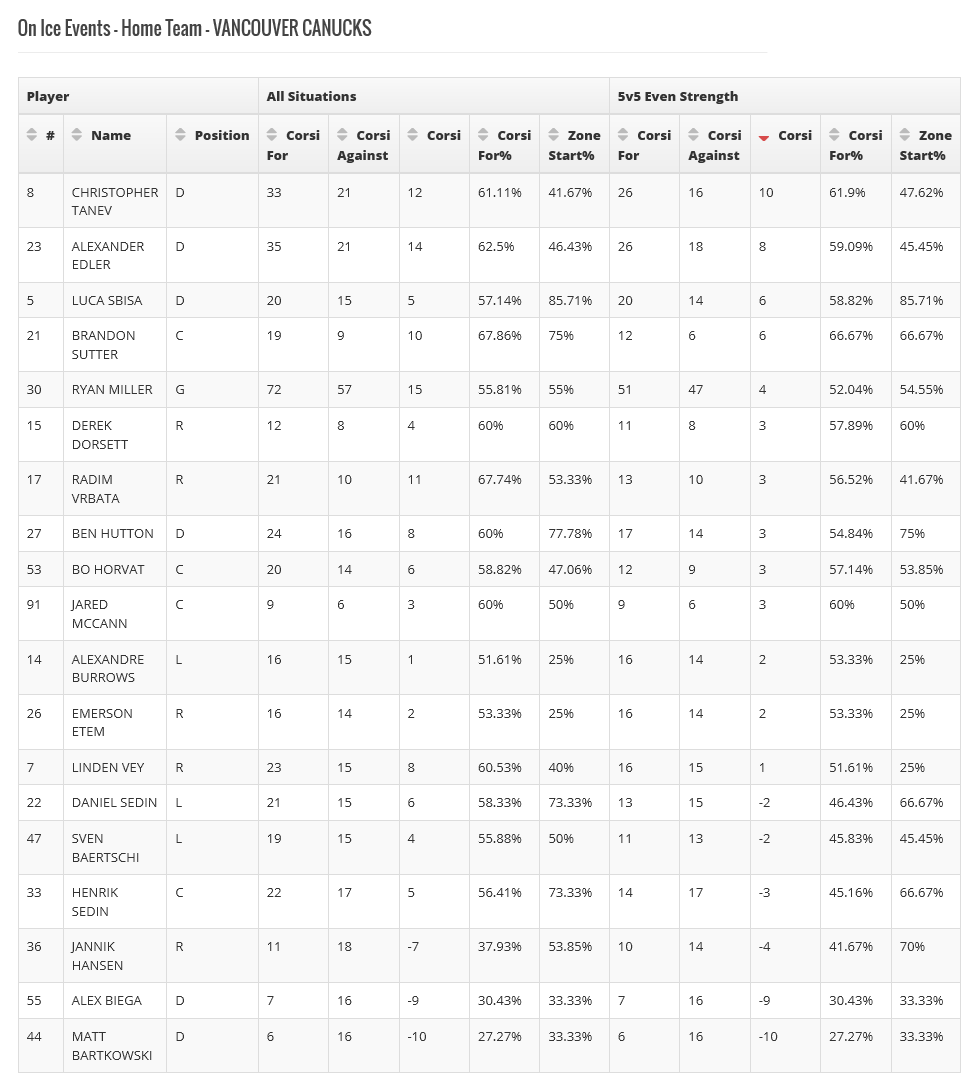
Individual Corsi For: EV 5v5—>Sbisa +8; Hutton +6; Burrows & Etem, +3 each; Individual Corsi For: All Strengths—>Sbisa +7; Hutton +6; Etem & Vey, +3 each
The Canucks came out in the last period playing sloppy including being caught on another sloppy change that resulted in a Columbus scoring opportunity.
Jared McCann would answer that with a great scoring opportunity of his own but was stopped cold by the Blue Jackets goaltender.
Vancouver would get another power play opportunity when Chris Tanev was high sticked by Rene Bourque at 6:06. Canucks power play had great scoring opportunities and great puck movement, even hitting a goalpost, but were unable to bury the puck with the man advantage.
After killing off a penalty, the Blue Jackets received a power play of their own when Jared McCann would go off for hooking Brandon Dubinsky at 8:35.
Columbus would waste little time taking advantage of their third power play of the game, when Scott Hartnell would score to even up the game at 1-1, 31 some 31-seconds later.
Hartnell, his 18th goal of the season, on a wrist shot, assisted by Cam Atkinson (16) and Ryan Murray (13) at 9:06.
Canucks continued to press for the another goal but kept wasting their opportunities.
Going into the last five minutes of the third period, it was anybody’s game.
Vancouver dominated the final five minutes of the game, with the Blue Jacket goalie coming up with save after save, as the Canucks kept pressing.
The game would end tied at 1-1 in regulation play and go to overtime.
Canucks were 3-9 in the season going into overtime, and needed the extra point to keep pace with Anaheim and Arizona.
Columbus player William Karlsson would get a penalty for interference at 2:26 and the Canucks went on a 4 on 3 power play.
The Canucks power play could not score and Ryan Miller would end up making a great save to send the game to a shoot out to decide the game winner.
Columbus won the game 2-1 in the shoot out.
VANCOUVER, BC – FEBRUARY 4: Joonas Korpisalo #70 of the Columbus Blue Jackets stops Sven Baertschi #47 of the Vancouver Canucks on a shootout attempt during their NHL game at Rogers Arena February 4, 2016 in Vancouver, British Columbia, Canada. Columbus won 2-1 in a shootout. (Photo by Jeff Vinnick/NHLI via Getty Images)
Vancouver sits in 5th place in the Pacific division, with 52 points and are 3 points behind Anaheim and 2 points behind Arizona, in 3rd and 4rth respectively; and 6 points behind 2nd place San Jose.
Vancouver ended their consecutive streak at home of not winning the face-off battle against their opponent, at 16 games, as they won 31 of 56 face-offs against Columbus tonight.
Canucks ended their consecutive games streak without a power play goal at 6 games tonight.
Vancouver ended their consecutive streak at home of opponents scoring the opening goal at 8 games, with the Linden Vey goal tonight.
Two new studies reveal how altering the composition of trees in forests is influencing not only the carbon cycle, but air surface temperatures to a significant degree as well. The results highlight how human-made changes to forests hold more severe consequences than previously believed.
Worldwide, reforested areas are increasingly prominent; for example, in Europe, 85% of forests were managed by humans as of 2010. Strong favoritism of foresters to plant more commercially valuable trees – such as Scot pines, Norway spruce and beech – has resulted in reforestation of 633,000 square kilometers of conifers at the expense of broadleaved forests, which decreased by 436,000 square kilometers since 1850.
To gain more insights into the impact of this favoritism, Kim Naudts and colleagues reconstructed 250 years of forest management history using a land-cover model, but also included forest management factors such as changes in tree species.
Their analysis reveals that the conversion of broadleaved forests to coniferous forests caused significant changes in evapotranspiration and albedo, the amount of solar energy reflected from the Earth back into space. These changes, in combination with the release of carbon that is associated with managed forests, are contributing to warming rather than mitigating it. This is happening despite an overall increase in tree coverage. Thus, climate frameworks should account for land management practices in addition to land cover when trying to mitigate warming, the authors say.
A second study describes how changes in global forest cover are affecting the fluxes of energy and water between the land and the atmosphere, and how this process can vary across different forest regions. In the past, the degree to which biophysical effects of deforestation can influence climate have been debated in the scientific community, but these results shed new light on the matter, suggesting that aridness and forest type are important variables.
Such data could better inform climate treaties, the authors, Ramdane Alkama and Alessandro Cescatti, note. Their analysis, based on satellite data of surface temperature and variations in forest cover, reveals that forest clearing is causing an increase in average and maximum surface temperatures, except at the northernmost latitudes.
They note that evapotranspiration plays a key role in how forest clearing impacts temperatures, since arid areas show the strongest warming pattern, followed by the temperate, the tropical, and the boreal zones.
Together, these two studies demonstrate previously unappreciated complexities of the role that forests play in affecting the carbon cycle and air surface temperatures.
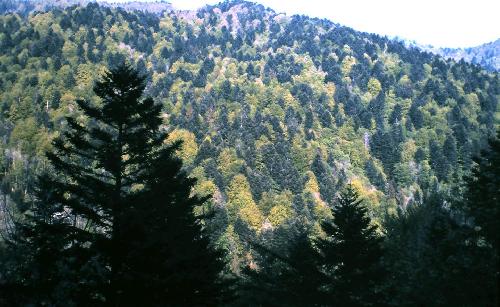
Coniferous (dark green) and broadleaved (light green) trees in summer in Alsace (France) exhibit differences in surface properties. This material relates to a paper that appeared in the Feb. 5, 2016, issue of Science, published by AAAS. The paper, by K. Naudts at Institut Pierre Simon Laplace in Gif-sur-Yvette, France, and colleagues was titled, “Europe’s forest management did not mitigate climate warming.” Credit: Ernst-Detlef Schulze
source: American Association for the Advancement of Science
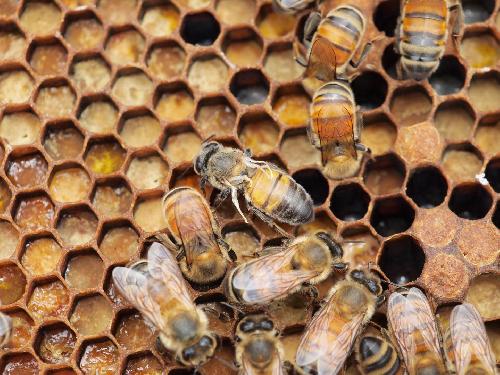
The spread of a disease that is decimating global bee populations is manmade, and driven by European honeybee populations, new research has concluded.
A study led by the University of Exeter and UC Berkeley and published in the journal Science found that the European honeybee Apis mellifera is overwhelmingly the source of cases of the Deformed Wing Virus infecting hives worldwide. The finding suggests that the pandemic is manmade rather than naturally occurring, with human trade and transportation of bees for crop pollination driving the spread.
Although separately they are not major threats to bee populations, when the Varroa mite carries the disease, the combination is deadly, and has wiped out millions of honeybees over recent decades. Varroa feed on bee larvae while the Deformed Wing Virus kills off bees, a devastating double blow to colonies. The situation is adding to fears over the future of global bee populations, with major implications for biodiversity, agricultural biosecurity, global economies, and human health.
The study was funded by the Natural Environment Research Council (NERC) and supported by a Royal Society Dorothy Hodgkin Fellowship. It involved collaborators from the universities of Sheffield, Cambridge, Salford and California, as well as ETH Zurich in Switzerland.
Lead author Dr Lena Wilfert, of the University of Exeter’s Centre for Ecology and Conservation, on the Penryn Campus in Cornwall, said: “This is the first study to conclude that Europe is the backbone of the global spread of the bee killing combination of Deformed Wing Virus and Varroa. This demonstrates that the spread of this combination is largely manmade – if the spread was naturally occurring, we would expect to see transmission between countries that are close to each other, but we found that, for example, the New Zealand virus population originated in Europe. This significantly strengthens the theory that human transportation of bees is responsible for the spread of this devastating disease. We must now maintain strict limits on the movement of bees, whether they are known to carry Varroa or not. It’s also really important that beekeepers at all levels take steps to control Varroa in their hives, as this viral disease can also affect wild pollinators.”
Researchers analysed sequence data of Deformed Wing Virus samples across the globe from honeybees and Varroa mites, as well as the occurrence of Varroa. They used the information to reconstruct the spread of Deformed Wing Virus and found that the epidemic largely spread from Europe to North America, Australia and New Zealand. They found some two-way movement between Europe and Asia, but none between Asia and Australasia, despite their closer proximity. The team also looked at samples from other species suspected of transmitting the disease, including different species of honeybee, mite and bumblebees, but concluded that the European honeybee was the key transmitter.
Professor Roger Butlin, Professor of Evolutionary Biology at the University of Sheffield, said: “Our study has found that the deformed wing virus is a major threat to honeybee populations across the world and this epidemic has been driven by the trade and movement of honeybee colonies.
“Domesticated honeybee colonies are hugely important for our agriculture systems, but this study shows the risks of moving animals and plants around the world. The consequences can be devastating, both for domestic animals and for wildlife. The risk of introducing viruses or other pathogens is just one of many potential dangers.”
Senior author Professor Mike Boots of Exeter and UC Berkeley concluded: “The key insight of our work is that the global virus pandemic in honeybees is manmade not natural. It’s therefore within our hands to mitigate this and future disease problems.”
As Canada prepares to sign the Trans-Pacific Partnership, a Canadian Centre for Policy Alternatives (CPPA) report confirms the massive deal will severely weaken our public health care system.
The far-reaching TPP covers 12 countries that represent 40 per cent of global trade (Canada, Chile, Mexico, Peru, the United States, Japan, New Zealand, Australia, Brunei, Singapore, Vietnam and Malaysia). The deal will likely be signed on February 4, while ratification could take up to two years.
Combined with reports the TPP will cost Canada 58,000 jobs, it’s another reason Canada should not be signing or ratifying the deal.
make it more difficult and expensive for Canadian governments to establish new public health programs, including pharmacare,
undermine health regulation, and
obstruct efforts to renew and expand public health care in the face of new challenges.
US-style patent protections will mean higher drug costs
By caving to US corporate demands for longer pharmaceutical patent protections, Canada has negotiated a deal that will see prescription drug costs increase by $636 million annually once the TPP comes into force. This will be an added financial burden for public health care, employer benefit programs and other private insurers, as well as individuals. If the Canadian health care system has to shoulder increased drug costs, they may have to cut health care services and jobs.
The TPP’s impact on drug costs will be felt most acutely in developing countries, as longer patents block the entry of lower-priced generic drugs. This limits access to life-saving medicines. The international humanitarian medical organization Médecins Sans Frontières has highlighted how competition between generic drug makers dramatically drove down the costs of HIV medications, helping expand treatment to six million people in the developing world.
Foreign investor protections that promote privatization
The TPP gives foreign investors the right to sue governments if they feel a policy decision limits their profits. This system, called investor-state dispute settlement (ISDS), bypasses Canadian courts in favour of secretive, pro-investor tribunals that award enormous sums of money at a government’s expense. A recent example is Eli Lilly’s $500-million NAFTA claim against Canada.
These investor rights rules cost Canadian taxpayers hundreds of millions of dollars. They also lock in privatization and deregulation. For example, when private insurers already provide coverage for prescription drugs, like in Canada, an ISDS claim would make it very expensive if the government to decide to bring this coverage into the public system.
The TPP’s ISDS rules would make it next to impossible to create a public national prescription drug program. It would also make it prohibitively expensive to bring health care support services like laundry, IT or food services back into the public domain, even if the private contract has failed.
Attacking Canada’s pride
Canadians are proud of their health care system. Trade deals like the TPP, CETA and the Trade in Services Agreement are dangerous to our public health care. As the CCPA report concludes, the TPP is the worst of all worlds. It incorporates problems from previous trade agreements, and introduces new threats to Medicare.




 CANUCKS BANTER By Andrew Chernoff FEBRUARY 5, 2016







 Andrew Phillip Chernoff