New target could help to reduce symptoms of asthma attacks, research shows

An international team of researchers from the Universities of Leicester and Naples has examined the role of a receptor in the body that could help to prevent or reduce the effects of asthma attacks.

In a new paper, published in the British Journal of Pharmacology, the team examined the role in the body of nociceptin, a peptide that activates the nociceptin receptor, better known for its association with pain processing.

In asthma there is a constriction of the airways and an increase in immune activation – typically these are treated with a dilator (salbutamol) and a steroid (to reduce immune response).

The study identified that nociceptin has substantial activity in asthma models given before or during an asthma attack – and that a single molecule reduces both the immune response and causes dilation.

It is hoped through the observation that scientists can demonstrate effects before or during asthma that the discovery could help to prevent or reduce established asthma attacks in people suffering from the disease.

Professor David Lambert, Professor of Anaesthetic Pharmacology from the University of Leicester’s Department of Cardiovascular Sciences and Leicester’s Hospitals said: “I have been working on the pain related and immune modulatory actions of nociceptin for many years and it is really exciting to see this translated into a further therapeutic arena; the devastating airways disease of asthma.”

Professor Chris Brightling, NIHR Senior Investigator and Honorary Consultant from the University of Leicester’s Department of Infection, Immunity and Inflammation and Leicester’s Hospitals added: “In spite of good treatments for asthma many people with asthma still have ongoing symptoms and frequent attacks. This exciting research presents an entirely new approach for asthma that needs to be tested in clinical trials.”

Professor Bruno D’Agostino from the University of Naples said: “For many years, my research group has been working on the role of nociceptin in the regulation of airway responsiveness in animal models, and it is very interesting translating our results into clinic area regarding asthma, a disease that is forecast to grow over the next years.”

This study was part funded by Airway Disease Predicting Outcomes through Patient Specific Computational Modelling (AirPROM), Asthma UK, and the National Institute for Health Research (NIHR) Leicester Respiratory Biomedical Research Unit.

Work in Italy was funded by PRIN 2010-2011 n. 2010Y4WMCR_005 from the Italian Ministry of Education, University and Research (MIUR).

AirPROM is funded from the European Union under grant agreement n° 270194 and brings together experts and current research to build a multi-scale computational model of the lung as a new way of characterising asthma and COPD.

Dr Erika Kennington, Head of Research at Asthma UK, added: “There’s nothing as terrifying as not being able to breathe, yet every 10 seconds someone in the UK has a potentially life threatening asthma attack. This research is exciting because the protein identified here may relieve not just the symptoms, but the inflammation of the lungs and the tightening of the airways that cause asthma too. We urgently need more investment in asthma research to turn these findings into new treatments.”

Source: University of Leicester

Source: New target could help to reduce symptoms of asthma attacks, research shows | Science Codex

Sea level rise threatens larger number of people than earlier estimated

Rising sea level threatens larger number of people that earlier estimated. Shanghai with over 24 million inhabitants is one of the megacities that will suffer from the projected sea level rise and intensified storms. Credit: Olli Varis / Aalto University

More people live close to sea coast than earlier estimated, assess researchers in a new study. These people are the most vulnerable to the rise of the sea level as well as to the increased number of floods and intensified storms. By using recent increased resolution datasets, Aalto University researchers estimate that 1.9 billion inhabitants, or 28% of the world’s total population, live closer than 100 km from the coast in areas less than 100 meters above the present sea level.

By 2050 the amount of people in that zone is predicted to increase to 2.4 billion, while population living lower than 5 meters will reach 500 million people. Many of these people need to adapt their livelihoods to changing climate, say Assistant Professor Matti Kummu from Aalto University.

The study found that while population and wealth concentrate by the sea, food must be grown further and further away from where people live. Highlands and mountain areas are increasingly important from food production point of view, but also very vulnerable to changes in climate.


  • Over the past century there has been a clear tendency that cropland and pasture areas have grown most in areas outside the population hotspots, and decreased in coastal areas. This will most probably only continue in the future, summarises Professor Olli Varis from Aalto University.


Even though people and wealth continue to accumulate in coastal proximity, their growth is even faster in inland and mountainous areas, the study reveals. This contradicts the existing studies. In the future, the world will be less diverse in terms of urbanisation and economic output, when assessing it from geospatial point of view.

For the analysis, researchers used several global gridded datasets. They first created a geographic zoning in relation to the elevation and proximity to coast. This was then used to study the factors included in the study, which were grouped into five clusters: climate, population, agriculture, economy, and impact on environment. For the factors with temporal extent, the researchers also assessed their development over time period of 1900-2050.

source: Aalto University

Source: Sea level rise threatens larger number of people than earlier estimated | Science Codex

New discoveries on the connection between nicotine and type 2 diabetes

Researchers at Lund University in Sweden have made two new discoveries with regard to the beta cells’ ability to release insulin. The findings can also provide a possible explanation as to why smokers have an increased risk of type 2 diabetes.

The study was conducted on mice and donated beta cells from humans, and is now published in the scientific journal Cell Reports.

The researchers have discovered that so-called nicotinic acetylcholine (nicotine-sensitive) receptors influence the normal release of insulin. They also show that a specific genetic alteration renders dysfunctional nicotine-receptors affecting the number of functional nicotine-sensitive receptors found in beta cells. A reduced number of functional receptors leads to a decrease in insulin secretion, thereby increasing the risk of developing type 2 diabetes.

“The receptors in the beta cells that stimulate the release of insulin are normally activated by the signal substance acetylcholine, but they can also be activated by nicotine. Never before has the importance of nicotine-sensitive receptors been shown in terms of the function of beta cells. Our research indicates that people who lack these receptors are at higher risk of developing type 2 diabetes”, says Isabella Artner, researcher at Lund University responsible for the study.

Isabella Artner and her colleagues have also discovered that the gene MafA (muscoloaponeurotic fibrosacoma oncogene family A) found in insulin-producing beta cells control the number of nicotine-sensitive receptors and thereby their ability to receive signals from the central nervous system.

“The effect that this single gene, MafA, alone has on insulin secretion was previously unknown, and nicotine receptors have never before been connected to type 2 diabetes”, says Isabella Artner, and continues:

“We know that smokers have an increased risk of developing type 2 diabetes, but the reason why has not been firmly established. Perhaps it has to do with the nicotine-sensitive receptors we describe. Our findings increase knowledge about the connection between smoking and type 2 diabetes.

Source: Lund University

Source: New discoveries on the connection between nicotine and type 2 diabetes | Science Codex

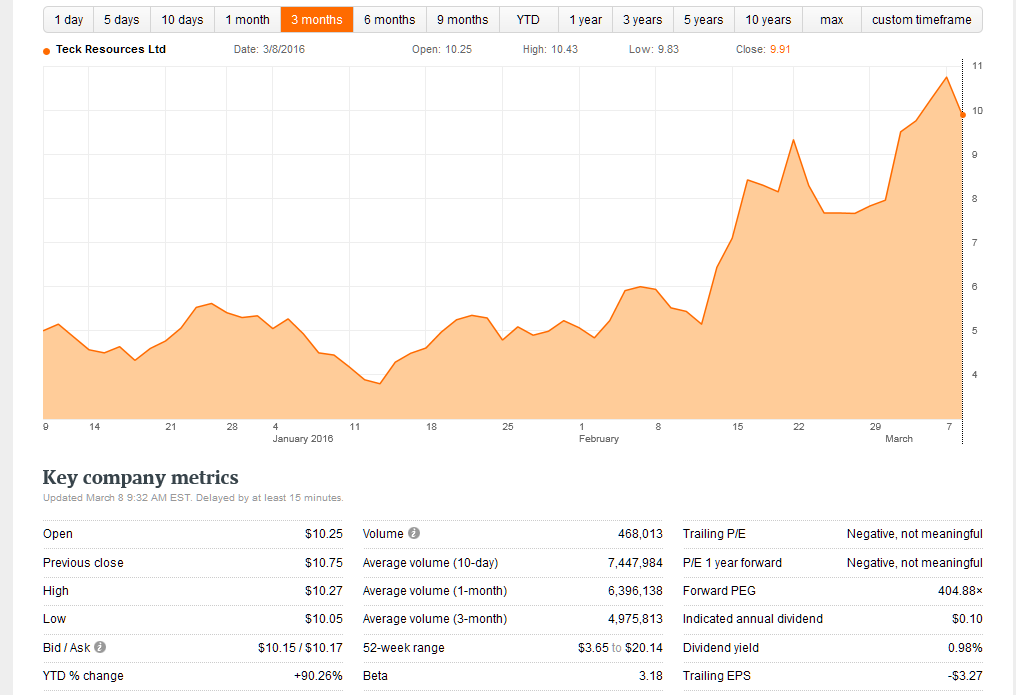
Teck Resources Ltd lower today, after setting a new 100-day high

screenshot-www theglobeandmail com 2016-03-08 06-50-26

Teck Resources Ltd is sharply lower today, dropping $0.36 or 3.35% to $10.39 after setting a new 100-day high. Over the last five days, shares have gained 30.53% and 94.57% year to date. Shares have underperformed the S&P TSX by 32.22% during the last year.

Source: http://www.theglobeandmail.com/