Budget turns left but doesn’t step on the gas

images

March 22, 2016

OTTAWA—Today’s federal budget delivers on poverty reduction, makes important steps towards reducing inequality, and addresses decades of underfunding and neglect on reserves. However, delaying infrastructure and social program investments will not solve the problems of slow growth and high unemployment.

“This budget provides something that’s been missing for a long time: a real response to poverty and inequality,” says CCPA Senior Economist David Macdonald. “Today’s changes to the Canada Child Benefit and Guaranteed Income Supplement will have a big impact on reducing poverty for children and seniors.”

There are many welcome investments in today’s budget but CCPA economists say more spending is needed to boost Canada’s faltering economy. The projected deficit of just over $29 billion for both of the next two years—amounting to at most 1.5% of GDP—is relatively smaller than any federal deficit run between 1974 and 1996 and federal government spending as a share of the economy remains at near-historic lows.

“The Liberals are spending in the right places, but the amounts aren’t up to the task. The deficit is too small to really tackle Canada’s biggest economic challenges: unemployment and slow growth,” says Macdonald. “It’s important to remember that every deficit creates a surplus elsewhere in the economy. Every billion dollars in federal deficit means an extra billion in the pockets of Canadians through new transfers or higher wages, extra money for the provinces, and extra opportunities for businesses.”

Today’s budget implemented a large portion of the Liberal’s election platform but several promises were not addressed, including: closing the stock option deduction loophole, closing loopholes for small businesses, reducing subsidies for the fossil fuel industry, and implementing home care (although this may come in the future). The largest surprise is the carving out of major on-reserve commitments, which are positive, from money that would otherwise have gone to municipalities, which is negative.

“The Liberals’ first budget says it can, and does, move the needle on slowing growth in the first two years of this fiscal plan, creating tens of thousands of jobs in the process,” says CCPA Senior Economist Armine Yalnizyan. “Why do they then take their foot off the gas pedal and watch growth fall in the next two years of the fiscal plan?”

Economic growth forecasts continue to be downgraded, in Canada as around the world.  One of the key ways a government can counteract that trend is by investing in infrastructure. “The biggest surprise in today’s budget was the decision to back-end load infrastructure spending plans, which rise to their highest level in the Liberals’ second mandate, five years from now,” says Yalnizyan. “This five-year fiscal plan sees the federal contribution to the economy fall to the lowest level in over 60 years, as cities struggle to meet accelerating demands for affordable housing and public transit. We need the federal government to play a bigger role for more than a couple of years.”

The new federal government made a big splash last fall when Prime Minister Trudeau appointed equal numbers of women and men to Cabinet. The budget includes money to increase spaces in shelters for victims of domestic violence and support for the Inquiry into Missing and Murdered Aboriginal Woman and Girls. It lacks any significant investment in prevention measures.

“This government has made important symbolic commitments to improving women’s lives,” says Senior Researcher Kate McInturff. “What we don’t see in the budget is the money to back that up. With the addition of $3 million in 2016-2017 and $5 million in 2017-18, the budget for Status of Women accounts for a paltry 0.016% of total federal program spending in both years. That’s not going to buy real change for women in Canada.”

Source: Budget turns left but doesn’t step on the gas: think tank | Canadian Centre for Policy Alternatives

Teck Resources Ltd (TCK) Stake Reduced by Swiss National Bank

Swiss National Bank decreased its stake in Teck Resources Ltd (NYSE:TCK) by 0.3% during the fourth quarter, according to its most recent filing with the Securities and Exchange Commission. The fund owned 2,499,879 shares of the company’s stock after selling 7,100 shares during the period. Swiss National Bank owned approximately 0.43% of Teck Resources worth $9,625,000 at the end of the most recent reporting period.

A number of other institutional investors have also added to or reduced their stakes in the company. Great West Life Assurance Co. Can increased its position in Teck Resources by 9.2% in the fourth quarter. Great West Life Assurance Co. Can now owns 3,234,232 shares of the company’s stock valued at $12,482,000 after buying an additional 273,237 shares during the period. Korea Investment CORP increased its position in Teck Resources by 6.4% in the fourth quarter. Korea Investment CORP now owns 612,700 shares of the company’s stock valued at $2,355,000 after buying an additional 36,900 shares during the period. Finally, Hexavest Inc. acquired a new position in Teck Resources during the fourth quarter valued at $1,895,000.

Teck Resources Ltd (NYSE:TCK) traded up 1.957% on Tuesday, reaching $8.595. The company’s stock had a trading volume of 4,951,063 shares. Teck Resources Ltd has a 52 week low of $2.56 and a 52 week high of $16.20. The stock’s 50 day moving average is $6.08 and its 200-day moving average is $5.14. The firm’s market capitalization is $4.95 billion.

Over the last five days, shares have gained 5.38% and 94.57% year to date. Shares have underperformed the S&P TSX by 36.99% during the last year.                  http://www.theglobeandmail.com March 23, 2016

Teck Resources (NYSE:TCK) last released its quarterly earnings data on Thursday, February 11th. The company reported $0.03 earnings per share (EPS) for the quarter, beating analysts’ consensus estimates of ($0.02) by $0.05. The firm had revenue of $2.14 billion for the quarter, compared to analyst estimates of $1.95 billion. During the same period in the previous year, the business posted $0.23 EPS. Teck Resources’s revenue for the quarter was down 5.4% on a year-over-year basis. Analysts predict that Teck Resources Ltd will post ($0.06) EPS for the current year.

Several equities analysts recently weighed in on TCK shares. Paradigm Capital upgraded Teck Resources from a “hold” rating to a “buy” rating in a research report on Sunday, February 14th. Zacks Investment Research upgraded Teck Resources from a “sell” rating to a “hold” rating in a research report on Thursday, February 18th. Scotiabank restated a “sector perform” rating and set a $8.00 price target (down from $8.50) on shares of Teck Resources in a research note on Tuesday, February 16th. Canaccord Genuity lowered Teck Resources from a “hold” rating to a “sell” rating in a research note on Thursday, December 17th. Finally, Nomura dropped their price target on Teck Resources from $6.40 to $4.25 in a research note on Friday, January 8th. Five equities research analysts have rated the stock with a sell rating, eleven have given a hold rating and six have issued a buy rating to the stock. Teck Resources currently has a consensus rating of “Hold” and an average target price of $9.47.

Teck Resources Ltd. is engaged in the business of exploring, acquiring, developing and producing natural resources. The Company is focused on steelmaking coal, copper, zinc and energy. The Company exports seaborne steelmaking coal and produces mined zinc. The Company also produces lead, molybdenum, silver, and various specialty and other metals, chemicals and fertilizers.

12 Month Chart for NYSE:TCK

Source: Teck Resources Ltd (TCK) Stake Reduced by Swiss National Bank – Financial Market News

The Canadian Government’s Expenditure Plan for 2016-17

Get the report
The Government’s Expenditure Plan for 2016-17

Get the data

Main Estimates Figures. xlsx

Summary
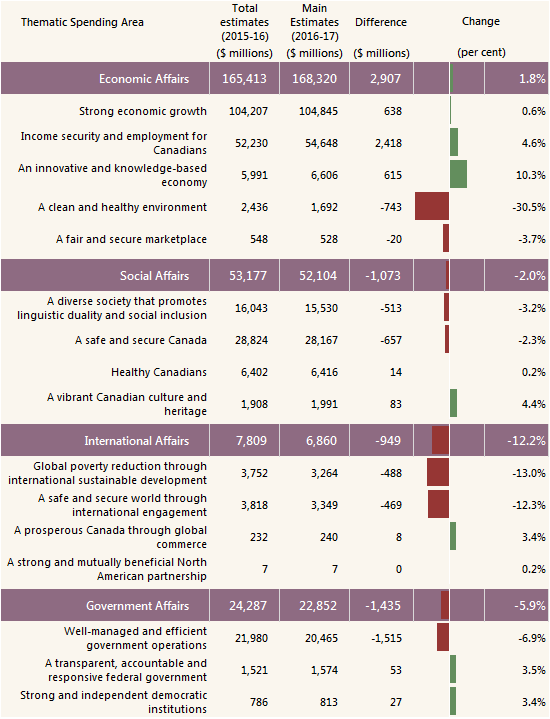
The Government’s Expenditure Plan and Main Estimates for 2016-17 outline $250.1 billion in budgetary spending authorities. This represents a decrease of approximately $550 million compared to total budgetary authorities outlined in 2015-16, mostly driven by decreases in direct program spending (DPS), partially offset by increases in major transfers to persons, and other levels of government.

The decline, in general, stems from the sun-setting of various initiatives, for example the remediation of contaminated sites. Some of these measures are likely to be re-announced sometime in the future. Associated with this are expectations of future requests for funds through the Supplementary Estimates process, later in the year.

The Government has also initiated a pilot project, providing parliamentarians the ability to approve Transport Canada’s grants and contributions at the program level. This move allows Parliament to provide greater scrutiny on the spending of funds, and builds on recent transparency initiatives, notably the TBS InfoBase and the publication of frozen allotments in Supplementary Estimates (C) 2015-16.

Spending by policy area

Source: The Government’s Expenditure Plan for 2016-17