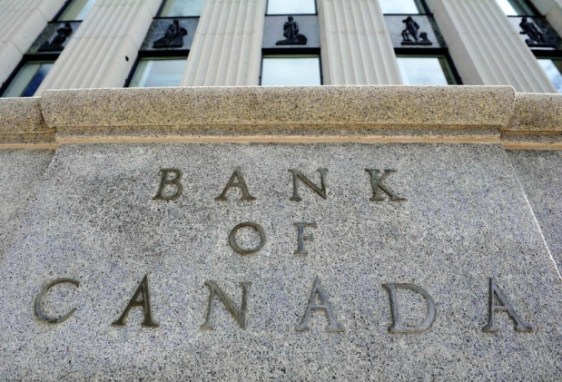
QUEBEC CITY, Quebec, Sept 20 (Reuters) – – Interest rates will stay lower for longer, and businesses need to adjust expectations for return on investment or Canada’s economy risks not seeing the improvement in productivity needed for growth, Bank of Canada Governor Stephen Poloz said on Tuesday.
In a speech outlining what low rates mean for businesses and governments, Poloz said it is obvious the Canadian economy is still facing strong headwinds and needs stimulative monetary policy to counteract them and move the country closer to full capacity.
“We also need to watch the full effects of the government’s fiscal stimulus unfold,” he said in a speech to economists in Quebec City that once again put the onus on government to stimulate the economy, given the already low level of official interest rates.
Poloz urged corporations to adjust the hurdle for new investment, saying it has been weaker than expected because some firms aren’t taking the low rate environment into account when deciding if an investment is worthwhile.
The governor said that while companies were uncertain about future demand prospects, they should not expect the kind of returns they could get before the financial crisis.
“My response has been to say that in the current and prospective environment, 4 percent will probably turn out to be a pretty good return,” Poloz said.
“Businesses need to make sure their expectations about investment returns reflect the current and likely future reality and reconfigure their investment plans accordingly.”
The Canadian dollar slightly pared earlier losses against its U.S. counterpart after Poloz’s remarks.
Poloz also said the aging of the population has driven a steady decline in the economy’s potential growth rate, but that companies and governments alike need to make adjustments because accommodative monetary policy is not as stimulative as it would have been before the crisis.
“Put simply, we’re dealing with lower for longer, not lower forever … we cannot just sit back and wait for these slow-moving forces to reverse,” he said.
Poloz said tax and immigration policy and business financing conditions should be aimed at nurturing firms, and argued that lowering trade barriers would help boost growth.
(Additional reporting by Andrea Hopkins and David Ljunggren in Ottawa; Editing by Paul Simao)
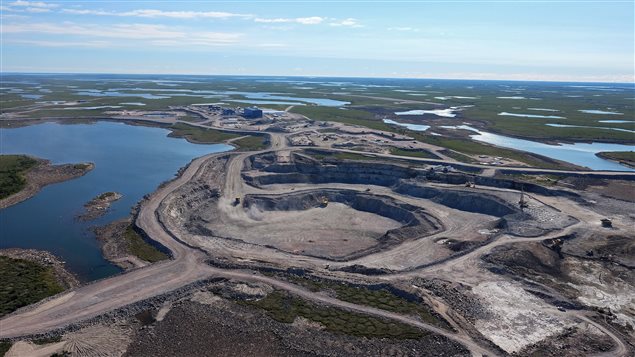
The Gahcho Kue diamond mine, located about about 280 kilometres northeast of Yellowknife in the Northwest Territories, is shown in a handout photo. Photo Credit: PC / THE CANADIAN PRESS/HO-De Beers Group of Companies
By Levon Sevunts, Radio Canada International
20 September, 2016
Canada is set to cement its position as one of the big players in the global diamond industry with the official opening of the Gahcho Kue diamond mine in the Northwest Territories today.
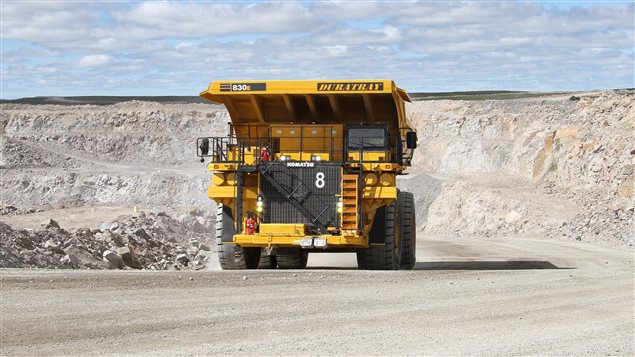
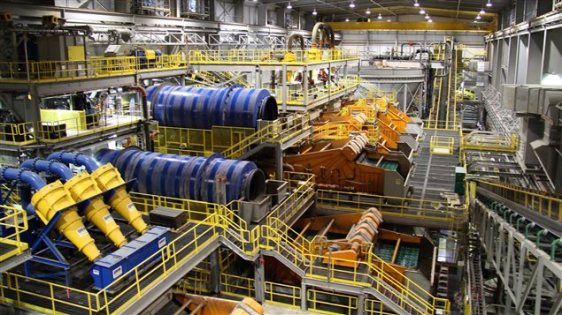
The mine, which sits in the tundra about 280 kilometres northeast of territorial capital of Yellowknife, is estimated to be one of the 10 biggest diamond mines in the world. It is expected to produce an average of 4.5 million carats a year over the life of the mine, according to De Beers Canada.
Gahcho Kue, a joint venture between De Beers Canada (51 per cent) and Mountain Province Diamonds (49 per cent), is the sixth diamond mine opened in Canada since BHP Billiton’s EKATI Mine in the Lac de Gras region, about 300 kilometres northeast of Yellowknife, started in 1998.
“It will be a very significant contributor to the NWT economy,” Kim Truter, CEO of De Beers Canada, told The Canadian Press.
A socio-economic impact report released by De Beers earlier this months estimated that the operation will provide $6.7 billion to the Canadian economy over its estimated life span of 12 years and has generated $440 million to the territory’s economy so far.
The mine supported more than 2,700 direct and indirect jobs in 2015, with employment at the site representing more than 10 per cent of employment in the NWT’s extractive industries, according to the report.
De Beers expects will need about 530 workers to operate.
Truter said the company has been working to share the benefits of Gahcho Kue with local First Nations and Métis, with impact benefit agreements signed with six groups in the area.
Market volatility
Canada’s diamond production is expanding at a time of growing volatility in the industry. Global sales of polished stones declined 2 per cent last year to $24.7 billion US as demand fell in emerging markets like India and China.
Lower prices and market instability meant a much bigger drop in the sales of rough diamonds, which dropped about 30 per cent to an estimated $13.7 billion US, forcing De Beers to close its Snap Lake diamond mine in December last year at a loss of more than 400 jobs.
But the company is banking on the purchasing power of the Millennial generation (those aged 15-34) who spent more than $25 billion US on diamond jewellery in 2015 in the four largest markets – the US, China, Japan and India, according to The Diamond Insight Report 2016.
“Most encouragingly, however, Millennials are still 10 years away from their most affluent life stage and the generation comprises more than 220 million potential diamond consumers in the four main markets,” said Bruce Cleaver, CEO, De Beers Group.
“The diamond industry therefore has a major opportunity on the horizon but it will only capitalise on it fully if it continues to innovate and invest across the value chain.”
De Beers, the world’s leading diamond company, started prospecting for diamonds in Canada in the early 1960s. In 1987, a second year geology student Brad Wood who was working for De Beers stumbled upon kimberlite rocks, volcanic rocks that sometimes contain diamonds, while fishing on Attawapiskat River, in the James Bay lowlands of Northern Ontario. The site would eventually become today’s Victor Mine.
But it wasn’t until 1991, when two enterprising geologists, Stewart Blusson and Chuck Fipke, discovered large diamond deposits in the Lac de Gras region of the Northwest Territories that the word learned of Canada’s Arctic diamonds.
Diamond production at the Anglo-Australian mining giant BHP Billiton’s EKATI Mine in the Lac de Gras region, about 300 kilometres northeast of Yellowknife, started in 1998 (Fipke and Blusson, each hold a 10 per cent share in the EKATI Mine).
In 2003, Rio Tinto, another giant British-Australian mining and metals company, opened its Diavik Mine not far from EKATI.
And in 2008, De Beers opened its first Canadian mine at Snap Lake about 220 kilometres northeast of Yellowknife.
Ontario joined Canada’s diamond club in 2008, when De Beers started commercial diamond production at its Victor mine, about 90 kilometres west of the First Nations community of Attawapiskat, in northern Ontario.
And Quebec is expected to join Canada’s diamond producing club once the Renard Mine owned by Stornoway Diamonds becomes operational by the end of 2016.
In less than a decade, Canada was propelled to the diamond mining major leagues, becoming the world’s third-largest producer, behind Botswana and Russia, producing 15 percent of the world’s diamonds by value.
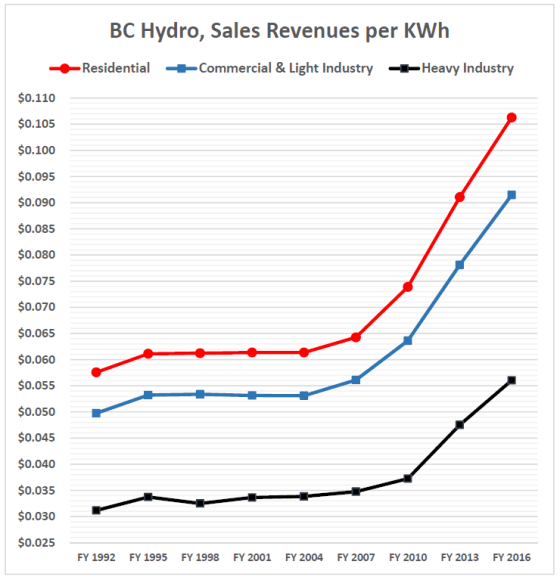
BC Hydro has three particularly important types of customers. These consumers, all inside British Columbia, are categorized as:
Residential,
Commercial and light industry,
Heavy industry.
There are others outside the province but BC power users shouldn’t be subsidizing their needs by delivering electricity at a fraction of today’s marginal cost.
In the past year, the utility began reporting certain sales outside BC as if these were domestic consumption. BC Hydro wants to show a greater need for power to rationalize increased IPP purchases and addition of generating facilities.
It is manipulation intended to hide BC Hydro’s growing surplus of power. It makes no sense to add yet more capacity or purchase power at high prices if it is to be dumped outside British Columbia for a fraction of what new power costs.
That is precisely what happens because BC Hydro’s three types of domestic customers bought the same quantity of power in fiscal year 2016 as they did in fiscal year 2005.
However, IPP purchases in 2016 were 222% more by volume and 312% more by dollar value than in 2005. That means 835 million additional dollars went from the pockets of ratepayers to the accounts of private power producers, most of whom are not owned by British Columbians.
In addition to throwing billions at IPPs, BC Hydro has been spending money like a drunken lottery winner. And, we know where they get the cash that’s being thrown around. What isn’t being taken through higher electricity rates is borrowed, to be recovered by even larger price rises.
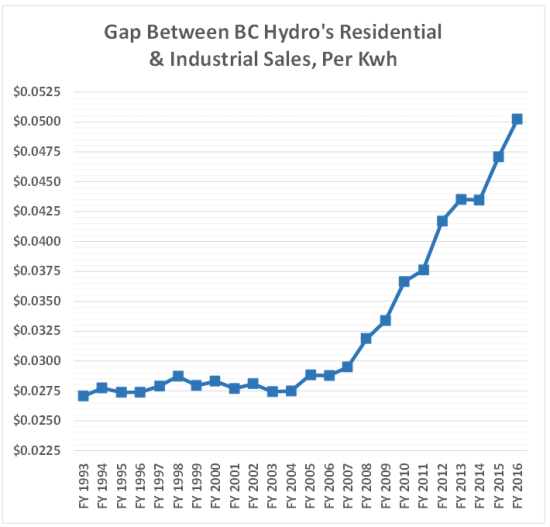
We had ten years without power rate increases (1993 to 2003), then years of modest increases (2004 to 2010). However, in 2011, Christy Clark returned. Although Premier Gordon Campbell set the stage and began doing the dirty deals, Clark’s Government avoided every opportunity to avoid or moderate the losses.
In addition, they spun out yet more benefits for their special friends, particularly big contributors in the resource industries. Here is a look at electricity prices over 25 years. Obviously, residential users carry the largest burden.
Thousands of protesters rallied on Tuesday against the European Union’s free Transatlantic Trade and Investment Partnership (TTIP) trade pact with the United States and Comprehensive Economic and Trade Agreement (CETA) with Canada in the Belgian capital ahead of the upcoming talks.
BRUSSELS (Sputnik) — Organizers estimate that between 10,000 and 15,000 demonstrators gathered in Brussels’ European Quarter that is home to the European parliament, Commission and EU Council.
Local trade unions, environmental groups and Canadian farmers demanded that Europe halt talks with Canada on the CETA deal that seeks to liberalize trade. They argue that it will water down food, environment and job protections.
An EU-Canada Summit, scheduled for October 27-28, is expected to see the controversial Comprehensive Economic and Trade Agreement signed.
It will still need to be ratified by some 40 national and regional EU parliaments.
EU leaders have been pushing for a trade deal with Canada as prospects for a similar agreement with the United States began to fade.
German Economy Minister Sigmar Gabriel said in August that the US-EU TTIP pact had collapsed.
A new round of talks on it is planned for October 3.
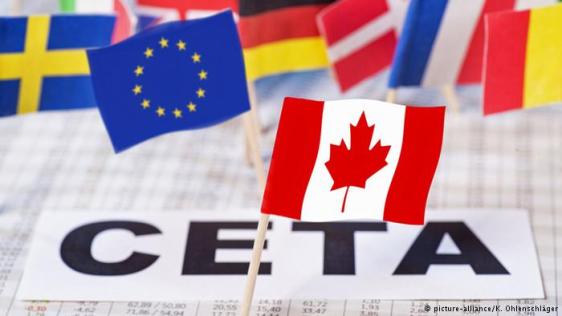
The CETA free trade agreement between Canada and the EU is proving highly controversial. It was discussed with Canadian International Trade Minister Chrystia Freeland, live in the DW News studio. Canada expects CETA to be signed in October.


 Andrew Phillip Chernoff