Horsey McHorseface, because ‘hey, why not?’ – NZ Herald News

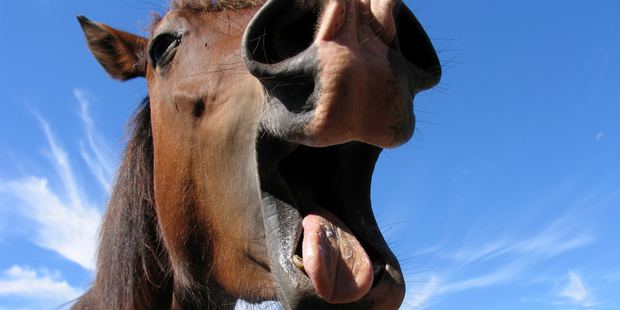
Horsey McHorseface was purchased for $45,000 in New Zealand in November. Photo / iStock

A New Zealand-bred horse is making waves in the racing world for his “unique” moniker.

Horsey McHorseface was purchased for $45,000 in New Zealand in November by Australian Joe Rosetti. The 2-year-old gelding will debut in Australia next month.

Rosetti’s racing manager Jake Bruce spoke to CNN about the quirky name.

“We had a laugh about it in the office and thought, ‘Hey, why not’,” he said.

“Joe’s a good bloke and he’s a good horse. We just thought it would be a good fit.”

Burke said Horsey had “as good a chance as any to make it”.

“We’d absolutely love to win with him on a big day. It would be hilarious and great for the owners,” he told CNN.

The name follows an online poll in the UK where thousands of people flocked to a government website to support naming a British research ship RRS Boaty McBoatface.

NZ Herald

Source: Horsey McHorseface, because ‘hey, why not?’ – World – NZ Herald News

Morning Skate: Stanley Cup Playoffs Edition – April 14, 2016

MORNING SKATE: STANLEY CUP PLAYOFFS EDITION – APRIL 14, 2016

Welcome to the “Morning Skate: Stanley Cup Playoffs Edition,” a daily collection of the latest news and notes from around the NHL.

WEDNESDAY’S RESULTS

Home Team in Caps
TAMPA BAY 3, Detroit 2 – TBL leads 1-0
PITTSBURGH 5, NY Rangers 2 – PIT leads 1-0
ST. LOUIS 1, Chicago 0 (OT) – STL leads 1-0

ELLIOTT, BACKES LEAD BLUES TO OVERTIME VICTORY . . .

Brian Elliott denied all 35 shots he faced and David Backes scored at 9:04 of the extra frame to help the Blues take a 1-0 lead in their series against the defending Stanley Cup champion Blackhawks.

* Elliott, who made a combined 15 stops in the third period and overtime, registered his first career playoff shutout (20 GP). He posted four blank sheets in 2015-16, including three straight from March 19-25.
* Elliott improved to 12-1-0 in his last 13 decisions (regular-season and playoffs) dating to Feb. 12.
* Backes recorded his first career playoff overtime goal (30 GP). He has two such tallies in 727 regular-season games: Dec. 14, 2013 at CBJ and Oct. 31, 2015 vs. MIN.

. . . 60 IS NOT ENOUGH (AGAIN)

The Blues and Blackhawks required overtime for the fifth time in their past seven postseason meetings. In the 2014 First Round, the clubs played past regulation four times, with each team winning twice.

* The Blues and Blackhawks played their fourth overtime game of 2015-16 (including the regular season). St. Louis has won all four such contests.
* The Blackhawks opened the postseason with an overtime game for the fifth consecutive year, falling to 2-3 in those contests.
* There were 19 overtime games in the 2015 Stanley Cup Playoffs, including five that involved the Blackhawks (4-1).

HORNQVIST’S HAT TRICK POWERS PENGUINS . . .

Patric Hornqvist (3-1—4) scored his first career playoff hat trick to power the Penguins past the Rangers in their series opener.

* Hornqvist became the first Penguins player to notch a hat trick in the postseason since Game 6 of the 2014 First Round, when Evgeni Malkin tallied 3-0—3 in Pittsburgh’s series-clinching win at CBJ.
* Via Elias, Hornqvist became the first player in franchise history to post a hat trick in the team’s playoff opener. The last player to accomplish that feat for any team was Toronto’s Alexander Mogilny on April 9, 2003 at PHI (3-0—3).
* Hornqvist registered his only other three-goal and four-point game – regular season or playoffs (539 GP) – earlier this year, on Feb. 29 vs. ARI (3-1—4).

. . . ZATKOFF SHINES IN STANLEY CUP PLAYOFFS DEBUT

Jeff Zatkoff stopped 35 shots, including the first 28 he faced, to win his postseason debut in his first NHL start since Feb. 20.

* Elias says that Zatkoff became the first Penguins goaltender to win his playoff debut in exactly 25 years. On April 13, 1991, Frank Pietrangelo earned a Game 6 victory to help Pittsburgh extend its opening round series against New Jersey en route to its first Stanley Cup.

DID YOU KNOW?

Sidney Crosby posted 1-2—3, his 10th career three-point postseason game. Via Elias, Crosby (44-77—121 in 101 GP) ranks sixth in Stanley Cup Playoffs history in points per game:

Most Points Per Game, Stanley Cup Playoffs History (Minimum: 50 GP)
1. Wayne Gretzky 1.84
2. Mario Lemieux 1.61
3. Mark Messier 1.25
4. Bobby Orr 1.24
5. Mike Bossy 1.24
6. Sidney Crosby: 1.20

TOP LINE PROPELS LIGHTNING TO SERIES LEAD

The line of Nikita Kucherov (2-1—3, +3), Alex Killorn (1-1—2, +3) and Tyler Johnson (0-2—2, +3) combined for all three goals to help the defending Eastern Conference champion Lightning take a 1-0 series lead against the Red Wings.
* Kucherov, who scored a career-high 30 goals during the regular season, matched playoff career highs for goals and points. He has registered three other multi-goal games in the postseason, all during Tampa Bay’s run to the 2015 Stanley Cup Final.
* Killorn scored the winner moments after Detroit successfully challenged a Lightning goal, which was overturned after new blue-line cameras assisted in showing Tampa Bay was off-side.

MILESTONES & BENCHMARKS

* Head coach Joel Quenneville served his 118th career playoff game behind the Blackhawks bench to move past Bill Reay (117) for the most in franchise history.
* Penguins forward Tom Kuhnhackl (1-0—1) scored a shorthanded goal while making his postseason debut. Pittsburgh placed second in the League with 11 shorthanded goals during the regular season.
* Rangers goaltender Antti Raanta (16 SV) made his postseason debut in relief of Henrik Lundqvist, who left the game after the first period.

LOOSE PUCKS

Lightning goaltender Ben Bishop made 34 saves, including five stops in the final 70 seconds of regulation . . . Red Wings defenseman Mike Green and forward Justin Abdelkader scored less than two minutes apart early in the second period . . . Rangers forward Derek Stepan (2-0—2) posted his second career multi-goal playoff game (also May 27, 2014 at MTL: 2-0—2) . . . ICYMI: Rapper Snoop Dogg shared his picks for the Stanley Cup Playoffs Bracket Challenge powered by Samsung . . . “Twitter Moments” highlighted wins by the Blues and Lightning.

SNEAK PEEK AT THURSDAY’S ACTION

All Times Eastern
Philadelphia @ Washington, Game 1, 7:00 p.m., NBCSN, CBC, TVAS, CSN-PH, CSN-DC
NY Islanders @ Florida, Game 1, 8:00 p.m., CNBC, SN, TVAS2, MSG+, FS-F
Minnesota @ Dallas, Game 1, 9:30 p.m., NBCSN, SN360, TVAS3, FS-N, FS-WI, FS-SW
San Jose @ Los Angeles, Game 1, 10:30 p.m., CNBC, CBC, TVAS, CSN-CA, FS-W

CAPITALS BEGIN STANLEY CUP QUEST AGAINST FLYERS

The Presidents’ Trophy-winning Capitals begin their quest for the first Stanley Cup in franchise history when they welcome the Flyers to Verizon Center for Game 1 of their opening round series.

This marks the fifth playoff meeting between Washington and Philadelphia, who have split their first four – both teams won one of those series in overtime of a Game 7 (WSH: 1988 DSF, PHI: 2008 CQF).

The Capitals and Flyers also split their four matchups in 2015-16 (WSH: 2-0-2, PHI: 2-2-0), with each of the last three games decided by one goal. In fact, seven of the last 10 meetings between these clubs have featured one-goal margins dating to March 2, 2014 (WSH: 3-3-4, PHI: 7-3-0).

PANTHERS, ISLANDERS LOOK TO SNAP PLAYOFF DROUGHTS

The Panthers and Islanders, who are meeting in the postseason for the first time, look to snap lengthy playoff droughts when they begin their series at BB&T Center. Florida has not won a postseason series since the 1996 Eastern Conference Final, when it defeated Pittsburgh (and current Panthers forward Jaromir Jagr) in seven games en route to its lone appearance in the Stanley Cup Final. New York, meanwhile, has not won a playoff series since the 1993 Patrick Division Final, when it beat Pittsburgh (and Jagr) in seven games before bowing out in the Eastern Conference Final. The Panthers went 2-1-0 against the Islanders this season, with New York securing its lone victory via a three-goal, third-period comeback on March 14.

STARS, WILD FACE OFF IN FIRST POSTSEASON SERIES

The Western Conference champion Stars – who played in Bloomington, Minn., from 1967-68 through 1992-93 – start their first postseason series against the Wild when the clubs meet for Game 1 at American Airlines Center.

Four of the five contests between these teams in 2015-16 featured one-goal margins, with Dallas winning three of those games in overtime (DAL: 4-1-0, MIN: 1-1-3). That reversed a trend from last season that saw Minnesota win four of their five head-to-head matchups (MIN: 4-1-0, DAL: 1-3-1).

The Stars are hoping for the return forward Tyler Seguin, who shared fifth place in the NHL with 33-40—73 in 72 games before being sidelined with an Achilles injury on March 17.

KINGS, SHARKS AGAIN RENEW RIVALRY IN PLAYOFFS

California rivals meet in the playoffs for the fourth time overall – and third time in the past four seasons – when the Kings welcome the Sharks to STAPLES Center for Game 1 of their First Round series.

Including regular-season and playoff games, Los Angeles and San Jose have faced off more than any two teams since the start of 2010-11 (51x). In their last postseason matchup, in the 2014 First Round, the Kings became the fourth club in NHL history to overcome a 3-0 series deficit – a feat that sparked Los Angeles to its second Stanley Cup triumph.

The teams have split their 10 head-to-head games since then (LAK: 5-5-0, SJS: 5-4-1), with San Jose winning three of their five meetings this season.

Twitter: @NHL and @PR_NHL | Facebook: NHL | Instagram: @NHL and @PR_NHL


Royal Australasian College of Surgeons under fire over live animal labs

Dr Jill Tomlinson is calling for the Royal Australasian College of Surgeons to stop using live animals for surgical training. Photo: Wayne Taylor

Julia Medew

April 13 2016 – 11:46PM     Julia Medew

The door to the old laboratory near St Vincent’s Hospital in Fitzroy was unmarked for good reason. Inside, about six live greyhounds were strapped to operating tables waiting to be cut open.

The tall, thin dogs were lying on their backs, barrel-shaped chests in the air, legs unnaturally tied down on their sides. They had been anaesthetised and had tubes in their mouths to keep them breathing, just like people would during major surgery.

For Jill Tomlinson, it was a shocking sight. Like many trainee surgeons before her, Dr Tomlinson was there for the “early management of severe trauma” course in 2004 – an essential part of her training. She does not know where the dogs came from but suspects they had been used for racing.

In groups of four, the aspiring surgeons had to cut holes in a dog’s throat, chest, abdomen and leg to insert tubes for air, fluid drainage or drug infusion. The potentially life-saving techniques are used on people with serious injuries needing emergency care.

“Because I had expressed concerns … my demonstrator [a senior surgeon teaching the course] turned up the gas fairly high and said I could be reassured the animal wouldn’t feel anything,” Dr Tomlinson recalls.

Still, she loathed slicing the dog’s chest open with a scalpel to insert a tube into the space between its lung and chest cavity because she thought it unnecessary. Dr Tomlinson said she had previously worked on cadavers and believed the college could use tissue samples from dead animals or mannequins used for other medical training instead.

“I was both upset and angry that I had no other alternative than to participate in something that I felt was wrong,” she says.

Dr Tomlinson is one of nearly 86,000 people lobbying the Royal Australasian College of Surgeons to stop using live animals in their training courses. This year hundreds of animals – most likely sheep and pigs – are scheduled to be used for dozens of trauma courses at venues including hospitals such as Westmead and St George in Sydney. After the procedures, the college says the animals are humanely killed.

A petition run by PETA (People for the ethical treatment of animals) says despite the availability of patient simulators and despite other countries ceasing the use of live animals for surgical training, the Royal Australasian College of Surgeons continues the practice needlessly.

“Unlike animals, realistic simulators accurately replicate human anatomy and physiology and are reusable and shareable,” the petition says.

The group says simulators are so effective the US military recently banned the use of animals for its equivalent trauma course. It says “continuing to mutilate and kill animals for these trauma training courses is extremely cruel and archaic” and breaches the National Health and Medical Research Council’s guidelines, which say the use of animals must be justified and only used when suitable alternatives are not available.

President of the Royal Australasian College of Surgeons David Watters said live animals were used for severe trauma courses because they better replicate emergency situations where there is a beating heart and blood loss. He said the college currently only uses sheep and pigs in accordance with the Australian Code of Practice for the Care and Use of Animals for Scientific Purposes (the NHMRC guidelines referred to by PETA), and that a vet or qualified animal technician is always present.

“Great care is undertaken in regard to the animals’ welfare … with constant veterinary anaesthetic supervision to ensure animals experience no pain,” he said. “At the end of the procedure the animals are humanely euthanised.”

Professor Watters said while participants who object to working on live animals can attend the course and use patient simulators at a small number of sites, the college does not believe these simulators are good enough to replace animals for all of the courses. He is hoping they will be suitable within five years.

Meanwhile, he said the overwhelming response obtained from participants was that mannequins do not reproduce the feel and responsiveness of living tissue to a degree that faithfully represents reality.

“The medical literature supports this position with a strong preference for the anaesthetised animal approach from both participants and instructors,” he said.

Dr Tomlinson, now a plastic surgeon, disagrees. Since the course, she has performed the procedures on humans and said there were major differences between the anatomy of a human and a greyhound.

“I don’t think the argument that it needs to be done for training holds up,” she said.

Another surgeon who did not want to be named agrees. When she did the course five years ago, she said she was horrified by the experience of “killing a dog bit by bit”. At one stage she said a peer accidentally punctured the dog’s bladder while trying to insert a tube into its abdomen, causing urine to spray out. Shortly after that, the dog stopped breathing on the table.

“The dog had been over-gassed, so it just died on the table,” she said. “It was more traumatic than euthanising it … It just wasn’t the right thing to do.”

Source: Royal Australasian College of Surgeons under fire over live animal labs

WFTU » WFTU Statement on May Day 2016

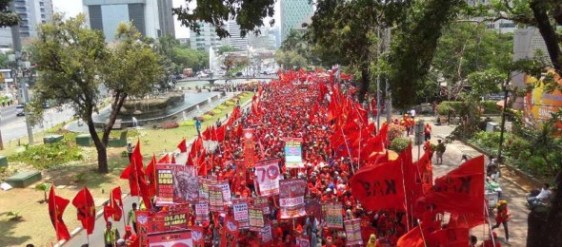
The World Federation of Trade Unions on the occasion of the International Workers’ Day on 1st May 2016 conveys a militant salute to all men and women of the working class and to the 92 million members of WFTU in 126 countries.

Men and women, younger or older, employed or unemployed, migrants and refugees, the World Federation of Trade Unions wishes you strength, determination and courage in your small-scale or large-scale struggles.

The multinationals, the reactionary governments, neo-fascist and racist forces, the imperialist mechanisms dread this day. Because it is a symbol of internationalism, a symbol of struggle, a symbol of class unity. These are our most powerful tools with which we need to arm ourselves in our struggles for better lives, in our struggles against poverty and wars generated by the capitalist barbarity.

Building strong class-oriented base trade unions that are massive, democratic, militant we strengthen the WFTU.

And by strengthening the WFTU as a rooted class-oriented Organization of the base, internationalist and uniting, we strengthen our trade unions.

In all countries of the world, with all forms of action we demand our contemporary needs, our labor, social and trade union rights.

Our reality of misery, unemployment, poverty and wars in contrast to the technological and scientific progress and the wealth we produce, prove how unrealistic and rotten the capitalist mode of production is.

We rally our forces and build our social alliance with the popular strata against exploitation and capitalist barbarity.

On the occasion of May Day we once more want to send our internationalist solidarity to the peoples of Palestine, Libya, Syria, Lebanon, Iraq Afghanistan, Yemen and all peoples who are suffering imperialist attacks and fight for their right to decide for themselves over their present and future.

This year 2016, the 17th World Trade Union Congress will summon the representatives of the class-oriented trade union movement in the heroic land of South Africa. On 5-8 October 2016, thousands of delegates, real militant unionists, from all continents will gather in Durban, analyze the global and regional developments, exchange experience and proposals and resolute on the strategy and action plan of the WFTU for the next five years.

With this Congress we make a vital step forward for the international class-oriented trade union movement. “Forward! For the contemporary needs of the working class against poverty and wars generated by the capitalist barbarism”.

THE SECRETARIAT

Source: WFTU » WFTU Statement on May Day 2016