Canadian consumer confidence shows positive pressure (released April 18, 2016)

Bloomberg-Nanos Economic Banner

Bloomberg Nanos Weekly Consumer Confidence Tracking

Both the forward looking Expectations Sub-indice and the retrospective Pocketbook Sub-indices showed positive movement in the past week which included pronouncements by the Governor of the Bank of Canada on the state of the Canadian economy.

“Overall, forward looking views on real estate and the strength of the Canadian economy are noticeably above the 2016 average for those two measures,” said Nanos Research Group Chairman Nik Nanos. “This is in contrast to perceptions related to job security and personal finances which are flat for 2016.”

“Consumer attitudes among younger cohorts suggest that while the economy will be facing excess capacity, weak investment, and significant labor-market slack over coming year, low interest rates and energy prices should prop up household spending in the near term. In the longer-run, recent analysis suggests that Canada’s labor market has become more flexible, with younger workers and women more attuned to changing employment opportunities, which should help the economy transition toward new industries”, said Bloomberg economist Robert Lawrie.

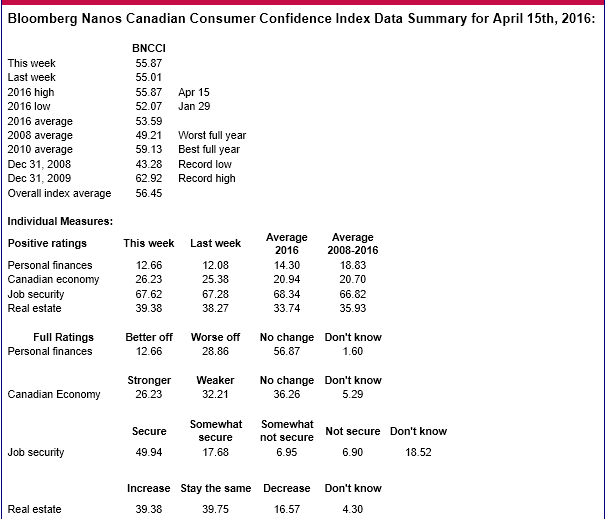
The BNCCI, a composite of a weekly measure of financial health and economic expectations, registered at 55.87 compared with last week’s 55.01. The twelve month high stands at 58.62.

The Bloomberg Nanos Pocketbook Index is based on survey responses to questions on personal finances and job security. This sub-indice was at 57.53 this week compared to 56.75 the previous week. The Bloomberg Nanos Expectations Index, based on surveys for the outlook for the economy and real estate prices, was at 54.21 this week (compared to 53.27 last week).

The average for the BNCCI since 2008 has been 56.45 with a low of 43.28 in December 2008 and a high of 62.92 in December 2009. The index has averaged 53.59 this year.

To view the weekly tracking visit our website.

Methodology

The BNCCI is produced by the Nanos Research Corporation, headquartered in Canada,  which operates in Canada and the United States.  The data is based on random telephone interviews with 1,000 Canadian consumers (land- and cell-lines), using a four week rolling average of 250 respondents each week, 18 years of age and over. The random sample of 1,000 respondents may be weighted by age and gender using the latest census information for Canada and the sample is geographically stratified to be representative of Canada. The interviews are compiled into a four week rolling average of 1,000 interviews where each week, the oldest group of 250 interviews is dropped and a new group of 250 interviews is added. The views of 1,000 respondents are compiled into a diffusion index from 0 to 100. A score of 50 on the diffusion index indicates that positive and negative views are a wash while scores above 50 suggest net positive views, while those below 50 suggest net negative views in terms of the economic mood of Canadians.

A random telephone survey of 1,000 consumers in Canada is accurate 3.1 percentage points, plus or minus, 19 times out of 20.

All references or use of this data must cite Bloomberg Nanos as the source.
screenshot-{domain} {date} {time}

Saudi-Iran tensions scupper deal to freeze oil output 

Saudi Arabia’s Oil Minister Ali al-Naimi arrives to a meeting between OPEC and non-OPEC oil producers, in Doha, Qatar April 17, 2016. REUTERS/Ibraheem Al Omar

By Rania El Gamal and Reem Shamseddine

DOHA (Reuters) – A deal to freeze oil output by OPEC and non-OPEC producers fell apart on Sunday after Saudi Arabia demanded that Iran join in despite calls on Riyadh to save the agreement and help prop up crude prices.

The development will revive oil industry fears that major producers are embarking again on a battle for market share, especially after Riyadh threatened to raise output steeply if no freeze deal were reached.

Iran is also pledging to ramp up production following the lifting of Western sanctions in January, making a compromise with Riyadh almost impossible as the two fight proxy wars in Yemen and Syria.

Some 18 oil nations, including non-OPEC Russia, gathered in the Qatari capital of Doha for what was expected to be the rubber-stamping of a deal – in the making since February – to stabilize output at January levels until October 2016.

But OPEC’s de facto leader Saudi Arabia told participants it wanted all members of the Organization of the Petroleum Exporting Countries to take part in the freeze, including Iran, which was absent from the talks.

Tehran had refused to stabilize production, seeking to regain market share post-sanctions.

After five hours of fierce debate about the wording of a communique – including between Saudi Arabia and Russia – delegates and ministers announced no deal had been reached.

“We concluded we all need time to consult further,” Qatar’s energy minister Mohammed al-Sada told reporters. Several OPEC sources said if Iran agreed to join the freeze at the next OPEC meeting on June 2, talks with non-OPEC producers could resume.

TOUGH SAUDI STANCE

The failure to reach a global deal could halt a recent recovery in oil prices.

“With no deal today, markets’ confidence in OPEC’s ability to achieve any sensible supply balancing act is likely to diminish and this is surely bearish for the oil markets, where prices had rallied partly on expectations of a deal,” said Natixis oil analyst Abhishek Deshpande.

In December, OPEC failed to agree on output policy for the first time in years after Iran disagreed over a production ceiling proposed by Saudi Arabia, arguing again that it wanted to boost output post-sanctions.

“Without a deal, the likelihood of markets balancing is now pushed back to mid-2017. We will see a lot of speculators getting out next week,” Deshpande said.

Brent oil (LCOc1) has risen to nearly $45 a barrel, up 60 percent from January lows, on optimism that a deal would help ease the supply glut that has seen prices sink from levels as high as $115 hit in mid-2014.

Amrita Sen of Energy Aspects said oil prices could fall below $40 on Monday in a knee-jerk reaction.

“While today’s lack of a freeze deal has no negative impact on balances – since Iran is really the only country likely to raise output substantially – it has a huge negative impact on sentiment especially as the deal had been hyped up so much,” she said.

Saudi Arabia has taken a tough stance on Iran, the only major OPEC producer to refuse to participate in the freeze.

Deputy Crown Prince Mohammed bin Salman told Bloomberg that the kingdom could quickly raise production and would restrain its output only if Iran agreed to a freeze.

Iran’s oil minister Bijan Zanganeh said on Saturday OPEC and non-OPEC should simply accept the reality of Iran’s return to the oil market: “If Iran freezes its oil production … it cannot benefit from the lifting of sanctions.”

(Reporting by Rania El Gamal and Reem Shamseddine; Additional reporting by Sam Wilkin, Katie Paul and Tom Finn; Writing by Dmitry Zhdannikov and Andrew Torchia; Editing by Dale Hudson)

Source: Saudi-Iran tensions scupper deal to freeze oil output – Yahoo Finance

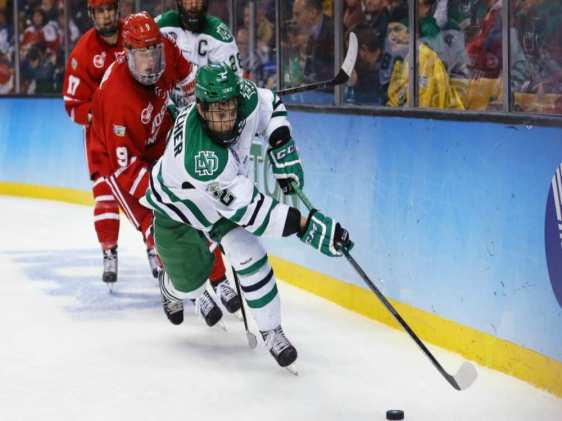
Signing Troy Stecher was no slam dunk for Canucks

JASON BOTCHFORD

Published on: April 16, 2016

If you were ever looking to find out what a 22-year-old gets up to on the Friday after signing his first pro contract, look no further than Troy Stecher.

The North Dakota communications major was in school, late into Friday afternoon, as committed to finishing his college education as he is to the Canucks.

Stecher signed a two-year entry-level contract with Vancouver this week, and is a promising right-shot defenceman whose presence in the organization should alleviate some of the residual angst over the Canucks pointlessly losing Frankie Corrado in the fall.

Stecher was supposed to be the Canucks slam-dunk college free-agent this spring. He’s from here, and grew up in Richmond. His parents live here, and there was a time when his dad, Peter, had Canucks season tickets. He even was a part of a Canucks development camp in 2014.

But despite any perceived advantages, the Canucks got a big win in signing Stecher, and it was far closer to not happening than most people have assumed.

“It was really close at the end,” Stecher admitted. “We had it down to five, and we narrowed it down to Vancouver after that. It was a long process.

“Being my hometown, it was an added benefit.”

The hometown kid signed by the hometown team makes for a wonderful story, and an easy one too. But don’t be naive. It’s not the entire reason he signed.

Stecher, who is bright, mature, thoughtful and impressively serious, understands math and the situation in Vancouver. Would the signing have happened with the right-shot 22-year-old Corrado in the organization still?

Maybe, but, maybe not.

“Obviously you’re going to do your due diligence and your homework,” he said.

Anyone could have assessed the Canucks as a team desperately in need of a young, right-shot defenceman who has an NHL shot, can make a power-play dance and someone who can skate.

And, boy, can Stecher skate.

For that, he credits his father for pointing out he had short, choppy strides when he was a young teen, and for a Tsawwassen hockey school, where he worked out with Brendan Gallagher and turned those short, choppy strides into something that, at times, made him look like a running antelope in the NCAA this season.

Watching some of his games, there’s Yannik Weber in him. Stecher is grittier and faster, but has that same dynamic offensive potential. And, at 5-foot-10-and-a-half is essentially the same size.

Generally, defencemen under six-feet are thought to be undersized. But Stecher counters that by pointing out the three defencemen he models his game after, Dan Boyle, Duncan Keith and the Minnesota Wild’s Jared Spurgeon, who are all successful NHL blueliners and all on the smaller side of the league.

“It doesn’t matter who you are, every player has obstacles they have to overcome,” Stecher said.

It has provided a nice incentive for him, as he said part of the reason trained those long hours to improve his skating was because of that label he wasn’t big enough.

Stecher’s breakout season for North Dakota saw him go from 13 points to 29. He was the sixth-most productive defenceman in college hockey, and that was like chum in the water for NHL teams.

There had been rumours even last year the NHL was interested in him after passing him over in three consecutive drafts because of his size, and output, which wasn’t impressive until this season.

His best line this week after signing was when he essentially said that if he were a Canucks fan he’d be jacked about the progress of his North Dakota teammate Brock Boeser.

He wasn’t talking about how many goals Boeser scored, which was pretty remarkable. Instead, he was speaking to how Boeser handles himself off the ice.

Thing is, Stecher is much like Boeser, the Canucks’ 2015 first-round pick. They are both dedicated, clean-living kids who, if they can make it, have the character to fit right into an organization currently led by two of the classiest players in the league, the Sedin twins.

For an example, Stecher is passing on an opportunity to play in Utica this season, something Ben Hutton did at the end of last year on an amateur tryout deal which didn’t impact his contract situation.

Stecher is staying in school in part because he doesn’t want to lower his grades, which would negatively impact North Dakota’s score in the NCAA’s academic progress rate program.

Low APR scores can result in NCAA penalties such as scholarship reductions and postseason bans.

“I never want a situation where something I did leads the coach to tell someone ‘Sorry, you can’t be a part of this’ because there was a cut,” Stecher said. “You need to leave the program in good standing if you leave early. I didn’t want to jeopardize the programs.”

It does sound like something a Sedin would say, doesn’t it?

jbotchford@postmedia.com

twitter.com/botchford

Source: Signing Troy Stecher was no slam dunk for Canucks | Vancouver Sun

Precarious work drives interest in basic income

Aleksandra Sagan, The Canadian Press
Published Sunday, April 17, 2016 11:11AM EDT


TORONTO — In the mid- to late 1970s, every single person in one rural Manitoba city received $1,255 a year — roughly $7,500 in today’s dollars.

The amount increased depending on the number of people living in each household, maxing out at $3,969, or nearly $23,500 in 2016 currency, for a family of five or more.

The people in the Dauphin, Man., experiment didn’t have to work to receive this stipend. If they did, their benefit dropped 50 cents for every dollar they received.

The residents of Dauphin just had to exist to receive their full guaranteed annual income.

About four decades later, policy-makers and the public in Canada and around the world are eyeing the basic guaranteed income scheme again, buoyed by an evolving labour landscape and technological advances that have left them wondering if today’s social services are enough.

Finland plans to launch a basic income pilot next year. The Swiss will soon vote on unconditional basic income in a referendum.

Closer to home, the Ontario government’s latest budget promises to run a pilot in the future and multiple politicians across Canada have expressed interest in studying the idea.

“I think people are simply looking at the state of the economy and they’re starting to focus on changes that have been taking place for a very long time,” said Evelyn Forget, a professor at the University of Manitoba, who studied the so-called mincome experiment in Dauphin and continues to research data from the pilot.

One of these changes, she said, is that work is no longer a permanent, 9-to-5 gig with health coverage and a pension. Instead, it takes longer for people to land stable employment and many shuffle between short-term contracts without such benefits, she said.

In the Greater Toronto Area, for example, 60 per cent of workers have stable, secure jobs, according to a 2013 report on precarious work. Insecure employment has spread beyond jobs in the service sector to the white-collar workforce as well, a followup report found.

This changing labour force is prompting people to rethink how governments deliver social programs, said Forget, and realize that current solutions like income assistance are expensive and for the most part, ineffective.

“I think tensions are building in our society,” said Wayne Lewchuk, a McMaster University professor of economics and labour studies, who co-authored both reports in conjunction with United Way Toronto & York Region.

“More and more people are questioning … the wisdom of how we’re organizing our labour markets and our economy.”

Lower wages and precarious employment lower a person’s purchasing power, he said, and more people spending less negatively effects the economy.

A guaranteed basic income could be a way to prime the economic pump, Lewchuk said.

Another change in the workforce could come from technological advancements that will eliminate jobs, some basic income advocates argue.

Millions of positions will be lost over the next several years thanks to disruptive labour market changes, according to a World Economic Forum report published this year.

No job is safe from machine-outsourcing, writes Scott Santens, a basic income advocate who lives in the U.S. off of a crowdfunded monthly basic income.

He argues people need to prepare for a world where their income isn’t dependent on the jobs machines can do, but instead should be given a stipend to sustain themselves while doing the kind of work they still find valuable.

Forget believes it is a matter of continued public interest and political will for basic income to become reality.

“I think it’s almost inevitable, eventually, that this kind of a policy will be implemented.”

Source: Precarious work drives interest in basic income | CTV News

‘Boaty McBoatface’ tops public vote as name of polar ship – BBC News

NERC Image The £200m ship will replace RRS Ernest Shackleton and James Clark Ross when it becomes operational in 2019

Boaty McBoatface has become the overwhelming choice in a public vote to name a £200m polar research ship.

The name, suggested by former BBC Radio Jersey presenter James Hand, went viral, crashing the Natural Environment Research Council (Nerc) website.

Boaty McBoatface was the runaway winner with 124,109 votes. The second most popular choice, Poppy-Mai, had 34,245.

Nerc said that according to its competition rules it would have the final say on any name.

Antarctic Survey

At the height of the furore, Mr Hand tweeted an apology, but said that the storm his suggestion had created “had legs of its own”.

The Royal Research Ship (RRS), which is currently being built by Cammell Laird on Merseyside, is due to become operational in 2019 and will replace RRS Ernest Shackleton and James Clark Ross.

It will study ice sheets, ocean currents and marine life as part of the Cambridge-based British Antarctic Survey.

When it launched the competition, Nerc said it was looking for “something inspirational” that would exemplify the ship’s work, but that did not prevent people making suggestions which also included Pingu and It’s Bloody Cold Here.

Usain Boat and What Iceberg? had been among nearly 7,000 other suggestions.

Source: ‘Boaty McBoatface’ tops public vote as name of polar ship – BBC News