
TPP: Urgent need for full, independent assessment | Canadian Union of Public Employees

Apr 18, 2016

Hearings into the massive Trans-Pacific Partnership kicked off in Vancouver with a stark warning from the Trade Justice Network about the deal’s many negative consequences, and an urgent call for a comprehensive, public and independent assessment of the pact.

TJN co-chair Blair Redlin told members of the House of Commons Committee on International Trade there is no rush to ratify the TPP, and every reason for a proper economic, social and environmental evaluation of the deal. CUPE is a member of the Trade Justice Network.

Outside the hearings, demonstrators rallied against Canada ratifying the deal, and advocacy group OpenMedia organized a giant TV screen displaying protest messages from across the country.

Redlin told the committee the TPP’s main goal is to protect foreign investors by securing and expanding corporate rights. The deal is less about trade, as 97 per cent of Canada’s exports to TPPcountries are already duty-free.

The TPP’s investor-state dispute settlement (ISDS) system will let foreign corporations sue governments if a law or regulation interferes with their investments – and profits. Under theseNAFTA-style rules, Canada is already the most-sued developed country. Expanding access to this one-sided process could mean a spike in new cases.

The TPP’s controversial ISDS rules will limit government powers to regulate in the public interest, including by supporting industries that create good local jobs, and protecting the environment. A government investing in transit or wind turbines could face challenges for favouring local procurement.

Ratifying the TPP comes at a high price, said Redlin. Independent analysis of the deal has found it will:

  • Cost Canada 58,000 jobs
  • Increase income inequality
  • Limit access to generic drugs, which in turn will drive up health care costs
  • Let corporations move to countries with cheaper labour and weaker labour laws
  • Hurt Canada’s agricultural, manufacturing and technology sectors
  • Threaten internet freedom

Redlin highlighted the outcomes of a recent TJN-sponsored forum, where Nobel Prize-winning economist Joseph Stiglitz described the TPP as the “worst trade deal ever.”

The TPP was finalized by the former Harper government during last year’s federal election, and then signed by the new Liberal government. Consultations on the deal have been limited, poorly publicized, and have appeared to favour the voices of corporations – not citizens.

Source: TPP: Urgent need for full, independent assessment | Canadian Union of Public Employees
Prime Minister to Travel to New York to Sign the Paris Agreement on Climate Change

OTTAWA, April 18, 2016 /CNW Telbec/ – The Prime Minister, Justin Trudeau, today announced that he will travel to New York Cityfrom April 20 to 22, 2016, to sign the Paris Agreement on climate change.

Canada has committed to play a positive and constructive role in the world, and to make meaningful contributions to important global challenges such as climate change.

In November 2015, Canada and 194 other countries reached the Paris Agreement— an international agreement to address climate change that is ambitious, durable, and applicable to all parties. It recognizes the important role of subnational governments, civil society, and the private sector, and it highlights Indigenous, community, human, and gender rights.

During his visit, the Prime Minister will also discuss the issues of climate change and youth engagement with students at New York University, and meet with counterparts.

Canada has resolved to be an international leader in the low carbon global economy over the coming decades. The government will continue to work with our provincial, territorial, and international partners to develop a more coordinated approach to climate change, so that our children and our grandchildren can enjoy a world more prosperous and sustainable than the one we know today.

Quote

Canada is a country whose greatest strength is its respect for diversity and pluralism.  We have much to contribute to the international community – from combatting climate change to helping build a more peaceful and prosperous world.”

– Rt. Hon. Justin Trudeau, Prime Minister of Canada

This document is also available at http://pm.gc.ca

For further information: PMO Media Relations: 613-957-5555

Source: Prime Minister to Travel to New York to Sign the Paris Agreement on Climate Change

Silver Price Manipulation Class Action Brought on Behalf of Canadian Investors

TORONTO, April 15, 2015 /CNW/ – A class action lawsuit seeking $1 billion in damages on behalf of Canadian investors was launched today in the Ontario Superior Court of Justice.

The class action alleges that the defendants, including The Bank of Nova Scotia, conspired to manipulate prices in the silver market under the guise of the benchmark fixing process, known as the London Silver Fixing, for a fifteen-year period.

It is further alleged that the defendants manipulated the bid-ask spreads of silver market instruments throughout the trading day in order to enhance their profits at the expense of the class. This alleged conduct affected not only those investors who bought and sold physical silver, but those who bought and sold silver-related financial instruments.

Law enforcement and regulatory authorities in the United States, Switzerland, and the United Kingdom have active investigations into the defendants’ conduct in the precious metals market.

The case is on behalf of all persons in Canada who, between January 1, 1999 and August 14, 2014, transacted in a silver market instrument either directly or indirectly, including investors who participated in an investment or equity fund, mutual fund, hedge fund, pension fund or any other investment vehicle that transacted in a silver market instrument.

A copy of the Notice of Action can be found at sotosllp.com. Potential class members can register on the website to obtain more information as the case progresses.

The plaintiffs and the proposed national class are being represented by a national team of lawyers from Sotos LLP (www.sotosllp.com), Koskie Minsky LLP (www.kmlaw.ca) and Camp Fiorante Matthews Mogerman (www.cfmlawyers.ca) with offices inOntario and British Columbia.

SOURCE Sotos LLP

For further information: contact David Sterns at 416-977-5229 or dsterns@sotosllp.com

Source: Silver Price Manipulation Class Action Brought on Behalf of Canadian Investors

Alberta business owners still worrying about labour: ATB poll

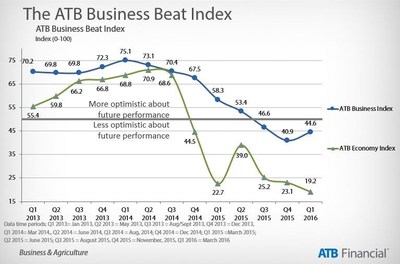
The ATB Business Beat Index (CNW Group/ATB Financial)

CALGARY, April 18, 2016 /CNW/ – Just as it was one year ago, Alberta small and mid-sized enterprise owners and operators (SMEs) are worried about labour and workforce issues. But the reasons they worry about employee-related issues has changed. That’s the key finding from the latest edition of the ATB Business Beat survey.

In each survey, ATB asks SMEs what, besides sales, keeps them up at night. One year ago, the most popular answer was labour/workforce, with comments focusing on the difficulty of finding and retaining skilled employees. In the latest edition of the Business Beat, worries about keeping staff members employed and busy, pending layoffs and meeting payroll were the most common SME concerns.

“What a difference a year can make,” said Wellington Holbrook, ATB’s Executive Vice-President, Business & Agriculture. “The economic downturn has had a major impact on small and mid-sized businesses in Alberta, especially when it comes to keeping staff on. We encourage any business owner in Alberta having difficulty making payroll to talk to your banker. Depending on your unique situation, we may be able to help, both in the short term and long term.”

The ATB Economy Index—which measures confidence in the province’s economy among Alberta SMEs—is at an all-time low. The Economy Index currently sits at 19.2, down from 23.1 in January. The ATB Business Index, meanwhile, rebounded slightly to 44.6, up from 40.9 in the previous survey. The Business Index measures small and mid-sized business owners’ confidence in their own operations. Scores below 50 mean more respondents feel pessimistic than optimistic.

Breaking down the results to specific sectors, SMEs in the energy sector are the most optimistic in the Alberta economy with an Economy Index result of 21.6. SMEs in the retail sector are the least optimistic with an index of 16.4. When it comes to confidence in their own operations, SMEs in the construction sector are the most optimistic with a Business Index result of 52.0. Once again, retail SMEs are the least optimistic in their own operations with an index of 32.0.

Click here to view the full report.

Source: Alberta business owners still worrying about labour: ATB poll

Fair use prevails as Supreme Court rejects Google Books copyright case 

Image by Roman Boed The Stacks The Library at the Rijks Museum in Amsterdam.

The Supreme Court on Monday declined (PDF) to hear a challenge from the Authors Guild and other writers claiming Google’s scanning of their books amounts to wanton copyright infringement and not fair use.

The guild urged the high court to review a lower court decision in favor of Google that the writers said amounted to an “unprecedented judicial expansion of the fair-use doctrine.” (PDF)

At issue is a June decision (PDF) by the 2nd US Circuit Court of Appeals that essentially said it’s legal to scan books if you don’t own the copyright. The Authors’ Guild originally sued Google, saying that serving up search results from scanned books infringes on publishers’ copyrights even though the search giant shows only restricted snippets of the work. The writers also claimed that Google’s book search snippets provide an illegal free substitute for their work and that Google Books infringes their “derivative rights” in revenue they could gain from a “licensed search” market.

The Supreme Court let stand the lower court opinion that rejected the writers’ claims. That decision today means Google Books won’t have to close up shop or ask book publishers for permission to scan. In the long run, the ruling could inspire other large-scale digitization projects.

Fair use is a concept baked into US copyright law, and it’s a defense to copyright infringement if certain elements are met. The US Copyright Office says the defense is decided on a case-by-case basis. “The distinction between what is fair use and what is infringement in a particular case will not always be clear or easily defined. There is no specific number of words, lines, or notes that may safely be taken without permission. Acknowledging the source of the copyrighted material does not substitute for obtaining permission,” the US Copyright Office says. There are, however, at least four factors that judges must consider when deciding fair use: the purpose of use, the nature of the copyrighted work, the amount and substantiality of the portion taken, and the effect of the use upon the potential market.

The Supreme Court did not comment in its order other than to say that Justice Elena Kagan did not participate.

Google, for its part, urged the justices to side against the writers because, in the end, their works would be more readily discovered. “Google Books gives readers a dramatically new way to find books of interest,” Google’s brief said. (PDF) “By formulating their own text queries and reviewing search results, users can identify, determine the relevance of, and locate books they might otherwise never have found.”

Unlike other forms of Google search, Google does not display advertising to book searchers, nor does it receive payment if a searcher uses Google’s link to buy a copy. Google’s book scanning project started in 2004. Working with major libraries like Stanford, Columbia, the University of California, and the New York Public Library, Google has scanned and made machine-readable more than 20 million books. Many of them are nonfiction and out of print.

Source: Fair use prevails as Supreme Court rejects Google Books copyright case | Ars Technica