Study Reveals How Chinese Skullcap Makes Anti-Cancer Compounds 

The Chinese skullcap (Scutellaria baicalensis). Image credit: Dalgial / CC BY-SA 3.0.

A new study, published in the journal Science Advances, has revealed how the popular Chinese herbal remedy Huang-Qin (Scutellaria baicalensis) — also known as the Chinese skullcap — produces compounds which may help to treat cancer and liver diseases.

Apr 11, 2016

The Chinese skullcap is cultivated in China, Siberia, Mongolia and Korea. It is an herb used in traditional Chinese medicine to treat a variety of conditions including epilepsy, hepatitis, infections, and cancer. It is often used in combination with other botanicals such as PC-SPES and sho-saiko-to.

Previous research on cells cultured in the lab has shown that certain compounds called flavones — found in the roots of the Chinese skullcap — not only have beneficial anti-viral and anti-oxidant effects, but they can also kill human cancer cells while leaving healthy cells untouched.

In live animal models, these flavones have also halted tumor growth, offering hope that they may one day lead to effective cancer treatments, or even cures.

As a group of compounds, the flavones are relatively well understood. But the beneficial flavones found in the roots of the Chinese skullcap — such aswogonin and baicalin — are different: a missing hydroxyl (-OH) group in their chemical structure left scientists scratching their heads as to how they were made in the plant.

“Many flavones are synthesized using a compound called naringenin as a building block,” said study senior author Prof. Cathie Martin, from the John Innes Centre in Norwich, UK.

“But naringenin has this -OH group attached to it, and there is no known enzyme that will remove it to produce the flavones we find in the Chinese skullcap roots.”

Chinese skullcap: root-specific flavones from this plant have a variety of reported additional beneficial effects including anti-oxidant and anti-viral properties. Image credit: John Innes Centre.

Chinese skullcap: root-specific flavones from this plant have a variety of reported additional beneficial effects including anti-oxidant and anti-viral properties. Image credit: John Innes Centre.

Prof. Cathie and her colleagues explored the possibility that Chinese skullcap’s root-specific flavones (RSFs) were made via a different biochemical pathway.

Step-by-step, they unraveled the mechanism involving new enzymes that make RSFs using a different building block called chrysin.

“We believe that this biosynthetic pathway has evolved relatively recently inScutellaria roots, diverging from the classical pathway that produces flavones in leaves and flowers, specifically to produce chrysin and its derived flavones,” Prof. Martin said.

“Understanding the pathway should help us to produce these special flavones in large quantities, which will enable further research into their potential medicinal uses.”

“It’s exciting to consider that the plants which have been used as traditional Chinese remedies for thousands of years may lead to effective modern medicines,” she added.

_____

Qing Zhao et al. 2016. A specialized flavone biosynthetic pathway has evolved in the medicinal plant, Scutellaria baicalensis. Science Advances, vol. 2, no. 4, e1501780; doi: 10.1126/sciadv.1501780

Source: Study Reveals How Chinese Skullcap Makes Anti-Cancer Compounds | Biology, Medicine | Sci-News.com

Flexible hours controlled by management cause stress and damage lives of low-paid workers

A researcher who embedded himself in several London branches of one of the UK’s largest supermarkets found that management used a combination of ‘flexed-time’ contracts and overtime to control worker shifts to meet times of anticipated demand, while ensuring costs are kept to a minimum.

Workers at the supermarket chain were frequently expected to extend or change shifts with little or no notice, often to the detriment of their home and family lives – causing the majority of workers interviewed to feel negatively about their jobs.

Low wages and lack of guaranteed hours, combined with convoluted contractual terms, weak union presence, and pressure from managers that at times bordered on coercion (“…there are plenty of people out there who need jobs”) meant that many felt they had no choice but to work when ordered, despite the impact on childcare, work-life balance and, in some cases, health – both physical and mental.

Dr Alex Wood, who conducted the research while at Cambridge’s Department of Sociology, has chosen not to name the retailer in the new study, published today in the journal Human Relations. Having spoken with union representatives from across the retail sector, however, Wood believes the practises he encountered are now endemic across major supermarkets in the UK.

The Government’s website describes flexible working as something that “suits an employee’s needs”. However, Wood says there is a critical distinction – one overlooked by the Department of Work and Pensions (DWP) – between workers controlling their own schedules, and management imposing control.

“Control over flexible working enables a better work-life balance. However, such control is the privilege of high-end workers. When low-paid, vulnerable workers experience flexible working time, it is at the whim of managers who alter schedules in order to maximise profits, with little consideration for the work-life balance of employees,” said Wood.

The practice of low core-hour contracts that can be ‘flexed up’ are most notoriously embodied in zero-hour contracts – recently reported to affect over 800,000 British workers. Last year, then DWP Minister Iain Duncan Smith held up a survey claiming to show “most” workers on such contracts find them to be beneficial.

Wood says this is an example of conflating low-end, hourly-paid workers who have schedules dictated by management – those in supermarkets, for example – with highly paid professionals such as consultants who control their own hours of work. While all are technically on zero-hours contracts, their experiences of work are dramatically different.

“It is misleading to claim that flexibility provided by zero-hour contracts is beneficial for ‘most’ workers’ work-life balance, and it is simply implausible to suggest this is the case for low-paid, vulnerable workers who by definition lack the power to control their working time,” said Wood, who contributed evidence to the coalition government’s zero-hours policy review in 2014.

For the study, Wood conducted interviews with a number of workers from across four of the UK retailer’s stores, ranging from check-out operators to online delivery drivers, as well as interviewing union reps and officials. He also conducted two months of “participatory observation”: working as a shelf stacker in one of the larger supermarket stores.

His findings have led Wood to conclude that the problem of precarious contracts goes far beyond just zero-hours, encompassing most management-controlled flexible contracts.

At the time of the research, the UK retailer had a policy of new stores reserving 20% of all payroll costs for short-term changes in shifts, which requires around 45% of all staff to be on flexible contracts, says Wood, although interviews with union representatives indicated this was likely higher.

While contracted for as little as 7.5 core hours, all flexible workers had to provide 48 hours of availability per week at the point of application – with greater availability increasing the chances of being hired.

Officially, ‘flexed’ hours were not to exceed 60% of workers’ core hours. However, despite being contracted for a weekly average of just nine core hours, Wood found that standard flexible workers were working an average of 36 hour weeks.

Management used combinations of ‘overtime’ – additional hours that are voluntary but can be offered on-the-spot – with ‘flexed time’ – additional hours that are compulsory but require 24 hours’ notice – to ensure staffing levels could be manipulated at short notice to meet expected demand.

Both overtime and flexed time were paid at standard rates, keeping payroll costs down, and Wood found distinctions between the two were frequently blurred – disregarding what little contractual protection existed.

“In reality, the nature of low pay and low hours contracts means these workers can’t afford to turn down hours,” said Wood.

“Whether zero core hours, or seven, or nine – none provide enough to live on. This precarious situation of not having enough hours to make ends meet is heightened by a perception that refusal to work additional hours meant they would not be offered them again in future, something most workers simply couldn’t afford.”

The stress caused by management-controlled flexed time of low hour contracts, and the impact on home and family lives, were frequently raised by the workers that Wood spoke to.

One worker provided what Wood describes as a “characteristic experience”. Sara co-habited with her partner Paul, also employed at the UK retailer. “[W]e’ve set aside Saturday as a day to do something – me, Paul and my son – as a family… She [Sara’s manager] now wants me to work Saturdays… it’s all up in the air.”

Colin, another worker, described the impact of dramatic schedule alterations to his wellbeing: “I had to change hours, or accept another position, or try another store… I felt really sick, it just hit me, it hit all of us…”

Asim, a union rep, made it clear that management bullying occurred: “People have been told, wrongly, that they can be sacked for it if they don’t change their hours.”

Under Duncan-Smith, the UK government legislated to ban ‘exclusive’ zero-hours contracts – those that have no guaranteed hours but restrict workers from getting another job – but Wood says this is simply a straw man, and new DWP Minister Stephen Crabb must go much further.

‘It’s imperative that Stephen Crabb breaks from his predecessor and recognises the damage which wider manager-controlled flexible scheduling practices, including all zero hours contracts, do to work-life balance,” Wood said.

“Policies are needed which strengthen low-end workers’ voice. When alterations to schedules are made solely by managers and driven by cost containment, flexibility is only beneficial for the employer not the employees.”

Source: University of Cambridge

Source: Flexible hours controlled by management cause stress and damage lives of low-paid workers | Science Codex


Cancer interactive tool to raise awareness of ‘lifestyle factor’ risks 

Australians can assess their cancer risk using a website that will be launched today by the Federal Health Minister Sussan Ley.

Ms Ley said the interactive tool asked participants about their drinking, smoking and exercise habits, diet and weight in a bid to highlight how lifestyle factors can contribute to the risk of cancer.

“130,000 people are going to be diagnosed with cancer in Australia this year,” Ms Ley said.

“We want that number to come down and we want people to realise they can do something about their own risk.”

Ms Ley said some cancer cases in Australia could be prevented if people increased their awareness of the risk.

“We all sometimes think ‘oh I hope that doesn’t happen to me’,” she said.

“What this tool aims to do is educate people how to make sure it doesn’t happen to them, or at least it minimises their risk.”

You can check your cancer risk here: Cancer Australia — lifestyle risk

Source: Cancer interactive tool to raise awareness of ‘lifestyle factor’ risks – ABC News (Australian Broadcasting Corporation)

Tata steel workers vote for pay cut to save jobs in Scunthorpe – BBC News

Workers have voted to accept a deal which will safeguard about 4,400 jobs at Tata’s steelworks at Scunthorpe.

Greybull Capital, a UK-based investment firm, is to plough up to £400m into the plant – but workers had to accept a pay cut and smaller pension contributions.

In an earlier ballot, Community, Unite and GMB members accepted temporary changes to their terms and conditions.

Officials said it was a positive step in “securing a sustainable future” for the plant.

Unite’s National Officer, Harish Patel, said: “This will have been a difficult decision to take for many, but by agreeing to make these short-term sacrifices, members have secured a future for steelmaking in Scunthorpe and the long product division’s other sites.

“Government ministers need to make sure that the sacrifices are not being made in vain by taking decisive action to support the steel industry and allowing steelworkers to compete on a level playing field with their global competitors.”

Steve McCool, from the union Community, echoed calls for Government action.

“He said: “The steel made at Scunthorpe and across the north of England is some of the best in the world and is absolutely vital to the infrastructure and construction industries.”

“When Britain builds, we must always build using British steel,” he said.

The Government is yet to respond to a request to comment on what the union leaders have said.

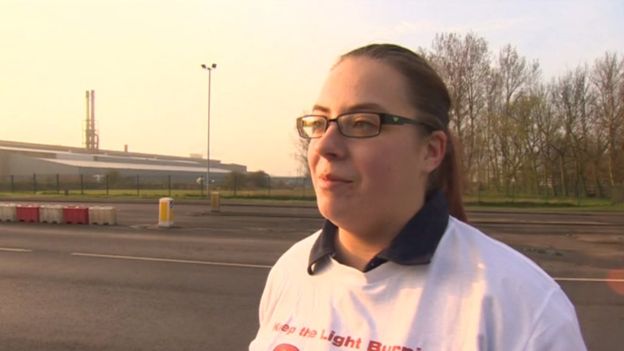
Charlotte Upton
Charlotte Upton says the deal will allow her and her colleagues to stay close to their families

Ahead of the vote, steelworker Charlotte Upton said the proposed deal meant “job security for me so I can stay where my family is, near my home”.

“It means I can continue to be a steelworker, I love my job.”

The proposed temporary changes to terms and conditions include a one year, 3% reduction in pay, and a one year, 3% reduction (from 6%) in both employer’s and employee’s pension contributions.

The Tata signs will be also removed and replaced with ones saying British Steel.

The Scunthorpe steelworks is part of Tata Steel’s long products division, which was put up for sale in 2014.

Source: Tata steel workers vote for pay cut to save jobs in Scunthorpe – BBC News

CUPE marks the Day of Mourning, calls for asbestos ban | Canadian Union of Public Employees

Every year, on April 28, workers around the world mark the Day of Mourning for workers killed or injured on the job.

It’s an important day for us to remember those we’ve lost and renew our resolve to make our workplaces safer.

Approximately 1,000 workers die each year in Canada from exposure to work-related hazards.

This year we honour these CUPE members who lost their lives at work since the last Day of Mourning:

William Miller, 56, CUPE 4705, City of Greater Sudbury, Ontario

Paul Barao, 60, CUPE 2544, Peel District School Board, Ontario

Thierry Leroux, 26, CUPE 5153, Council of the Anishinabe Nation of Lac-Simon, Quebec

Claude Davidson, 48, CUPE 3333, Réseau de Transport de Longueuil, Quebec

Mike McNeil, 61, CUPE 1259, Glades Lodge Nursing Home, Nova Scotia (on leave)

Jody Taylor, 43, CUPE 1004, City of Vancouver, BC

Day of Mourning ceremonies are being held across the country. Find an event in your region.

CUPE National President Mark Hancock and National Secretary-Treasurer Charles Fleury will attend a ceremony in Victoria, BC.

“On April 28 we mourn these six CUPE members, and all the other workers who’ve been injured or killed. It’s a terrible loss that we refuse to accept as being part of the job. All workers should be able to come home healthy and safe at the end of a shift,” said Hancock.

The Strategic Directions document passed at CUPE National Convention made 2016 CUPE’s Year of Health and Safety.

“Ensuring the health and safety of workers is at the heart of the work of our union—it’s part of our core values,” Hancock continued.

“When convention delegates made 2016 the year of health and safety, they gave us a great opportunity to put renewed focus on this important issue.”

To mark the Day of Mourning this year, CUPE is renewing its call for a full ban on the use, import and export of asbestos in Canada. While the former Conservative government stood in the way of progress on the issue, Hancock says the Liberals have a chance to do things differently.

“The Harper government showed a repeated disregard for the health and safety of Canadians. This Liberal government now has an opportunity to show that they do care—that the lives of countless workers across Canada matter to them,” said CUPE National President Mark Hancock.

“It’s time to catch up with the rest of the world. On April 28, we’re calling on the Trudeau government to ban the import, export and use of asbestos in Canada.”

Hancock reiterated this demand in a letter to the prime minister. And on April 19,CUPE members participated in lobbying organized by the CLC, where a full asbestos ban was among the items up for discussion.

There are lots of other things happening as part of the Year of Health and Safety. Most CUPE divisions are holding a health and safety conference in 2016. CUPE will be providing educational materials and staff assistance to each division putting together a conference.

CUPE has also launched the new Health and Safety Learning Series. Modelled after the successful Steward Learning Series, the new Health and Safety Learning Series will include a nine-hour introductory course and a selection of three-hour modules.

Of course, important work is happening every day in our locals. That’s why each month we’re profiling aCUPE member about their health and safety activism at work. And for locals that want to recognize their own local activists, CUPE is offering a special certificate, for free, on our website. Order one and celebrate an activist in your local today.

Source: CUPE marks the Day of Mourning, calls for asbestos ban | Canadian Union of Public Employees