Scientists Identify Brain Circuit that Controls Binge Drinking 

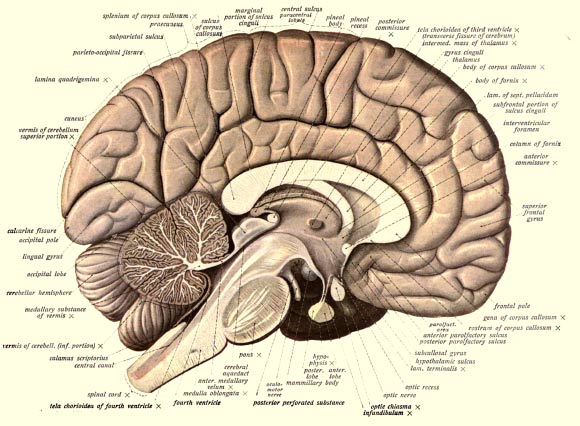
An anatomical illustration from Sobotta’s Human Anatomy, 1908, shows the structure of a human brain. Image credit: Dr Johannes Sobotta.

A team of scientists led by Dr. Todd Thiele from the University of North Carolina at Chapel Hill has identified a circuit between two brain regions that controls binge ethanol intake.

The two brain areas – the extended amygdala and the ventral tegmental area – have been implicated in alcohol binge drinking in the past.

However, this is the first time that the two areas have been identified as a functional circuit, connected by long projection neurons that produce a substance called corticotropin releasing factor (CRF).

The results, published online March 3, 2016 in the journal Biological Psychiatry, provide the first direct evidence in mice that inhibiting a circuit between two brain regions protects against binge alcohol drinking.

“The puzzle is starting to come together, and is telling us more than we ever knew about before,” Dr. Thiele said.

“We now know that two brain regions that modulate stress and reward are part of a functional circuit that controls binge drinking and adds to the idea that manipulating the CRF system is an avenue for treating it.”

In their study, Dr. Thiele and co-authors show that alcohol activates the CRF neurons in the extended amygdala, which directly act on the ventral tegmental area.

These observations in mice suggest that when someone drinks alcohol, CRF neurons become active in the extended amygdala and act on the ventral tegmental area to promote continued and excessive drinking, culminating in a binge.

“The findings may shed light on future pharmacological treatments that may help individuals curb binge drinking and may also help prevent individuals from transitioning to alcohol dependence,” Dr. Thiele said.

“It’s very important that we continue to try to identify alternative targets for treating alcohol use disorders.”

_____

Jennifer A. Rinker et al. Extended Amygdala to Ventral Tegmental Area Corticotropin-Releasing Factor Circuit Controls Binge Ethanol Intake.Biological Psychiatry, published online March 3, 2016; doi: 10.1016/j.biopsych.2016.02.029

Source: Scientists Identify Brain Circuit that Controls Binge Drinking | Neuroscience | Sci-News.com

Canucks 2016 NHL Draft Thoughts As Promised Change Continues

2016_NHL_Entry_Draft_logo


Just-saying  By Andrew Phillip Chernoff  April 28, 2016


Canucks ownership promised “Change Is Coming” at the end of the 2014 season.

And it did:

  • the addition of Trevor Linden, who played 16 seasons as a Canuck and earned the nickname “Captain Canuck”,  as President of Hockey Operations for the Vancouver Canucks by team owner Francesco Aquilini on Wednesday, April 9, 2014;
  • the hiring of Jim Benning on Wednesday, May 21, 2014, a former teammate of Linden, to be the Canucks 11th general manager;
  • the announcement of Willie Desjardins as the 18th coach of the franchise on Monday, June 23, 2014, who led the AHL’s Texas Stars to a Calder Cup championship on Tuesday, June 17, 2014;
  • the signing of goalie Ryan Miller on July 1, 2014 to a 3-year contract.

demonstrated aggressive leadership by Canucks ownership and new management to put the club right and demonstrate to the media, fans and the league, that the Canucks were prepared to be competitive, relevant and put the pieces in place to once again be one of the elite teams in the NHL.

The trading of Ryan Kesler, before the start of the 2014 NHL Draft, ensured that Kesler would not be an issue with the Canucks moving forward and the moving of Jason Garrison which freed up cap space, continued the theme of “Change Is Coming”.

This past season was a struggle, disappointing, frustrating, and it is in the past now.

The 2016 NHL Draft  continues the theme of “Change Is Coming”, as the Vancouver Canucks continue to add pieces on their climb back to become one of the top teams in the NHL.

The Draft Lottery is on April 30th and Vancouver will find out where they will be slotted for their first pick of the draft.

The Vancouver Canucks can select as high as first and as low as sixth in the 2016 NHL Entry Draft June 24-25 in Buffalo.

My choices for the Canucks first pick of the 2016 NHL draft, in order of preference, are:

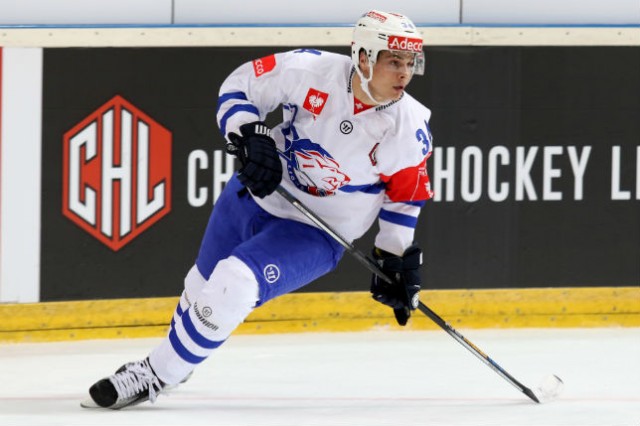
1)-Auston Matthews – Center
Auston-Matthews-ZSC-640x426

Auston Matthews is an American professional ice hockey player. Matthews is currently playing for the ZSC Lions of the Swiss National League A. Previously, Matthews played for the U.S. National U18 Team in the USHL. Wikipedia

A high octane dynamo that thrives under the microscope, Auston Matthews is a complete offensive forward who consistently boasts quick hands, feet, and thinking at both ends of the ice. Naturally nimble skater that accelerates to top speed very quickly. An unwavering focus on fine tuning elements of his own game facilitates confidence and competence in his young, but mature, mind. Prolific goal scoring ability and doesn’t wait for opportunities to show themselves. He makes his own luck, so to speak, maximizing the use of his body and stick to gain leverage against the toughest of opponents. All-in-all, a generational talent that has the potential to develop into a top flight franchise center.

Uncle: Wes Matthews(NFL Player – external link)

Source: http://www.eliteprospects.com/

2)-Matthew Tkachuk – Left Wing

Matthew Tkachuk of the London Knights. Photo by Aaron Bell/OHL Images

Matthew Tkachuk of the London Knights. Photo by Aaron Bell/OHL Images

Matthew Tkachuk is an American ice hockey player. He is currently playing with the London Knights of the Ontario Hockey League. Tkachuk is a top rated prospect who is projected to be a possible Top 5 pick at the 2016 NHL Entry Draft. Wikipedia

A multi-dimensional energy winger that plays a pro-style, adaptive game. Well-versed as a guy who can consistently put up points, but also as an agitator who plays with a little bit of bite and nastiness. Skates with excellent balance and speed, outclassing many in his age range. No lack of offensive instincts and knows how to score in many different ways. Confidence in his abilities and playing to the extent of his capabilities strengthens his work ethic and creativity. All-in-all, a unique and effective forward who defines his own limits and seeks to exceed them, along with all on-ice expectations.

Brother: Brady Tkachuk
Father: Keith Tkachuk
Cousins: Casey Fitzgerald, Ryan Fitzgerald, Scott Fitzgerald, Tom Fitzgerald, Jimmy Hayes, Kevin Hayes

Source: http://www.eliteprospects.com/

3)-Jesse Puljujärvi – Right Wing
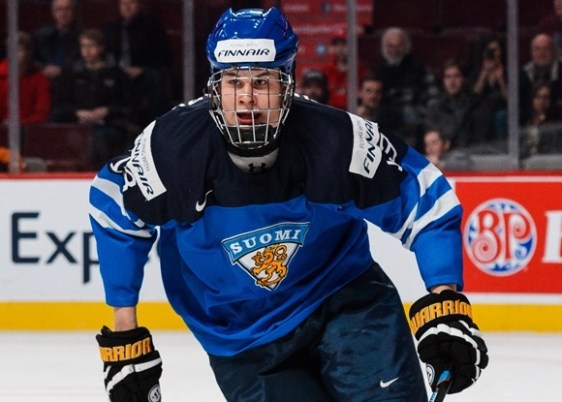
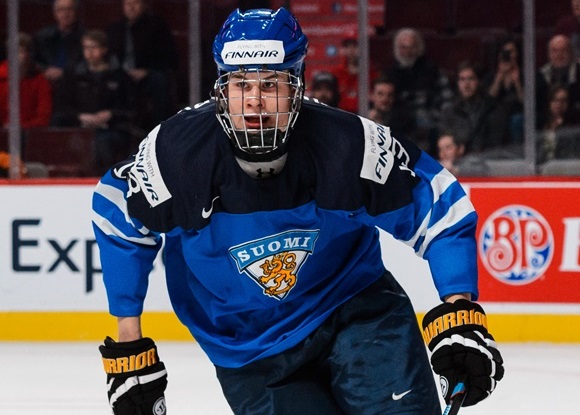
MONTREAL, QC - DECEMBER 27: Jesse Puljujarvi #13 of Team Finland skates during the 2015 IIHF World Junior Hockey Championship game against Team Slovakia at the Bell Centre on December 27, 2014 in Montreal, Quebec, Canada. Team Slovakia defeated Team Finland 2-1. (Photo by Minas Panagiotakis/Getty Images)

MONTREAL, QC – DECEMBER 27: Jesse Puljujarvi #13 of Team Finland skates during the 2015 IIHF World Junior Hockey Championship game against Team Slovakia at the Bell Centre on December 27, 2014 in Montreal, Quebec, Canada. Team Slovakia defeated Team Finland 2-1. (Photo by Minas Panagiotakis/Getty Images)

Jesse Puljujärvi is a Finnish ice hockey player, currently playing with Kärpät in the Finnish Liiga. Puljujärvi is rated as a top prospect who is expected to be a top 5 pick in the 2016 NHL Entry Draft. Wikipedia

Puljujärvi is a big winger who combines size, skating and skill. A strong skater who can blast past the opposition in full speed. Able to use his size, reach and stickhandling skills to retain the puck in speed. A smart player at both ends of the ice, both on and off the puck. Great work ethic and positive attitude. More of a playmaker than a scorer and could improve his shooting skills. Doesn’t shy away from physical play, but could use his size more to his benefit.

A truly dominant two-way force that consistently demonstrates elite hockey sense, proactive defensive awareness, and a full array of offensive tools. Comparable to Jamie Benn of the Dallas Stars, Puljujärvi owns a dangerously accurate shot, as well as exceptional playmaking ability that pairs up quite nicely with his superb vision and enthusiasm. Has the ability to absolutely dominate by using his size and speed to keep possession of the puck until he determines it to be the right time for the rubber to hit the back of the net. Everything that he does, he does well, to the fullest of his ability; there are no empty holes in this electrifying and hard-nosed forward’s game.

Source: http://www.eliteprospects.com/

4)- Jakob Chychrun – Defenseman

092815Chychrun5-672

Jakob Chychrun is an American-born Canadian ice hockey defenceman. He is currently an alternate captain for the Sarnia Sting of the Ontario Hockey League. Wikipedia

An unyielding two-way defenceman, Jakob Chychrun is a rising star with a toolbox bursting at the seams. Consistently displays elite four-way skating ability and is not afraid to throw his weight around physically. Plays with poise and composure through high pressure situations and, with the puck on his stick, can direct the play up-ice. Exhibits a particularly potent shot that works its magic on the power play and on the forecheck. Excellent first pass and uses his vision and awareness to keep the puck moving in the direction of the opposition’s tail or to a teammate with more time and space. Defensively adept at tracking the puck and staying a step ahead of the opposition. Proactive with his stick and body, exerting pressure on the opposition and forcing them to make hurried decisions.

All-in-all, a well-rounded two-way defender that competes with pro-level drive and makes his authoritative presence felt at both ends of the ice.

Father: Jeff Chychrun
Uncle: Luke Richardson
Cousin: Morgan Richardson

Source: http://www.eliteprospects.com/

5)-Pierre-Luc Dubois – Left Wing

0f8f40bd-3c2e-4760-8b55-3856be63946e_JDX-NO-RATIO_WEB

Pierre-Luc Dubois is a Canadian ice hockey player. He is currently playing with the Cape Breton Screaming Eagles of the QMJHL. Wikipedia

A dexterous and driven competitor that has all the makings of a dynamic two-way winger. Not the most electric skater, but is shifty and plays to the extent of his physical capabilities; he knows his limits and plays within them, which facilitates a student-like approach to the growth of his game. Possesses high hockey-IQ and is consistent in his efforts. Not the most physical player, but is when he needs to be. All-in-all, Dubois is an invaluable all-around player who plays in all situations and exceeds expectations when the opportunity arises. (Curtis Joe, EP 2016)

A top-end talent that impacts all aspects of the game from different angles. May well be the most complete player in the 2016 NHL Entry Draft. His multidimensional play and elite offensive prowess reminds scouts a little bit of James Neal. Competitiveness marks his game and he consistently proves to be a high impact player when he is on the ice. [EP]

Father: Éric Dubois

Source: http://www.eliteprospects.com/

6)-Patrik Laine – Right Wing
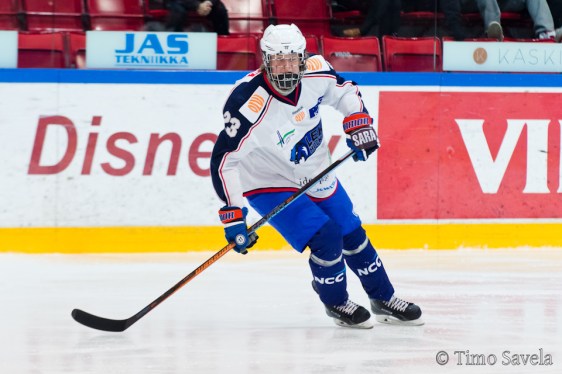
2014_10_15_patrik_laine_leki-1x

Patrik Laine is a Finnish ice hockey player. He currently plays with Tappara in the Finnish Liiga. Laine is rated as a top prospect in the 2016 NHL Entry Draft, and is expected by hockey analysts to be a top-two overall selection. Wikipedia

A natural scorer, Laine’s greatest asset is his intimidating shot. He’s not a speedy skater, but possesses power and a long stride, and protects the puck well with his large frame and longer stick. Overall, skating has been a minor issue through Laine’s development but has improved with some help from his ability to read the game. Laine has the hunger to create chances on his own from the wing and actively looks for and creates opportunities to use his shot. His elite wrist shot is notable for its quick release and his powerful one-timer from the top of the circle is a constant threat on the man-advantage.

Source: http://www.eliteprospects.com/

As for their other picks, the Canucks should take a good look at these available players, in no particular order:

Defensemen:

Forwards:

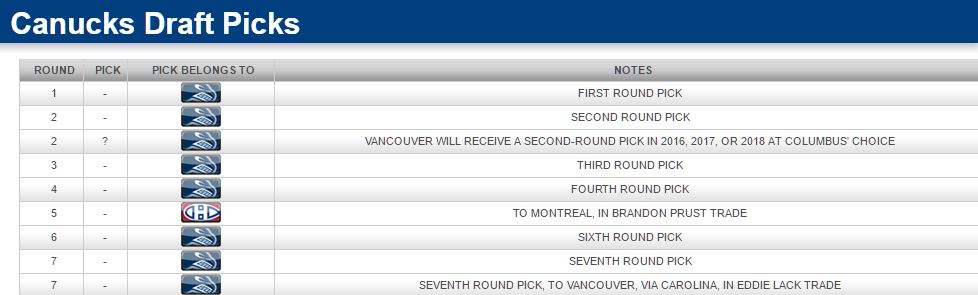
As of now, the Canucks have seven draft picks, and could have eight:

Capture

The Canucks need size, great skaters and skillful players, both up front and on the back end.

The 2014 draft choices the Canucks made were: left wing Jake Virtanen sixth overall, centre Jared McCann 24th overall, goaltender Thatcher Demko 36th overall, defenceman Nikita Tryamkin 66th overall, defenceman Gustav Forsling 126th overall, centre Kyle Pettit 156th overall and defenceman MacKenzie Stewart 186th overall.

Right wing Linden Vey from the Los Angeles Kings was also acquired in exchange for Vancouver’s 50th selection in the 2014 NHL Entry Draft.

Virtanen, McCann and Tryamkin were on the Canucks roster this past season; Linden Vey has been in and out of the Canucks line-up since he was acquired. Thatcher Demko signed with Vancouver a couple of weeks ago after an incredible 2015-16 college season.

The Vancouver Canucks selected a total of seven players in the 2015 NHL Entry Draft: right wing Brock Boeser 23rd overall, defenceman Guillaume Brisebois 66th, centre Dmitry Zhukenov 114th, defenceman Carl Neill 144th, centre Adam Gaudette 149th, right wing Lukas Jasek 174th, and defenceman Tate Olson 210th. The 66th overall selection was acquired by trade from Carolina, plus a 7th round pick in 2016 for Eddie Lack and the 210th pick was acquired from San Jose in exchange for Patrick McNally.

It is possible that one or more of the 2015 Canuck draft picks could see time on the Canucks playing roster next season depending on training camp and injuries.

With the current Canucks roster in a state of flux regarding cap space, free agency and change of direction regarding personnel, the 2016 NHL Draft Lottery on Saturday will be the start of an interesting summer for the Vancouver organization.

The Canucks said change was coming, it definitely has, and continues. It remains to be seen how that change will continue to shape the team and its fortunes for the coming season and beyond.


Canucks sign Thatcher Demko

Vancouver, B.C. – Vancouver Canucks General Manager Jim Benning announced today that the club has signed goaltender Thatcher Demko to a three-year entry-level contract.

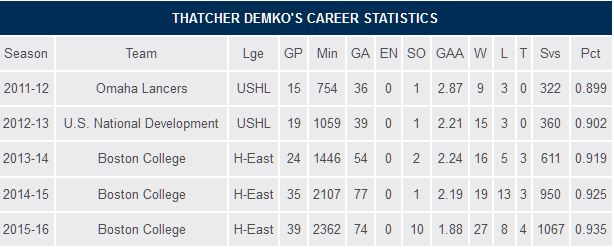
Demko, 20, completed his third season with Boston College, leading the Eagles to the Hockey East regular season championship and a berth in the NCAA Frozen Four. Demko posted a 27-8-4 record along with a .935 save percentage and a 1.88 goals-against average in 39 games with the Eagles this season. His 10 shutouts on the year set a new Boston College school record and ranks as the second most in college hockey history for a single season.

The 6-4, 195-pound goaltender was awarded the 2016 Mike Richter Award as the most outstanding goaltender in NCAA men’s hockey. He was also a finalist for the 2016 Hobey Baker Award.

In three seasons at Boston College, Demko has posted a 62-26-10 record, along with a 2.08 goals-against average and a .928 save percentage. A native of San Diego, California, Demko was originally selected by Vancouver in the second round, 36th overall, at the 2014 NHL Entry Draft.

Capture

Source: Canucks sign Thatcher Demko – Vancouver Canucks – News

Canadian Government Economic and Fiscal Outlook – April 2016

Get the report
Economic and Fiscal Outlook – April 2016

Get the data

EFO April 2016 – Figures.xlsx  

Summary

This report responds to the 4 February 2016 Standing Committee on Finance motion. It incorporates data available up to and including 12 April 2016.

Since the Parliamentary Budget Officer’s November 2015 report, the outlook for the global economy has deteriorated further. Expectations of the future path of prices for key commodities have also been revised lower.

Despite this weaker external outlook, PBO anticipates that the combination of fiscal measures in Budget 2016 and accommodative monetary policy will help bolster the Canadian economy.

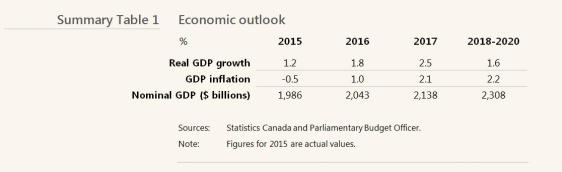
PBO projects that growth in real gross domestic product (GDP) will rebound to 1.8 per cent in 2016 and then rise to 2.5 per cent in 2017. Economic growth is then expected to moderate over 2018 to 2020, reflecting the tapering of fiscal measures and the normalization of monetary policy.

The level of nominal GDP—the broadest single measure of the tax base—is projected to be almost $20 billion lower each year, on average, between 2016 and 2020 compared to our November report.

However, relative to the Government’s planning assumption for nominal GDP in Budget 2016 our projection is, on average, $40 billion higher per year over 2016 to 2020. The difference is most pronounced in 2016 and 2017, reaching close to $50 billion in those years.

PBO’s November 2015 fiscal outlook provided an independent status quo planning assumption for the start of the 42nd Parliament. We have updated our fiscal outlook to include measures announced in Budget 2016 as well as measures announced prior to the budget.

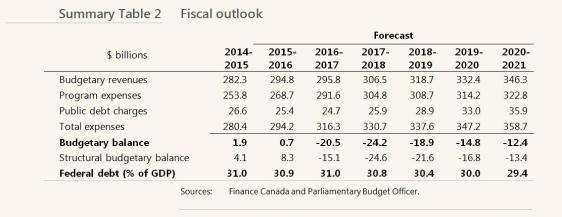
PBO estimates there was a small surplus in 2015-16. We expect a budgetary deficit of $20.5 billion in 2016-17, which is mostly attributable to $13.2 billion of new measures since the Fall Update. The deficit is then projected to rise to $24.2 billion in 2017-18 as the result of moving to the 7-year breakeven mechanism for Employment Insurance premium rates (a 15 per cent reduction in contributions) and a $7.5 billion increase in direct program expenses.

We project the deficit to decline to $12.4 billion over 2018-19 to 2020-21 based on the Government’s forecast that direct program expenses (DPE)—in particular the operating costs of departments—will remain flat over the period 2017-18 to 2019-20.

PBO’s forecast of the budgetary deficit is $4.5 billion lower, on average, than Budget 2016 over the projection horizon. The average difference is roughly in line with the Budget 2016 forecast adjustment, which removed $40 billion from GDP (equivalent to $6 billion in revenues) in each year of the Government’s planning horizon.

Source: Economic and Fiscal Outlook – April 2016

Canadian Government Expenditure Monitor 2015-2016 Q3

Get the report
Expenditure Monitor 2015-2016 Q3.pdf

Get the data

Expenditure Monitor 2015-2016 Q3 – Figures_Data.xlsx

Summary
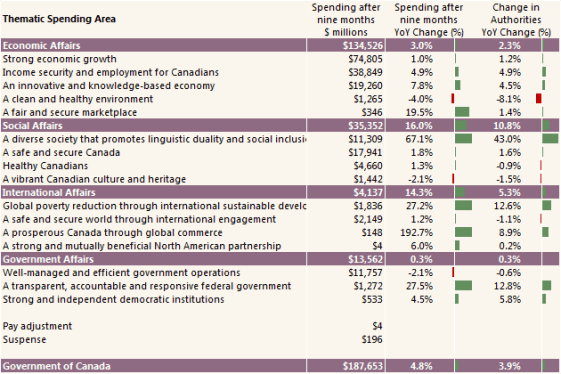
Government expenditures for the first nine months of 2015-16 were $187.7 billion, an increase of 4.8 per cent over the same period last year ($179.1 billion). This increase results from increased transfer payments for the unemployed and higher capital spending.

Employment Insurance (EI) benefits increased almost $1 billion (7.4 per cent) over the same period in 2014-15. According to Statistics Canada, the number of EI beneficiaries increased by 35,900 (7.1 per cent) between January 2015 and January 2016, largely attributable to increases in Alberta, and other energy dependent regions.  Concomitant with this, the national unemployment rate has risen to a three year high of 7.3 per cent in February.

Growth in capital spending is consistent with the $393 million in federal infrastructure investment promised in Budget 2015 for 2015-16. Budget 2016 also committed to spending a further $3.4 billion on federal assets over the next five years.

Overall, the spending pattern in this fiscal year is similar to the previous two fiscal years. PBO estimates that the Government will lapse $8.8 billion, including frozen allotments. This is higher than the most recent Department of Finance projection of $6.5 billion.

Source: Expenditure Monitor 2015-2016 Q3