Fraser Institute thinks sending your kid to university counts as “child care”

MAY 05, 2016 by

Apparently when the Fraser Institute hears “child care,” they seem to think about sending young adults off to university.

When most Canadians hear “child care,” they probably picture toddlers in daycare.

But when the Fraser Institute hears “child care,” they seem to think about sending young adults off to college or university.

In their latest report examining “child care in Canada,” the right-wing think tank sets out to calculate just how much money Canada spends on child care every year.

But a closer look at how they came up with their numbers shows a few interesting surprises!

fraser-childcare-header.jpg

What surprises?

Well, although the cover of the report features a photo of a tiny infant struggling with a set of building blocks, the report itself says it counts saving for university as a “child care” cost.

In calculating child care costs in Canada, the Fraser Institute includes the $800 million Canada Education Savings Grant program that the report itself describes as something designed to help parents “save for their child’s post-secondary education.”

Which only begs the question: is it reasonable to include the cost of saving for college or university as a “child care” program?

fraser-university-childcare.jpg

The Fraser Institute has a few other “child care” costs that may stretch the definition of “child care”:

The former Conservative government’s Children’s Fitness Tax Credit, eliminated in the Liberal government’s 2016 budget, which deducted up to $150 for kids under 16 involved in organized sports. Canada Revenue Agency said that includes “strenuous games like hockey or soccer, activities such as golf lessons, horseback riding, sailing and bowling.”

 The Canada Child Tax Benefit, a means-tested grant aimed at lower-income families to “help them with the cost of raising children under 18 years of age” – although it’s a direct-payment that is not explicitly tied to child care costs.

The former Conservative government’s Universal Child Care Benefit, also eliminated in the 2016 budget, which was a direct-payment of between $100 to $160 per month for everyone under the age of 18 – it too was not explicitly tied to child care costs.

The Fraser Institute includes all of these in their estimate of what Canada spends on child care.

If any of this seems a bit off from what most Canadians think when they hear “child care,” the Fraser Institute has an explanation:

“It is important to explain the distinction between child care and daycare as those terms are used in public policy discussions in Canada. Child care is the broader term and encompasses a range of services and benefits that flow to children. It includes daycare programs, but also covers cash benefits flowing to families to assist them with raising their children.”

But it’s not clear whose “distinction” that is, though.

A 2014 Statistics Canada report on child care limited their scope to “nannies, home daycares, daycare centres, preschool programs and before and after school services.”

Quebec’s government defines child care programs as “childcare centres, private day care centres and home childcare services.”

Meanwhile, Canada Revenue Agency defines a “child care expense” as any amount you pay “to have someone look after an eligible child” under the age of 16 because you have to work or go to school.

Saving for university or subsidizing a teenager’s sporting activities are also notably absent from “discussions” about “child care” hereherehereherehere and here.

What’s else? One of the citations hiding at the end of the report pegs child care costs in Canada about $20 billion lower than the Fraser Institute’s own estimate.

$20 billion is roughly the amount the Fraser Institute’s report pegs as the combined cost of the CESG, CCTB and UCCB.

That might not be a big surprise.

The right-wing Institute’s annual reports on how much average Canadians pay in taxes have also been criticized for including things that average Canadians don’t actually see on their tax bills, like corporate taxes and oil and gas royalties.

As the former editor of The Walrus John MacFarlane once noted:

“Critics of the Fraser Institute report have also pointed to a bias in its definition of taxes, in terms of what it included in its calculation of the average tax bill. Are royalties on oil and gas revenues taxes? Are import duties taxes? Are taxes on goods and services, property, vehicles, fuel, alcohol, and tobacco — so-called consumption taxes — as burdensome as those applied to income? Is it reasonable to include corporate taxes in the total that Canadian families pay?”

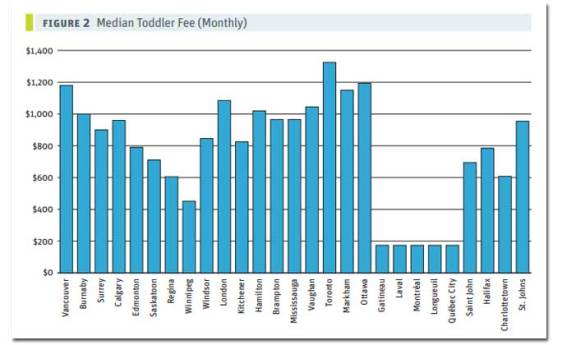
But despite what the Fraser Institute thinks, in reality, child care costs for Canadian families who actually have young children to worry about are still out of control:
childcarecosts-2015-02.jpg

Photo: robtowneo. Used under Creative Commons license. Shutterstock.

Source: Fraser Institute thinks sending your kid to university counts as “child care”

Federal Spending on Postsecondary Education

5 May 2016

Get the report
Federal Spending on Postsecondary Education.pdf

Get the data
Postsecondary Education –  Data.xls
Interactive Chart

Summary

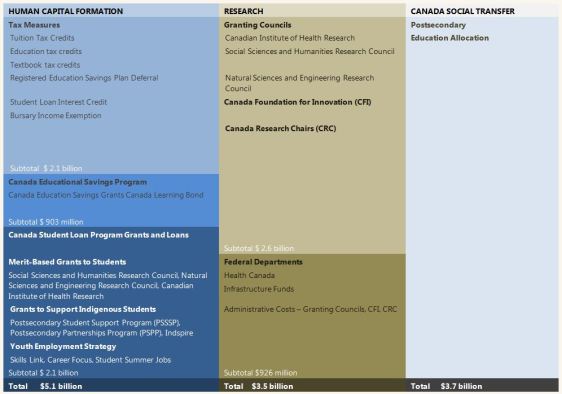
Table 1:  Federal Postsecondary Education Expenditure by Major Stream, 2013-14

This report analyzes federal spending on postsecondary education in Canada over the past 10 years; and, where possible, analyzes the distributional impacts of federal programs.  It also provides forward projections to 2020-21 taking into account recent Budget 2016 announcements.

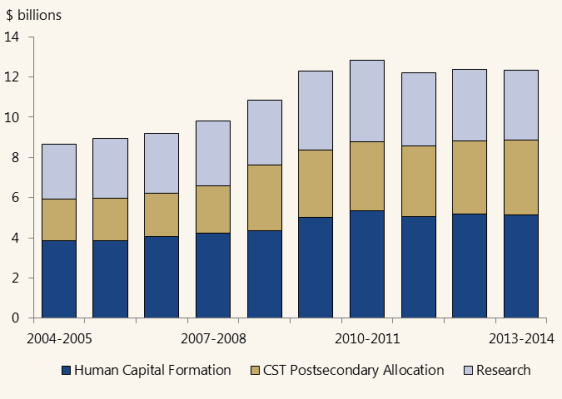
In 2013-14, total federal spending on postsecondary education reached an estimated $12.3 billion. This represents a decline from its peak of $12.8 billion in 2010-11. Over the past ten years, the greatest growth occurred in spending that supports human capital formation and the Canada Social Transfer (CST).

PBO estimates that roughly 60 per cent of postsecondary students belonged to higher-income families (that is, the two highest after-tax or disposable income quintiles).

Increases in federal funding targeted towards human capital formation have primarily benefited these families. This was due to a growing share of federal support provided through the tax system and the Canada Education Savings Program, Registered Educational Savings Plans.

Figure 1: Federal Expenditures on Postsecondary Education, by Area of Focus

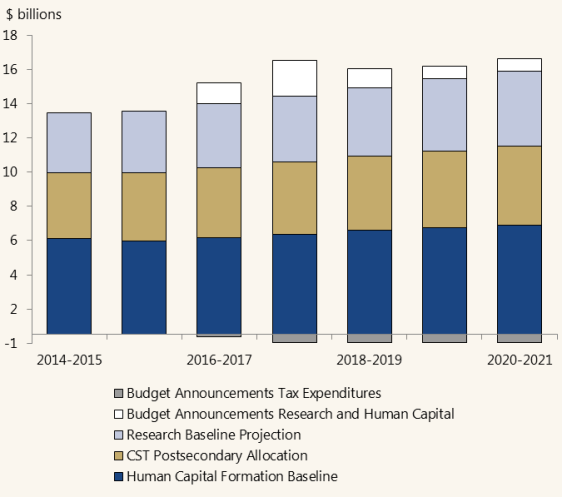
Taking into account recent Budget 2016 announcements, PBO estimates total federal spending on postsecondary education will exceed $15.7 billion by 2020-21. The re-allocation of education and textbook tax expenditure savings towards increases in student grants, loan repayment and student employment assistance (announced in Budget 2016) will likely make postsecondary education more affordable for some Canadians. These measures will not, however, significantly change the distribution of total federal spending on postsecondary education.

Figure 2: Expenditure Projections – Total Federal Expenditures on Postsecondary Education

Source: Federal Spending on Postsecondary Education

The Prime Minister announces changes in the senior ranks of the Public Service

OTTAWA, May 5, 2016 /CNW/ – The Prime Minister, Justin Trudeau, today announced the following changes in the senior ranks of the Public Service:

Daniel Jean, currently Deputy Minister of Foreign Affairs, becomes National Security Advisor to the Prime Minister, effective May 16, 2016.

Ian Shugart, currently Deputy Minister of Employment and Social Development, becomes Deputy Minister of Foreign Affairs, effective May 16, 2016.

Louise Levonian, currently Senior Associate Deputy Minister of Employment and Social Development and Chief Operating Officer for Service Canada, becomes Deputy Minister of Employment and Social Development, effective May 16, 2016.

Janine Sherman, currently Assistant Secretary to the Cabinet (Senior Personnel) Privy Council Office, becomes Deputy Secretary to the Cabinet (Senior Personnel and Public Service Renewal), Privy Council Office, effective immediately.

Biographical notes attached.


DANIEL JEAN

EDUCATION

Master of Business Administration, State University of New York
Bachelor of Social Sciences, International Relations and Economics, University of Ottawa
Executive Program, Queen’s University

PROFESSIONAL EXPERIENCE

Since November 2013
Deputy Minister of Foreign Affairs

2010 – 2013
Deputy Minister of Canadian Heritage

2010
Deputy Minister, Administrative Services Review, Privy Council Office

2008 – 2010
Deputy Secretary to the Cabinet (Operations), Privy Council Office

2007 – 2008
Associate Secretary of the Treasury Board

2007
Assistant Secretary, International Affairs, Security and Justice Sector, Treasury Board Secretariat

2003 – 2007
Assistant Deputy Minister, Policy and Program Development, and then Assistant Deputy Minister, Operations, Citizenship and Immigration Canada

2000 – 2003
Director General, International Region, Citizenship and Immigration Canada

1995 – 2000
Counsellor (Immigration), Canadian Embassy in Washington, Citizenship and Immigration Canada

1992 – 1995
Director, Immigration Control, Citizenship and Immigration Canada

1988 – 1992
First Secretary (Immigration), Canadian Commission in Hong Kong, and then Counsellor and Consul, Canadian Embassy in Port-au-Prince (Haiti), Foreign Affairs and International Trade Canada

1983 – 1988
Second Secretary (Immigration), Canadian Embassy in Port-au-Prince (Haiti), and then Vice-Consul (Immigration), Canadian Consulate General in Buffalo (United States), Foreign Affairs and International Trade Canada


IAN SHUGART

EDUCATION

Bachelor of Political Economy, Trinity College, University of Toronto

PROFESSIONAL EXPERIENCE

Since July 2010
Deputy Minister of Employment and Social Development

2008 – 2010
Deputy Minister of the Environment, Environment Canada

2006 – 2008
Associate Deputy Minister of the Environment, Environment Canada

1999 – 2006
Assistant Deputy Minister, Health Policy Branch, Health Canada

1997 – 1999
Visiting Assistant Deputy Minister, Health Protection Branch, Health Canada

1993 – 1997
Executive Director, Medical Research Council

1991 – 1993
Assistant Secretary, Social Policy and Programs Branch, Federal-Provincial Relations Office

1989 – 1991
Chief of Staff to the Minister, Energy, Mines and Resources

1984 – 1989
Senior Policy Advisor to the Minister of National Health and Welfare

1982 – 1984
Policy Director, Office of the Leader of the Opposition

1980 – 1982
Constitutional Policy Advisor, Office of the Leader of the Opposition

1979
Administrative Secretary to the Premier’s Advisory Committee on Confederation, Intergovernmental Affairs, Government of Ontario


LOUISE LEVONIAN

EDUCATION

Master of Arts (Economics), Queen’s University
Bachelor of Arts (Economics), Carleton University

PROFESSIONAL EXPERIENCE

Since June 2014
Senior Associate Deputy Minister of Employment and Social Development and Chief Operating Officer for Service Canada

2010 – 2014
Associate Deputy Minister of Finance

2008 – 2010
Assistant Deputy Minister, Tax Policy Branch, Finance Canada

2007 – 2008
General Director, Tax Policy Branch, Finance Canada

2007
Special Advisor, Tax Policy Branch, Finance Canada

2006 – 2007
Director of Operations, Priorities and Planning, Privy Council Office

2003 – 2006
Director, Business Income Tax Division, Finance Canada

2002 – 2003
Departmental Secretary, Deputy Minister’s Office, Finance Canada

1998 – 2002
Senior Chief, Strategic, Structural and Quantitative Analysis, Personal Income Tax Division, Finance Canada

2001
Tax Consultant, Barents Group, KPMG

1995 – 1998
Senior Economist, Federal-Provincial Relations Division, Finance Canada

1993 – 1995
Economic Analyst, Expenditure Analysis Division, Treasury Board Secretariat

1990 – 1993
Senior Economic Analyst, Economic Evaluation Branch, Transport Canada


JANINE SHERMAN

EDUCATION

Master of Arts, Economics, University of Manitoba
Bachelor of Arts, Economics and Commerce, University of Manitoba

PROFESSIONAL EXPERIENCE

Since October 2014
Assistant Secretary to the Cabinet, Senior Personnel, Privy Council Office

2010 – 2014
Director of Operations, Machinery of Government Secretariat, Privy Council Office

2008 – 2010
Director General, Policy, Planning and Communications, Canada School of Public Service

2007 – 2008
Executive Director, Strategic Policy, Planning and Governance, Canada School of Public Service

2000 – 2007
Director, Strategy and Policy, Canadian Center for Management Development/ Canada School of Public Service

1998 – 2000
Senior Analyst, Social Development Policy, Operations Branch, Privy Council Office

1993 – 1997
Chief, Structural and Quantitative Analysis, Personal Income Tax Division, Tax Policy Branch, Department of Finance

1986 – 1993
Various positions, Tax Policy and Economic Development Policy Branches, Department of Finance


This document is also available at http://pm.gc.ca

SOURCE Prime Minister’s Office

Source: The Prime Minister announces changes in the senior ranks of the Public Service

Legion Selects Winners of Poster and Literary Contests

1st place senior colour poster winner: Olivia Zeng, Coquitlam, BC (CNW Group/The Royal Canadian Legion Dominion Command)

OTTAWA, May 5, 2016 /CNW Telbec/ – The winners of the Legion’s Poster and Literary Contests for 2016 were announced today at Dominion Command.

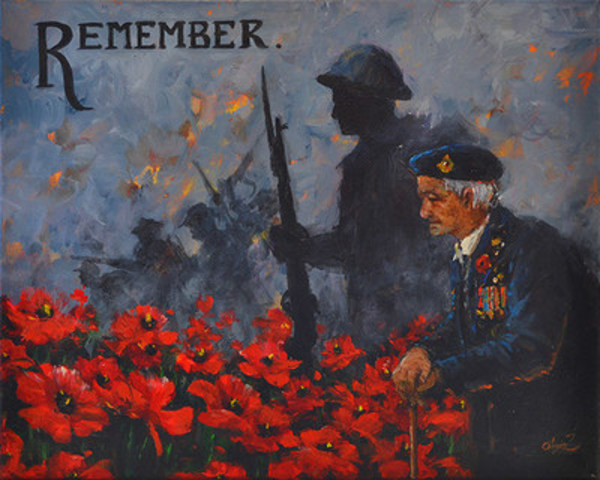
1st place winners of the Legion’s 2016 poster contests (CNW Group/The Royal Canadian Legion Dominion Command)

“The idea of perpetuating Remembrance to Canada’s younger generations through Poster and Literary contests began in 1960 and has continued since then,” says Royal Canadian Legion Dominion President, Tom Eagles.  “It is another tangible example of the Legion’s activities in the community,” adds Eagles.

More than 100,000 youths from all areas of the country, in both official languages, participate in these contests.

The national winners for 2016 are:

Poster:

Senior Colour Poster

Olivia Zeng, Coquitlam, BC

Senior B&W Poster 

Casey O’Neill, Belleisle Creek, NB

Intermediate Colour Poster

 Juliana Jiang, Richmond Hill, ON

Intermediate B&W Poster

Lauren Cheslock, Stittsville, ON

Junior Colour Poster

Johnny Rivas-Gonzalez, Hamilton, ON

Junior B&W Poster

Alastair Capstick, Bloomfield, NB

Primary Colour Poster

Kayla Jackson, Dartmouth, NS

Primary B&W Poster

Kadie Lynn Hofer, Camrose, AB

Literary:

Senior Poetry

Ethan Edstrom, Edmonton, AB

Senior Essay

Shane Pendergast, Mount Stewart, PE

Intermediate Poetry

Quirina Thompson, Medicine Hat, AB

Intermediate Essay

Kate Shackleton, Scarborough, ON

Junior Poetry

Evan Dicks, Deer Lake, NL

Junior Essay

Wesley Finner, Kemptville, ON

About the Poster and Literary Contests

The contests are divided into four categories:

  • Primary (Poster Contest only) – grades 1,2 and 3;
  • Junior – grades 4, 5 and 6;
  • Intermediate – grades 7, 8 and 9; and
  • Senior – grades 10, 11, 12.

The contests are organized by Legion branches with schools in their area and the winning entries progress through various levels at the Legion with the final entries being forwarded to Legion national headquarters in Ottawa where they are judged and the national winners declared.

The Poster Contests participants are asked to submit their work in either black & white or colour format with the theme of Remembrance and what it represents to them.  Similar to the Literary Contests, submissions are marked based on originality, expression and presentation.

Regarding the Literary Contests, participants are asked to submit an essay/composition or a poem with a Remembrance theme.  Submissions are accepted in either French or English and are marked on the basis of originality of thought, expression, presentation, grammar and spelling.

Prizes will be awarded to the national winners in each category and to the winners’ schools. Each of the first place winners in the senior category will also be brought to Ottawa to attend the National Remembrance Day Ceremony held in Ottawa on November 11th, 2016 where they will place a wreath on behalf of the Youth of Canada. They will also have an opportunity to visit and meet with the Governor General and others in the Vice-Regal Party during this visit.

The Senior winning entries in both the Poster and Literary Contests will also be displayed at the Canadian War Museum between July 1st, 2016 and May 1st, 2017.  The second place winners and any participant receiving an Honourable Mention will be displayed in the foyer of the House of Commons during the annual Remembrance Day period in November 2016.

SOURCE The Royal Canadian Legion Dominion Command

Source: Legion Selects Winners of Poster and Literary Contests

Floods and coastal erosion may expose contents of UK landfills, study finds

The contents of historic coastal landfill sites could pose a significant environmental threat if they erode, according to a new study from Queen Mary University of London (QMUL).

There are 1264 historic coastal landfill sites in England and Wales, all of which are sealed and no longer receive waste, but fall wholly or partially within the Environment Agency’s Tidal Flood Zone 3.

In the first academic study of its kind, researchers from QMUL investigated the contents of two sites in Essex: Leigh Marshes Landfill, used from 1955 to 1967; and Hadleigh Marsh Landfill, used from 1980 to 1987, to determine the potential consequences should the sites be tidally flooded or erode.

The analysis found that 100 per cent of the Leigh Marsh waste samples and 63 per cent of the Hadleigh Marsh samples contained contaminants at concentrations that exceed marine sediment quality guidelines ‘probable effects levels’, indicating that adverse effects to flora and fauna could be expected if the waste was to erode into surrounding coastal wetlands.

The findings are from a forthcoming report for the Environment Agency, authored by Dr Kate Spencer, Reader in Environmental Geochemistry at QMUL, and James Brand, PhD student at QMUL’s School of Geography.

“It’s important to state clearly that we’re not saying these sites are currently eroding. What our findings show is that in the event of erosion, there would be serious environmental consequences due to the level of contaminants that would pollute the surrounding protected ecological sites.”

The main risks to these landfills come from the effects of climate change, including erosion and flooding with salt water from storm surges and higher water levels.

According to Dr Spencer, many of these sites may be vulnerable to erosion and coastal flooding in the future.

“If you take a look inside these sites, they reflect consumption and waste patterns of the time. So one historic landfill site might contain a huge amount of plastics, and another might be full of coal ash. Many of them were in use when there were no rules about what went in. This is important because it means that we can’t draw national conclusions from individual sites — every landfill is essentially unique and some will prove more risky than others.”

Mr Brand said that it was “important to understand the sheer scale of some of these sites”. The Hadleigh Marsh site contains 500,000m3 of waste — if this waste were to erode and be released to the adjacent marsh, there is sufficient material to cover 138 Wembley size football pitches to a depth of half a metre.

The study says that while a policy of relocating the waste away from vulnerable sites would be preferable, it is likely that the waste will continue to be protected in situ due to the enormous costs and risks associated with relocating the waste.

The next stage of the research will create a vulnerability index for historic coastal landfill sites, to determine where resources and attention might best be focused.

source: Queen Mary University of London

Source: Floods and coastal erosion may expose contents of UK landfills, study finds | Science Codex