Fiscal and Economic Impacts of Curtailing the Planned Tax Cut for Small Businesses

Get the report
Fiscal and Economic Impacts of Curtailing the Planned Tax Cut for Small Businesses.PDF

Summary
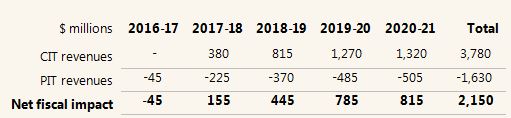
PBO estimates that the Budget 2016 decision to defer reductions in the small business tax rate will reduce federal revenues by $45 million in 2016-17, and increase revenues by $155 million in 2017-18 rising to $815 million in 2020 21 (Summary Table 1).  The initial reduction in revenues reflects timing differences in the tax reference years related to the filing deadlines for personal and corporate income tax returns.

Summary Table 1 – Fiscal impact of changes to the small business tax rate

PBO estimates that by 2020-21, Budget 2016 changes to the small business tax rate will reduce real GDP by $300 million (0.015 per cent) and the level of employment by about 1,240 jobs created or maintained (Summary Table 2).

Summary Table 2 – Economic impact of changes to the small business tax rate

Source: Fiscal and Economic Impacts of Curtailing the Planned Tax Cut for Small Businesses

Study: Smartphone alerts increase inattention — and hyperactivity

CHARLOTTESVILLE, Va., May 9, 2016 — Society’s increasingly pervasive use of digital technology may be causing ADHD-like symptoms even among the general population, according to a new study of college students presented this week in San Jose, California at the Human-Computer Interaction conference of the Association for Computing Machinery.

“Less than 10 years ago, Steve Jobs promised that smartphones ‘will change everything,'” said Kostadin Kushlev, a psychology research scientist at the University of Virginia, who led the study with colleagues at the University of British Columbia. “And with the Internet in their pockets, people today are bombarded with notifications – whether from email, text messaging, social media or news apps – anywhere they go. We are seeking to better understand how this constant inflow of notifications influences our minds.”

Kushlev said that recent polls have shown that as many as 95 percent of smartphone users have used their phones during social gatherings; that seven in 10 people used their phones while working; and one in 10 admitted to checking their phones during sex. Smartphone owners spend nearly two hours per day using their phones.

The researchers designed a two-week experimental study and showed that when students kept their phones on ring or vibrate, they reported more symptoms of inattention and hyperactivity than when they kept their phones on silent.

“We found the first experimental evidence that smartphone interruptions can cause greater inattention and hyperactivity – symptoms of attention deficit hyperactivity disorder – even in people drawn from a nonclinical population,” Kushlev said.

During Kushlev’s and his colleagues’ study, 221 students at the University of British Columbia drawn from the general student population were assigned for one week to maximize phone interruptions by keeping notification alerts on, and their phones within easy reach. During another week participants were assigned to minimize phone interruptions by keeping alerts off and their phones away. At the end of each week, participants completed questionnaires assessing inattention and hyperactivity. The results showed that the participants experienced significantly higher levels of inattention and hyperactivity when alerts were turned on.

The results suggest that even people who have not been diagnosed with ADHD may experience some of the disorder’s symptoms, including distraction, difficulty focusing and getting bored easily when trying to focus, fidgeting, having trouble sitting still, difficulty doing quiet tasks and activities, and restlessness.

“Smartphones may contribute to these symptoms by serving as a quick and easy source of distraction,” Kushlev said.

Kushlev emphasized, however, that ADHD is a neurodevelopmental disorder with a complex biological and environmental etiology.

“Our findings suggest neither that smartphones can cause ADHD nor that reducing smartphone notifications can treat ADHD,” he said. “The findings simply suggest that our constant digital stimulation may be contributing to an increasingly problematic deficit of attention in modern society.”

The silver lining is that the problem can be turned off.

“Importantly, we found that people can reduce the harmful effects of overstimulation by smartphones simply by keeping their phones on silent and out of easy reach whenever possible, thus keeping notifications at bay,” Kushlev said.

His research colleagues at the University of British Columbia are Jason Proulx, a senior research assistant, and Elizabeth W. Dunn, an associate professor of psychology.

Source: University of Virginia

Source: Study: Smartphone alerts increase inattention — and hyperactivity | Science Codex

Screening for postpartum depression — research review and update

May 9, 2016 – Mothers of new babies should undergo screening for postpartum depression–preferably across healthcare locations and at multiple times up to one year after delivery, according to a research review in the Harvard Review of Psychiatry. The journal is published by Wolters Kluwer.

“Postpartum depression remains vastly under-diagnosed and under-treated, despite widespread consensus regarding its prevalence and potentially devastating consequences,” write Dr. Erin Smith of Western Psychiatric Institute and Clinic of University of Pittsburgh Medical Center and colleagues. They analyze current research evidence on PPD screening from the psychiatrist’s perspective.

Screening for PPD–What Psychiatrists Need to Know

Approximately 14.5 percent of women will experience a new episode of depression during pregnancy or in the initial months after delivery, studies report. Yet many cases of PPD go undiagnosed, and nearly half of diagnosed cases go untreated. After delivery, PPD can impede bonding with the newborn, adversely affecting the child’s behavioral and emotional development.

Major obstetrics and pediatrics specialty groups recommend screening for PPD. But while there’s an extensive body of research on PPD screening, it’s mainly targeted to the primary care practitioners who provide routine care for mothers and infants. Dr. Smith and collages review the evidence on screening tools, timing, and location–directed toward psychiatrics and other mental health professionals involved in treating PPD.

Postpartum depression is defined as symptoms of major depression developing within the first month after delivery, but the risk can persist for much longer. A key issue is distinguishing PPD from “maternity blues”–short episodes of mood swings, tearfulness, and mild depression that occur in up to 80 percent of new mothers, often within the first week after delivery.

This can make it difficult to decide how often and when to screening for PPD. Screening immediately after delivery may be less accurate, but may also improve access to psychiatric care. Screening just once after delivery may miss cases of PPD that develop later–up to one year after delivery. Women who don’t experience PPD after their first pregnancy still need screening after subsequent pregnancies.

Several highly accurate questionnaires for PPD screening are available. The most commonly used tools, such as the Edinburgh Postnatal Depression Scale, can be used in a wide range of settings and take just a few minutes to perform. Other tools can provide accurate screening for PPD in just two questions.

Screening may be performed at clinics, doctor’s offices, or other settings that that provide care to pregnant women and their families. The pediatrician’s office has been suggested as the “most logical and readily available setting”–although it may be challenging to carry out screening at routine well-baby visits. Dr. Smith and colleagues emphasize the need for close attention to new mothers with a past history of depression, in whom PPD risk increases to 25 percent.

Once PPD is suspected or recognized, referral for mental health evaluation and management is essential. Treatment may include psychotherapy, which the authors believe is a “reasonable option” for mild depression; and/or medication, which they recommend for women with moderate to severe symptoms.

“Postpartum depression screening is recognized to be important for detection, feasible to carry out across locations, and useful in facilitating early diagnosis and treatment for women,” Dr. Smith and colleagues conclude. They urge psychiatrists to be familiar with the screening approaches used in their area, and to be alert for possible depression in pregnant women and those with recent delivery.

“When used alone, screening does not increase the likelihood that women will receive treatment and follow-up,” the researchers add. They highlight the need for further studies aimed at improving follow-up and treatment retention after diagnosis of PPD.

Source: Wolters Kluwer Health

Source: Screening for postpartum depression — research review and update | Science Codex

Canada Becomes a Full Supporter of the United Nations Declaration on the Rights of Indigenous

NEW YORK, NY, May 10, 2016 /CNW/ – The Honourable Carolyn Bennett, Minister of Indigenous and Northern Affairs, today announced that Canada is now a full supporter, without qualification, of the United Nations Declaration on the Rights of Indigenous Peoples. Today’s announcement also reaffirms Canada’s commitment to adopt and implement the Declaration in accordance with the Canadian Constitution.

This announcement confirms Canada’s commitment to a renewed, nation-to-nation relationship with Indigenous peoples – a relationship based on recognition of rights, respect, co-operation and partnership. Canada will engage with Indigenous groups on how to implement the principles of the Declaration. This engagement will include provinces and territories whose cooperation and support is essential to this work and to advancing the vital work of reconciliation with Indigenous peoples in Canada.

Quote

“Today’s announcement that Canada is now a full supporter of the Declaration, without qualification, is an important step in the vital work of reconciliation. Adopting and implementing the Declaration means that we will be breathing life into Section 35 of Canada’s Constitution, which provides a full box of rights for Indigenous peoples.”

The Honourable Carolyn Bennett, M.D., P.C., M.P.
Minister of Indigenous and Northern Affairs


Related

United Nations Declaration on the Rights of Indigenous Peoples
UNPFII Fifteenth Session 9-20 May 2016

Source: Canada Becomes a Full Supporter of the United Nations Declaration on the Rights of Indigenous