Government of Canada highlights improved support for Veterans and their families

Budget 2016 reaffirms commitment to Veterans

REGINA, May 24, 2016 /CNW/ – The Honourable Kent Hehr, Minister of Veterans Affairs and Associate Minister of National Defence, spoke with Veterans and community leaders in Regina today to highlight the Government of  Canada’s support for Canada’s ill and injured Veterans and how Budget 2016 will enhance that support.

To help Veterans and their families as they transition from military to civilian life, Veterans Affairs Canada will build on an existing suite of programs and supports with enhancements to financial benefits, restored access to critical services and more front-line staff.

An increase to the Disability Award to a maximum of $360,000 will mean more money in the pockets of Veterans who suffer from illnesses such as post-traumatic stress disorder (PTSD) as a result of service.

Increasing the Earnings Loss Benefit to 90% of a Veteran’s pre-release salary will ensure former members undergoing rehabilitation have the financial support they need.

Expanding access to the Permanent Impairment Allowance by introducing an individualized assessment will ensure Veterans are more appropriately compensated for the impact of a service-related impairment on their career.

Finally, Veterans Affairs Canada will re-open nine offices across the country and hire additional case managers so that each serves no more than 25 individuals. Additionally, a new office will open in Surrey, B.C., and outreach to Veterans in the North will be expanded by working with local partners.

Budget 2016 delivers $5.6B in additional benefits and takes historic steps to treat Veterans with care, compassion and respect.

Quick Facts

  • The Government of Canada will make it easier for Veterans’ families to access the Funeral and Burial Program for a dignified burial. The Department plans to increase the estate exemption from $12,015 to $35,279 and also apply an annual cost of living adjustment to this amount.
  • Plans are also underway to expand the scope of the Commemorative Partnership Program to allow funding for the building of new community war memorials and to streamline the application process.
  • The new Have Your Say consultation tool, available on the Veterans Affairs Canada website, invites Veterans, stakeholders and Canadians to their provide feedback on Veterans’ issues and priorities.
  • The Minister of Veterans Affairs remains committed to all items in his mandate letter, including pensions for life.

Quote


“The Government of Canada is taking historic steps to ensure Canadian Veterans and their families are treated with care, compassion and respect. Budget 2016 reaffirmed our intent to give back to Veterans and deliver on our promises to restore critical access to services and improve the long-term financial security and independence of disabled Veterans and their families.”

The Honourable Kent Hehr, Minister of Veterans Affairs and Associate Minister of National Defense

Associated Links


SOURCE Veterans Affairs Canada

For further information: Media Relations, Veterans Affairs Canada, 613-992-7468 1

RELATED LINKS
www.veterans.gc.ca

Source: Government of Canada highlights improved support for Veterans and their families

Canadian Government Supplementary Estimates (A) 2016-17

18 May 2016

Get the report
Supplementary Estimates (A) 2016-17.pdf

Get the data
SEA_2016-17_Figures.xlxs

Summary

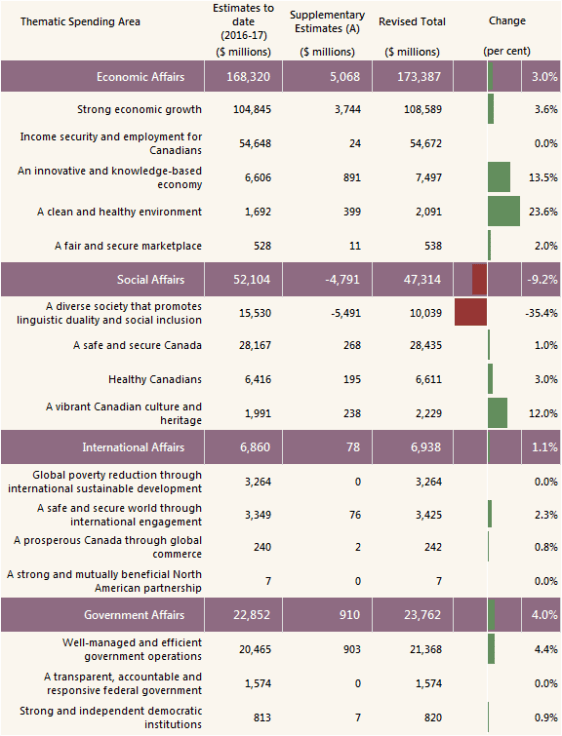
The first Supplementary Estimates for the 2016-17 fiscal year outline $1.3 billion in additional net budgetary spending. The Estimates request $7.0 billion from Parliament in “voted” authorities (the largest such amount in a decade), and partially offset that with a decrease of $5.7 billion in “statutory” authorities related to the cessation of the Universal Child Care Benefit (UCCB).

These Supplementary Estimates are historically large because, for the first time since the 2007 renewal of the EMS, the Government has incorporated a significant number of new measures from the recent Budget.  As was originally intended almost one decade ago, presenting a “Budget implementation” supplementary estimates will ensure parliamentarians are more easily able to scrutinize major legislative aspects of Budget 2016 in concert (this includes Bills C-2 and C-15, currently before the Senate and House of Commons, respectively).

These Estimates have also returned to the practice of providing a reconciliation tables between the Estimates and the Budget, granting Parliament with additional ability to provide scrutiny to the Government’s finances.

The PBO is encouraged by the Government’s continued progress on addressing the recommendations for Estimates renewal presented in the Seventh Report of the House of Commons Standing Committee on Government Operations and Estimates.

The majority of the new funds requested in these Supplementary Estimates relate to infrastructure pledges outlined in Budget 2016. Of the $7.0 billion requested in voted authorities, $3.9 billion is devoted to infrastructure spending. Largest amongst these is $1.4 billion for the Office of Infrastructure of Canada to set up funds for public transit and wastewater infrastructure, and $1.1 billion for Canada Mortgage and Housing Corporation to address indigenous and low-income housing needs. Both are classified under Economic Affairs in the Whole of Government framework.

Social Affairs will receive the largest decrease in spending, (9.2 per cent, $4.8 billion), mostly as result of the cessation of the UCCB and its replacement with the new Child Care Benefit (CCB) as outlined in Budget 2016. As the CCB is administered through the tax system, this spending is not reflected in the Estimates.

Related posts

  • 17 March 2016

    This note presents detailed analysis of the federal government’s Expenditure Plan and Main Estimates for 2016-17, which supports the first two appropriation bills that will seek Parliaments approval for almost $90 billion.

Source: Supplementary Estimates (A) 2016-17-PBO

Prime Minister of Canada concludes his visit to Tokyo | Prime Minister of Canada

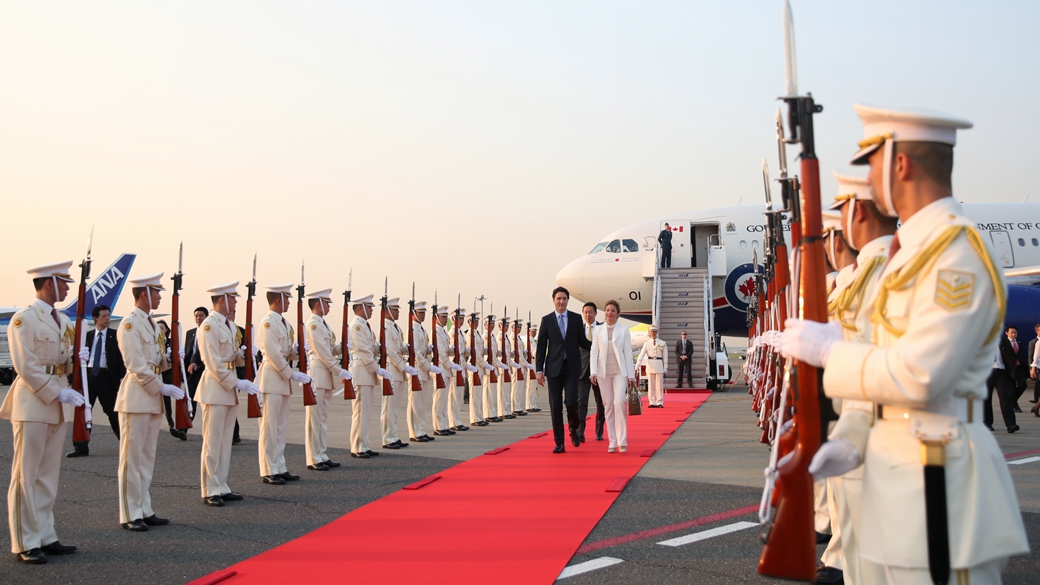
The Prime Minister Justin Trudeau and Mrs. Grégoire-Trudeau arrive in Tokyo, Japan.

Tokyo, Japan

24 May 2016

The Government of Canada has committed to deepen and renew its social and economic engagement with Asia, in order to better pursue Canada’s interests and values.

Today, the Prime Minister, Justin Trudeau, concluded his official working visit in Japan, which included an audience with the Emperor and Empress of Japan, and a meeting with Prime Minister Shinzo Abe.

While in Tokyo, the Prime Minister met with representatives of the automotive sector to underline that Canada is a great place to invest. He also took the opportunity to discuss trade opportunities, promote Canadian quality, and highlight Canada’s research and development capacity and innovation expertise. The automotive sector represents tremendous opportunities to create jobs, strengthen the middle class, and grow both countries’ economies.

During the meeting with Prime Minister Abe, the two leaders discussed a wide range of issues important to Canada and Japan, including the implementation of the Paris Agreement on climate change, global health initiatives, infrastructure for sustainable growth, and collaboration on Arctic science. Finally, they discussed the revitalization of the Canada-Japan Joint Economic Committee, an important forum to improve economic ties between Canada and Japan.

Quote

“Improving trade relations with Japan is a top priority of our government. The growing collaboration between Canada and Japan – on innovation and science – will contribute directly to our economic growth, and will benefit all Canadians.”

– Rt. Hon. Justin Trudeau, Prime Minister of Canada

Quick Facts

  • Prime Minister Trudeau last met with Prime Minister Abe on March 31, 2016 in Washington D.C.
  • Japan is among Canada’s top five bilateral merchandise trading partners.
  • This year marks the 40th anniversary of the Canada-Japan Joint Economic Committee (JEC), which began in 1976 based on the Japan-Canada Framework for Economic Cooperation.
  • The JEC focuses on priority areas of cooperation, including infrastructure, energy, science and technology, the business environment, promoting investment and tourism. A cooperative working group led by Global Affairs Canada and Japan’s Ministry of Foreign Affairs will monitor progress within these priority areas of cooperation to ensure that the framework is as effective as possible.
  • Canada and Japan are partners in numerous international groups and organizations including the G7, G20, APEC, the ASEAN Regional Forum, and the OECD.

Source: Prime Minister of Canada concludes his visit to Tokyo | Prime Minister of Canada

Online therapy effective at treating depression and anxiety

HOLLYWOOD, Fla., May 12, 2016 – Doctors from the University of Pittsburgh showed that providing an online computerized cognitive behavioral therapy (CCBT) program both alone and in combination with Internet Support Groups (ISG) is a more effective treatment for anxiety and depression than doctors’ usual primary care. The preliminary findings were highlighted today at the annual meeting of the Society of General Internal Medicine (SGIM) in Hollywood, Florida.

The National Institutes of Mental Health-funded randomized trial, led by Bruce L. Rollman, M.D., M.P.H., professor of medicine and director of the Center for Behavioral Health and Smart Technology at the University of Pittsburgh, enrolled 704 depressed and anxious patients from 26 UPMC-affiliated primary care offices across western Pennsylvania.

Patients 18 to 75 years old were referred into the trial by their UPMC primary care physician between August 2012 and September 2014. Eligible and consenting patients were then randomized to one of three groups: care manager-guided access to the eight-session Beating the Blues CCBT program; care manager-guided access to both the CCBT program and a password-protected ISG patients could access 24/7 via smartphone or desktop computer; or usual behavioral health care from their primary care physician.

Over the six-month intervention, 83 percent of patients randomized to CCBT started the program, and they completed an average of 5.3 sessions. Seventy-seven percent of patients assigned to the ISG logged into the site at least once, and 46 percent provided one or more posts or comments.

Six months later, those patients randomized to CCBT reported significant improvements in their mood and anxiety symptoms and the more CCBT sessions patients completed, the greater the improvement in mood and anxiety symptoms.

Although patients randomized to both CCBT and ISG had similar overall improvements in mood and anxiety symptoms compared to patients randomized to only CCBT, secondary analysis revealed those who engaged more with the ISG tended to experience greater improvements in symptoms.

Several CCBT programs have proven as effective as face-to-face cognitive behavioral therapy at treating mood and anxiety disorders and are used by many patients outside the U.S., but CCBT remains largely unknown and underutilized within the U.S., Dr. Rollman said. ISG that enable individuals with similar conditions to access and exchange self-help information and emotional support have proliferated in recent years, but benefits have yet to be established in randomized trials.

“Our study findings have important implications for transforming the way mental health care is delivered,” Dr. Rollman said. “Providing depressed and anxious patients with access to these emerging technologies may be an ideal method to deliver effective mental health treatment, especially to those who live in areas with limited access to care resources or who have transportation difficulties or work/home obligations that make in-person counseling difficult to obtain. We hope that these findings will focus further attention on the emerging field of e-mental health by other U.S. investigators.”

Source: University of Pittsburgh Schools of the Health Sciences

Source: Online therapy effective at treating depression and anxiety | Science Codex