Lack of business investment could derail Canada’s economic growth

OTTAWA, May 30, 2016 /CNW/ – Business investment outside of the energy sector remains sluggish, despite many manufacturing industries being at or close to full capacity, according to a new briefing released by The Conference Board of Canada.

“For the past year, we at the Conference Board have stressed the need for a rebound in business investment to support Canada’seconomic growth,” said Matthew Stewart, Associate Director, Economic Forecasting and co-author of the briefing. “If non-energy investment does not rebound over the coming months, capacity constraints in some manufacturing industries could impact future growth.”

HIGHLIGHTS

  • In order for exports to continue to drive economic growth, a pickup in non-energy investment aimed at expanding productive capacity is needed.
  • Our current economic outlook assumes a modest increase in non-energy investment spending in the second quarter with a stronger pick up in the second half.
  • Current business investment intentions are much more pessimistic than what is included in our current economic outlook.
  • Most leading manufacturing industries have reached or nearly reached their capacity to continue to grow.
  • Manufacturing industries in particular are expected to reduce capital expenditures this year by an average of 10.9 per cent.
  • Without a pickup in investment, capacity constraints have the potential to upset recent economic momentum.

The transportation equipment, wood products, food, primary metal and paper industries have been the key drivers of manufacturing growth in Canada, accounting for 64 per cent of year-over-year increases in output. These manufacturing industries, which have been leading Canada’s rebound in exports, are at or fast approaching full capacity. In the fourth quarter of last year, the wood products manufacturing industry was operating at 99.3 per cent capacity. Paper manufacturing was not far behind, operating at 98.2 per cent and transportation equipment operated at 97.3 per cent of its capacity. Meanwhile, transportation equipment manufacturing recorded its highest capacity utilization rate in history in the third quarter of 2015.

Despite many manufacturing industries operating near capacity, businesses remain reluctant to invest. In fact, manufacturers across a range of industries expect to cut investment this year by an average of nearly 11 per cent. Moreover, the transportation equipment, wood products, food, primary metal and paper manufacturers are expected to post worse-than-average investment declines.

In the Conference Board’s Index of Business Confidence survey, business leaders cited weak market demand, government policies, a shortage of qualified staff, and the depreciation of the Canadian dollar (which increases the cost of imported technology and machinery) as reasons for not investing. While market demand should improve as the U.S. economy continues to strengthen, the remaining factors—government policies, a shortage of qualified staff, and the depreciation of the Canadian dollar—will likely continue to hold back investment.

While we still expect non-energy investment spending to pick up in the second half of the year as accelerating demand from the U.S. improves the incentive for firms to expand their capacity, the continued lack of investment has the potential to severely limit Canada’s future growth.

The executive briefing is available on The Conference Board of Canada’s e-library.

SOURCE Conference Board of Canada

Source: Lack of business investment could derail Canada’s economic growth

TOP PROSPECTS DESCEND ON BUFFALO FOR NHL COMBINE

Top prospects Auston Matthews, Patrik Laine, Jesse Puljujarvi, Pierre-Luc Dubois, Matthew Tkachuk and Alexander Nylander are among the 114 draft-eligible players expected to attend the 2016 NHL Combine, which runs through this Saturday at First Niagara Center and HarborCenter in Buffalo.

The event will be held at First Niagara Center and the HarborCenter in Buffalo from May 30 to June 4.

cut

Auston Matthews

The week includes one-on-one interviews with NHL teams, medical examinations and fitness testing.

Among the top North American skaters invited to the Combine are left wing Pierre-Luc Dubois (6-2, 201) of Cape Breton in the Quebec Major Junior Hockey League, left wing Matthew Tkachuk (6-1, 200) of London in the Ontario Hockey League, left wing Alexander Nylander (6-0, 180) of Mississauga in the OHL, and defenseman Jakob Chychrun (6-2, 205) of Sarnia in the OHL.

Nine goaltenders were invited to the Combine, among them Evan Fitzpatrick of Sherbrooke of the QMJHL and Filip Gustavsson of Lulea’s team in Sweden’s junior league. Fitzpatrick (6-3, 206) is No. 1 on NHL Central Scouting’s final ranking of North American goaltenders and Gustavsson (6-1, 184) is No. 1 on the final ranking of international goaltenders.

Click here for a list of expected attendees.

Statement by the Prime Minister of Canada on the International Day of United Nations Peacekeepers 

Ottawa, Ontario
29 May 2016

The Prime Minister, Justin Trudeau, today issued the following statement on the International Day of United Nations Peacekeepers:

“Today, we salute United Nations peacekeepers, past and present, who have dedicated their lives to the pursuit of peace, safety, and freedom for others. They have greatly sacrificed to provide hope and security for the most vulnerable persons around the globe.

“Peacekeeping has a deep connection to Canadian values and leadership. The first UN peacekeeping mission came about in large part due to the efforts of Lester B. Pearson, our fourteenth Prime Minister, and the leadership of UN Forces Commander E.L.M. “Tommy” Burns. Together, their actions during the Suez Crisis of 1956 marked the beginning of Canada’s identity as a peacekeeping country.

“Since then, UN peace operations have evolved from separating belligerents and monitoring cease fires to protecting vulnerable populations and working to establish the conditions for durable peace. As conflicts have grown in intensity and complexity, so too have the risks for UN peacekeepers who put their lives on the line for the safety of others.

“On behalf of all Canadians, I commend UN peacekeepers for their selfless work and tremendous contributions to the advancement of global peace and human rights. We will continue working with the UN to promote peace and the resolution of serious conflicts around the world.”

Source: Statement by the Prime Minister of Canada on the International Day of United Nations Peacekeepers | Prime Minister of Canada

Canucks Offseason Update, 2016 NHL Draft, The Next Chapter

Just-saying           By Andrew Chernoff   May 28, 2016

The Vancouver Canucks have been busy trying to “rebuild”, or “retool” the team as they prepare for the upcoming 2016 NHL Draft and later the 2016-17 season.

CANUCKS OFFSEASON WHEELING AND DEALING

Canucks General Manager Jim Benning has been adding youth to the already formidable youth movement established by the Canucks since he has been the Canucks general manager.

On May 25, Benning demonstrated he was not shy about pulling a trade, if he felt it could help the club, when Vancouver acquired 24 year old defenceman Erik Gudbranson and Florida’s 2016 fifth round pick (NYI) in exchange for Jared McCann and the Canucks 2016 second and fourth round picks.

Benning has received criticism about the trade and questions about an apparent philosophical change to acquire Gudbranson, in trading away McCann and the Canucks 2016 second and fourth round picks.

Gudbranson is a 6-foot-5, 220-pound defenceman who will play in the team’s top four next season, according to Benning, and felt the deal was too good to pass up at this stage of the offseason.

It was a steep price to pay, but this past season Gudbranson came into his own for Florida, as he ranked third on the Panthers in hits (150), fourth in blocked shots (73) and fourth in average ice time per game (20:06). The 2010 3rd overall NHL draft pick ranked second on the Panthers and led Florida defencemen in average ice time in the 2016 playoffs (26:54) in addition to ranking second on the team in blocked shots (8).

Earlier in March, the Canucks signed 2009 draft pick, 25 year old right wing Anton Rodin to a one-year, one-way contract on March 22; and on March 9, signed their fourth pick (third round, 66th overall) in the 2014 NHL Draft, defenceman Nikita Tryamkin, to a 2-year entry-level contract.

Tryamkin was able to play in 13 games for the Canucks this past season after signing, registering a goal and an assist (1-1-2). He registered a career-high five hits, Apr. 1 at ANA…Notched a career-high three shots and 21:01 TOI, Mar. 27 vs CHI…Recorded four hits and a career-high four blocked shots, Mar. 19 vs STL…Appeared in his first NHL game and recorded his first NHL point, Mar. 16 vs COL. He collected his first career NHL goal, Apr. 7 at CGY.

2016 NHL DRAFT

Vancouver will enter the 2016 NHL Entry Draft, currently owning the 5th, 33rd, 63rd, 93rd, 153rd, 183rd and 193rd overall picks, potentially giving the Canucks a great opportunity to add to an already impressive collection of young talent, that Vancouver is hoping will payoff in an optimistic future for the team.

Since the Canucks reorganization in 2014, the Canucks drafts have yielded the following:

2014

Round 1, 6th overall pick: Jake Virtanen

Round 1, 24th overall (from Anaheim): Jared McCann

Round 2: Thatcher Demko

Round 3: Nikita Tryamkin

Round 5: Gustav Forsling

Round 6: Kyle Pettit

Round 7: Mackenze Stewart

2015

Round 1 (23rd overall): Brock Boeser

Round 3: Guillaume Brisebois

Round 4: Dimitry Zhukenov

Round 5: Carl Neill

Round 5 (from Rangers): Adam Gaudette

Round 6: Lukas Jasek

Round 7: Tate Olson

THE NEXT CHAPTER

According to Trevor Linden, President, Hockey Operations, the Canucks are developing their next core—the next generation of the team.

“We’re getting younger and faster. There’s nothing like seeing a young core group come together, right from the start. It’s an exciting time to be a Canucks fan.”

General Manager Jim Benning, echos the same thoughts, as the Canucks strive to build a winning team, assuring Canuck fans alike, it’s happening.

“We are accelerating the development of our young players by surrounding them with the best NHL leadership, character and talent. There are no shortcuts. No one says this will be easy. What it will be, is what you’ve come to expect from Canucks hockey at its best: Exciting. Energetic. Emotional. You’ll see the future of the team emerging in front of you, every night.”

And Coach Willie Desjardins is just as psyched about the Canucks future, and his expectations are crystal clear and unambiguous.

“Every time we hit the ice I want our guys to play hard, with energy and speed. It’s about competing every shift with passion, whether you’re a veteran or a rookie. That’s what we’re trying to teach here: a relentless belief that a Vancouver Canuck is going to do things the right way, for his teammates, every single day. That’s what makes great teammates, and that’s what makes great teams.”

Marketing is one thing, and well and good. The Canucks need to make it happen.

Make it happen, and the sell outs will return for all home games.

Make it happen. Winning makes believers, is infectious, builds, is good for the bottom line, provides stability.

Just saying.

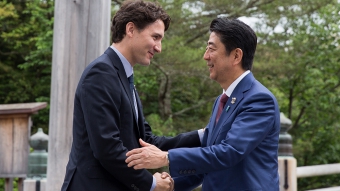
Prime Minister attends the G7 Summit in Ise-Shima

Ise-Shima, Japan
27 May 2016

The Government of Canada remains committed to creating jobs, strengthening the middle class, and helping those working hard to join it. When the majority of middle class Canadians feel confident about their future – and their families’ future – the whole country benefits.

Today, the Prime Minister, Justin Trudeau, concluded the G7 Leaders’ Summit in Ise-Shima, Japan. Following the Summit, the G7 leaders issued a joint-declaration where they committed to tackle major global challenges such as the need to promote sustainable economic growth that benefits all citizens, not just the wealthiest one per cent.

While in Ise-Shima, Prime Minister Trudeau shared Canada’s proactive approach to bolster economic growth by making strategic investments in infrastructure and clean technologies – investments that will support good, well-paying jobs and strengthen the middle class. He underscored the need to improve growth around the world, but also stressed the need to question who the growth is going to benefit.

The G7 leaders also discussed pressing foreign policy and security challenges, including Russian interference in Ukraine, the fight against the Islamic State of Iraq and the Levant (ISIL), and the global migration crisis. The Prime Minister highlighted the need for G7 solidarity to refrain from paying ransom to terrorist groups.

During the Summit, the Prime Minister also supported Japan’s decision – as host country of the Summit – to place a particular focus on women’s empowerment and health. He shared Canada’s commitment to advancing gender equality and advancing women’s rights, and he encouraged his G7 counterparts to demonstrate leadership in the context of the Fifth Replenishment Conference of the Global Fund to Fight AIDS, Tuberculosis and Malaria, which will be held in Montreal in September 2016.

Quote

“For Canada, we know what made us successful in the past – a strong middle class. At the G7 this week, we had the opportunity to sit down with some of our closest international partners and discuss ways to not only improve global economic growth, but to also make sure that growth benefits all our citizens, not just a select few.”
– Rt. Hon. Justin Trudeau, Prime Minister of Canada

Quick Facts

  • The Leaders of the G7 – united by common values of freedom and democracy, and respect for human rights and the rule of law – come together each year to discuss issues of domestic and global concern. The G7 includes Canada, France, Germany, Italy, Japan, the United Kingdom and the United States. Representatives of the European Union also attend meetings.
  • The G7 presidency rotates annually among country members. Japan holds the G7 presidency in 2016, and will be followed by Italy in 2017 and Canada in 2018.
  • G7 Leaders also took part in discussions with the Leaders of Laos, Indonesia, Vietnam, Bangladesh, Sri Lanka, Papua New Guinea, and Chad, who had been invited by Japan to discuss shared challenges.
  • G7 ministerial-level meetings are also held each year to build on the Leaders’ agenda. Japan has convened a total of 10 G7 ministerial meetings in 2016.

Associated links

Source: Prime Minister attends the G7 Summit in Ise-Shima