Casual Dress Code in Fashion at Work

One in Five Managers Say Employee Attire Is Less Formal Than Five Years Ago
Office attire gets complicated. (CNW Group/OfficeTeam)

TORONTO, June 1, 2016 /CNW/ – Dressing up for work continues to go out of style, new research from staffing firm OfficeTeam shows.

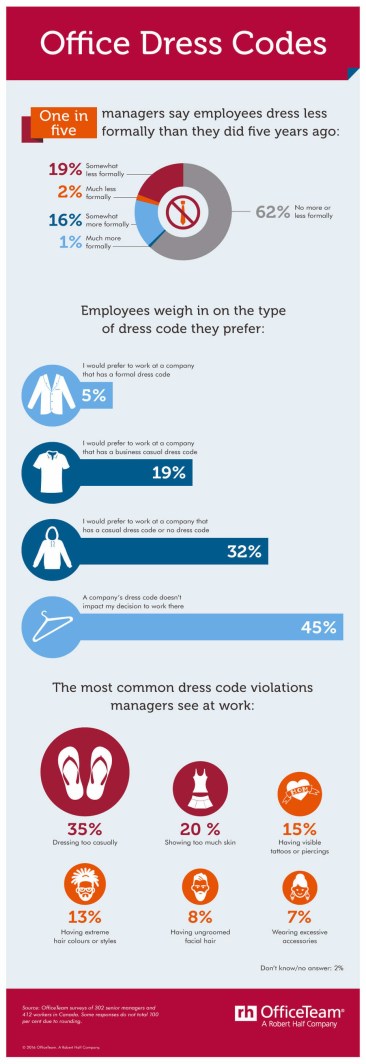
One in five (21 per cent) Canadian senior managers interviewed said employees wear less formal clothing than they did five years ago. In addition, 19 per cent of office workers stated they would prefer to be at a company with a business casual dress code; 32 per cent favour a casual dress code or no dress code at all.

But there are limits to what passes as acceptable office attire. When senior managers were asked about the most common dress code violation at work, wearing overly casual clothing was the top response (35 per cent), followed by showing too much skin (20 per cent).

Senior managers were asked, “Do you think employees at your company dress more or less formally than they did five years ago?

Their responses:

Much more formally

1%

Somewhat more formally

16%

No more or less formally

62%

Somewhat less formally

19%

Much less formally

2%

100%

Workers were asked, “Which of the following statements most closely describes how a company’s dress code impacts your decision to work there?

Their responses:

I would prefer to work at a company that has a formal dress code

5%

I would prefer to work at a company that has a business casual dress code

19%

I would prefer to work at a company that has a casual dress code or no dress code

32%

A company’s dress code doesn’t impact my decision to work there

45%

101%*

*Responses do not total 100 per cent due to rounding.

Senior managers were also asked, “Which of the following is the most common dress code violation at your company?

Their responses:

Dressing too casually

35%

Showing too much skin

20%

Having visible tattoos or piercings

15%

Having extreme hair colours/styles

13%

Having ungroomed facial hair

8%

Wearing excessive accessories

7%

Other/don’t know/no answer

2%

100%

“How employees present themselves, including how they dress in a business environment, reflects their level of professionalism and may effect perceptions of the company itself,” said Koula Vasilopoulos, a district president for OfficeTeam.

“Workers should be aware of business guidelines and take cues from their peers, particularly as they look to advance their careers, in order to ensure they leave an impression that is consistent with their desired roles.”

OfficeTeam offers seven questions employees should ask themselves when choosing what to wear for work:

  1. Does this follow company policy? If there’s a written dress code, abide by it. Also consider what your manager and coworkers wear, and use that information to guide your choices.
  2. Am I revealing too much? If you have to ask yourself this question, the answer is likely “yes.” Avoid clothes that show too much skin, and err on the side of caution when displaying tattoos or piercings.
  3. Is this distracting? Wearing wild or bright prints can attract attention for the wrong reasons. In most workplaces, neutral colours and simple patterns, such as pinstripes, are a safe bet.
  4. Am I overdoing it? Take a subtle approach to jewelry, makeup, perfume and cologne. Also note that unconventional hair colours or styles and unkempt facial hair may be frowned upon at more conservative companies.
  5. Do I feel confident? If you’re uncomfortable in your outfit, it’ll show. Make sure your clothes fit well and don’t require a lot of readjusting.
  6. Will I offend anyone? Steer clear of wearing apparel with profanity, political statements or other questionable material.
  7. Does it pass the final check? Give yourself a once-over from head to toe. Look out for wrinkled, torn or stained garments and scuffed shoes.

About the Research

The surveys of senior managers and workers were developed by OfficeTeam. They were conducted by independent research firms and include responses from more than 300 senior managers at Canadian companies with 20 or more employees, and more than 400 Canadian workers 18 years or older and employed in office environments.

Source: Casual Dress Code in Fashion at Work

New Democrat brand on negative trajectory in Nanos Index (ending May 27, 2016)

The Nanos Party Power Index

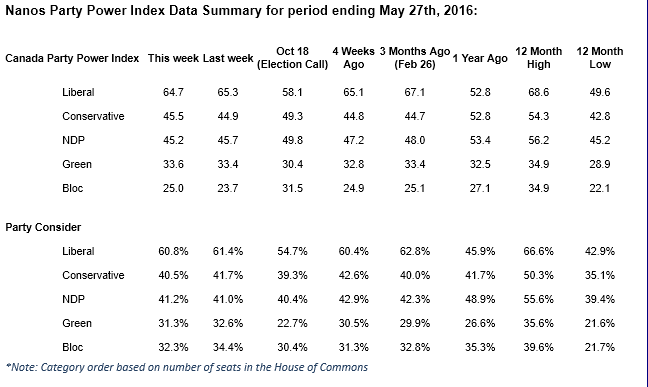
  • Nanos Party Power Index –  The Nanos Party Power Index is a composite of a series of questions including vote preferences and impressions of the federal leaders.  The latest tracking suggests that although the Liberals continue to score well on the Index, the New Democrats are on a negative trajectory with their lowest score since the Index was created in 2013.  The Liberals scored 64.7 out of a possible 100 points while the Conservatives scored 45.5 points, the NDP 45.2 points, the Greens 33.6 points and the BQ 25.0 points (QC only).
  • Accessible Voters – Asked a series of independent questions for each federal party, 60.8% of Canadians said they would consider voting Liberal, 41.2% would consider voting NDP, 40.5% would consider voting Conservative and 31.3% would consider voting Green.

The team at Nanos in conjunction with Klipfolio have launched our new live political data portal where you run the numbers you want and can explore the trends and data you need.  This is part of our campaign, not only to provide the most reliable data to Canadians but to let them use it as they wish. We were the first to do nightly tracking and now we are the first research organization to post live public opinion data for Canadians. Here’s the link to check it out.

To view the detailed tracking visit our website.

Methodology

The views of 1,000 respondents are compiled into a party power brand index for each party that goes from 0 to 100, where 0 means that the party has no brand power and 100 means it has maximum brand power. A score above 50 is an indication of brand power for the party and its leader at this time.

The important factors in this weekly tracking include the direction of the brand strength or weakness and also the brand power of one federal party relative to another.

The data is based on random telephone interviews with 1,000 Canadians, using a four week rolling average of 250 respondents each week, 18 years of age and over. The random sample of 1,000 respondents may be weighted by age and gender using the latest census information for Canada, and the sample is geographically stratified to be representative of Canada.

The interviews are compiled into a four week rolling average of 1,000 interviews where each week, the oldest group of 250 interviews is dropped and a new group of 250 interviews is added. The current wave of tracking is based on a four-week rolling average of 1,000 Canadians (250 per week) ending May 27th 2016.

A random telephone survey of 1,000 Canadians is accurate 3.1 percentage points, plus or minus, 19 times out of 20.

All references or use of this data must cite “Nanos Party Power Index” as the source.

screenshot-{domain} {date} {time}

Trudeau remains strong on preferred PM measure tracked by Nanos (ending May 27, 2016)

Nanos Weekly Leadership Tracking

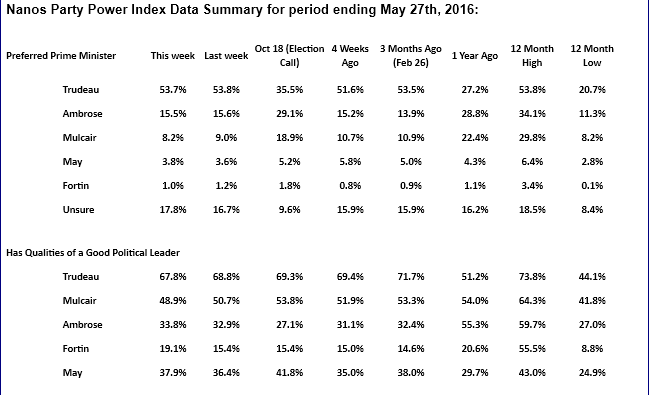
  • Preferred Prime Minister – Trudeau remains near his 12 month high on the preferred Prime Minister tracking while Mulcair breaks new 12 month low on this measure.  More than one of two Canadians (53.7%) prefer Trudeau as PM while 15.5% prefer Ambrose, 8.2% prefer Mulcair, 3.8% prefer May and 17.8% of Canadians are unsure.
  • Qualities of a Good Political Leader – When asked a series of independent questions for each federal party leader, two of three Canadians (67.8%) thought Trudeau had the qualities of a good political leader while 48.9% thought similarly of Mulcair. Almost four in ten Canadians (37.9%) thought May had the qualities of a good political leader while 33.8% thought Ambrose had the qualities of a good political leader.

The team at Nanos in conjunction with Klipfolio have launched our new live political data portal where you run the numbers you want and can explore the trends and data you need.  This is part of our campaign, not only to provide the most reliable data to Canadians but to let them use it as they wish. We were the first to do nightly tracking and now we are the first research organization to post live public opinion data for Canadians.

We were the first to do nightly tracking and now we are the first research organization to post live public opinion data for Canadians. Here’s the link to check it out.

To view the detailed tracking visit our website.

Methodology

The views of 1,000 respondents are compiled into a party power brand index for each party that goes from 0 to 100, where 0 means that the party has no brand power and 100 means it has maximum brand power. A score above 50 is an indication of brand power for the party and its leader at this time.

The important factors in this weekly tracking include the direction of the brand strength or weakness and also the brand power of one federal party relative to another.

The data is based on random telephone interviews with 1,000 Canadians, using a four week rolling average of 250 respondents each week, 18 years of age and over. The random sample of 1,000 respondents may be weighted by age and gender using the latest census information for Canada, and the sample is geographically stratified to be representative of Canada.

The interviews are compiled into a four week rolling average of 1,000 interviews where each week, the oldest group of 250 interviews is dropped and a new group of 250 interviews is added. The current wave of tracking is based on a four-week rolling average of 1,000 Canadians (250 per week) ending May 27th, 2016.

A random telephone survey of 1,000 Canadians is accurate 3.1 percentage points, plus or minus, 19 times out of 20.

All references or use of this data must cite “Nanos Party Power Index” as the source.

screenshot-{domain} {date} {time}

High school coaches are throwing their pitchers under the bus – Chicago Tribune

Paul Bergstrom pitches Friday for Notre Dame College Prep against Loyola Academy. He left the game after about 50 pitches. (Abel Uribe / Chicago Tribune)

Editorial Board

May 30,2016

High school baseball pitchers rack up some pretty impressive stats these days: Fastballs in the upper 80s and a 9.12 percent annual increase in UCLRs.

Translating for nongeeks: Hard-throwing high schoolers are wearing out their arms and driving up the need for Tommy John surgery, a serious elbow procedure technically known as ulnar collateral ligament reconstruction.

What a bizarre and completely unnecessary phenomenon. Where are the coaches? Watching from the dugout as kids hurt themselves by pitching too many innings in too many games.

In the major leagues, where pitching time is carefully monitored to prevent injuries, a typical starter throws about 105 pitches per game. Still, hurlers get hurt because pitching is tough on the body. Then there’s Brady Huffman of Genoa-Kingston High in DeKalb County, who tossed 167 pitches in a game this season, the Tribune’s John Keilman reports. “I trust him when he says that he has something left,” Huffman’s clueless coach told the Daily Chronicle of DeKalb.

Positive trajectory for consumer confidence flattens – still near high for 2016 (released May 30, 2016)

Bloomberg-Nanos Economic Banner

Bloomberg Nanos Weekly Consumer Confidence Tracking

After a positive series of weeks in the Bloomberg Nanos Canadian Confidence Index – the index remained steady in the week over week numbers.

“Even with the one week abatement, overall confidence remained near a high for 2016,” said Nanos Research Group Chairman Nik Nanos.

“Long-term demographic trends, labour market displacements, and a deficit of business investment continue to weigh on the economy’s potential output, according to recent analysis. Add to that the direct and indirect effects of the economic shocks on household balance sheets. Still, the trend in consumer expectations continues to be positive, which suggests an extended honeymoon period for the new government and the prospect of a fiscal stimulus”, said Bloomberg economist Robert Lawrie.

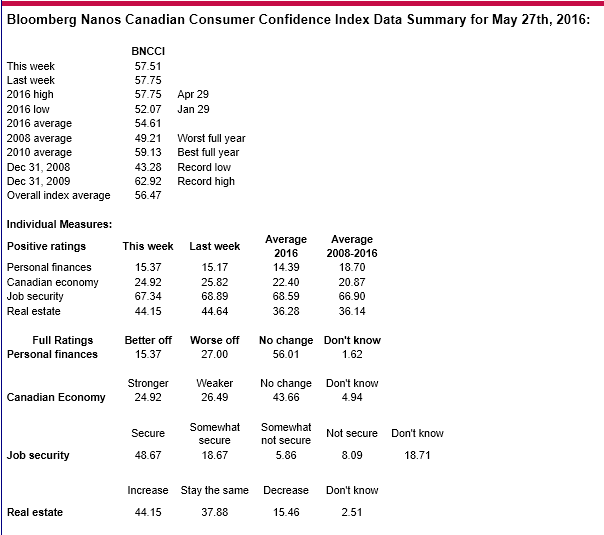
The BNCCI, a composite of a weekly measure of financial health and economic expectations, registered at 57.51 compared with last week’s 57.75. The twelve month high stands at 58.62.

The Bloomberg Nanos Pocketbook Index is based on survey responses to questions on personal finances and job security. This sub-indice was at 58.23 this week compared to 58.64 the previous week. The Bloomberg Nanos Expectations Index, based on surveys for the outlook for the economy and real estate prices, was at 56.78 this week (compared to 56.85 last week).

The average for the BNCCI since 2008 has been 56.47 with a low of 43.28 in December 2008 and a high of 62.92 in December 2009. The index has averaged 54.61 this year.

To view the weekly tracking visit our website.

Methodology

The BNCCI is produced by the Nanos Research Corporation, headquartered in Canada,  which operates in Canada and the United States.  The data is based on random telephone interviews with 1,000 Canadian consumers (land- and cell-lines), using a four week rolling average of 250 respondents each week, 18 years of age and over. The random sample of 1,000 respondents may be weighted by age and gender using the latest census information for Canada and the sample is geographically stratified to be representative of Canada. The interviews are compiled into a four week rolling average of 1,000 interviews where each week, the oldest group of 250 interviews is dropped and a new group of 250 interviews is added. The views of 1,000 respondents are compiled into a diffusion index from 0 to 100. A score of 50 on the diffusion index indicates that positive and negative views are a wash while scores above 50 suggest net positive views, while those below 50 suggest net negative views in terms of the economic mood of Canadians.

A random telephone survey of 1,000 consumers in Canada is accurate 3.1 percentage points, plus or minus, 19 times out of 20.

All references or use of this data must cite Bloomberg Nanos as the source.

Bloomberg Nanos Canadian Consumer Confidence Index Data Summary for May 27th, 2016:

nanos