
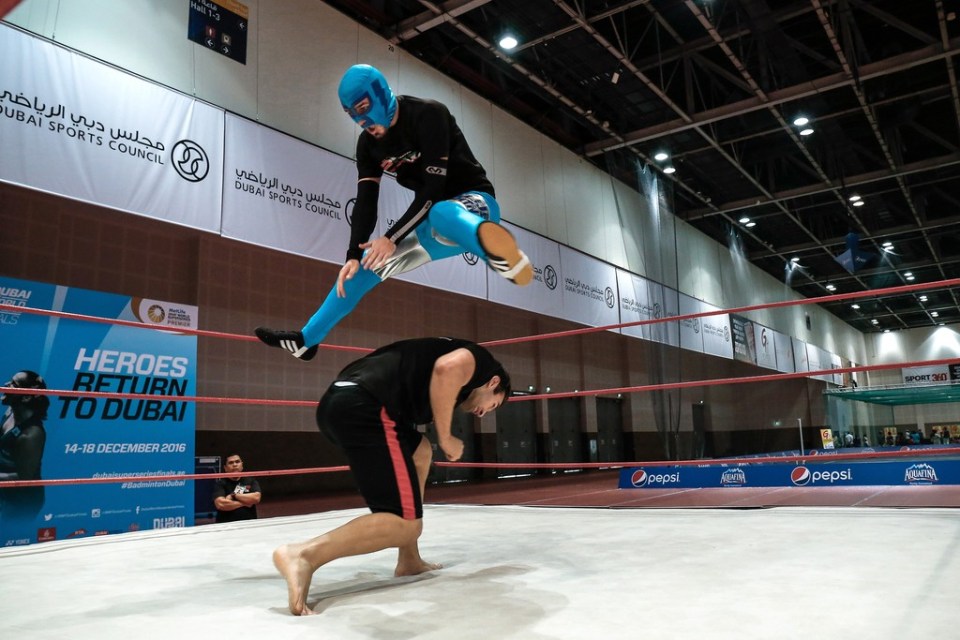
Dubai Sports World beats summer heat 

Masked fighter Blue Lighting and Caleb Hall, coach and founder of DXB Pro Wrestling Academy, shape up at the launch of Dubai Sports World 2016, the largest indoor sporting event in the Middle East, which runs until the end of August. Victor Besa for The National

Source: Dubai Sports World beats summer heat | The National

Effectiveness of early sport specialization limited in most sports, sport diversification may be better approach at young ages

American Medical Society for Sports Medicine
Apr 18, 2013


Effectiveness of early sport specialization limited in most sports, sport diversification may be better approach at young ages

San Diego, CA – Ever-increasing requirements for success in competitive sports has created added pressure for young athletes to train with greater intensity at earlier ages. The goal to become the next Olympian or more commonly, to obtain a college scholarship, motivates many parents to encourage their children to specialize in one sport at a young age. This has resulted in an increased demand for year-round sport training programs, facilities and products. But is this approach really an effective way to generate long-term success in competitive athletics?

John P. DiFiori, MD, President of the American Medical Society for Sports Medicine, Chief of the Division of Sports Medicine and Non-Operative Orthopaedics at the David Geffen School of Medicine at UCLA and Team Physician for the UCLA Department of Intercollegiate Athletics, says that few who specialize in one sport at a very young age make it to elite levels. “With the exception of select sports such as gymnastics in which the elite competitors are very young, the best data we have would suggest that the odds of achieving elite levels with this method are exceedingly poor. In fact, some studies indicate that early specialization is less likely to result in success than participating in several sports as a youth, and then specializing at older ages.”

Dr. DiFiori encourages youth attempt to a variety of sports and activities. He says this allows children to discover sports that they enjoy participating in, and offers them the opportunity to develop a broader array of motor skills. In addition, this may have the added benefit of limiting overuse injury and burnout.

A UCLA sports specialization study surveying 296 NCAA Division I male and female athletes, average age 19, found that 88 percent participated in an average of two to three sports as a children, and 70 percent did not specialize in one sport until after the age of 12. In a similar study of Olympians in Germany, results found that on average, the Olympians had participated in two other sports during childhood before or parallel to their main sport. Both studies support the concept of sports diversification in adolescence – not specialization.

In his nearly 20 years serving as a team physician for the UCLA Department of Intercollegiate Athletics, Dr. DiFiori appreciates the benefits of sports participation in general – increased self-esteem, self-discipline, development of leadership qualities and social skills, and overall health and well-being. But he warns external pressure on a child to train and compete in one sport at an early age may cause more harm than good. Social isolation, lack of independence, preferential treatment, abusive relationship, burnout and injury are some of the potential negative effects.

“Physical activity contributes to a happy and healthy childhood,” says Dr. DiFiori, “however, parents, coaches and children should monitor and measure their involvement level in a singular sport against the overall well-being and future success of the participant.”

Dr. DiFiori presented, “Early Sports Participation: A Prescription for Success?” on Thursday, April 18, 2013, at the annual meeting of the American Medical Society for Sports Medicine in San Diego, Calif.

About the 2013 AMSSM Annual Meeting: The conference featured lectures and research addressing the most challenging topics in sports medicine today including prevention of sudden cardiac death, concussion, biologic therapies and other issues facing the field of sports medicine. More than 1,500 sports medicine physicians from across the United States and 10 countries around the world attended the meeting.

About the AMSSM: The AMSSM is a multi-disciplinary organization of sports medicine physicians whose members are dedicated to education, research, advocacy, and the care of athletes of all ages. Founded in 1991, the AMSSM now comprises more than 2,300 sports medicine physicians whose goal is to provide a link between the rapidly expanding core of knowledge related to sports medicine and its application to patients in a clinical setting. www.amssm.org

Source: Effectiveness of early sport specialization limited in most sports, sport diversification may be better approach at young ages

Teens at breaking point

Sporting success is coming at the price of young, vulnerable bodies.

Teenage athletes are suffering permanent injuries as intense sports programmes push vulnerable bodies to breaking point.

A prominent sports doctor said he had treated teenagers with injuries to the spine, pelvis and feet, often due to a sudden increase in activity.

Dr Graham Paterson, at AXIS Sports Medicine said people who looked to the likes of Tiger Woods and tennis player Andre Agassi for inspiration believed constant practice in one sport produced success.

But repetitive movements could put children’s growing skeletons at risk of injury.

READ MORE:
* Rugby tackling should be banned in schools, UK medic claims
* Injuries just ‘part of sport’
* Specialist doctor says risk of youth rugby need scrunity

“There are many kids who suffer injuries which means they can’t continue to pursue their – or their parent’s – dream of being a star,” he said.

Paterson, a former All Blacks sports doctor, said high pressure placed on children at secondary school level meant sports practice can suddenly triple or quadruple just as teens are experiencing their adolescent growth-spurt.

“There is an awareness that you don’t train horses when they are growing fast, you don’t make dogs run when they are growing fast, but we don’t have understanding in the community we have to look after our adolescents and take the load off a little bit.”

Many parents of injured children ask why they weren’t told of the risks, he said.

He wanted to tell parents exercise is a positive thing, but a teenagers have a better chance of succeeding and being injury-free by competing in a variety of sporting activities.

A study of gold medallists found there were more Olympic champions who specialised later rather than earlier in their teenage years.

“By doing a multiple number of different sports you’re spreading the load. You’re still building strength, diligence and coordination but you are not focused on one activity.”

AUT Millenium in Auckland is the training ground for the country’s elite athletes, but children are encouraged to specialise later in sports.

“We’re seeing more injuries coming about from kids not getting variety in their programme,” athlete development programme director Dr Craig Harrison said.

Teenagers were also under greater pressure to succeed in their chosen sport at even younger ages – the BMX World Championships accepted children from the age of six.

“Its ridiculous. We see parents pushing for their kids to go to these events,” he said.

“There’s a lot of age group competitions and parents looking to get their kids into the teams. It’s all driven from the top and commercial side where sport has gone.”

The number of programmes and expectations from individual sports had also increased, he said.

“The biggest issue we see is the lack of communication between the programmes. There is no one overseeing their weekly and long term schedules.”

AUT Millenium don’t encourage any specialisation in a sport until age 14 – an approach backed up by the research, Harrison said.

Older children who had been in structured sports from a young age missed out on creative play and lacked fundamental athleticism, he said.

“They haven’t done their time in the backyard climbing trees or biking around their streets.”

The warnings come as school sports academies become a common feature across the country.

AUT professor of public health Grant Schofield said children were in some cases being taken out of class to do extra training at sports academies.

“The whole secondary school sport thing is a little perverse.”

 – Sunday Star Times

Source: Teens at breaking point

Asbestos Threats to Health Rise as Demolitions Skyrocket | The Tyee

An asbestos-abatement worker takes down drywall to access the attic, where there is insulation containing asbestos. Photo credit: Luiz Lopes

BC doubles inspectors; industry urges mandatory licencing for removers.

By João Vitor Corrêa and Luiz Lopes, June 4, 2016, TheTyee.ca

The soaring number of house demolitions in B.C. has prompted work safety officials to almost double the number of asbestos-prevention officers in the province, a move that could cost an extra $1 million a year.

”Because asbestos continues to be a hazard of the magnitude it is, we have put budget towards hiring another seven officers this year,” said Scott McCloy, director of media relations at WorkSafeBC.

From 2006 to 2015, the wrecking ball swung into 26,632 residential units across Metro Vancouver with an annual average of 2,663 demolitions, according to a report.

Part of the asbestos exposure problem is being caused by pressed homeowners who are willing to hire the ”cheap guys,” said Jerome Klett, who runs an asbestos-removal firm and has been in the business for more than 17 years.

”They wouldn’t be in business if there weren’t people to hire them,” he said.

According to Klett, costs per house can range from $500 to $30,000, depending on the affected area of the house and the level of risk. There are fixed costs such as labour, incidental, and disposal costs.

”A bin of asbestos drywall, for example, costs $4,000 to $5,000 to dispose of because the company has to ship it to Alberta,” he said.

Cracking down on ‘wild west show’

”It was kind of a Wild West show on the residential side of asbestos removal,” said Klett. ”It’s only been now, in the last three or four years, when they’ve started trying to crack down on it but they’ve let it go for so long and it’s gotten so bad they can’t keep up with it.”

According to a WorkSafeBC database, inspections conducted by prevention officers resulted in fines totalling $648,959 imposed on companies that breached workplace regulations when handling asbestos in 2015. Penalties have ranged from $1,000 to approximately $130,000. From over 70 cases, 62 penalties were for residential sites, four were unclear, and two were for commercial sites.

”As long as the asbestos is not disturbed, workers are safe and families are safe. But if the asbestos is disturbed through renovations or through demolitions, that’s when those fibres can enter the lungs of a person,” said McCloy from WorkSafeBC.

More than 60 per cent of the fines handed out in 2015 were for repeated violations of the Occupational Health and Safety Regulation and Workers’ Compensation Act.

WorkSafeBC officers receive and review demolition permits issued by five municipalities (Coquitlam, Vancouver, Saanich, Nanaimo, Port Coquitlam and Surrey). The agency mainly relies on consultations, education, and inspections to ensure workplace safety rules are followed. If enforcement is necessary, an officer can issue a warning letter or impose an administrative penalty.

But the B.C. Insulators Association’s business manager, Lee Loftus, said penalties are not enough to regulate the industry. He said there has to be mandatory licensing of contractors and workers since currently any person with a business licence can open an asbestos-abatement firm.

McCloy said WorkSafeBC is open to the idea of mandatory licensing, but ”that would be considered an extra measure, protection.”

”It doesn’t mean that workers will necessarily be any safer with certification than they are now,” said McCloy.

If a worker does not dispose of hazardous material properly, the problem evolves from a safety violation in the workplace to a serious community issue. Neighbours, family members, bystanders, they can all get exposed to asbestos fibers.

”When they do the demolitions and they haven’t done the testings and they run the excavator over the top of this thing, the whole surrounding area is contaminated with dust. And what do you find in that dust? You find asbestos in that dust,” said Loftus. ”(Bystanders) don’t know they are being exposed.”

WorkSafeBC is embroiled in a court case against Seattle Environmental Consulting Ltd., which is at the top of the list of several companies with violations. The firm racked up almost $280,000 in penalties since 2007 for knowingly providing false information and improperly removing hazardous material from demolition sites.

The company has paid none of the fines at the time, according to court documents.

Asbestos exposure has been the leading cause of all workers’ deaths in B.C. for the past six years, according to WorkSafeBC data. In 2015, it was responsible for 44 per cent of all workplace deaths in the province, based on compensation claims.

WorkSafeBC estimates that asbestos-related fatalities will peak between 2015 and 2020, fuelled by a large number of workers who were exposed decades ago.

That’s because a person affected by an asbestos-related disease takes decades to show symptoms. Once breathed in, asbestos fibers can remain in the lungs for years without being noticed. Several diseases are associated with the exposure to asbestos-containing products, such as lung and colorectal cancer, asbestosis, and mesothelioma.

Tracey Ford lost her father to mesothelioma in 2008, 18 months after he was diagnosed. It is an incurable form of cancer in the lining of the lungs caused almost entirely by exposure to asbestos.

”He and my mom, they had just started their retirement. They worked for decades, very hard, to have a long, healthy retirement and he didn’t get that. So it was really sad,” she said, a little teary-eyed.

Her father, Dave Ford, had a long career working as an electrician for a pulp and paper mill. Tracey Ford believes her dad was exposed to asbestos when handling wires and other products containing asbestos fibers.

”He was exposed through his workplace unknowingly,” she said.

”Health and safety were a big deal to him. He was very safety conscious and if he had known, he would’ve taken whatever precautions were necessary. It definitely would’ve made a difference.”  [Tyee]

Source: Asbestos Threats to Health Rise as Demolitions Skyrocket | The Tyee
Canadian milk matters-thousands of dairy farmers from across Canada gather for rally on Parliament

OTTAWA, June 2, 2016 /CNW/ – Today, thousands of dairy farmers and supporters came together for a rally on Parliament Hill to highlight the critical importance of supply management in Canada.

This was in addition to other regional events, one held in Prince Edward Island at the office of the Minister of Agriculture and Agri-Food Lawrence MacAuley, and one in downtown Regina.

Dairy Farmers of Canada (DFC) President Wally Smith, joined by representatives from all 10 provinces, called on the Government to take action to ensure a sustainable dairy industry.

“We are here today, from all corners of this nation, not only to celebrate the economic, social, and health contributions and benefits of nutritious and high quality milk to our country, but to also celebrate the supply management system,” said Wally Smith.

“To ensure the continued sustainability of the supply management system, the Government needs to work with us to tackle these challenges head on. We want to thank Canadians for their support and ask the Government to work with us to ensure a robust industry.”

The situation in Canada is significantly better than others around the world where supply management has been dismantled. With low global milk prices, and massive surpluses, the global markets are failing and foreign governments have had to step in to keep their national dairy industry viable.

The Canadian dairy industry is currently facing a number of challenges that need to be addressed by the Government to ensure that the three fundamental pillars of the supply management system are sustained.

Quick Facts

As a key economy driver of the national economy, the industry contributes:

  • $19 Billion a year to Canada’s GDP
  • $3.6 Billion in taxes each year
  • Supports 215,000 jobs

About Dairy Farmers of Canada

DFC is the national organization representing Canada’s dairy farmers striving to create stable conditions for the Canadian dairy industry, today and in the future. Among other activities, DFC invests in research that will continue to reduce farming’s impact on the environment and promotes practices that improve sustainability and viability of dairy farms, as well as save money and energy. To learn more, visit dairyfarmers.ca.

SOURCE Dairy Farmers of Canada (Corporate)

Source: Canadian milk matters-thousands of dairy farmers from across Canada gather for rally on Parliament